



10 Gold Trading Strategies That Actually Work in 2026



Gold trading strategies have become more important than ever in 2026. Gold has put traders through the wringer this year. The precious metal surged to an all-time high of roughly $5,595 per ounce at the end of January before spending the next five months grinding lower, with prices now trading between $4,000 and $4,200. Anyone who bought the top and held is nursing a painful drawdown, while traders using proven gold trading strategies have capitalized on the market's sharp swings and volatility. In a market like this, success isn't about predicting every move—it's about applying the right strategy at the right time. Whether you're a beginner or an experienced trader, the 10 gold trading strategies below can help you identify high-probability setups, manage risk effectively, and trade with greater confidence in today's market
That gap is the whole point. Gold in 2026 is not a buy and forget asset. It is a market with big daily ranges, sharp reversals around central bank news, and long stretches of chop in between. You need an actual strategy, and you need to know which strategy fits the conditions in front of you.
Here are 10 gold trading strategies that continue to perform well in today's market, along with when to use each strategy and the market conditions where they work best.
What gold looks like right now
Before any strategy makes sense, you need the backdrop.
The rally that took gold to record highs in January was driven by central bank buying, fiscal deficits, and reserve managers moving away from the dollar. None of that has gone away. What changed is the interest rate picture. Inflation stayed hotter than expected, the Federal Reserve turned hawkish, and rate cut expectations got pushed out. Higher real yields make gold less attractive to hold, so the price came off hard.
The result is a market caught between two forces. The World Gold Council's mid year outlook describes it as a consolidation phase, with short term headwinds pulling against structural support, and suggests gold may trade in a band of roughly five percent either side of $4,100 in the second half of the year unless something changes. Major banks have trimmed their targets too. Goldman Sachs moved its year end forecast down to around $4,900, while J.P. Morgan still sees $5,000 or higher as achievable.
For a trader, the takeaway is simple. Direction is genuinely uncertain, ranges are wide, and the big moves cluster around economic data. That environment rewards flexibility and punishes stubbornness.
Best Gold Trading Strategies for 2026
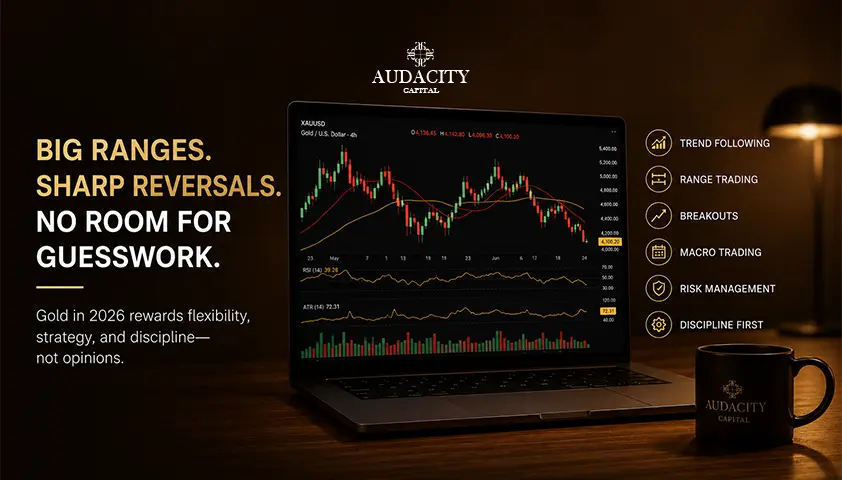
1. Trend following on the 4 hour chart
The oldest approach in the book, and still the one that pays the most when gold decides to move.
Set a 50 period and 200 period exponential moving average on the H4 chart. When the 50 sits above the 200 and price is holding above both, you only take longs. When it flips, you only take shorts. Entries come on pullbacks into the 50 EMA rather than chasing extended candles.
The strength here is that gold trends hard when it trends. The January run and the February to April decline both offered weeks of directional movement. The weakness is that trend systems get shredded in sideways markets, which is exactly what much of the last quarter has looked like. Use a filter. If price has crossed the 50 EMA more than three or four times in the last twenty candles, the trend system is not the tool for today.
2. Range trading the consolidation band
When gold stops trending, it does not stop moving. It just moves between levels.
Identify the top and bottom of the current range on the daily chart, then sell rejections at the top and buy rejections at the bottom on the H1 or H4. Confirmation matters more than precision. Wait for a clear rejection wick or a bearish or bullish engulfing candle before entering, and put your stop beyond the extreme of the range rather than a fixed number of pips away.
Given the sort of band gold has been holding in recent months, this has been the highest probability approach available. The catch is that ranges eventually break, and the break usually comes fast. Never let a range trade turn into a hopeful hold.
3. Breakout trading with volatility confirmation
The mirror image of the range trade. Instead of fading the edges, you wait for price to leave them.
The mistake most traders make is entering on the first candle that pokes through a level. Gold produces false breaks constantly, especially during thin Asian hours. Add two filters. First, require a close beyond the level on the timeframe you are trading, not just a wick. Second, require expanding volatility, which you can check with the Average True Range. If ATR is flat or falling as price breaks out, the move usually fails.
Breakouts that follow a long, tight consolidation tend to run further than breakouts from choppy conditions. Patience before the entry is what makes this one work.
4. The London to New York overlap play
Gold's liquidity is not evenly spread across the day. The Asian session is usually slow and prone to fake moves. London brings the first real volume. The window where London and New York are both open, roughly 13:00 to 17:00 GMT, is where most of the meaningful daily range gets created.
Trading only that window does two things. It puts you in the market when spreads are tightest and order flow is genuine, and it stops you from taking marginal setups during hours when nothing is really happening. Plenty of consistently profitable gold traders trade a four hour window and then close the laptop.
If you are on a funded account with a daily loss limit, this alone is worth adopting. Fewer hours in the market means fewer chances to hand back a good week.
5. Trading the macro calendar
Gold reacts to a short list of events more than anything else. US CPI, the monthly jobs report, and FOMC rate decisions and minutes. In a year where the entire story is whether the Fed hikes, cuts, or holds, these releases are the market.
There are two honest ways to trade them, and one dishonest one.
The first is to trade the reaction rather than the number. Let the initial spike happen, wait for the first fifteen or thirty minute candle to close, then trade in the direction of the settled move. Slower, but survivable.
The second is to stay flat through the release and trade the trend that develops in the hours afterwards, when the spread has normalised and direction is clearer.
The dishonest one is guessing the number and holding a position into the release. That is not a strategy, it is a coin flip with a widened spread and slippage stacked against you. It is also the single fastest way to breach a funded account.
6. The real yield and dollar overlay
This is less a standalone strategy and more a bias filter that improves every other strategy on the list.
Gold pays no interest, so it competes with real yields, meaning bond yields adjusted for inflation. When real yields rise, holding gold costs you more in opportunity terms and the price tends to struggle. When they fall, gold usually finds a bid. The US dollar works similarly, since gold is priced in dollars. A strong dollar is generally a headwind.
Check the dollar index and the ten year yield before your session. If both are pushing higher, be sceptical of long setups even if the chart looks clean. If both are rolling over, your long setups just got a lot more attractive. It takes thirty seconds and it stops you from trading against the macro tide.
7. Fibonacci pullback entries
After a strong directional leg, gold rarely goes straight to the next level. It retraces, and the retracements are surprisingly respectful of standard Fibonacci levels.
Draw the retracement from the swing low to the swing high of the last clear leg. The 38.2 percent and 61.8 percent levels are the ones to watch, and the zone between them is where most decent continuation entries live. What turns this from a guess into a setup is confluence. A Fib level that lines up with a prior structural level, a moving average, or a round number like $4,100 is far stronger than a Fib level floating in empty space.
Stop goes below the swing low for a long, or above the swing high for a short. If the retracement goes past 78.6 percent, treat the leg as failed rather than hoping.
8. The gold to silver ratio trade
A relative value idea for traders who want something less crowded.
The gold to silver ratio simply divides the gold price by the silver price. Historically it oscillates within a broad band, and extremes have often preceded a reversion. When the ratio runs unusually high, silver has tended to outperform gold on the way back. When it drops unusually low, the reverse.
This is a slower, swing style approach and it is not a short term timing tool. It works best as a portfolio level tilt, deciding which metal to favour rather than deciding when to click buy. Silver is also considerably more volatile than gold, so size down accordingly.
9. Intraday scalping on the 5 and 15 minute
Gold's daily range makes it attractive to scalpers, and it is also where most beginners get destroyed.
If you scalp gold, three rules are not optional. Trade only during the high liquidity window described above. Use a broker or account with a tight, stable spread, because a two dollar spread on a ten dollar target eats your entire edge. And define your maximum number of trades per day before you start.
Structure wise, the simplest version that works is trading with the H1 trend, entering on M5 pullbacks to a short term moving average, targeting a fixed multiple of your risk, and taking the trade off rather than managing it endlessly. Scalping fails on execution and psychology far more often than on strategy design.
10. ATR based position sizing
This is the one nobody wants to read about and the one that decides whether the other nine matter.
Gold moves in large nominal amounts. A hundred dollar daily range is normal now. If you size a gold position the same way you size a EURUSD position, you are taking several times the risk you think you are.
Use the Average True Range to set your stop, then size the position so that the stop equals a fixed percentage of your account, typically one percent or less. If ATR is high, your stop is wider and your position is smaller. If volatility contracts, you can size up slightly on the same risk. Your dollar risk per trade stays flat regardless of what gold is doing.
For anyone trading a funded account with a daily loss limit and a maximum drawdown, this is the difference between a long career and a short one. Volatility adjusted sizing keeps a normal losing streak from becoming a breach.
How to Choose the Right Gold Trading Strategy

Most traders collect strategies. Good traders match them to conditions.
Ask one question before the session: is gold trending or ranging? Look at the daily chart. If price is making higher highs and higher lows, or lower highs and lower lows, use trend following, Fib pullbacks, and breakouts. If price is bouncing between two horizontal levels, use range trading and fade the extremes.
Then check the calendar. If there is high impact US data in the next few hours, either reduce size or wait. Then check the dollar and yields for your directional bias. That whole routine takes five minutes and prevents most avoidable losses.
Mistakes that end gold accounts
- Trading gold with forex position sizing, which is the most common account killer of all.
- Holding through CPI or FOMC with full size and no stop.
- Averaging into a losing position because gold "always comes back".
- Trading the Asian session out of boredom.
- Switching strategy after two losing trades, then switching back after two more.
- Ignoring the spread when scalping.
Key Takeaways
- The best gold trading strategies are the ones that match current market conditions rather than relying on a single approach. Whether you prefer trend following, breakout trading, range trading, or news-based setups, combining a proven strategy with disciplined risk management will help you trade gold more consistently.
- Trend following and breakouts work when gold is moving. Range trading works when it is not. Knowing which regime you are in matters more than the strategy itself.
- The London to New York overlap produces most of the day's meaningful movement, and trading only that window improves results for most people.
- Never take a blind directional position into CPI, NFP, or an FOMC decision. Trade the reaction instead.
- Real yields and the dollar are gold's two biggest macro drivers. Use them as a bias filter on every setup.
- Position size using ATR, not habit. Gold's ranges are large enough that standard forex sizing quietly multiplies your risk.
- On a funded account, survival is the strategy. Fewer trades, defined hours, and volatility adjusted risk keep you inside your daily loss limit and maximum drawdown.
Put These Gold Trading Strategies Into Practice
Reading about gold trading strategies is only the first step. Consistent results come from applying them in real market conditions while following a disciplined risk management plan. Whether you prefer trend following, breakout trading, or range trading, practicing your strategy before risking significant capital can help you build confidence and refine your execution.
Ready to trade gold with a funded account? Explore Audacity Capital's funding programs and put your trading skills to the test in live market conditions.
FAQ
Trend following on the 4 hour chart with pullback entries, traded only during the London and New York overlap. It has fewer moving parts than the alternatives, it keeps you out of the market during low quality hours, and it teaches you to wait for a setup instead of chasing candles.
It is volatile and liquid, which is what a trader wants. It is also uncertain in direction, with prices well off the January record and analyst forecasts ranging widely. That combination suits active trading better than passive holding.
The London to New York overlap, roughly 13:00 to 17:00 GMT, is where liquidity peaks and most of the daily range gets built. The Asian session is generally slow and produces more false moves.
One percent of your account or less per trade is the standard guideline, and it should be calculated from your stop distance rather than a fixed lot size. Because gold's ranges are wide, a fixed lot approach will give you wildly inconsistent risk from one trade to the next.
Not into the release. Spreads widen, slippage is real, and the first move often reverses. Wait for the first fifteen or thirty minute candle to close and trade the direction that survives, or stay out and take the trend that forms afterwards.
Interest rate expectations and real yields, the strength of the US dollar, central bank buying, and geopolitical risk. In the current environment, Fed policy expectations are doing most of the heavy lifting.
Yes, with one adjustment. Funded accounts have a daily loss limit and a maximum drawdown, so risk management has to come first. Smaller per trade risk, defined trading hours, and avoiding high impact news exposure are what keep the account alive long enough for your edge to show up.
Neither is easier, but gold is less forgiving of poor position sizing because of its larger nominal ranges. Traders coming from major forex pairs usually need to reduce their lot size significantly before gold behaves the way they expect.

Handa nang maglapat ng disiplinadong panganib sa crypto? Galugarin ang mga bagong instrumento ng crypto ng Audacity Capital at dalhin ang iyong diskarte sa pangangalakal.
Matuto PaNewsletter
Sumali sa aming newsletter.
Sumali sa Aming Social Community

Simulan ang Iyong Paglalakbay Ngayon Gamit ang Aming Libreng Pagsubok
Ipagmalaki ang iyong mga kasanayan at tagumpay sa pamamagitan ng mga sertipiko at makakuha ng pagkilala para sa iyong pagsusumikap at dedikasyon mula sa mga potensyal na mamumuhunan at kasamahan.
Libreng PagsubokMga Kaugnay na Artikulo
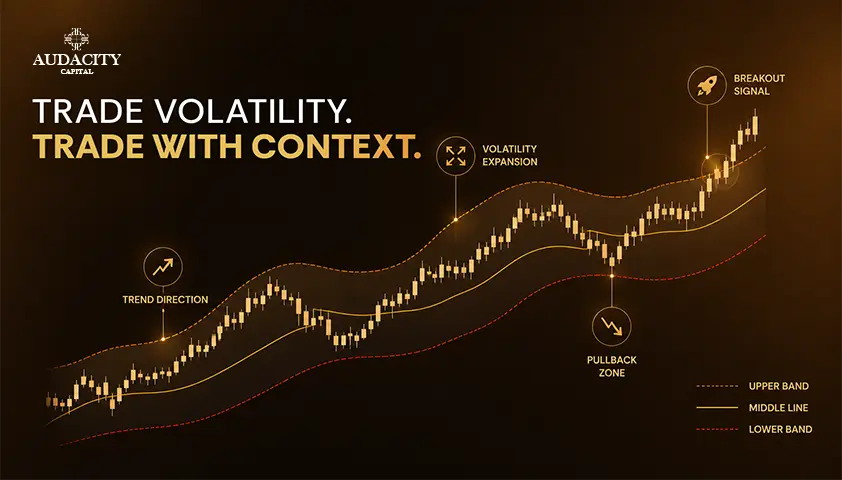
Keltner Channel Trading Strategy: How to Read Volatility With Context
Discover how Keltner Channels measure market volatility, spot trend pullbacks, and confirm breakouts. Includes setup rules, settings, and testing methods.

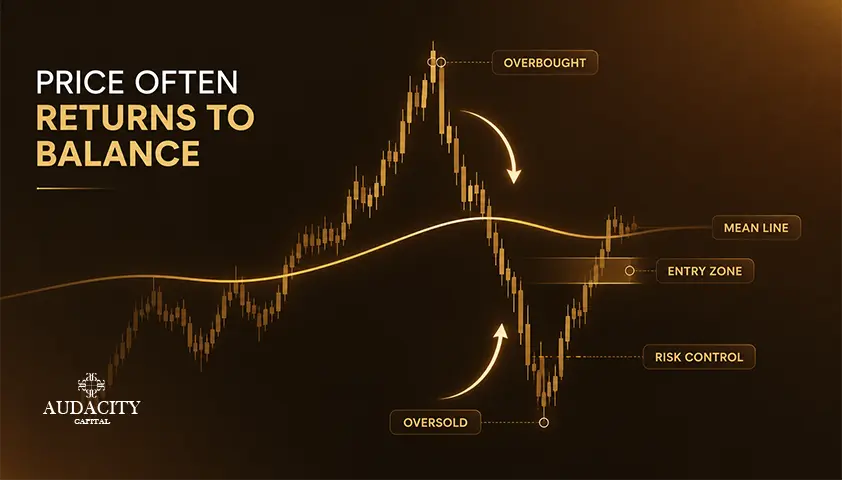
Mean Reversion Trading Strategy Explained (2026)
Prices that stretch too far tend to snap back to an average, but only in the right market. Learn the tools, the setup, and the trend risk.
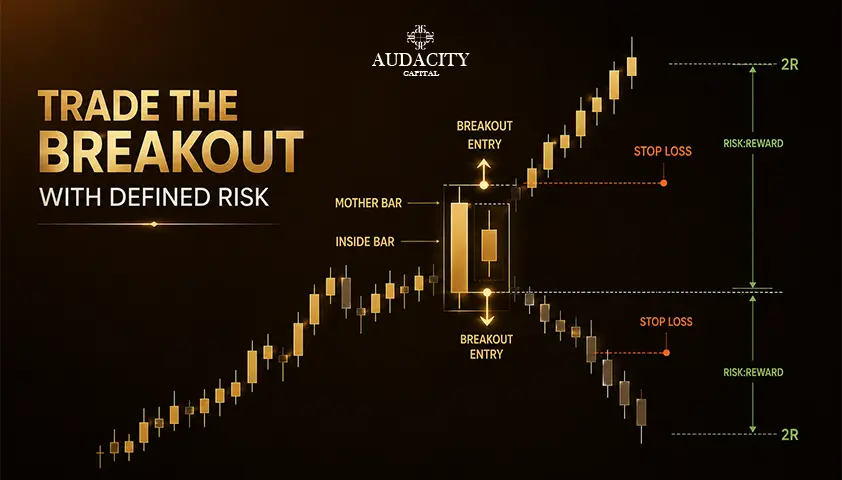
Inside Bar Trading Strategy: Rules, Entries and Risk Guide
Master the inside bar trading strategy with practical rules for pattern identification, entry triggers, stop placement, risk management, and testing.

Martingale Strategy in Trading
How the martingale trading strategy works, what the doubling arithmetic actually costs, why position sizing cannot create an edge, and where it is banned.