


What Is Slippage in Trading?


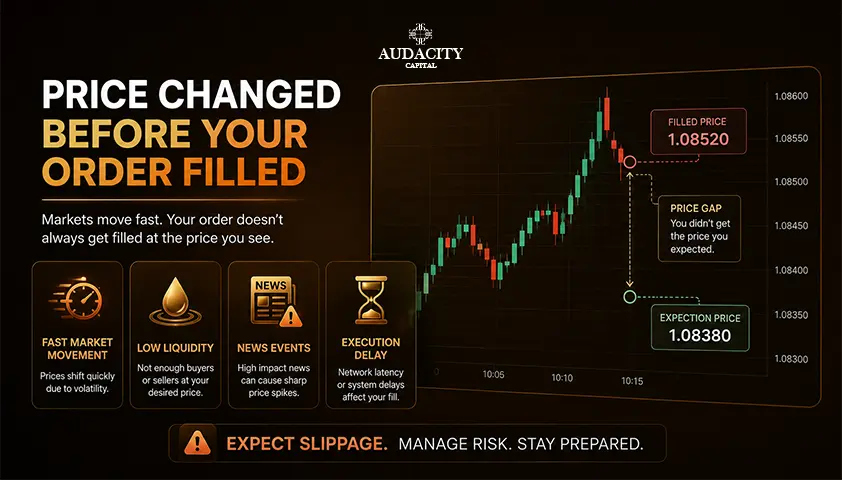
Slippage is the difference between the price a trader expects when placing an order and the average price at which that order actually executes.
It can be negative, positive, or zero, and it applies to every market where orders take time to travel from a platform to a matching engine or liquidity source.
Picture a buy order requested at $100.
The fill comes back at $100.20. That $0.20 gap per unit is negative slippage.
For a sell order, the direction flips, so the same numerical move needs to be read differently.
Most explanations stop at volatility and low liquidity. That is not enough. To understand slippage properly, a trader also needs to see how bid and ask prices, available depth, order type, partial fills, and repeated execution costs feed into the final result.
Slippage cannot be fully removed, and standard stop orders may fill beyond the chosen level in fast or gapping markets.
What Slippage Means and How to Calculate It?
Slippage is measured by comparing the price you planned against the price you actually received. Three different prices matter here, and they are often confused.
1. Expected price: the quote visible on the chart or ticket when the trading decision was made.
2. Requested price: the specific price attached to the order, such as a limit price or a stop trigger.
3. Execution price or fill price: the price actually reported by the venue or liquidity source after the order is matched.
These three values can all be different numbers on the same trade.
The slippage meaning in trading depends on direction.
For a buy, a fill above the expected price is negative and a fill below is positive. For a sell, a fill below the expected price is negative and a fill above is positive.
Always keep buy and sell examples labeled clearly, because a lower fill price is good for a buyer and bad for a seller.
Slippage can be expressed several ways:
- Price units: the raw difference between expected and fill.
- Pips or points: standardized measures for forex, indices, and futures.
- Cash: adverse price difference multiplied by filled quantity or the contract point value. Contract specifications are platform-specific.
- Percentage slippage: cash slippage divided by trade value.
The average fill price matters most when liquidity is thin.
If a 300-unit market buy fills 100 units at $50.00, 100 at $50.02, and 100 at $50.05, the reported fill is the volume-weighted average of $50.023, not the first quote you saw on screen.
Here is a direction-aware view of how to calculate slippage:
Scenario | Expected price | Average fill | Difference | Outcome | Cash effect (100 units) |
Buy with negative slippage | $100.00 | $100.20 | +$0.20 | Worse entry | -$20 |
Buy with positive slippage | $100.00 | $99.90 | -$0.10 | Better entry | +$10 |
Sell with negative slippage | $100.00 | $99.85 | -$0.15 | Worse entry | -$15 |
Sell with positive slippage | $100.00 | $100.12 | +$0.12 | Better entry | +$12 |
Note: Never apply one unsigned formula. A profitable sell fill will look negative in raw numbers unless you track direction alongside the difference.
Why Slippage Happens?
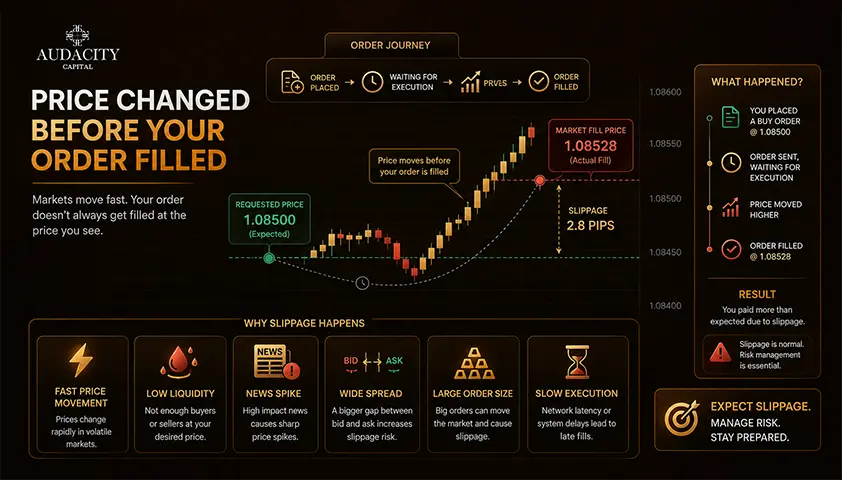
Slippage happens because the executable price at the moment the order reaches the market is not the same as the price the trader saw when they decided to trade.
Several mechanisms drive that gap.
1. Price movement during execution:
Every order takes time to travel from the platform to the venue or liquidity provider. Quotes can be updated in that interval.
2. Insufficient liquidity at the quoted price:
The top of the book is only available for a limited quantity. Larger orders consume that level and continue filling deeper into the order book or aggregated pool.
3. High volatility:
Economic releases, earnings, central-bank decisions, geopolitical events, session opens, and closes all cause quotes to update faster than orders can fill.
4. Gaps and closed-market periods:
After a weekend, halt, or major announcement, price can reopen far beyond a stop, leaving no executable prices between trigger and next quote.
5. Execution method and infrastructure
Routing choices, liquidity pools, exchange matching, network latency, and platform fill policy all shape what happens after an order is sent.
Normal market slippage is not automatically a platform error or manipulation. It is the absence of enough executable liquidity at the expected price when the order arrives.
Positive, Negative, and Zero Slippage
Slippage is not always bad. Three outcomes are possible on any given fill.
- Negative slippage increases the cost of an entry or worsens an exit.
- Positive slippage, also known as price improvement, produces a better fill than expected.
- Zero slippage means the order filled at the expected level.
Direction matters. The same price movement between order and fill can be positive for a buyer and negative for a seller.
Use buy and sell arrows in your journal rather than describing positive slippage as simply "a lower price."
Positive slippage is not the platform handing out free profit. It means a better executable price became available before or during matching. It should be measured, not assumed.
There is no universal figure for normal slippage.
It depends on instrument, order size, session, volatility, available depth, execution venue, and strategy horizon. Compare each result with your own baseline for the same conditions, not with a blanket pip or percentage rule.
Slippage vs Spread, Commission, Price Impact, and Requotes
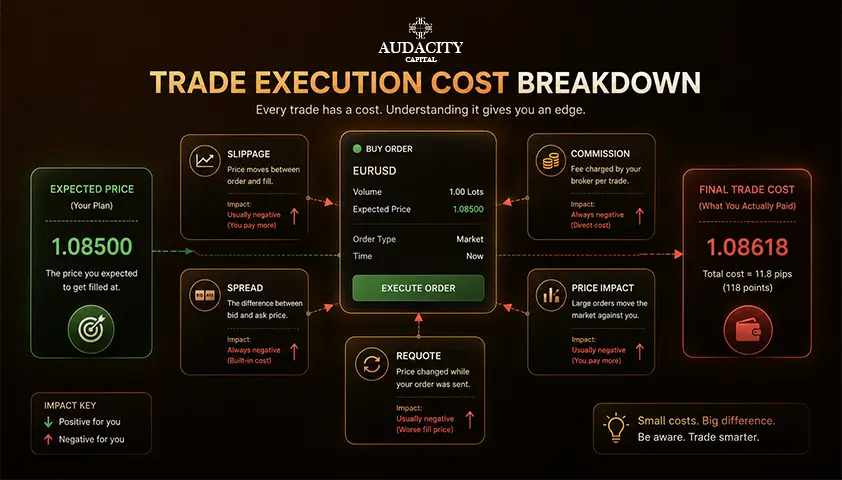
These costs and events are often bundled together, but each one compares different prices or triggers. This is where a lot of confusion lives, and it is where trading slippage explained properly makes the biggest difference.
- Bid-ask spread: the difference between the current bid price and ask price. It exists before you trade. Buys interact with the ask, sells interact with the bid.
- Slippage: the difference between the expected or requested price and the actual fill. It appears at execution, not before.
- Commission: a separate fee based on volume, contract, or transaction value. Swap and financing are holding costs, not slippage.
- Price impact: the market movement caused by consuming available liquidity, usually when order size is large relative to depth. Price impact can create slippage, but the terms are not interchangeable.
- Requote: the requested price was not accepted, so a new price is offered or the order is rejected. With market execution, the order may instead fill at the available price without a requote, depending on the account type.
Cost or event | What is compared | When it appears | Can it be positive? | Main trader control |
Bid vs ask | Before execution | No | Instrument, session | |
Slippage | Expected vs fill | At execution | Yes | Order type, size, timing |
Commission | Fee schedule | At execution or close | No | Account, size |
Price impact | Pre-trade vs post-trade market price | During execution | Rarely | Size, splitting |
Requote | Requested price vs current price | Before execution | Neutral | Execution mode, deviation |
How Order Types Change Slippage Risk?
Every order type trades one form of risk for another. No single order gives both price certainty and execution certainty in every condition.
1. Market order: prioritizes execution. Fills immediately at whatever prices are available, which may span several levels.
2. Limit order: prioritizes price. A buy limit fills at the limit or lower, a sell limit at the limit or higher. The trade may not fill or may only partially fill.
3. Stop order: a trigger, not a fill. Once triggered, it typically becomes a market order, so the final price can be worse than the stop in fast moves or gaps.
4. Stop-limit order: places a limit order after the stop is triggered. Caps the acceptable price but can leave you in the position if price runs past the limit.
5. Guaranteed stop: where offered, provides a fixed exit price. Availability, extra fees, distance rules, and provider terms all apply. Not universally available.
6. Slippage tolerance or maximum deviation: rejects or cancels the trade if execution falls outside a set range. Tight settings reduce bad fills but increase missed entries and requotes.
Think in terms of price certainty versus execution certainty.
Limit and stop-limit orders give you price control at the cost of possible non-execution. Market and standard stop orders give you execution certainty at the cost of possible slippage.
How Slippage Differs Across Markets?
The underlying concept is the same across markets, but the execution structure is different.
1. Stocks and exchange-traded futures:
Orders interact with a visible or venue-specific order book. Market depth, halts, opens, and thin contracts drive partial fills and gap risk.
2. Retail forex and CFDs:
Pricing is drawn from the broker or provider's connected liquidity rather than one central book. Execution mode, aggregated depth, and bid-ask movement all shape fills.
3. Centralized crypto exchanges:
Thin pairs and large market orders can walk through several order-book levels, especially outside peak activity hours.
4. Decentralized exchanges:
A slippage tolerance setting caps accepted price movement, while pool depth, trade size, fees, and automated market-maker mechanics drive price impact. Setting tolerance too high invites poor fills.
Market | Execution structure | Common slippage trigger | Useful metric | Special risk |
Stocks | Central limit order book | Opens, halts, thin symbols | Cash and percentage | Auction gaps |
Futures | Exchange order book | Rollovers, news, thin contracts | Ticks and cash | Session gaps |
Retail forex or CFDs | Aggregated liquidity | News, low-liquidity hours | Pips | Rollover gaps |
Crypto (CEX) | Exchange order book | Thin pairs, weekends | Percentage | 24/7 volatility |
Crypto (DEX) | AMM pools | Pool depth, trade size | Percentage | Sandwich or MEV risk |
Note: Do not compare slippage in percentage terms across markets without normalizing for volatility, tick size, trade size, and strategy horizon.
Why Slippage Can Change the Whole Trade?
Execution costs can transform a profitable idea into a losing one.
1. Risk-reward shifts at both ends of a trade
A worse entry pushes the target further away and brings the stop closer. A worse stop fill widens the realized loss beyond the planned amount, which in turn breaks the position-sizing math the trader relied on.
2. Small costs compound
Consider a strategy that expects $8 of edge per trade before execution costs. If round-trip negative slippage averages $3 per trade, that is a 37.5% reduction in gross edge before commissions and spreads. Real results vary because positive slippage must also be included in the average.
3. Backtest-to-live drift is a related problem.
A test that fills every order at the signal price or candle close can materially overstate performance, especially for breakout, news, and automated stop-entry strategies. Backtesting costs need to include realistic execution assumptions.
4. Position sizing based only on stop distance assumes the stop will fill at the planned level.
It usually will, but gap risk and adverse execution can still push the loss further. A buffer or stress test is useful, particularly on accounts with strict loss limits.
For funded traders, drawdown is calculated on actual account equity and realized fills, not on the price the trader hoped to receive. Slippage during a permitted trade can still move a planned loss beyond a daily or maximum threshold.
How to Avoid Slippage in Trading Without Creating a New Risk
Every action to reduce slippage carries a trade-off. The goal is to manage execution, not to promise a perfect fill. These are the practical answers to how to avoid slippage in trading without introducing a bigger problem.
1. Trade liquid instruments during active sessions: Confirm that spreads and depth are actually normal for the chosen product.
2. Reduce exposure around high-impact events: Scheduled releases, opens, rollovers, and closed-market gaps should be avoided or sized down unless the strategy has been tested for those conditions.
3. Reduce order size or split large orders: Splitting can lower price impact but adds time risk and possibly extra fees.
4. Use limit orders when price matters more than execution: Accept that the trade may be missed or partially filled.
5. Use stop-limit orders selectively: Only when staying in the position is less damaging than accepting a fill beyond the limit.
6. Set deviation or slippage tolerance from real data: Too tight rejects valid trades, too wide allows unacceptable fills.
7. Stabilize automated infrastructure: A VPS can reduce avoidable latency, but it does not remove market slippage.
8. Include execution costs in every backtest and forward test: Model spread, commission, delay, variable slippage, and stress test worse-than-average days.
9. Measure before you change: Segment fills by instrument, session, order type, size, and event before deciding what actually helps.
Do not adopt a rule of "always avoid news" or "always use limit orders." The right choice depends on the strategy, on liquidity, and on the cost of missing the trade.
How to Measure Slippage in Your Trading Journal?
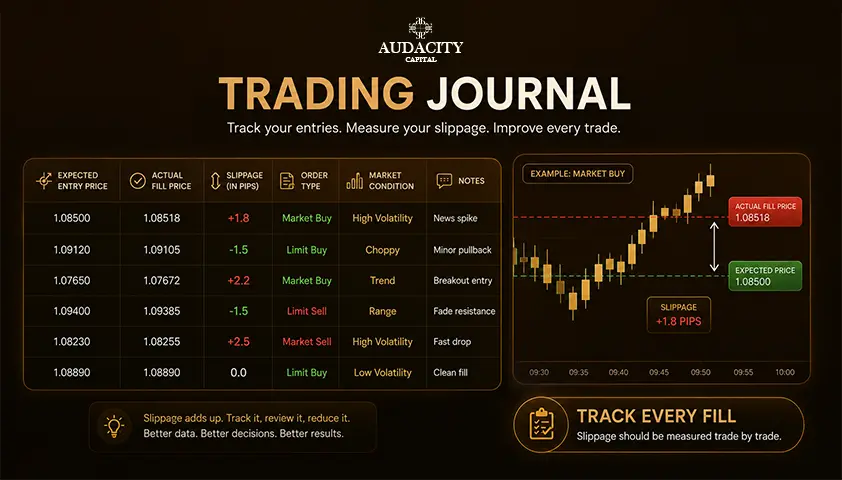
You cannot manage what you do not record. A useful log captures the entire path from decision to fill.
For each trade, record:
- Decision or signal price
- Requested or trigger price
- Bid and ask at submission if available
- Execution timestamp
- Average fill and quantity
- Order type and size
- Spread at execution
- Session and whether a scheduled event was active
Calculate entry slippage and exit slippage separately. Report positive, negative, and net figures rather than logging only the worst fills.
Use a range of statistics: average, median, worst decile, maximum, and cash slippage per trade. The median describes a typical fill, while the tail describes abnormal-condition risk.
Segment the data by instrument, time of day, size, order type, and news versus normal conditions. A single overall average often hides the actual source of the problem.
Compare execution against your strategy's average edge or R, not against a universal standard. A one-tick difference is trivial for a multi-day swing and destructive for a small-target scalper.
Investigate further when you see repeated one-sided negative slippage in calm and liquid conditions, fills inconsistent with platform timestamps or order history, unexpected partial fills, or a large change after switching venues, accounts, or infrastructure.
Review logs and request an execution explanation before assuming misconduct.
Slippage in Backtesting, Automation, and Prop Firm Accounts
Realistic execution assumptions separate strategies that survive live conditions from strategies that only look good on paper.
Backtesting:
Do not fill every order at the signal price. Add spread, commission, order delay, variable slippage, partial fills where supported, and stress tests for gap or news conditions. A strategy that fails after realistic costs does not have enough edge for live trading.
Automation:
Log requested and executed prices for every order. Define what the robot does after a requote or rejection. Test maximum deviation and prevent the algorithm from chasing price beyond the strategy's defined limit.
Copy trading:
Provider and follower can receive different prices due to server location, liquidity, symbol mapping, and execution delay. Judge follower performance on actual fills, not on the provider's headline result.
Prop firm accounts:
Check whether floating equity counts toward daily or maximum drawdown, whether news trading and weekend holding are permitted, and whether realistic slippage could push a planned risk past the breach threshold.
Permission to trade an event does not guarantee clean execution on it.
Frequently Asked Questions
Yes, positive slippage occurs when an order fills at a better price than expected. It is often called price improvement. It usually happens when a better executable price becomes available between order submission and matching, and it should be tracked alongside negative slippage rather than treated as a bonus.
No, the spread is the difference between the current bid and ask before you trade, while slippage is the difference between the price you expected and the price at which your order actually filled. Spread exists on every quote. Slippage only appears at execution and can be positive, negative, or zero.
A standard stop is a trigger, not a guaranteed exit. Once the market touches the stop level, the order usually becomes a market order and fills at the next available prices, which can be worse than the stop during fast moves, gaps, or thin liquidity.
No, limit orders control the worst acceptable price but do not guarantee execution. A buy limit fills at the limit or lower and a sell limit at the limit or higher, but the trade may not fill at all or may fill only partially if price moves away first.
There is no universal figure. Normal ranges depend on instrument, order size, session, volatility, and execution venue. The useful benchmark is your own baseline for the same conditions, tracked as median and tail values rather than a single average.
Usually not. Slippage is normally an execution outcome caused by movement, depth, and routing between order and fill. Persistent unexplained patterns, especially one-sided results in calm conditions, are worth checking against your logs and the provider's execution policy.
It can, but many simulators either model slippage poorly or ignore it. Demo fills often appear cleaner than live fills, which is one reason live results can diverge from demo performance and why forward testing on small live size is a useful step.
Yes. Drawdown limits are calculated on realized equity and actual fills, not on the price you intended to get. Slippage on a permitted trade, especially around news or gaps, can push a planned loss past a daily or maximum threshold, so sizing needs a buffer for adverse execution.

Kriptoya disiplinli risk uygulamaya hazır mısınız? Audacity Capital'in yeni kripto enstrümanlarını keşfedin ve ticaret stratejinizi getirin.
Daha Fazla BilgiBülten
Yeniliklerden haberdar olmak için bültenimize katılın.
Sosyal Topluluğumuza Katılın

Bugün Yolculuğunuza Başlayın Ücretsiz Denememizle
Becerilerinizi ve başarılarınızı sertifikalar aracılığıyla gururla sergileyin ve potansiyel yatırımcılardan ve akranlarınızdan sıkı çalışmanız ve özveriniz için takdir alın.
Ücretsiz Denemeİlgili Makaleler
Double Top Pattern: How to Trade It
Learn how to identify, confirm, and trade a valid double top pattern with precise targets and stops.


What Is BOS in Trading? A Complete Guide to Break of Structure (2026)
Learn what BOS in trading means, how Break of Structure works, how to identify bullish and bearish BOS, and how traders use it in market analysis.

Micro Futures Contracts Explained
What micro futures contracts are, why a smaller size does not mean lower risk, the margin trap that catches small accounts, and what they actually cost.
Best Trading Simulator Apps in 2026: Practice Trading Risk-Free
Compare the best trading simulator apps in 2026 for stocks, forex, futures and crypto. See features, markets, realism, pricing and beginner-friendly options.