



Forex Correlation Pairs: Positive & Negative Currency Pairs



You trade the EUR/USD and GBP/USD pairs at the same time, expecting to diversify your exposure across two currency pairs. But when the US dollar strengthens, the two pairs may fall, putting both the positions vulnerable to losses.
You had two positions, but both are exposed to the same market.
This is an example of positive forex correlation.
The forex correlation pairs are currency pairs that exhibit a relationship between their price movements over a period of time. Some pairs usually move in the same direction, while others tend to move in opposite directions.
For instance, EUR/USD and GBP/USD typically exhibit positive correlation, while EUR/USD and USD/CHF usually exhibit negative correlation.
Understanding the currency pair correlation helps traders to identify overlapping trades, compare correlated pairs, check for market support on the trend and manage their exposure.
In this forex correlation guide, we discuss the types of correlation, how the correlation coefficient works in forex, currency pairs correlation table, examples of correlated forex pairs, and forex correlation trading strategies.
What Are Forex Correlation Pairs?
Forex correlation pairs are currency pairs whose price movements have a statistical relationship over a particular period. They may move in the same direction, in opposite directions, or show little consistent relationship.
For instance, EUR/USD and GBP/USD exhibit positive correlation. In case of the weakening of the US dollar, both pairs can rise against it. But their movements do not need to be similar since both euro and British pound also react to their own economic situations.
It is also important to learn how to distinguish and interpret forex currency pairs when traders want to understand the reason for the similar reaction of some pairs to changes in currency strength.

Correlation measures the relationship between the two sets of price changes. It does not mean causation.
The two pairs could be moving in tandem due to the same market driver like changes in US dollar sentiment, but this doesn’t necessarily mean that one pair causes the other pair to move
Correlation is measured on a scale from -1 to +1:
- +1: Perfect positive correlation. Both pairs are moving together in a consistent linear manner.
- 0: No meaningful linear correlation. There is no noticeable consistent relationship between their movements.
- -1: Perfect negative correlation. Both pairs are moving in the opposite directions in a consistent linear manner.
Real-world market relationships tend to lie somewhere between these extremes.
- Positive example: EUR/USD and GBP/USD have often shown the same movement.
- Negative example: EUR/USD and USD/CHF have often shown opposite movements.
But most importantly, correlation is a dynamic concept, not a static one. A relationship that appears strong this quarter may weaken or even reverse next quarter. Bear this in mind throughout this guide.
Types of Correlations in Forex
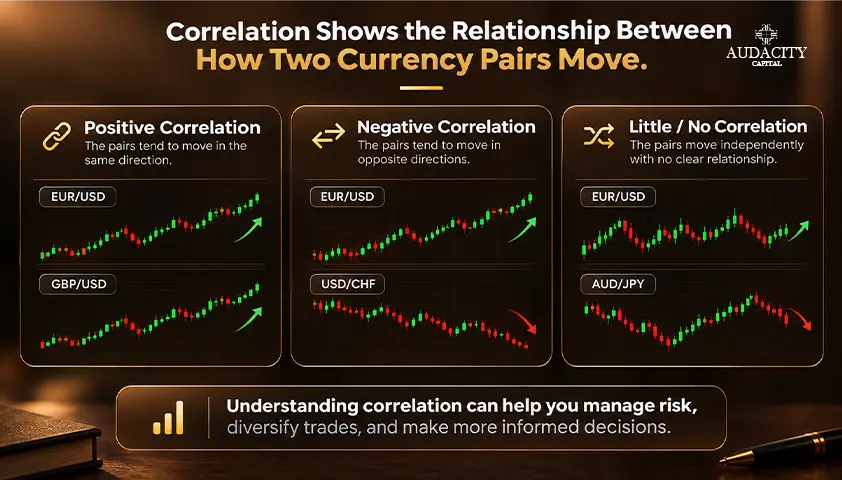
There are three main forms of currency correlation: positive, negative, and weak or zero. Each says something different about how two pairs relate.
1. Positive Correlation
Positive correlation is where two currency pairs move in the same direction. They are positively correlated when they tend to rise and fall together during the measurement period.
The classic example is EUR/USD and GBP/USD. Both use the US dollar as the quote currency, and therefore a general move in the dollar may affect them both in the same way. Some other common positive correlation pairs include:
- AUD/USD & NZD/USD: both are commodity-related currencies of the Asia-Pacific region against the US dollar.
- EUR/JPY & GBP/JPY: both have the Japanese yen as the quote currency.
In practice, it will mean duplicating risk. If you purchase both EUR/USD and GBP/USD, then you might actually take the same positions with respect to the US dollar.
2. Negative Correlation
Negative correlation means that the currency pairs move opposite each other. One such example is EUR/USD and USD/CHF. When EUR/USD rises, USD/CHF may often move lower.
The position of the shared currency is important here. In EUR/USD, the US dollar is the quote currency, but in USD/CHF, it’s the base currency.
In case the dollar gets weak, EUR/USD rises while USD/CHF drops. The euro and Swiss franc can also respond similarly to broader market conditions. However, differences in monetary policy, economic data and safe-haven demand can weaken this relationship.
Negative correlation doesn’t mean that the two currency pairs will always move in opposite ways. There will be days, weeks, or whole periods where the relationship breaks down.
3. Weak or Zero Correlation
Zero correlation value indicates a very weak linear relationship between two pairs during the measured period. It may be important for traders who try to diversify their trading exposure from one market driver.
However, weak historical correlation is not an indicator of future independence. In times of economic news reports, central bank announcements or market stress, previously uncorrelated pairs can become strongly correlated.
How Is Forex Correlation Measured?
Forex correlation is measured with the help of correlation coefficient that varies between -1 and +1. You do not have to calculate anything on your own.
Any modern platform and correlation tool calculates this coefficient automatically. The forex correlation matrix shows these coefficients for many pairs at a time.
Here is how you interpret them:
Correlation Value | General Interpretation |
+0.80 to +1.00 | Strong positive correlation |
+0.50 to +0.79 | Moderate positive correlation |
-0.49 to +0.49 | Weak or limited correlation |
-0.50 to -0.79 | Moderate negative correlation |
-0.80 to -1.00 | Strong negative correlation |
This is an interpretation range, not a set universal trading rule that will apply to every trade. Each trader or platform has different parameters when they draw the line in each particular case.
For instance:
- A coefficient of +0.90 indicates a strong positive historical relationship.
- A coefficient of -0.90 indicates a strong inverse historical relationship.
- A coefficient close to 0 indicates little consistent linear relationship.
The coefficient doesn't tell you which one of them is stronger, which one is going to move first, or whether any of the pairs is expected to go up or down.
Correlation Timeframes and Lookback Periods
The correlation number often needs to be considered in context of the time frame used to calculate it. Two pairs could have a strong correlation in the last 30 days and a much weaker one in the last six months.
Some typical lookback periods include:
- Short-term: a few days to two weeks, highly sensitive to recent news.
- 30-day: current market situation.
- 90-day: medium-term perspective that filters out some noise.
- 6-month or 12-month: long-term, structural correlations.
The most suitable lookback period will depend on your trading horizon. A short-term trader will probably be more interested in the recent behavior, while a long-term trader may prefer a longer period.
Don’t confuse the two. The chart timeframe (one hour, four hours, daily) is the timeframe of each candle. The correlation lookback period (30 days, 90 days, six months) is the period the calculation is done from.
They can be mixed together, for instance daily candles with a 90-day lookback period.
Why Forex Correlations Change Over Time
Correlations may become stronger, weaker, and even reverse due to:
- Interest rate changes
- Central bank actions
- Economic situation
- Market sentiment
- Geopolitical events
- Commodity price changes
- Market volatility fluctuations
The main point is that you should not assume any correlation to be constant. Test it again under new circumstances.
Forex Correlation Pairs Table
This currency pairs correlation table contains commonly known connections between currency pairs. The table is qualitative, so no exact coefficients are mentioned.
Currency Pair 1 | Currency Pair 2 | Common Relationship | Typical Behaviour |
EUR/USD | GBP/USD | Positive | Often move in similar directions |
AUD/USD | NZD/USD | Positive | Frequently respond similarly to USD and regional factors |
EUR/JPY | GBP/JPY | Positive | May behave similarly to JPY and risk sentiment |
EUR/USD | USD/CHF | Negative | Often move in opposite directions |
GBP/USD | USD/CHF | Negative | May show an inverse behavior |
Note: This is a qualitative currency pair correlation table, not a live correlation matrix. It does not present any numerical figures for correlations. Actual correlation depends on the measurement period, market situation, and data chosen.
It is important for traders to verify the correlation through recent price action data to apply it to the trading process.
What Are the Most Correlated Forex Pairs?
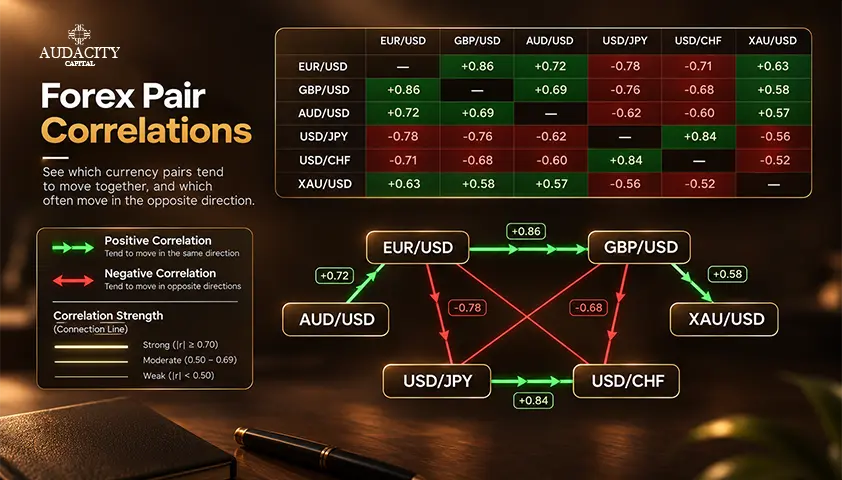
These are the pairings that are mentioned most by traders. We've kept the lists brief and included an explanation of each because quality is more important than number.
Positively Correlated Forex Pairs
The following positive correlated forex pairs are commonly referred to as forex pairs that move together:
- EUR/USD and GBP/USD: they are both quoted against US dollars, and Euro and GBP economies are interlinked with each other through European trade and similar sensitivity to global sentiment.
- AUD/USD and NZD/USD: both have commodity-based economies and are geographically located near to each other. Both are quoted against the dollar.
- EUR/JPY and GBP/JPY: with yen as the common quote currency, both can react to either strength or weakness of the yen and changes in risk appetite.
Negatively Correlated Forex Pairs
Here are some examples of forex pairs that move opposite each other:
EUR/USD and USD/CHF: the dollar is on opposite sides, and the euro and Swiss franc have tended to move similarly against the dollar.
GBP/USD and USD/CHF: same dollar effect, which could make them inversely related.
When you create your own correlated forex pairs list, keep in mind that even the most correlated forex pairs may not remain correlated.
Correlation patterns can also differ across minor currency pairs and exotic currency pairs, where liquidity and local economic factors may influence price movements.
Example of Currency Correlation
Let’s put the theory into practice in two hypothetical examples.
Positive Correlation Example: EUR/USD and GBP/USD
Suppose that the US dollar loses value after worse-than-expected US economic data. EUR/USD goes up, and GBP/USD moves up too. They share the US dollar as the quote currency, so they both move in the same way because of the same dollar movement.
Now imagine a trader holding long positions in both pairs. From the perspective of the trading platform, this is two different trades. In reality, however, it may actually be the same trade against the US dollar.
In case the dollar recovers, both trades may go against the trader simultaneously, and the combined loss may be larger than expected.
Negative Correlation Example: EUR/USD and USD/CHF
In this case, the dollar depreciates. The EUR/USD goes up and USD/CHF goes down.
The common currency in the two pairs is the US dollar, which appears as the quote currency in the EUR/USD and the base currency in the USD/CHF. A strong movement of the dollar can, therefore, move both pairs in opposite directions.
However, both the above relationships can change at any point in time due to monetary policy differences between the Swiss National Bank and the European Central Bank or due to a safe-haven rush to the Swiss Franc.
Why Is Forex Correlation Important to Traders?
Forex pairs correlation is important to traders for the following reasons:
Reason #1: Avoiding duplicate exposure
Having multiple positions that are highly positively correlated can expose you to more risk from a single market move than you think.
For instance, a trader who is long on both EUR/USD and GBP/USD may have more exposure to USD weakness than he thinks. Both the trades can move against the trader when the dollar strengthens.
Reason #2: Understanding diversification
Having multiple currency pairs does not necessarily mean that your portfolio is diversified.
For instance, EUR/USD, GBP/USD and AUD/USD have different base currencies, but all three have the US dollar in common. In case there is a strong positive correlation between these pairs, then they may react to the same market events.
Correlation will help you know whether you are exposed to various market drivers or the same one.
Reason #3: Position sizing
Correlation is an important factor in analyzing position sizes. For instance, having EUR/USD and GBP/USD with high positive correlation increases the risk of exposure to the same market movements.
Traders must evaluate the risk of the whole portfolio instead of every individual trade. The right position size depends on the trader’s account size, risk preference and strategy.
Reason #4: Risk management
Analysis of correlation can show traders that they have too much or overlapping risk, especially when all the correlated trades move against them at once.
Correlation can also help when choosing which forex pairs to trade, while currency pair volatility is another factor to consider when assessing overall risk.
Forex Correlation Trading Strategies
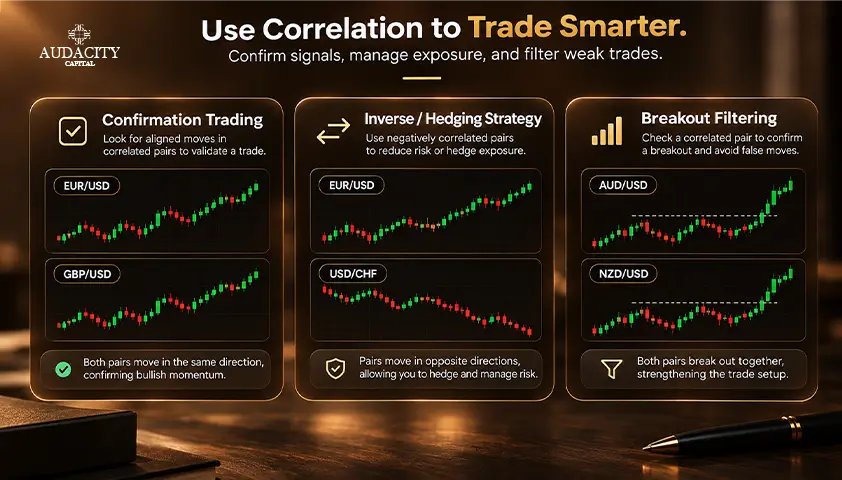
Here we present some examples of forex correlation trading strategies. Please note that none of them is guaranteed to be profitable, and correlation should be treated as additional information.
A. Confirmation Trading
Confirmation trading is where one currency pair is compared to another pair which has a positive correlation with the first one.
For instance, if EUR/USD rises above a critical resistance level, the trader can also check whether GBP/USD is experiencing the same trend.
In case both the pairs are strengthening, then this may provide more information regarding broader USD weakness.
However, the movement of the second currency pair will not be a confirmation that the breakout for EUR/USD will work. The trader should still consider price structure, market conditions and other relevant signals prior to making a decision.
B. Correlation-Based Hedging
Correlation-based hedging is a strategy where related currency positions are employed in order to balance specific risks in the market.
For instance, a trader who maintains a long position on EUR/USD can think about how an open position on another currency pair will influence total USD exposure.
However, a negative correlation does not mean that an effective hedge will be achieved.
There are factors to take into account:
- Direction of the trade: Negatively correlated pairs can neutralize or reinforce the exposure, depending on the trade direction.
- Size of the positions: Different position sizes will lead to an imbalance in the total exposure.
- The nature of correlation: Weak or changing correlation will not give the required effect.
- Market situations: Unexpected economic reports or news may interfere in the process.
Hedging also includes higher trading costs and does not reduce market risk.
Thus, traders need to consider the real risk of both positions, and not assume that negatively correlated pairs would compensate for any possible loss.
C. Breakout Confirmation and Filtering
Related pairs can be used to provide additional context for breakout assessment.
Let's say that EUR/USD breaks resistance level. If GBP/USD is usually positively correlated but does not display any similar strength, then a trader may want to research the breakout more carefully before acting.
Conversely, similar movement across related pairs may provide broader market context.
It is better to use this method as a filtering tool, as similar movements do not confirm a breakout, and differences between correlated pairs do not invalidate a trade automatically.
Correlation Between Forex and Other Markets
Currency correlation doesn’t exist exclusively between forex pairs. In some cases, certain currencies can be sensitive to events in other financial markets, such as commodities.
CAD and Oil
Canada is a major exporter of oil. Thus, movements in oil prices around the world can at times affect the CAD.
For instance, positive oil price developments can drive CAD in certain market environments.
A trader can keep track of the USD/CAD and oil prices to understand the relationship between oil prices and currency exchange.
AUD and Commodities
Australia is a significant exporter of commodities, including iron ore and other natural resources.
Commodity market movements can affect the AUD, although interest rates, economic data and broader market sentiment play a role as well.
Gold and Forex
There can be a correlation between gold and currencies like the US dollar and Australian dollar.
For instance, the price of gold and the US dollar have had an inverse relationship in some market conditions. But again, this is not consistent across all periods.
AUD is susceptible to fluctuations in the gold market as well as the commodities market.
For Indian traders reading the blog, USD/INR may be influenced by dollar performance, oil prices (because India imports a large share of its crude), capital flows, and RBI policy.
The rules for retail traders to trade forex pairs in India are specific, so check the current regulations before trading any pair. A strong fundamental analysis background helps comprehend cross-market correlations.


Are You Looking For A Most Trusted Prop Firm?
Join the Prop FirmCommon Mistakes When Using Forex Correlation
- Considering that correlation is permanent. Past connection between two pairs can be weakened, strengthened, or even reversed. Remember that any number you see is a snapshot.
- Not considering the time period of calculation. One currency pair can be highly correlated over 30 days, but a weaker relationship over six months. Always remember the timeframe you use.
- Confusing correlation with causation. Moving in the same direction does not mean that one pair moves the other one. It means that they have some common cause.
- Not taking into account cumulative risk. Several positively correlated trades can significantly increase your market risk in comparison with each trade separately.
- Correlation does not make decisions independently. Direction, entry point, stop-loss, and profit target are calculated separately from correlation.
Trading costs are equally important. Compare forex pairs with lower spreads while choosing trading instruments.
Conclusion
Forex correlation assists traders in realizing how seemingly unrelated currency pairs are interconnected through shared currencies, economies, and sentiment in the market.
Positive correlation means that the pairs move in the same direction, whereas negative correlation means that they move in opposite directions. Weak or zero correlation implies that there is no significant linear relationship between the two currency pairs during the chosen period of time.
A currency pair correlation table may help in determining such correlations; however, traders need to keep in mind that historical patterns are not constant. Correlation depends on the circumstances and timeframe chosen by the trader.
The key point is to use forex correlation as additional information about the market.
Guides About Currency Pairs
- The Best Forex Currency Pairs to Trade
- Best Days to Trade Forex
- Best Currency Pairs to Trade in the Sydney Forex Session
- Best Currency Pairs to Trade in the Forex Asia Session
- Best Currency Pairs to Trade in the New York Session
- Best Currency Pairs to Trade in The London Session
- Best Forex Currency Pairs to Scalp
- Forex Currency Pairs With Lowest Spreads
- Forex Exotic Currency Pairs
- Trending Forex Currency Pairs
- The Most Volatile Forex Currency Pairs
Check Our Funded Trader Program
Frequently Asked Questions About Forex Correlation Pairs
Some of the frequently correlated pairings include EUR/USD and GBP/USD as well as AUD/USD and NZD/USD. These pairings either share currencies and/or economic drivers. It is important to note that the correlations vary and, therefore, some of the most correlated forex pairs now may be different from those next quarter.
This is usually seen in pairs with high positive correlations. For example, EUR/USD and GBP/USD, AUD/USD and NZD/USD, and EUR/JPY and GBP/JPY all move in the same direction since they have common currencies and/or respond to economic and sentiment factors, though this isn’t guaranteed.
Examples of negatively correlated pairings that move in opposite directions include EUR/USD and USD/CHF as well as GBP/USD and USD/CHF. In the mentioned pairs, the US dollar is on the opposite ends which can create the inverse relationship.
The closer the number is to +1 or -1, the stronger the correlation is. A high positive or negative correlation is considered strong when the figure falls above +0.80 or below -0.80, respectively. But these thresholds are guidelines, not fixed rules, and everything depends on the timeframe of analysis.
Yes. A change in interest rates, central bank policy, economic data, market sentiment, geopolitical events and time frame of analysis may all affect the correlation in one way or another. Past correlation must never be viewed as a constant one.
A forex correlation table presents the correlation coefficient of the historical relationship between currency pairs during a certain period of time. Every cell reflects the level of connection between the two pairs over a given period. This is an analysis of past data and does not predict future movements.
There is no universal timeframe that will be best for all traders. The measurement window should roughly correspond to your trading horizon: smaller for short-term traders, larger, like 90 days or six months, for traders with longer investment periods. Comparison of different windows might be helpful.
Yes. Positive correlation of several pairs might cause overlapping or concentrated risk, meaning that one negative move may influence all of them. Reviewing correlation helps you see your overall risk.

Ready to apply disciplined risk to crypto? Explore Audacity Capital's new crypto instruments and bring your trading strategy.
Learn MoreNewsletter
Join our newsletter to stay up to date on features and releases.
Join Our Social & Community

Start Your Journey Today With Our Free Trial
Proudly showcase your skills and accomplishments through certificates and get recognition for your hard work and dedication from potential investors and peers.
Free TrialRelated Articles

10 Best Futures Prop Firms for Swing Trading In 2026
Compare the best futures prop firms for swing trading in 2026 with overnight holding, flexible rules, fast payouts, and funded accounts.


Are Volumes Useful In Forex Or Not?
Learn how trading volume helps forex traders confirm trends, identify market strength, and improve decision-making with practical insights.

How To Choose The Right Prop Firm – A Complete Checklist
Learn how to choose the right prop trading company with our expert guide. Compare fees, rules, profit splits, and platforms to trade confidently.

Swing Trading vs Day Trading: Key Differences Explained
Compare swing trading vs day trading, including strategies, costs, risks, time commitment, and prop firm rules to choose the right trading style.