


How Much Money Do You Need to Start Trading Futures? ($500 vs $5,000 Explained)



Future Trading Minimum Capital
Most beginner traders need between $1,000 and $5,000 to start trading futures effectively.
Although some brokers allow accounts with as little as $500, small balances often create:
- higher leverage risk
- limited flexibility
- faster drawdowns
- increased emotional pressure
For most beginners:
- $500 = very high risk
- $1,000–$5,000 = recommended starting range
- $5,000+ = more stable trading flexibility
Introduction
Most beginner traders need between $1,000 and $5,000 to start trading futures realistically.
While some brokers allow traders to open accounts with as little as $500, small accounts often struggle because of:
- leverage risk
- margin requirements
- commissions and fees
- limited flexibility during market volatility
In this guide, you’ll learn:
- realistic futures trading capital requirements
- how margin works
- beginner risk management principles
- common mistakes small accounts make
How Much Money Do You Need to Start Trading Futures?
Most traders need $1,000–$5,000 to trade futures effectively. While $500 is possible, it is high risk and not recommended for beginners.
The amount(s) needed will vary as shown below:
- Minimum amount to open a futures trading account: $0 -$500
- Bare minimum for you to start trading: $500 -$1,000 (considered high risk)
- Recommended amount for a beginner trader: $1,000 - $5,000
- If you wish to engage in more stable trading: $5,000+
Minimum vs Recommended Capital
There’s no better way to understand the amounts needed to start trading, than by using a comparison table. Below is a table showing the comparison between the minimum vs the recommended capital.
Level | Amount | Risk |
Minimum | $500 | Very High |
Beginner | $1K–$5K | Moderate |
Stable | $5K+ | Lower |
The exact amount depends on margin requirements, trading strategy, and risk management—here’s how it works in practice.
At this point, it’s important to point out that the exact amounts needed will depend on a variety of factors, e.g., risk management, trading strategy, and margin requirements as explained below.
Example: If You’re Starting with $1,000
- Margin required: $100
- Stop-loss per trade: $50
- 3 losses = $150 loss (15% drawdown)
Can You Start Trading Futures with $500?
Yes — but it comes with significant risk.
Small futures trading accounts often struggle because:
- one or two losses can create major drawdowns
- commissions and fees consume a larger percentage of capital
- leverage increases emotional pressure
- limited margin reduces trading flexibility
While some brokers allow it, most experienced traders consider $500 too small for long-term futures trading consistency.
How Much Money Do You Need for Different Futures Contracts?
Futures Contract | Suggested Beginner Capital | Risk Level |
|---|---|---|
Micro E-mini S&P 500 (MES) | $1,000–$2,500 | Moderate |
E-mini S&P 500 (ES) | $5,000–$15,000 | High |
Micro Nasdaq (MNQ) | $1,500–$3,000 | High |
Crude Oil Futures | $5,000+ | Very High |
Gold Futures | $3,000–$10,000 | High |
Micro futures contracts are generally considered more beginner-friendly because they allow traders to manage smaller position sizes and lower risk exposure.
Why Many Beginners Start with Micro Futures
Micro futures contracts are designed for traders who want:
- lower capital requirements
- smaller position sizes
- reduced risk exposure
Compared to standard futures contracts, micro futures allow traders to practice:
- risk management
- position sizing
- trade execution
without requiring large amounts of capital.
This is one reason many beginner futures traders start with:
- Micro E-mini S&P 500 (MES)
- Micro Nasdaq (MNQ)
- Micro Gold contracts
What Are the Best Ways to Start Trading Futures Contracts When You Have Limited Capital?

There are numerous ways to go about this as shown below:
- Try to focus on being consistently profitable
- Trade micro futures contracts
- Avoid the temptation to engage in overtrading
- Only risk 0.5% to 1% of your available capital per trade
What Are Some of the Costs Forgotten by Small Accounts?
Fees, commissions, and slippage can quickly reduce small accounts—especially when overtrading. Even a low-cost micro that has sub-dollar round-trip fees will quickly erase any profit run if you overtrade while chasing gains.
To prevent this, Audacity Capital provides you with simulated access to large capital tiers, a scaling program that preserves learning while ensuring you don’t wipe out your account, and built-in risk rules.
What Is Futures Margin?
Futures margin is the minimum amount of capital required in your account to open and hold a futures position. There are two key types: initial margin, which you need to open a trade, and maintenance margin, which you must maintain to keep the position open. If your account drops below maintenance margin, a margin call may require you to add funds or close positions.”
This version keeps the focus on practical concepts—capital requirements, account risk, and what happens if the balance falls. No need for deep theory—just actionable clarity.
Why Does the Futures Margin Feel Like an Invisible Cost on Your Trading Capital?
Exchanges get to set the initial and maintenance margins that influence the number of contracts a trader can run at a time, and which directly impact your position-sizing. Given that certain contracts have low posted requirements, the margin requirements may sometimes be <1% of notional value. which increases risk further.
Pro Tip: Don't ask "How many contracts can I afford with my margin?" Ask "How many contracts can I afford if my stop-loss is hit, while only risking 1% of my account?
Day Trading vs Overnight Margins
Margin requirements will normally vary depending on how long a trader has held a position. Many brokerage firms provide reduced day trading margins for all positions that you have opened and exited within the same trading day.
- Day trading margin: It comes with low margin requirements for traders involved in intraday trading.
- Overnight margin: It generally attracts higher margin requirements for all positions that a trader has held beyond the close of the trading session.
Day Trading vs Overnight Margins
Feature | Day Trading Margins | Overnight Margins |
|---|---|---|
Typical Cost | Lower margin requirements | Higher margin requirements |
Holding Period | Positions closed within the same trading session | Positions held beyond market close |
Leverage | Higher leverage | Lower leverage |
Risk | Higher risk of rapid liquidation | Higher exposure to overnight market gaps |
Day trading margins are generally designed for short-term intraday trading, while overnight margins are intended for traders holding positions across multiple sessions. Understanding this difference is important because overnight positions usually require significantly more capital and carry additional market gap risk.
Why Margin Requirements Matter for Beginner Traders

Margin is a double-edged sword: it can make futures trading more capital efficient, but it will also increase your risk. Considering that futures traders tend to control a larger notional value using very little capital, even the smallest of price movements could significantly impact the account balance.
For a beginner trader, these futures margin requirements help highlight the importance of having a sound risk management plan. It also showcases the risks of trading with too little capital, which is likely to limit your flexibility while increasing the likelihood of a margin call during market volatility.
Can you trade futures contracts with a small account?
Yes, it’s possible to trade futures contracts even when you have a small account. However, be advised that this will change what you can do, including how you must behave. The reality is that small accounts demand that you use tighter risk control with each trade.
They also call for lower turnover and a sound risk management plan that treats psychology, fees, and leverage as the real constraints, rather than the numbers printed on the sign-up page.
How Leverage Increases Futures Trading Risk?
Leverage amplifies everything, and this should be a source of concern when operating with a small balance. With leverage, you must always remember that one single adverse move could easily equal a large percentage of your account equity.
This calls for you to understand that leverage is capacity, and not free money. When operating with high leverage, try to size your positions using percent risk instead of contract count. It’s recommended that you treat margin as a limit on how big you can get, and to ensure you cap your risk with each trade.
Doing so ensures that a routine swing doesn’t force you to make an emergency exit from a position.
What Kind of Capital Do You Need to Cover the Margin Requirements?
When looked at practically, you’ll find that the capital requirements for futures trading typically extend the initial margin. As a trader, you must make sure that you have enough capital to:
- Avoid forced position closures when the market is experiencing normal market volatility
- Cover the initial and maintenance margins
- Pay the brokerage commission and fees
- Absorb short losses
For instance, if your futures contract requires that you have $500 in day trading margin, opting to trade with only $500 will leave you with no room for adverse price movements. In such a scenario, a single losing trade will automatically trigger a margin call or even cause the session to end prematurely.
Recommended Cushion – Looking Beyond the Margin
Most seasoned traders maintain a capital cushion that’s well beyond the recommended minimum margin requirements. They use the additional buffer to help them manage their risk more effectively, ensuring they can remain in trades in line with their trading plan.
The "20-Stop" Rule for Practical Capitalization
To move beyond vague "cushions," many professional traders utilize the 20-Stop Rule. This suggests your account should be funded with:
Minimum Capital = Intraday Margin + (20 × Maximum Strategy Stop-Loss)
For example, if you are trading a Micro E-mini contract with a $100 day-trading margin and your strategy uses a $50 stop-loss, your minimum starting capital should be $1,100 ($100 + $1,000). This ensures that even a string of losses doesn't immediately result in a margin call or the inability to place the next trade.
Although the exact cushion amount can vary from one trader to the next, having a larger buffer can help:
- Support consistent position sizing
- Provide flexibility when faced with normal market volatility
- Reduce emotional decision-making
Using the above approach may prove beneficial for new futures traders who are still in the process of developing a trading strategy and discipline.
Risk Considerations You Need to Understand as a Beginner Futures Trader
Understanding the amount you need to begin trading futures contracts will require you to understand the risks that will be involved. Keep in mind that these markets can be volatile, and that leverage can increase both your profits and losses.
As a beginner trader, you should consider:
- The role of education and practice (using a demo account) before trading live
- The potential for huge losses during normal market volatility
- How emotional pressure can impact decision-making
- The importance of position-sizing and stop-loss orders
The capital requirements for futures trading aren’t just about meeting the set minimum dollar amount: they’re there to ensure that you have enough resources to manage risk, trade thoughtfully, and adapt to changes in the market.
How Much Can Beginner Futures Traders Realistically Make?
Profitability depends on:
- account size
- risk management
- trading strategy
- consistency
For example:
- a trader risking 1% per trade on a $2,000 account risks about $20 per trade
- a trader risking 1% on a $10,000 account risks about $100 per trade
Most beginner traders focus first on:
- consistency
- discipline
- capital preservation
before trying to aggressively scale profits
Common Mistakes Made by Beginner Futures Traders
Every beginner trader will make several mistakes when starting out. The trick is to learn from those that have been made by others, and to try and avoid repeating the same.
Examples of commonly made mistakes include:
- Too much trading
- Starting with only your initial margin
- Overleveraging your trades
- Ignoring the various fees charged by the platform and the broker
Summary
Most beginner traders need between $1,000 and $5,000 to start trading futures realistically while maintaining proper risk management.
Although some brokers allow accounts with as little as $500, smaller balances often create:
- higher leverage risk
- limited flexibility
- emotional trading pressure
- increased margin call risk
For many beginners, starting with:
- micro futures contracts
- disciplined risk management
- lower position sizes
can provide a more sustainable learning environment while reducing the risk of large losses.
Learn, practice, and apply your trading strategy in Audacity Capital's free monthly trading competition.
Related Articles
Best Futures Prop Trading Firms 2026: Complete Guide for Traders
Read more about our guide How Much Money Do You Need to Start Trading?
Learn more about our latest guide How Much Money Do You Need to Start Forex Trading?
Read more about Our guide How Much Money Do You Need to Start Trading Stocks?
Leran more about our latest guide How Much Money Do You Need to Start Crypto Trading?
Read more about our latest guide How Much Money Do You Need to Start Options Trading?
Learn more about our guide How Much Money Do You Need to Start Swing Trading?
Read more about our guide How Much Money Do You Need to Start Day Trading?
FAQ
Initial margin is the collateral deposit a trader must place with a brokerage firm to open a new futures position. On the other hand, maintenance margin is the absolute minimum balance required to keep that position open. If the account equity falls below this maintenance level, a margin call is triggered, requiring additional funds to be deposited.
Brokers often reduce margin requirements for day trading to attract active intraday participants, sometimes allowing entries for as little as $50 to $500. However, the exchange sets much higher overnight margins for positions held past the daily close to account for increased risk and market gaps. Holding positions overnight without sufficient capital can lead to forced liquidation by the broker.
Technically you can open an account with a minimum deposit, but it is rarely a sustainable strategy for active trading. Starting with only the required margin leaves zero room for adverse price movements, meaning a single losing trade could immediately end your session. Most seasoned traders recommend a buffer well beyond the minimum to support consistent position sizing and reduce emotional pressure.
Account friction is the 'silent killer' of small accounts. For example, if you trade one Micro S&P 500 contract with a $5 round-turn commission/fee on a $500 account, you lose 1% of your entire balance the moment you enter and exit, regardless of whether the trade wins or loses. This 'negative carry' means you must have a high win rate just to break even.
Leverage acts as a capacity that allows you to control a high notional value with a relatively small deposit, but it means small price swings result in large percentage changes to your equity. Because of this sensitivity, traders are advised to size positions based on a percentage of their total risk rather than just the number of contracts. Using leverage without a strict plan can turn normal market volatility into a terminal crisis for a small account.

Ready to apply disciplined risk to crypto? Explore Audacity Capital's new crypto instruments and bring your trading strategy.
Learn MoreNewsletter
Join our newsletter to stay up to date on features and releases.
Join Our Social & Community

Start Your Journey Today With Our Free Trial
Proudly showcase your skills and accomplishments through certificates and get recognition for your hard work and dedication from potential investors and peers.
Free TrialRelated Articles

Micro Futures Contracts Explained
What micro futures contracts are, why a smaller size does not mean lower risk, the margin trap that catches small accounts, and what they actually cost.


What Is BOS in Trading? A Complete Guide to Break of Structure (2026)
Learn what BOS in trading means, how Break of Structure works, how to identify bullish and bearish BOS, and how traders use it in market analysis.
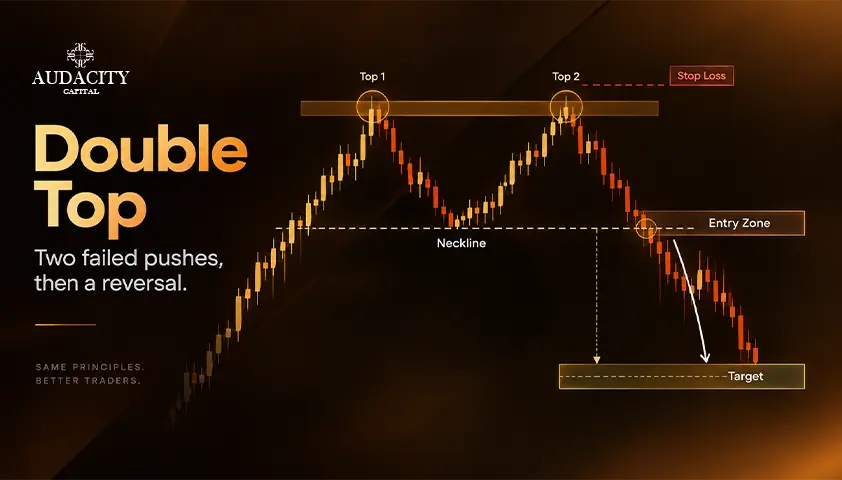
Double Top Pattern: How to Trade It
Learn how to identify, confirm, and trade a valid double top pattern with precise targets and stops.

Liquidity Sweeps Explained: How to Identify and Trade Them
Learn what a liquidity sweep is, how to identify bullish and bearish sweeps, spot sweeps vs breakouts, and use price action and market structure for confirmation.