



How to Scale a $50K Funded Trading Account: The Complete Roadmap



You passed the evaluation. You have a $50,000 funded account. Now what?
Knowing how to scale a funded account of 50k, traders are handed, comes down to one thing: turning consistent percentage returns into larger capital allocations, while deciding deliberately whether to compound your profit or withdraw it.
That is the whole game.
It is not a lucky run of trades that doubles your balance overnight, but a structured, rules-based progression that prop firms reward when you prove you can manage risk.
Here is the encouraging part: the traders who reach large allocations are rarely the most gifted. They are the ones who understood two things early. They got the withdraw-versus-grow decision right, and they understood that the full $50,000 is not what they are actually risking.
Master those two ideas and a serious allocation is well within reach. This roadmap gives you both, then builds out the rest:
- the real math behind a $50K account,
- how typical scaling plans work,
- the monthly return you genuinely need,
- how to size positions as you grow,
- the psychology of trading bigger,
- and a step-by-step plan you can follow from your first payout to your largest allocation.
What scaling a funded account actually means ?
Before getting into how to grow a funded account in practice, it helps to be clear on what scaling actually is. Scaling (a funded account) means a structured increase in the capital a prop firm allocates to you, tied to demonstrated and repeatable performance.
It is not a reward for a single big win. It is the firm steadily handing you more buying power because you have shown, over time, that you respect the rules and protect the downside.
Every scaling plan is shaped by two perspectives that pull in the same direction.
From the firm's side, capital is released only as risk discipline is proven, because the firm carries the cost of your losses.
From the trader's side, a scaling plan is a transparent ladder: instead of staying stuck at $50K forever, you know exactly what performance and behavior unlock $100K, $200K, and beyond.
One distinction matters before going further.
Most prop firm accounts are simulated or evaluation-based environments, so scaling usually means qualifying for a larger account tier, not literally compounding a live retail balance the way you would in a personal brokerage account.
The capital allocation grows; the mechanism is the firm assigning you a bigger account once you hit a profit target and meet the conditions attached to it.
Scaling vs. withdrawing: two different goals
Keep this tension in mind as you read, because it shapes every decision that follows.
Scaling and withdrawing are two different goals.
Withdrawing converts your profit into cash in your bank now. Scaling leaves that profit working so you can reach a larger account and bigger future payouts.
Neither is automatically correct. The right answer depends on your consistency, your cash flow needs, and your tolerance for trading larger sizes.
We will resolve this fully later; for now, just notice that the choice exists at every milestone.
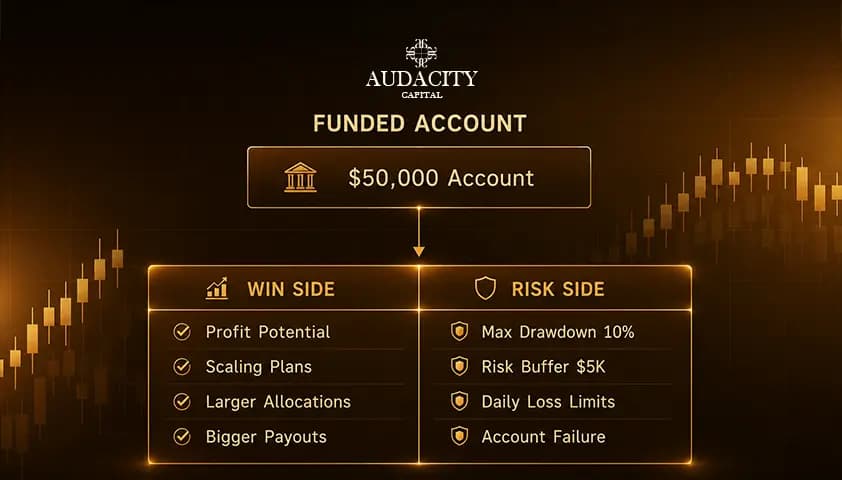
The real math: why a $50K account is not $50K of risk
This is the single most important reframe in this article, and it is the number that separates traders who last from those who flame out.
A $50,000 funded account does not give you $50,000 to risk.
With a typical maximum drawdown of 10%, your usable risk buffer is about $5,000, not $50,000. The headline number is the size of the account; the drawdown limit is the amount you can actually lose before the account is gone.
Once you internalize this, you trade with the kind of margin of safety that keeps you in the game long enough to scale.
Sit with that. The day you receive a $50K account, you are really managing a $5,000 margin of error. Every position sizing decision flows from that figure, not from the $50K on the dashboard.
Here is what disciplined risk per trade looks like against that buffer:
Risk per trade | Dollar risk on $50K | Consecutive losses to hit a $5,000 drawdown |
0.5% | $250 | 20 trades |
1% | $500 | 10 trades |
2% | $1,000 | 5 trades |
3% | $1,500 | Roughly 3 trades |
The pattern is obvious once you see it in dollars.
A trader risking 1% can absorb ten losing trades in a row before the account is at risk; a trader risking 3% has room for only three.
Every trader hits losing streaks, so the lesson is simple and freeing: keep your risk modest and you give yourself the runway to ride out the rough patches and keep scaling.
Restraint here is not a limitation, it is your edge.
Daily loss limit vs. maximum drawdown
Two rules govern how much you can lose, and traders constantly conflate them.
The daily loss limit caps how much you can lose in a single trading day.
The maximum drawdown caps your total loss measured from the starting balance or a trailing peak.
You can be comfortably inside your maximum drawdown and still breach your account by blowing through the daily loss limit on one bad session.
Constraint | What it limits |
Daily loss limit | The most you can lose in one trading day. Example: a $2,500 daily limit ends your day if losses reach that figure, even if your overall account is healthy. |
Maximum drawdown | The most you can lose in total from your starting balance or trailing peak. Example: a 10% drawdown on $50K means the account fails if equity falls $5,000 from the reference point. |
Know both numbers for your specific account before you place a trade. They define the boundaries of every scaling decision you make.
How a typical $50K scaling plan works
A prop firm scaling plan is the published set of conditions that move you from one account size to the next.
The structures vary, but three patterns cover most firms.
- Milestone-based plans increase your account size once you hit a defined profit target, for example reaching a set percentage gain.
- Tiered loss-limit expansion gradually widens your risk parameters as your net profit grows.
- Consistency-gated progression requires you to show steady results over a minimum number of trading days or months before the next tier unlocks.
A generic ladder helps make it concrete. A trader might start at $50K, reach $100K after hitting the firm's profit and time conditions, then progress to $200K and upward under the same logic.
At each step the firm typically attaches profit conditions (a required gain), behavior conditions (respecting drawdown and any consistency requirement), and sometimes a minimum number of active trading days or withdrawals.
The variation between firms is real and worth your attention.
Some firms double the account size when you hit a target. Some raise your drawdown allowance instead. Some increase your profit split as you climb.
Because the mechanics differ so much, the first practical step in any scaling strategy is simple: read your own firm's rulebook in full before you trade a single position.
Account doubling vs. profit-split increases
These are two different reward mechanisms, and understanding which one your firm uses changes your strategy.
Account doubling grows the capital under your management, which increases your earning potential per trade and favors traders focused on compounding toward a large allocation.
Profit-split increases grow your take-home on every dollar you earn, which favors traders focused on cash flow from a stable account size.
The strongest plans offer both: a path to larger capital and a rising split as you prove yourself.
What return you actually need to scale (and how long it takes)
Scaling targets feel abstract until you translate them into monthly percentages.
The good news is that the required numbers are more modest than most beginners assume. The hard part is consistency, not size.
Here is what a steady monthly return does to a starting figure through simple compounding:
Monthly return | After 3 months | After 6 months | After 12 months |
2.5% | +7.7% | +16.0% | +34.5% |
5% | +15.8% | +34.0% | +79.6% |
8% | +26.0% | +58.7% | +151.8% |
So how long does it take to double a $50K funded account? Honestly, for a disciplined trader it is usually a multi-month effort, not a multi-week sprint.
At a sustainable 5% per month you are looking at roughly a year of compounding to approach a double, and that assumes no significant drawdowns along the way.
Faster is possible, but speed and survival rarely travel together.
This is why the high-leverage approach you see promoted in forums and trading Discords is so dangerous.
The pitch is to risk large amounts to scale fast. The reality is that the strategy concentrates your entire account into a handful of trades, and a normal losing streak wipes it out.
Statistically, the trader who risks 1% and aims for steady monthly gains outlasts the trader who swings for the fences, and outlasting the streaks is how you actually reach larger capital.
A note on the numbers above: they are illustrative and assume clean compounding with no losing months. Hypothetical performance does not predict actual results, trading carries significant risk, and nothing here is financial advice.
Position sizing and risk as the account grows
As your account scales, your per-trade risk should change in dollars but not in percentage.
This is the core principle of position sizing for a growing funded account: keep your risk a fixed percentage of the account, and let the dollar figure rise naturally as the account gets bigger.
A trader risking 1% on a $50K account risks $500; the same trader risking 1% on a scaled $200K account risks $2,000. The discipline stays identical even as the stakes grow.
The opposite behavior is what ends most accounts right after a scale-up.
A trader hits a new tier, feels the momentum, and quietly raises the risk percentage to push growth faster.
That is an emotional decision dressed up as ambition, and it removes the very margin of safety that got them promoted. Scaling rewards the trader who keeps doing the boring thing at a larger size.
A simple position-sizing framework by tier
Fix your risk percentage once and apply it at every tier. This is the backbone of any sound funded account scaling strategy.
Here is what a flat 1% risk per trade looks like as your account scales across allocations:
Account size | 1% risk per trade | Approx. 10% max drawdown buffer |
$50,000 | $500 | $5,000 |
$100,000 | $1,000 | $10,000 |
$200,000 | $2,000 | $20,000 |
Notice that the buffer scales in lockstep with the risk. Your trading does not need to get more aggressive to earn more; it needs to stay consistent while the account grows.
That is the whole point of a scaling plan.

The withdraw vs. scale decision (the core dilemma)
This is the decision that defines a funded trader's trajectory: when you have profit sitting in the account, do you withdraw it or leave it in to scale?
Get it right and you compound steadily toward serious capital. There is no universal answer, but there is a clear way to think about it.
The case for withdrawing is mostly about reducing risk and reality-checking your progress.
Taking a payout de-risks your relationship with the firm, because money in your bank cannot be lost to a future drawdown or a rule breach. It validates that the income is real, which matters psychologically more than most traders admit. And it protects you against a single account-ending mistake erasing months of work.
The case for scaling, or leaving profit in, is about acceleration.
Profit left in the account moves you toward larger allocations faster, and a larger account produces bigger absolute payouts later.
If you are early in a strong, consistent run and your firm rewards growth generously, compounding can be powerful.
Rather than a verdict, use a framework.
Lean toward scaling when you have a long, documented track record of consistency, you do not need the cash right now, your firm has a reliable payout history, and you are psychologically comfortable trading larger size.
Lean toward withdrawing when your consistency is still developing, you have real cash flow needs, you are uncertain about the firm's reliability, or larger positions make you trade differently.
In practice, most professionals split the difference. They withdraw a portion of profit on each cycle to bank real income and reduce risk, and they leave a portion in to keep scaling.
This hybrid approach captures cash flow and growth at once, and it is the most defensible default for a funded trader who wants both security and a path to bigger capital.
Rules and traps to clear on your way up
Most accounts that fall away are lost to broken rules, not bad trading, and that is good news: rules are entirely within your control.
Clear these traps and you remove the main thing standing between you and the next tier. They vary by firm, so confirm each against your own agreement, but the common ones are predictable and easy to plan around:
Consistency rules. Some firms require your profit to be spread across days rather than earned in one or two big sessions.
Fix: spread your gains and check whether your firm enforces this before you concentrate on a winning streak.
Daily loss limits. One emotional session can breach the daily cap even when your overall account looks fine.
Fix: set a hard personal stop well inside the limit and walk away when you hit it.
Prohibited strategies. Martingale, certain hedging methods, and latency or arbitrage exploits are commonly banned and can void profits.
Fix: read the prohibited practices page and avoid anything in a gray area.
News-trading and weekend-holding restrictions. Some firms restrict trading around high-impact news or holding over weekends.
Fix: know the exact windows and rules; many firms now allow these, but never assume.
The master-account mistake. If you copy-trade across multiple accounts, one error on the master account is mirrored everywhere at once.
Fix: treat the master account with extra caution, because its mistakes multiply.
The meta-rule beneath all of these: read the specific scaling-plan fine print before you push for the next tier.
The cost of an hour reading the rulebook is nothing compared to losing a scaled account to a rule you did not know existed.
The psychology of trading larger size
Here is something most traders only learn the hard way, so learning it now puts you ahead: the strategy that scaled your account is the same strategy that should run it at the next tier.
The challenge is that it does not feel the same.
The traders who keep climbing are simply the ones who prepared for that shift, and you can be one of them.
Size anxiety is first. A 1% risk that felt routine at $50K is a much larger dollar figure at $200K, and the bigger number triggers hesitation, premature exits, and second-guessing of valid setups. The percentage is identical; only your nervous system has changed.
Then comes milestone protection. After reaching a new tier, many traders start trading scared, tightening up and avoiding good trades because they are terrified of giving back the gain.
Ironically, this caution breaks the consistency that earned the milestone in the first place.
Revenge trading is the one to guard against hardest.
A drawdown at a higher allocation stings in absolute dollars, and the urge to win it back immediately leads to oversized, low-quality trades.
The traders who last simply step away after a loss and come back to the next clean setup, and that single habit protects weeks of disciplined work.
The practical defenses are unglamorous and effective.
- Keep a trading journal so you can see that your process has not changed even when the dollar amounts have.
- Run a fixed daily routine so a larger size does not change how you show up.
- Treat every new tier as a fresh discipline test rather than a trophy, because in the firm's eyes, that is exactly what it is.
One $50K account or multiple accounts?
A popular forum strategy is to run several smaller accounts instead of scaling a single one.
Both approaches are legitimate, and the right choice depends on your capital, time, and discipline.
Scaling one account | Running multiple accounts |
Simpler to manage and track. Concentrates your effort and compounding into one growing allocation. Downside: all your eggs are in one basket, so a single breach sets you all the way back. | Diversifies firm risk and smooths payout flow across accounts. Downside: harder to manage, easy to over-trade, and copy-trading means one master-account mistake hits every account at once. |
As a rough guide, a single scaled account suits disciplined traders who want simplicity and a clear path to large capital.
Multiple accounts suit traders with the bandwidth, automation, and risk controls to manage several positions without diluting their focus or multiplying their mistakes.
Realistic income expectations from a scaled account
Honest numbers matter here, because inflated expectations cause the over-risking that ends accounts.
For consistent traders, a $50K funded account commonly produces somewhere in the range of $2,000 to $8,000 per month, scaling upward as your allocation grows. Those are gross figures before the profit split.
That last point is the one beginners forget.
Your take-home is your profit multiplied by your profit split. On a generous split you keep most of what you earn, but you should always model net income, not gross, when you plan around this.
A strong month on a $50K account is a meaningful side or full-time income for many people; it is not a lottery ticket.
Most importantly, treat income as an output of consistency, not a target you force.
Traders who chase a fixed dollar figure each month tend to over-trade and over-risk when the market is not cooperating.
Traders who focus on executing their process well let the income follow. The second group is the one that scales.*
*Results vary widely from trader to trader, this is not financial advice, and trading carries significant risk.
The step-by-step roadmap (consolidated playbook)
Here is the whole article distilled into a sequence you can follow from your first funded day to your largest allocation:
1. Read your firm's scaling-plan rules in full before you trade.
2. Calculate your true risk buffer (account size multiplied by maximum drawdown), not the headline number.
3. Set a fixed per-trade risk percentage and keep it constant across every tier.
4. Decide your withdraw-versus-scale rule in advance and write it down.
5. Hit profit milestones methodically and do not rush the timeline.
6. Increase position size systematically at each new tier, never emotionally.
7. Protect your psychology with routines, journaling, and milestone discipline.
Where to scale: choosing a firm with a clear scaling path
Your scaling outcome depends heavily on the firm behind the account.
When you evaluate where to trade, look for a transparent scaling plan with clearly published milestones, reliable and fast payouts, sensible drawdown rules, a meaningful scaling cap so your growth is not capped early, and a profit split that rises as you prove yourself.
Audacity Capital is one example of a firm built around those qualities.
With a track record since 2012, it offers a fast scaling plan toward larger capital, same-day payouts upon approval, profit share of up to 90%, and no consistency rule, on simulated funded accounts designed to develop real trading skill.
If you are choosing where to scale, you can review the details of its funded trader program and decide whether its terms fit your plan.
Conclusion
Scaling a $50K funded account is a discipline problem far more than a returns problem.
The math is forgiving if you respect your true risk buffer, the milestones are reachable if you do not rush them, and the psychology is manageable if you treat every tier as a fresh test.
Decide your withdraw-versus-scale rule in advance, keep your risk percentage fixed, and let consistency do the compounding.
Get those fundamentals right, choose a firm with a clear scaling path, and growing from $50K to a serious allocation becomes a matter of patience rather than luck.
Frequently asked questions
For a disciplined trader, doubling a $50K account is typically a multi-month effort rather than a few weeks. At a sustainable 5% per month it takes roughly a year of compounding, assuming no major drawdowns. Faster growth usually means higher risk and a higher chance of losing the account.
It depends on your consistency, cash flow needs, and comfort with larger size. Most professionals withdraw a portion of profit each cycle to bank real income and reduce risk, while leaving a portion in to keep scaling. That hybrid approach captures both security and growth.
Consistent traders commonly earn in the range of $2,000 to $8,000 per month gross on a $50K account, before the profit split is applied. Always model your take-home using your split, and treat income as a result of consistency rather than a fixed monthly target.
It should increase your risk in dollars but not in percentage. Keep a fixed percentage, such as 1%, at every tier, and let the dollar amount grow naturally with the account. Raising the percentage to scale faster is the most common reason accounts fail after a scale-up.
Yes. A scaled account is still bound by drawdown limits, daily loss limits, and the firm's rules. Many traders lose larger accounts to revenge trading or rule breaches rather than poor strategy, which is why discipline matters more, not less, as you grow.
Scaling one account is simpler and concentrates your compounding, but a single breach sets you all the way back. Running multiple accounts diversifies firm and payout risk but is harder to manage and riskier if you copy-trade. Choose based on your discipline, time, and automation.

Ready to apply disciplined risk to crypto? Explore Audacity Capital's new crypto instruments and bring your trading strategy.
Learn MoreNewsletter
Join our newsletter to stay up to date on features and releases.
Join Our Social & Community

Start Your Journey Today With Our Free Trial
Proudly showcase your skills and accomplishments through certificates and get recognition for your hard work and dedication from potential investors and peers.
Free TrialRelated Articles

Instant Funding vs the Challenge: Which Funded Account Should You Choose?
Two routes to a funded account, one honest comparison. See how instant funding vs challenge differ on cost, drawdown, and profit split, and which route fits you.


How Much Does an Instant Funded Account Cost?(2026 updated)
Sticker price tells only half the story. See what an instant funded account cost really covers, why it runs 2 to 3x a challenge, and if it's worth it.

What Is Take Profit in Trading? A Detailed Guide for Traders
Learn what a take profit is, how to set one well using technical levels, risk-reward, and ATR, plus partial profits, trailing stops, and a funded-trader lens.

Are Funded Accounts Legit? An Honest, Balanced Answer
Some funded account firms are real, some are scams. Find out if funded accounts are legit, how to spot a payout-denying firm, and what to check before you pay.