


Is Forex Trading Legal in India? RBI Rules Explained



Is forex trading legal in India? You have probably heard both yes and no, and both are partly true. That is why this topic is so confusing. The same pair, EUR/USD, can be legal in one place and illegal in another for an Indian resident.
This article clears that up with what the RBI actually permits as of November 2026.
Is Forex Trading Legal in India?
Yes, forex trading is legal in India. However, Indian residents can trade forex under specific conditions. You cannot pick just any broker or app, as it’s the RBI that decides who can offer forex services, which transactions residents can undertake, and where they can place them.
Under FEMA, Indian residents can deal in foreign exchange with RBI-authorised persons and for purposes the law permits. Electronic transactions add one more condition. They have to run through an RBI-authorised Electronic Trading Platform (ETP) or a recognised stock exchange, depending on the product. That is how traders reach permitted currency futures and options on the National Stock Exchange (NSE) and BSE. It does not mean every currency pair or derivative listed on an international trading website is open to Indian residents.
Overseas brokers are where most of the confusion starts. Many of them let Indian users register, deposit money and trade pairs such as EUR/USD. That tells you nothing about the legal position, though. A platform being available in India doesn’t show that its service follows FEMA and RBI requirements, and a licence from another country doesn’t show it either.
So, the answer to whether forex trading is legal in India also depends on:
- What you trade.
- Where you trade it.
Even a question as basic as is online forex trading legal in India has no blanket answer. It’s only the platform and the product that decide it.
Before you open an account, confirm that the broker is authorised, then look at which forex product it sells and what rules govern that transaction. Beginners and experienced traders face the same requirements. FEMA is the main law behind all of this, and the next section looks at it along with the regulators.
What Laws and Regulators Govern Forex Trading in India?

India has no single rule for the whole forex market. FEMA is the legislation, and the RBI and SEBI are the regulators, each with a different job. That split explains why a transaction can be permitted through one channel and not through another.
Foreign Exchange Management Act (FEMA), 1999
FEMA provides the legal framework for foreign exchange in India. It sets the conditions under which residents can deal in foreign currency and make overseas payments.
Section 3 restricts dealing in foreign exchange except through an authorised person, subject to the permissions and conditions FEMA provides. For traders, that means an online currency transaction isn’t permitted just because a website or app offers it. It has to fall within FEMA’s provisions and go through the required authorised channel.
Cross-border payments matter here too. Sending money abroad to fund a trading account is a foreign exchange transaction in itself, so an overseas broker accepting your payment doesn’t mean the transfer follows India’s rules. FEMA applies to the transaction, whichever app you use to reach the platform. For a plain overview of how the Act is laid out, see the Department of Revenue’s Broad Scheme of FEMA.
Role of the Reserve Bank of India (RBI)
The RBI regulates foreign exchange dealings and issues the directions that authorised persons and trading platforms follow. It decides which entities can deal in forex and which electronic platforms can offer permitted forex transactions. Residents can undertake permitted electronic forex transactions through authorised ETPs or recognised stock exchanges, subject to the applicable conditions.
Anyone can check who is authorised, because the RBI maintains records of authorised persons and ETPs. It also publishes an Alert List, which names entities that have no authorisation to deal in forex or to operate forex ETPs. Use that list with care. It isn’t exhaustive, so a platform missing from it has not been authorised by that fact alone. Check the authorisation records directly, and don’t rely on broker claims or tips from trading communities.
Role of the Securities and Exchange Board of India (SEBI)
SEBI regulates India’s securities market, including recognised stock exchanges and registered stockbrokers. It becomes relevant when traders use eligible stockbrokers to reach exchange-traded currency derivatives. Someone trading USD/INR futures on a recognised exchange works within that exchange’s trading and risk-management framework, and both the broker and the exchange have to meet the applicable requirements. SEBI keeps a list of its recognised stock exchanges.
SEBI registration doesn’t give a broker permission to sell every forex product, though. RBI rules still apply to foreign exchange transactions, while SEBI oversees the securities-market activities involved. It’s easy to assume that registration with one regulator covers everything on a platform, and the framework doesn’t work that way.
Which Forex Transactions Are Legal in India?
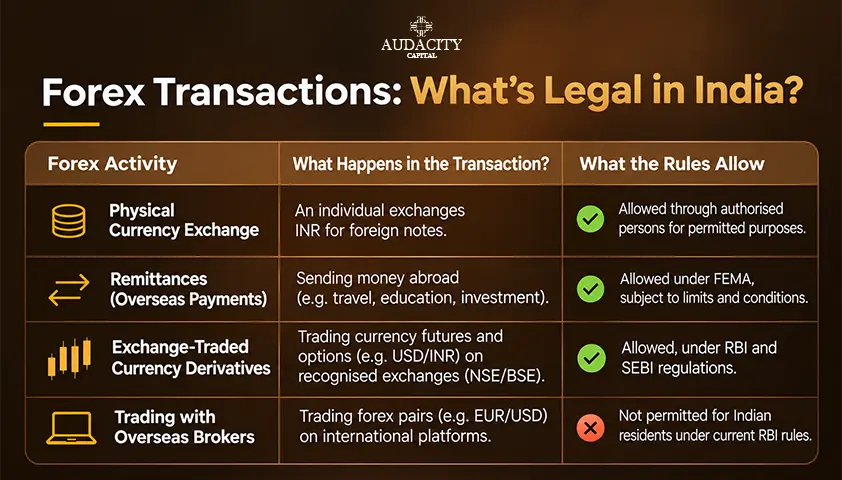
Not every forex transaction follows the same rules in India. The RBI makes a distinction between exchanging foreign currency for a permitted purpose and trading currency derivatives to manage exchange rate movements. The type of contract and the reason for entering it both matter.
Here is a look at the main types of forex transactions and their regulatory position.
Forex activity | What happens in the transaction? | What the rules allow |
Physical currency exchange | An individual exchanges INR for foreign notes. | Allowed through authorised persons for permitted purposes. |
Cash, tom and spot transactions | Foreign currency is bought or sold for settlement. | Allowed for eligible current and capital account transactions. |
INR-based futures and options | A trader enters into a derivative linked to a currency pair involving INR. | Allowed under the applicable RBI and exchange framework. |
Cross-currency derivatives | A trader takes a position on two foreign currencies. | Specific exchange-traded contracts are permitted under the relevant conditions. |
Offshore leveraged trading | A trader uses margin to speculate on currency price movements through an overseas platform. | Access to the platform does not establish permission under Indian regulations. |
Unauthorised online forex trading | A resident trades through an ETP without the required RBI authorisation. | Not permitted under the RBI framework. |
Can Indian residents trade cross-currency pairs?
Yes, but only through a SEBI-registered broker and on NSE, BSE and MSE. But Indian residents can’t trade cross-currency pairs through an offshore/international broker, as that route is prohibited under FEMA.
The RBI treats cross-currency pairs differently from derivatives involving INR.
Under its published guidance:
- FCY-INR derivatives can be undertaken for hedging exchange rate risk.
- FCY-FCY derivatives do not have a restriction in terms of purpose.
- Both remain subject to the applicable regulatory requirements.
Indian exchanges also offer specifically permitted cross-currency derivative contracts. This gives residents a regulated route to access certain international currency pairs without treating an overseas retail broker as an automatic alternative.
What Are the RBI Rules for Forex Trading in India?
The RBI does not allow residents to undertake foreign exchange transactions without considering the person providing the service and the purpose of the transaction. It has also laid down requirements for online platforms that offer forex trading facilities.
These rules are not limited to the broker's registration. They also apply to the actual transaction and the way traders execute and fund it.
The main requirements are:
- When doing forex transactions, only deal with an authorised person.
- Keep the transaction within the purposes permitted under FEMA.
- Use an RBI-authorised ETP or a recognised stock exchange for permitted electronic forex transactions.
- Follow the conditions applicable to the currency pair and derivative contract.
- Check the rules governing overseas remittances and trading margins.
- Don’t deposit money unless you verify the authorisation.
Are all online forex trading platforms legal in India?
No. The fact that a forex platform works in India does not mean it has permission to offer its services to Indian residents.
This is particularly relevant when dealing with international brokers. Some platforms advertise their services to Indian users and allow them to open accounts. They may also display licences issued by overseas financial regulators.
But these details do not answer whether the platform is authorised under India's foreign exchange framework.
For example, a broker might:
- Accept registrations from Indian residents.
- Display a foreign regulatory licence.
- Offer leveraged trading in major currency pairs.
- Accept deposits through international payment services.
None of these points alone establishes that the relevant forex transactions comply with FEMA.
The RBI requires residents to use authorised channels for permitted electronic forex transactions. Traders need to check the actual authorisation rather than assume that online availability is enough
What is the RBI-authorised ETP requirement?
An Electronic Trading Platform, or ETP, is the system you use to enter into transactions electronically, and it covers eligible financial instruments only. That’s why not every product you see online can be traded on one. This includes certain foreign exchange instruments and derivatives.
The RBI requires an entity operating an ETP in India to obtain prior authorisation. RBI’s Master Direction on Electronic Trading Platforms, 2025 covers the current framework.
This requirement matters because an ETP is not simply any website or application that displays currency prices. It is the platform through which eligible transactions are contracted.
What should you check before using a forex platform?
A trader commonly shuffles through a broker’s website, but that’s not enough. The table below walks through every required check:
Check | What to look for | What it tells you |
Company details | Legal name and registered entity | Who actually operates the service. |
RBI authorisation | Relevant authorised-person records | Whether the entity has the required permission to deal in forex. |
ETP status | RBI's authorised ETP records | Whether the platform has the required approval. |
Exchange records | Broker membership and registration | Whether the broker can offer exchange-traded derivatives. |
Contract details | Currency pair and product specifications | Whether the particular contract falls within the permitted framework. |
Payment arrangements | Applicable FEMA and LRS rules | Whether the proposed transfer or funding method is allowed. |
Can Indian Residents Trade Forex Through International Brokers?
An international forex broker may offer more currency pairs, trading instruments and account features than an Indian exchange-based broker. This is one reason some Indian traders look towards overseas platforms.
However, the availability of these features does not settle the legal position in India.
Indian residents must follow FEMA even when they use a website operated by a company outside the country because authorisation under Indian rules doesn’t mean a broker’s licence can substitute it.
Before using the service, check the following:
- Check the regulatory status of the broker and verify where it holds the licence.
- Find out about the Indian authorisation, if the entity has the required permission for the relevant activity involving Indian residents.
- Checkout if the funding methods follows LRS and FEMA requirements.
The distinction is between a broker being available to Indian customers and a transaction being permitted under Indian law. They are two different things.
Is trading EUR/USD through an international broker legal in India?
No, not through an international broker but yes, through an Indian exchange. Trading EUR/USD as a derivative in India, as a futures/options contract on NSE, BSE or MSE, is legal. But you can only trade them through a SEBI-registered broker. EUR/USD is one of the permitted cross-currency pairs along with many others like USD/JPY, GBP/ USD, EUR/INR, USD/INR, etc.
The RBI permits FCY-FCY derivatives without a restriction in terms of purpose. However, the transaction must still follow the applicable regulatory framework.
NOTE: Don’t use cross-currency permission as a reason to suppose that every EUR/USD overseas trading account is permitted. An eligible exchange-traded EUR/USD derivative and a leveraged retail forex contract by an overseas broker aren’t the same.
The platform, product and funding arrangements all need to meet the relevant requirements.
Can You Use LRS to Fund an Overseas Forex Trading Account?
The Liberalised Remittance Scheme allows resident individuals to send money abroad for permitted transactions. The general annual limit is USD 250,000 per financial year, subject to the conditions and restrictions under FEMA.
However, the scheme does not allow every type of overseas payment. The RBI specifically excludes remittances for margins and margin calls to overseas exchanges or overseas counterparties for online forex trading.
This is an important point because some traders confuse the overall LRS limit with permission to fund an overseas trading account.
The two are not the same.
Before making an overseas transfer, remember:
- LRS applies only to permitted current and capital account transactions.
- Margin payments for online forex trading through overseas exchanges or counterparties are not allowed under the scheme.
- A broker accepting international deposits does not make the payment permissible.
- Changing the payment route does not remove the underlying FEMA restrictions.
How to Check Whether a Forex Broker or Platform Is Authorised in India?
Checking the authenticity of a forex broker/ platform before opening an account should be non-negotiable. The platform may display its brand name and can still run the trading service under a different legal entity; thus, be alert.
- Find the legal entity: Check which company is providing the service by looking at the terms and conditions of the broker/ platform.
- Verify its authorisation: RBI's authorised-person information is very handy to cross-verify if the trading entity has permission to deal in forex.
- Check the trading platform: Search the RBI's authorised ETP records and check the activities covered by its approval.
- Search for warnings: Look up the entity in the RBI Alert List.
The Alert List is not complete. Absence from it does not prove that a broker or platform has RBI authorisation.
What Happens If You Trade Forex Through an Unauthorised Platform?
Using an unauthorised forex platform can put an Indian resident at risk of action under FEMA. The RBI does not permit residents to undertake forex transactions through unauthorised ETPs or for purposes outside the permitted framework.
Apart from regulatory consequences, traders may also face practical problems:
- Difficulty in recovering the deposited money.
- Delayed or refused withdrawals.
- No recognised route for dispute resolution.
- Payment providers or banks may question the transaction.
A platform's promises of easy withdrawals or customer support do not replace regulatory protection.
What Are the Penalties Under FEMA?
Section 13 of FEMA, 1999 provides for a penalty of up to three times the amount involved when the contravention is quantifiable. If the authority cannot quantify it, the penalty may reach ₹2 lakh. If the contravention continues, the penalty may add ₹5,000 per day after the first day. The authority determines the penalty through adjudication. It is not an automatic charge for every offshore trade.
What Changed in India's Forex Trading Rules in 2026?
In the 2026 forex trading rules of India, the RBI has made some changes to the foreign exchange framework during 2026. These involve new requirements for authorised persons and tighter conditions for certain INR-linked derivatives.
RBI's New October 2026 Restrictions
The RBI reduced the threshold on October 10, 2026. It now covers certain derivative transactions without establishing underlying exposure. It dropped from USD 100 million to USD 5 million equivalent. The change is applicable to exchange-traded currency derivatives and INR-related OTC contracts across recognised exchanges.
The RBI also stopped authorised dealers from allowing users to rebook INR-related derivative contracts that they had cancelled after the new directions. Contract rollovers at maturity remain permitted under the applicable conditions.
For hedging transactions, authorised dealers must also obtain an undertaking from users confirming that they have not hedged the same exposure with another dealer. These measures aim to improve discipline in the foreign exchange market.
Foreign Exchange Risk Reserve (FERR) Clarification
The RBI introduced a Foreign Exchange Risk Reserve for certain INR-related derivatives with a notional value exceeding USD 2 million equivalent. The requirement applies to specified current account hedges where the user purchases foreign currency against INR.
The rule is clear for authorised dealers. They maintain the reserve in cash with the RBI at 20% of the INR equivalent of the contract's notional value.
This is important to understand correctly. FERR is maintained by authorised dealers, not a general margin deposit that every individual trader must pay.
New Authorised-Person Regulations in 2026
The Reserve Bank of India also introduced the Foreign Exchange Management (Authorised Persons) Regulations, 2026 on April 30, 2026. The regulations were issued with the May 6 circular.
When we look at the new framework, we see who can apply for authorised-person status. We see the eligibility conditions. We see the different authorisation categories. And we see the activities each category can undertake.
The framework also introduces requirements relating to Forex Correspondents. For traders, the point is simple. Check current RBI records when you verify a forex service provider. Old authorisation information does not always reflect the current framework.
Is Forex Trading Legal in India for Beginners?
Forex rules are not separate for beginners and experienced traders. Whether it's your first trading account or you have traded for years, you still have to follow the same FEMA and RBI conditions.
But as a beginner, focus on these few points:
- Trading can be of many types, including spot forex, futures, options, or CFDs, so know what you are putting your money into.
- Verify the required authorisation of the broker and platform.
- Learn how your losses are affected by leverage and contract size.
- Never fall for guaranteed-profit claims.
- Before considering any unfamiliar overseas platform, learn about permitted exchange-traded products.
Conclusion: Is It Legal to Trade Forex in India?
Yes, Forex trading is legal in India as long as you follow the applicable FEMA and RBI rules. Before involving in this act, make sure you know the permitted transaction and are using only the authorised channels. Don’t fall for overseas brokers who accept Indian registrations but do not ensure their services comply with Indian regulations.
FAQs About Forex Trading Legality in India
Yes, forex trading is legal in India when the transaction is permitted under FEMA and conducted through authorised channels. Indian residents should not trade through unauthorised forex platforms.
Yes. Individual residents can undertake permitted forex transactions, subject to FEMA, RBI rules, applicable products and authorised channels.
Yes, permitted forex transactions can be conducted electronically through RBI-authorised ETPs or recognised stock exchanges, subject to applicable conditions.
An international broker accepting Indian customers does not automatically mean that its services are authorised for Indian residents. Traders need to verify the applicable RBI/FEMA requirements and the authorisation status of the relevant platform and entity.
EUR/USD is an FCY-FCY currency pair. RBI's framework distinguishes FCY-FCY derivatives from derivatives involving INR, but transactions must still be conducted through authorised channels and comply with the applicable rules.
RBI states that LRS cannot be used to remit margins or margin calls to overseas exchanges or overseas counterparties for online forex trading.
RBI's published material states that foreign-exchange CFDs are not permitted in India.
Yes. Recognised Indian exchanges can offer currency derivatives under the applicable RBI and SEBI framework. SEBI lists currency-derivatives segments for recognised exchanges including NSE, BSE and MSE.
Check the RBI's current lists of authorised persons and authorised ETPs. Do not rely solely on whether a platform appears on the RBI Alert List because RBI states that the Alert List is not exhaustive.
FEMA, or the Foreign Exchange Management Act, 1999, is a key part of India's legal framework governing foreign exchange transactions. It establishes restrictions and requirements around dealings in foreign exchange and authorised persons.

Ready to apply disciplined risk to crypto? Explore Audacity Capital's new crypto instruments and bring your trading strategy.
Learn MoreNewsletter
Join our newsletter to stay up to date on features and releases.
Join Our Social & Community

Start Your Journey Today With Our Free Trial
Proudly showcase your skills and accomplishments through certificates and get recognition for your hard work and dedication from potential investors and peers.
Free TrialRelated Articles

FX Options Trading: How It Works in Forex Markets?
FX options give you the right, not the obligation, to trade a currency pair at a set price by a set date. Learn how they work, who trades them, and the risks.


Best Forex Pairs to Trade: Top Currency Pairs Compared
Compare the best pairs to trade in forex based on liquidity, spreads, volatility and trading sessions, & learn how to choose the right pair for your strategy.
Best Forex Trading Sessions and Times for Funded Traders
Plan your Forex trading around the best time to trade forex globally. Get market data analysis for the time of the day with highest or most volatile trades

What Is Market Structure in Forex Trading?
Market structure in forex explained simply: swing highs and lows, BOS and ChoCh, support and resistance, plus how to read and trade it with discipline.