


Can You Hold Trades Overnight or Over the Weekend on a Prop Firm?


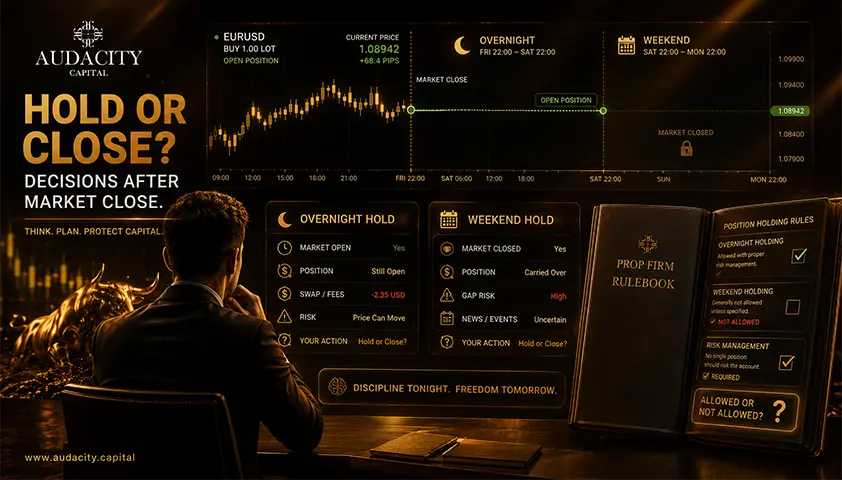
Can you hold trades overnight or over the weekend on a prop firm?
It depends on the firm, the account type, the stage of the evaluation, and the market being traded.
The most important rule is this: Do not hold a position solely because the company allows it. Hold only if the position can withstand the worst realistic gap before you are able to control it.
The simplest way to think about it is this.
Overnight holding is primarily time risk, and you can usually manage the position once liquidity returns. Weekend holding adds closed-market gap risk because the market can reopen with a gap before you can act.
Many prop firms operate on an intraday-only basis or restrict weekend holding to dedicated swing-trading accounts. Audacity Capital allows overnight and weekend holding on eligible programs, subject to the applicable trading rules. However, permission to hold positions overnight or over the weekend does not eliminate the associated risks. Here's a guide to the rules, the risks, the strategy, and where Audacity fits in.
Overnight vs Weekend Holding (What's the Difference?)
Overnight and weekend holding are often grouped together, but they involve different risks and are frequently governed by separate rules.
Overnight holding refers to keeping a position open beyond the end of the trading session and into the next trading day.
This is a time risk, as once the next session opens and normal liquidity returns, you may be able to control, manage, reduce, or unwind the position. The risk exists, but it can be mitigated.
Weekend holding means keeping a position open after Friday's market close until the market reopens, usually on Monday. Besides the time factor, weekend holding includes gap risk.
The market may open at a different price than it was closed, and there is nothing you can do about it until the new session begins. By then, the damage will already be done.
Remember that these two types of holding are often two separate permissions. A company may allow you to keep your trade overnight until the next weekday trading session, while requiring you to be flat before the weekend.
Who benefits from overnight and weekend holding?
Swing and position traders. If your edge is based on 4-hour, daily or weekly charts, you will not be able to flatten every Friday afternoon without losing the strategy. For these traders, the holding policy is not a detail. It is a deciding factor.
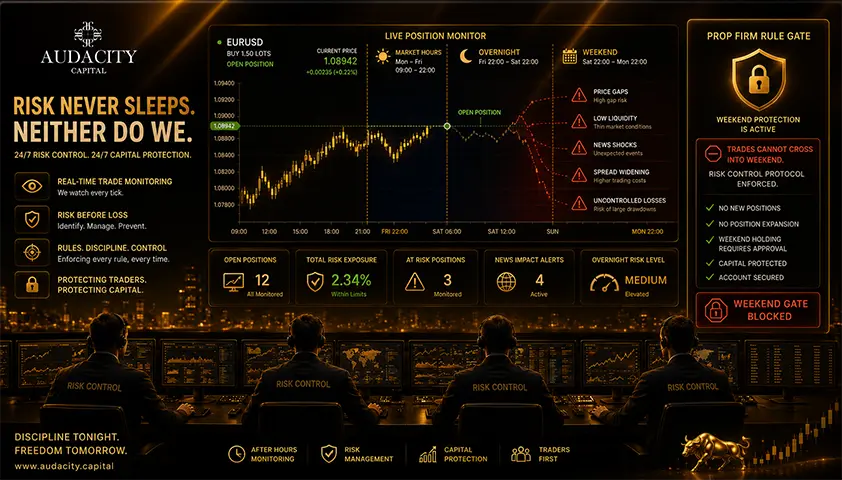
Why Many Prop Firms Restrict Overnight and Weekend Holding
The key factor is “gap risk”.
If the market is closed, the trader is sleeping, or simply can't make a move. You are not able to exit, shrink, or move a stop, hedge or act on breaking news.
A weekend extends that exposure across two days when major catalysts tend to be released: geopolitical escalation, sanctions, central-bank surprises, natural disasters.
These are unhedgeable gaps. If the price moves up over the weekend, your stop will not save you, as there is not enough liquidity for it to trade at your price.
In addition there's the firm's exposure. When many traders are holding leveraged positions in the same direction in a closed market, the firm is at risk as well.
In the simulated model scenario, it's a real liability. Many companies will not allow exposure at the weekend, or will only allow it with more stringent drawdown rules.
This is a legitimate gap-risk decision, and not firms being unfair. Consider holding policy as a spectrum of freedom, rather than good firms versus bad firms.
The Risks of Holding Overnight and Over the Weekend
This is where holding positions becomes dangerous. If you are trading multi-day positions you must take all of the following into account.
1. Gap risk.
Price can open far from the prior close, jumping straight past your stop. It is unhedgeable, you can't move when the market is closed and weekend gap moves are the worst of it.
For instance, the typical weekly gap for EUR/USD is approximately 10-20 pips, while geopolitical events can cause gaps of 50-100+ pips several times a year. Exotics are a whole lot worse.
Index futures such as the ES often experience opening gaps of 10 to 30 points at the Sunday open, and 50 to 100+ on high-impact weekend times. Cryptocurrencies can move 5–10% in a single day. The above examples are representative and are subject to change depending on company, broker and instrument.
2. The daily-loss-breach mechanic.
This is the one which surprises funded traders. Even if you don't make any fresh trades, a weekend gap can cause a daily downside breach at Monday's open.
The position you carried over the weekend will reopen at a worse price and the loss will be marked, and the daily loss limit will be breached. The account fails although you did have the option of holding, since your stop never had the chance to protect you against a gap.
3. Trailing drawdown.
A trailing or an end-of-day drawdown will follow your account upwards and will close the loss floor when you make a profit. This will slowly reduce the room for multi-day swings. A static drawdown, which keeps the floor fixed, absorbs gap risk much better.
4. Swap and rollover.
Swap fees are fees incurred for holding a position over the daily rollover. Swap is typically tripled on Wednesdays and is compounded during long weekends and it can get very negative on exotics. Some companies will also treat your swap as a loss or drawdown and this will gradually reduce your buffer.
5. Margin.
Some firms will have requirements for full initial margin for weekend holds, which will reduce your buying power by 80-90% while the market is closed.
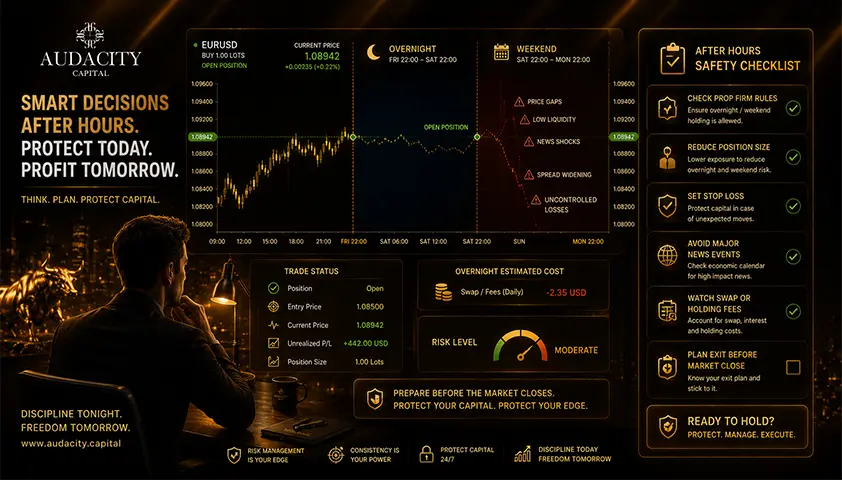
How to Hold Overnight and Over the Weekend Responsibly
Taking multi-day positions is a skill, and NOT a gamble on a quiet market. The following is the responsible playbook, based on the following principle: Hold when the position can survive the worst realistic gap before you can manage it.
1. Read your firm's specific rule first.
Overnight and weekend usually are different permissions. Be aware of the cutoff, account type, and stage (if swing account and add-on is needed), and check the terms. Holding on an intraday-only account is an instant violation.
2. Use the basic principle.
Do not hold because the firm allows it. Hold only when a realistic gap cannot breach your risk limits.
3. Minimize position size for weekends.
Implement wider stops and consequently smaller lots. Avoid holding a weekend position where a realistic gap, along with your daily loss limit, would breach the account. Don't hold intraday positions over multiple days.
4. Be aware of your drawdown type and reset.
A static drawdown will provide better protection against gaps than a trailing drawdown. Know the exact time when the daily loss limit resets, based on the weekend.
5. Account for swap.
Consider overnight swap, triple-swap Wednesdays, weekend swap, and see if it counts toward your drawdown.
6. Minimize or close before high risk weekends.
Gap risk increases when there are major scheduled events. Take partial profits and/or flatten when the calendar is dire.
7. Avoid holding maximum size over a weekend.
An oversized weekend position is a true gap risk bet, and it's exactly how funded accounts lose on a Monday open.
Weekend-holding checklist
The sizing for the worst gap is not a sure trade maker, it is a risk reduction. It simply keeps a single weekend from ending your account.
Overnight and Weekend Holding at Audacity Capital
Audacity Capital allows overnight and weekend holding, something many firms restrict by staying intraday-only or by gating it behind a swing account or paid add-on, often with reduced leverage.
That means swing and position traders can run multi-session strategies without flattening every Friday and without buying a separate add-on to do it.
And the candor matters just as much as the freedom. Allowing it does not remove the gap risk.
Audacity's daily loss limit and max drawdown still apply, so a weekend gap can still breach them at Monday's open. The responsible move is to size for the worst gap, not the best case.
The rule gives you room. Your risk management keeps you in the game.
There is a secondary advantage too. With no consistency rule, a single large multi-day winner will not create the payout-gating problem that some firms impose.
A strong swing trade that runs over several sessions is simply a strong trade, not a flag against your profit share.
Please verify Audacity's exact overnight and weekend policy on the live site, including how it applies across the Ability Challenge, Ability One, and the Funded Trader Program, any margin or leverage adjustments, swap treatment, cutoff times, and whether the max drawdown is static or trailing.
Terms change, and your account should be built on the current rules. A funded account is capital and structure. It is not an edge.
The edge is still yours to build through discipline. If you trade multi-day setups, see how Audacity's rules support swing and position trading, then put your strategy through an evaluation route that fits how you actually trade.
Related Articles
Prop Firms That Allow Weekend Holding
FAQ
Some firms allow it, many do not, and others gate it behind a swing account. Futures-focused firms are often intraday-only. Always check your firm's exact rule for your specific account type and stage before carrying a position into the weekend.
Usually yes. Holding past the daily rollover incurs swap or rollover fees, which are often tripled on Wednesdays and multiplied over long weekends. At some firms, swap can also count toward your drawdown, so factor it into your buffer.
The breach is typically marked at Monday's open and can fail the account even though holding was allowed and you placed no new trade. The daily loss limit still applies to a carried position, and your stop cannot protect you against a gap.
It depends on the firm and the account type. Some allow it in both evaluation and funded stages, while others restrict certain accounts or stages. Verify the current terms before holding any position through a session reset.
At many firms, yes. Overnight and weekend holding, often bundled with news trading, is unlocked only via a swing account or paid add-on, frequently with reduced leverage. Some firms, including Audacity Capital, allow it on standard accounts instead.
Yes. Audacity allows overnight and weekend holding, which many firms restrict. The daily loss limit and max drawdown still apply, so size for gap risk rather than the best case, and verify the current policy on the live site.
A static drawdown keeps the loss floor fixed at the starting balance, which is more predictable for multi-day holds. A trailing drawdown tightens the room as your account grows, which compounds your weekend gap exposure over time.
Size down so a realistic gap cannot breach your limits, take partial profit or reduce exposure before high-risk weekends, and never hold maximum size into a closed market. The goal is to make any single gap survivable.

Ready to apply disciplined risk to crypto? Explore Audacity Capital's new crypto instruments and bring your trading strategy.
Learn MoreNewsletter
Join our newsletter to stay up to date on features and releases.
Join Our Social & Community

Start Your Journey Today With Our Free Trial
Proudly showcase your skills and accomplishments through certificates and get recognition for your hard work and dedication from potential investors and peers.
Free TrialRelated Articles

Are Funded Accounts Legit? An Honest, Balanced Answer
Some funded account firms are real, some are scams. Find out if funded accounts are legit, how to spot a payout-denying firm, and what to check before you pay.

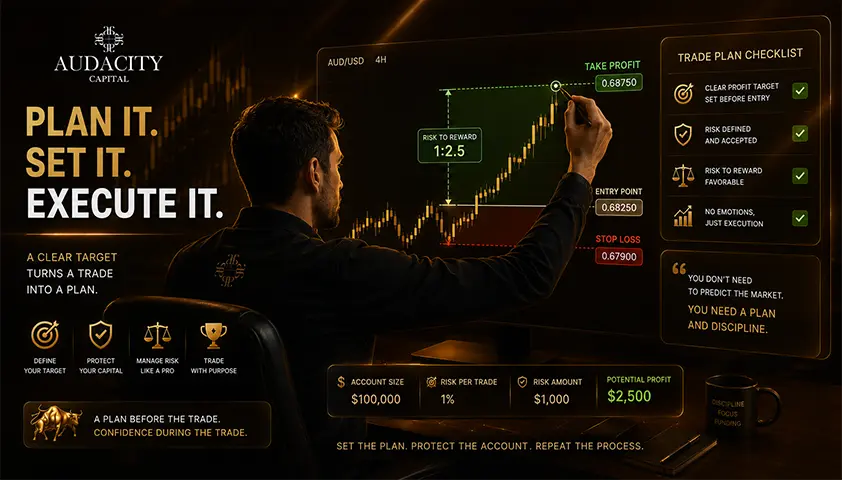
What Is Take Profit in Trading? A Detailed Guide for Traders
Learn what a take profit is, how to set one well using technical levels, risk-reward, and ATR, plus partial profits, trailing stops, and a funded-trader lens.

Best Local Payment Methods for Forex Prop Trading
Compare the best local payment methods for forex prop trading by region and learn faster, cheaper prop firm withdrawals with fewer delays.

Instant Funding vs the Challenge: Which Funded Account Should You Choose?
Two routes to a funded account, one honest comparison. See how instant funding vs challenge differ on cost, drawdown, and profit split, and which route fits you.