



The Correlation of Oil and Forex: How Crude Moves Currencies



KEY TAKEAWAYS
|
Crude oil and the currency market can look like separate worlds, but they are tied together more tightly than most new traders realize. When oil makes a big move, it ripples through the currencies of the countries that produce it and the ones that depend on importing it. That connection is what traders call the oil and forex correlation, and it can be a genuinely useful piece of context for reading the currency market.
This guide explains why the two are linked, which currency pairs react most, and, just as important, when the relationship breaks down. Because a correlation you trust blindly is far more dangerous than one you actually understand.
What Is the Oil and Forex Correlation?
At its simplest, it describes how crude oil prices and certain currencies tend to move in relation to one another. Correlation is measured on a scale from -1 to +1. A reading near +1 means two markets move in the same direction; near -1 means they move in opposite directions; and around 0 means there is no reliable relationship between them.
Oil does not correlate with every currency. The oil and forex correlation is strongest for commodity currencies, the currencies of nations whose economies lean heavily on exporting natural resources, and for the currencies of major oil importers, which feel the same effect in reverse. The rest of this guide is really about who sits on each side of that line, and why.
Why Oil and Currencies Move Together
Three forces drive the oil forex correlation:
- Oil is priced in US dollars. Almost all crude trades and settles in dollars worldwide, a legacy often called the petrodollar system. Because every barrel is bought with dollars, oil demand and the dollar are constantly interacting.
- Exporters earn on every barrel. When a country sells a lot of oil abroad, higher crude prices mean more money flowing in, which strengthens its trade balance and lifts demand for its currency. Lower prices do the reverse.
- Importers pay the bill. For countries that import most of their oil, a rising crude price is a rising cost. It widens the trade deficit and stokes inflation, both of which tend to weigh on the currency.
So the same oil move can push two currencies in opposite directions, depending on whether the economy behind each one sells oil or buys it.
USD/CAD and Oil: The Headline Relationship
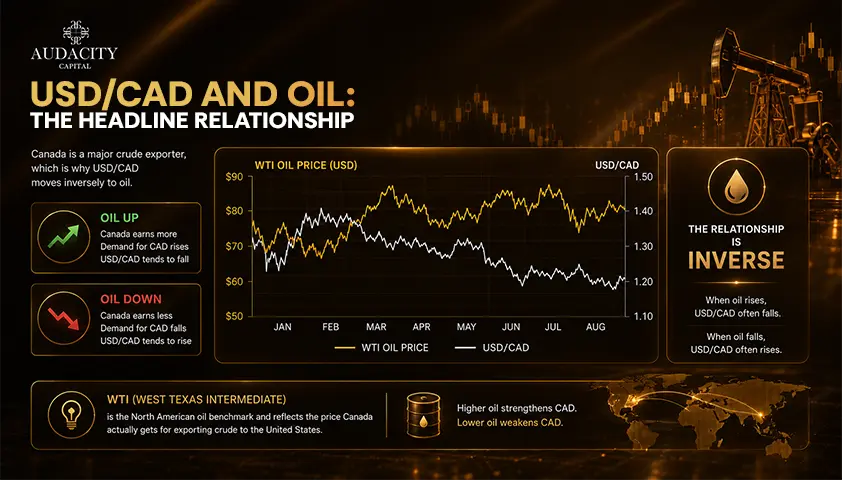
If there is one pair every trader ties to oil, it is USD/CAD. Canada is one of the world's largest crude exporters, so much of what it earns abroad depends on the oil price, which is why markets treat the Canadian dollar as a petro-currency.
The relationship is inverse. When oil rises, Canada earns more, demand for the Canadian dollar tends to increase, and because the US dollar is the base currency, USD/CAD falls (a stronger loonie). When oil drops, the pair usually rises. Historically this has been one of the tighter commodity-currency links in the market, with the correlation often cited in the region of 0.7 to 0.8 in strength, though it varies with conditions and is never fixed.
There is a benchmark detail worth knowing. West Texas Intermediate (WTI) is the North American oil benchmark and reflects the price Canada actually gets for exporting crude to the United States, so WTI tends to track the USD/CAD relationship more closely than the global Brent benchmark.
A simple example: if WTI rallies from around $70 to $85 on a supply cut, Canada earns more per barrel, the loonie tends to firm, and USD/CAD often drifts lower. If oil then reverses on demand worries, the move typically unwinds. The pair does not track every barrel tick for tick, but when oil makes a sustained move, the directional pull is usually there.
Which Currencies Are Most Sensitive to Oil?
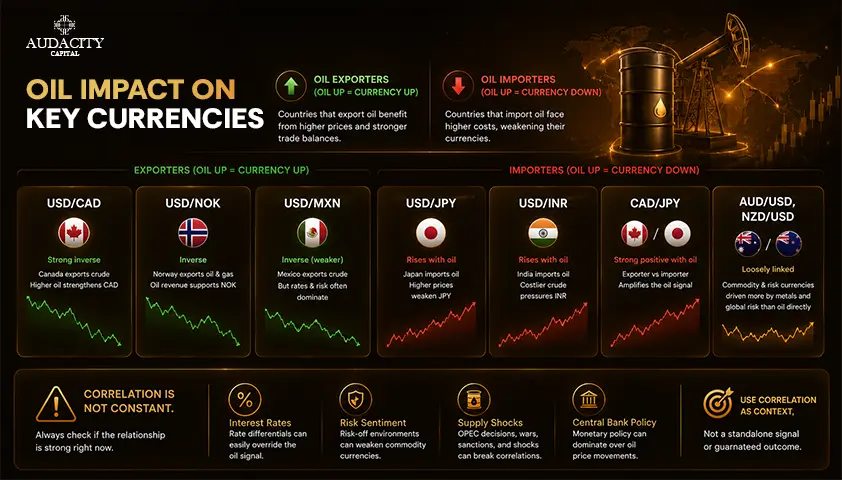
Beyond USD/CAD, several currencies carry an oil signal. Exporters tend to strengthen with oil; importers tend to weaken. This table sums up the usual relationships, though every one of them shifts over time:
Currency / pair | Typical link to oil | Why |
|---|---|---|
USD/CAD | Strong inverse | Canada is a major crude exporter; higher oil lifts the loonie, pulling USD/CAD down |
USD/NOK | Inverse | Norway is a large oil and gas exporter; oil revenue supports the krone |
USD/MXN | Inverse (weaker) | Mexico exports crude, but rate differentials and risk flows often dominate the peso |
USD/RUB | Historically inverse | Russia is a major exporter, but sanctions since 2022 make the pair largely untradeable in retail forex |
USD/JPY | Rises with oil | Japan imports nearly all its oil; higher prices widen its trade deficit and weigh on the yen |
USD/INR | Rises with oil | India is a large net oil importer; costlier crude pressures the rupee |
CAD/JPY | Strong positive with oil | Pairs an exporter (CAD) against an importer (JPY), amplifying the oil signal |
AUD/USD, NZD/USD | Loosely linked | Commodity and risk currencies driven more by metals and global risk than oil directly |
One note on the Russian ruble: it has historically moved with oil, but sanctions imposed since 2022 have made USD/RUB effectively untradeable on most retail platforms, so it is now more a textbook example than a practical trade. The Australian and New Zealand dollars are often grouped with oil, but they respond more to metals, dairy, and overall risk appetite than to crude specifically.
Oil and the US Dollar
There is also a direct, if looser, relationship between oil and the dollar itself, and it usually runs inverse. Because oil is priced in dollars, a stronger dollar makes crude more expensive for buyers using other currencies, which can dampen demand and weigh on the price. A weaker dollar tends to support it.
This link is less reliable than the USD/CAD one, and it has been complicated by the rise of US shale production. The United States was long thought of as a net oil importer, but its own output has grown enough to blur that picture, which in turn muddies the old assumption that higher oil automatically weakens the dollar. Treat the oil-dollar relationship as background context, not a hard rule.
Why the Oil and Forex Correlation Is Not Constant
Here is the part that quietly costs traders money: this relationship is not permanent. It strengthens in some periods and breaks down completely in others, because oil is never the only thing moving a currency. Several forces regularly override the oil and forex correlation:
- Interest rate differentials. If the central banks behind a pair are moving in different directions, rate expectations can easily swamp the oil signal.
- Risk sentiment. In a broad risk-off event, traders sell higher-risk currencies and buy safe havens regardless of where oil is trading.
- Oil-specific shocks. OPEC and its allies can move the crude price on policy alone, and rare dislocations, like the April 2020 session when a US oil contract briefly traded below zero, or the 2022 spike around the war in Ukraine, can scramble normal relationships entirely.
The practical lesson is to check whether the correlation is actually strong right now before you lean on it. Assuming a relationship holds when it has quietly broken down is one of the faster ways to take an avoidable loss.
How Traders Use the Oil and Forex Correlation
Used well, this relationship is a context tool, not a trading signal on its own. A few sensible ways traders apply the oil and forex correlation:
- As confirmation, not a trigger. A bearish move in oil might add weight to a bullish USD/CAD view you already hold on rate or technical grounds. It is one input among several.
- To avoid doubling up risk. Being long CAD and short oil at the same time is often the same bet twice. If the correlation holds and the trade goes wrong, both positions lose together, so knowing the relationship helps you spot hidden concentration.
- To manage risk properly. If you enter a USD/CAD trade because oil moved, your stop should account for how volatile oil is, not just the currency chart. When both markets are choppy, position size needs to reflect that.
Correlation is context that sharpens your read of the market. It is not an edge by itself, and it does not replace a plan, a stop, and sound risk management.
Where Audacity Capital Fits
You do not need a commodities account to trade the theme. The most direct way retail traders take a view on oil is through the currencies that move with it, and pairs like USD/CAD sit right in the mainstream of the forex market.
Audacity Capital is a proprietary trading firm, not a broker. We provide simulated funded accounts on MT5 and DXTrade, with a profit share of up to 90%, so traders can apply strategies like these at meaningful size without risking their own capital on every position. Understanding the oil and forex correlation can sharpen your analysis, but it is context, not a shortcut. A funded account gives you capital and structure, not an edge, and most retail traders lose money, so disciplined risk management still does the heavy lifting. If you want to put your process to the test, explore the Audacity Capital Funded Trader Program or enter our free funded account challenge.
Conclusion
Oil and currencies are linked through the dollar, through trade balances, and through the simple fact that some economies live or die on the price of crude. The oil and forex correlation is real and worth watching, especially in USD/CAD, but it is a relationship that bends and sometimes breaks. Read it as context, respect the moments it stops working, and it becomes a genuinely useful part of your analysis.
Frequently Asked Questions
Because Canada is one of the world's largest crude exporters, so a big share of its export income depends on the oil price. When oil rises, Canada earns more and the currency tends to strengthen, which is why the Canadian dollar moves closely enough with crude to earn the nickname.
Not the physical commodity itself, but you can take a view on oil through currency pairs that track it, most commonly USD/CAD. Many trading platforms, including MT5 and DXTrade, also offer crude oil as a contract for difference, which lets traders position on the price without handling barrels.
For the USD/CAD relationship, WTI is usually the more relevant benchmark, since it reflects the price Canada receives for exporting crude to the United States. Brent is the global reference point and matters more for international and European pricing. Many traders keep an eye on both to judge whether a move is local or worldwide.
Both are commodity links, but they run through different economies. Oil most affects exporters like Canada and Norway and importers like Japan and India. Gold has a stronger pull on currencies like the Australian dollar, since Australia is a major gold producer. A currency's commodity sensitivity depends on what its economy actually sells.
Not always. There is a tendency for a stronger dollar to weigh on oil, because crude is priced in dollars and becomes more expensive for other buyers, but it is a leaning, not a rule. Interest rates, supply decisions, and the growth of US oil production can all override it in any given period.
Indirectly, yes. OPEC and its allies influence the oil price through production decisions, and that price feeds straight into commodity currencies like the Canadian dollar and Norwegian krone. So an OPEC supply cut or increase can ripple into forex even though OPEC has nothing to do with currencies directly.
No. Oil is one influence, but commodity currencies also respond to other exports, such as metals and agricultural goods, as well as interest rate expectations and global risk appetite. Oil is often just the most visible driver, not the only one.

Trade with real capital. No guesswork—just a clear path to becoming a funded trader.
Start Your Trading Journey
Bereit, diszipliniertes Risiko auf Krypto anzuwenden? Entdecken Sie die neuen Krypto-Instrumente von Audacity Capital und bringen Sie Ihre Trading-Strategie mit.
Mehr erfahrenNewsletter
Treten Sie unserem Newsletter bei, um auf dem Laufenden zu bleiben.
Treten Sie unserer sozialen Gemeinschaft bei

Beginnen Sie Ihre Reise heute Mit unserer kostenlosen Testversion
Präsentieren Sie stolz Ihre Fähigkeiten und Leistungen durch Zertifikate und erhalten Sie Anerkennung für Ihre harte Arbeit und Ihr Engagement von potenziellen Investoren und Kollegen.
Kostenlose TestversionVerwandte Artikel

Prop Firms With No Minimum Trading Days
Prop firms with no minimum trading days compared, with evaluation rules, payout conditions and who each one suits.


Averaging Down: Explained
What averaging down does to your breakeven and your exposure, the one question that settles whether to do it, and why leverage changes the answer entirely.

Micro Futures Contracts Explained
What micro futures contracts are, why a smaller size does not mean lower risk, the margin trap that catches small accounts, and what they actually cost.

Liquidity Sweeps Explained: How to Identify and Trade Them
Learn what a liquidity sweep is, how to identify bullish and bearish sweeps, spot sweeps vs breakouts, and use price action and market structure for confirmation.