


Prop Firm vs Broker: Which One Is Better for Traders in 2026?



Ask a room of traders whether a prop firm vs broker is the smarter route, and you will get two confident, opposite answers.
Honestly they are different tools, not rivals, and neither is universally better. Which one fits you depends on your capital, your goals, your experience, and your discipline.
This guide gives you the even-handed comparison that most pages skip.
We will define each model, show how each actually makes money, put them side by side, and lay out the honest pros and cons of both, including the real downsides of the prop model.
Understanding the difference between a prop firm and a broker is the fastest way to decide which one suits you in 2026.
Who is a Broker?
A broker is a company that gives you access to the market so you can trade your own money.
When you open an account with a forex broker, you deposit your capital, place your trades, and keep 100% of your profits and losses, minus fees.
The account is yours. The gains are yours. The risk is entirely yours too.
That is the core of trading with a broker: full control and full responsibility. You decide your position sizes, your strategy, and your risk. Nobody imposes rules on you beyond regulatory limits, and nobody shares your profit.
But if the trade goes against you, that loss comes straight out of your own trading capital.
A few basic terms help here.
- The spread is the small gap between the buy and sell price, and it is one way the broker gets paid.
- Commissions are a fixed charge per trade on some account types.
- Leverage lets you control a larger position than your deposit alone, which magnifies both gains and losses.
Together, spreads and commissions are the everyday cost of trading through a broker.
How do brokers make money?
Brokers earn from three main sources: spreads, commissions, and swaps, which are the overnight financing costs on positions held past the daily rollover.
The important point is that their revenue is tied to your trading volume and to keeping you as a long-term client, not to whether you personally win or lose.
There are two ways a forex broker can handle your orders, and both are legal and common.
- In the A-book model, the broker passes your trade through to liquidity providers in the wider market and earns the spread or commission on the way.
- In the B-book model, the broker takes the other side of your trade internally rather than routing it out.
B-books are not a conspiracy. It is a standard, widely used practice, especially for smaller retail orders.
It can create a conflict of interest, because in that structure the broker profits when you lose, but well-regulated brokers manage that tension through oversight, hedging, and disclosure requirements.
Understanding these incentives simply helps you read the model clearly, without fear.
What is a Prop Firm?
A proprietary trading firm, or prop firm, takes a different approach. Instead of trading your own money, you trade the firm's capital after passing an evaluation.
In return, you keep a share of the profits, known as your profit split, and you trade under a defined set of risk rules. You are a performance partner, not a client, and your financial risk is the fee you pay to attempt the evaluation, not a large capital deposit.
A few terms matter here.
- An evaluation, sometimes called a challenge, is a test where you must hit a profit target while respecting risk limits.
- The profit split is your cut of the profits you generate, often the majority.
- Drawdown is the maximum loss you are allowed before the account is breached.
And here is the point most pages bury: in the standard model today, the capital is simulated.
Your payouts are real money, but you are not trading the firm's live funds. You are proving your skill on a simulated funded account, and the firm pays you from its own revenue based on your results.
Be clear-eyed about this from the start: the capital is usually simulated, and most people who attempt an evaluation or challenge do not pass it. We will cover exactly how honest those numbers are in the cons section.
How do Prop Firms Make Money?
The prop firm business model is straightforward once you see it. Firms earn from two main sources: the evaluation and challenge fees traders pay to attempt funding, plus a cut of the profits successful traders generate.
Some firms also earn from spread markups or optional add-ons.
Here is the honest part. A large share of a proprietary trading firm's revenue comes from fee income paid by the many traders who never pass the evaluation.
That is not automatically a bad thing, and it does not make the model illegitimate. But it explains why rules and pass rates matter so much, and why the fee is the firm's core revenue engine rather than a token deposit.
For this comparison, the key takeaway is simple: fees are central to the model, so the firm's transparency about its rules is something you should weigh carefully.
Prop firm vs broker: a side-by-side comparison

Let’s look at the differences in a clean side-by-side view.
The headline difference is capital and risk: with a broker you trade your own money and bear the full risk, while with a prop firm you trade the firm's capital for a fee and share the profit. The rest follows from that single distinction.
Feature | Broker | Prop firm |
Whose capital | Yours | The firm's (usually simulated) |
Up-front cost | Fund your own account | Pay an evaluation fee |
Ongoing cost | Spreads, commissions, swaps | Profit split, plus any re-attempt fees |
Who absorbs losses | You, in full | The firm, within its rules |
Profit kept | 100% minus fees | Your profit split |
Account size available | Limited by your own capital | Larger firm capital for a fee |
Rules and restrictions | Few beyond regulation | Drawdown limits and trading rules |
Control and freedom | Full | Rule-bound |
Regulation | Regulated financial institution | Usually an unregulated private service |
Best for | Capitalized, self-disciplined traders | Skilled but under-capitalized traders |
Pros and Cons of Trading with a Broker
The broker route is a path with some great advantages. But it also carries real limitations.
Pros
- Full control and freedom over your strategy, sizing, and risk.
- You keep 100% of your profits, minus fees.
- Your capital is genuinely yours and you can withdraw it whenever you like.
- Real live execution in the market.
- The protection of a regulated financial institution, with the investor safeguards that come with it.
Cons
- You need your own capital, and meaningful income requires meaningful trading capital. Small accounts produce small returns, even for good traders.
- You bear 100% of your losses. There is no cap and no safety net.
- There is no imposed structure or discipline. You have to build that yourself.
- The honest reality: most retail traders lose money over time. Spreads and commissions, leverage, and emotional decisions all work against the undisciplined.
Pros and Cons of Trading with a Prop Firm
The prop model can be a genuine opportunity, but only if you go in understanding these trade-offs clearly.
Pros
- Access to larger capital for a small fee, which lets a skilled trader operate at a size their own savings could not reach.
- Limited financial downside. You risk the evaluation fee, not a large deposit.
- Imposed structure and discipline. The risk rules force habits that many traders struggle to enforce alone.
- A potentially generous profit split, often weighted heavily in your favor.
- A path to scaling, where consistent results can unlock larger allocations over time.
Cons
- Drawdown caps sharply reduce your usable capital. This is the single biggest knock on the model. A $100,000 funded trading account with a 10% maximum drawdown gives you roughly $10,000 of real working room before you breach.
- Most evaluations are never passed. In one widely cited dataset of around 300,000 accounts, roughly 14% of traders pass an evaluation and only about 7% ever receive a payout..
- The capital is simulated in most models. Your payouts are real, but you are proving skill on a simulated funded account, not deploying the firm's live money.
- Re-attempt fees add up. Each failed evaluation or challenge is another cost.
- The rules restrict your freedom. Position limits, daily loss caps, and drawdown thresholds all constrain how you trade.
- You share your profit. Even a strong split still means giving up a slice of what you earn.
Which is Better for You in 2026?
By now you have understood that there is no universal winner in this comparison. Use this framework to match the model to your situation.
Choose a broker if:
- You already have sufficient trading capital to earn meaningfully.
- You want full control and to keep 100% of your profits.
- You value genuine ownership of your capital and the ability to withdraw it freely.
- You are self-disciplined and do not need imposed risk rules to trade well.
Choose a prop firm if:
- Your capital is limited and cannot support the size you want to trade.
- You are a skilled but under-capitalized trader who needs scale.
- You want imposed structure and discipline built into your trading.
- You want limited downside, risking a fee rather than a large deposit.
- You want a path to scale through a firm rather than years of slow account growth.
Can You Use Both a Prop Firm and a Broker?

Yes, and many traders do. The logic is diversification.
You can run a broker account with your own capital for long-term positions and full ownership, and use a prop firm for extra scale without risking your own money.
One gives you control, the other gives you reach. Used together, they cover different needs.
The caveat: Do not use multiple accounts or cross-firm hedging to try to guarantee a pass or game the rules. Opening opposing positions across firms to manufacture a guaranteed result violates prop-firm terms and gets accounts banned.
The value in combining prop trading vs broker trading comes from trading each account honestly, on its own merits, not from trying to engineer a loophole.
What to Look for If You Choose the Prop Firm Route
If you decide the prop route fits you, the firm you pick matters as much as your trading. Here is what to prioritize:
1. Transparent, published rules.
The full terms should be visible before you pay, with no hidden clauses that only surface after you fund.
2. A static rather than trailing drawdown.
This is the honest edge. Since drawdown caps are the prop model's biggest limitation, a fixed, visible floor is more forgiving than one that trails your account's peak and quietly tightens as you profit.
3. A reasonable profit split and proven payouts you can actually verify.
4. A way to try the model before you pay, so you can test the fit at no risk.
How Audacity Capital Fits in Your Decision
Audacity Capital, a proprietary trading firm founded in London in 2012, is built around exactly these principles.
It offers forex and CFD trading on MT5 and DXTrade, and three routes to suit different traders: the two-step Ability Challenge, the one-step Ability One, and the instant Funded Trader Program.
It uses a fixed static drawdown, and it runs a free monthly competition so you can test the model at no cost.
If a prop firm is right for you, choose a transparent one. You can explore our Funded Trader Program and the free trading competition to see how the model works before committing.
Note that the competition prize is a free funded challenge account that you still have to pass, not instant live funding.
FAQ
No. A broker gives you market access to trade your own money, while a prop firm gives you access to its capital after an evaluation, under rules, in exchange for a profit split. They are genuinely different models, though a prop firm often routes its trades through a broker or liquidity provider behind the scenes.
No. The prop firm provides the platform and the capital, which is usually simulated, so you do not open your own brokerage account. The firm handles the market connection itself.
In the standard model, no. Your financial downside is the evaluation or account fee. You do not owe the firm trading losses on simulated capital, which is different from a broker, where you can lose the capital you deposit.
Because the prop firm is providing the capital and carrying the risk, so it caps drawdown to protect itself. A broker does not need drawdown limits because you are risking your own money rather than theirs.
Often not. Tax treatment varies by country and by how the money is classified. Broker profits may be treated as capital gains in some places, while prop payouts are frequently treated as ordinary income.
Generally no. Brokers are regulated financial institutions, while most prop firms operate as private companies offering a skill assessment and funding service on simulated capital. That is exactly why vetting a firm's transparency and payout record matters so much.

Bereit, diszipliniertes Risiko auf Krypto anzuwenden? Entdecken Sie die neuen Krypto-Instrumente von Audacity Capital und bringen Sie Ihre Trading-Strategie mit.
Mehr erfahrenNewsletter
Treten Sie unserem Newsletter bei, um auf dem Laufenden zu bleiben.
Treten Sie unserer sozialen Gemeinschaft bei

Beginnen Sie Ihre Reise heute Mit unserer kostenlosen Testversion
Präsentieren Sie stolz Ihre Fähigkeiten und Leistungen durch Zertifikate und erhalten Sie Anerkennung für Ihre harte Arbeit und Ihr Engagement von potenziellen Investoren und Kollegen.
Kostenlose TestversionVerwandte Artikel
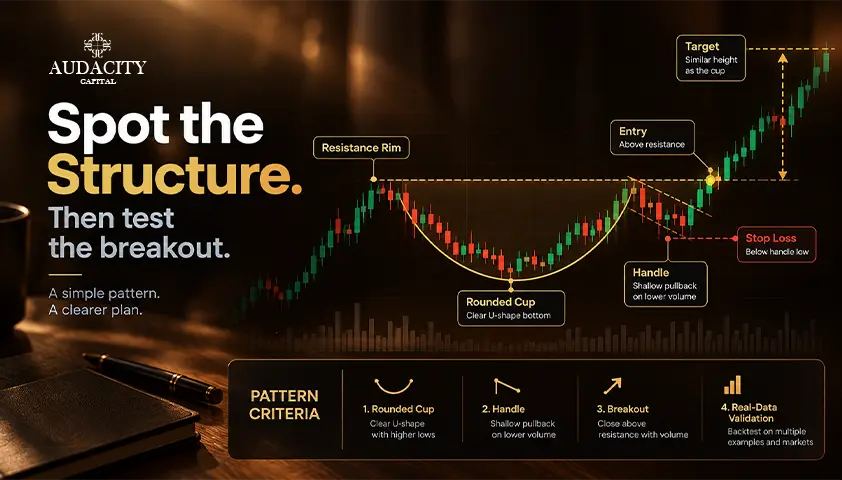
Cup and Handle Pattern: Criteria, Entry and Real Data
The cup and handle pattern explained: the criteria sources disagree on, how to trade it, and what the performance data actually says.


Spinning Top Candlestick Pattern: Meaning, Formation & How to Trade
Learn what the spinning top candlestick pattern means, how it forms, bullish and bearish setups, confirmation signals, trading strategies, examples, and risks.

Trade Deficit Explained: Causes, Effects and Markets
What a trade deficit is, what actually causes it, why it can widen in a strong economy, and why the textbook currency rule often fails.
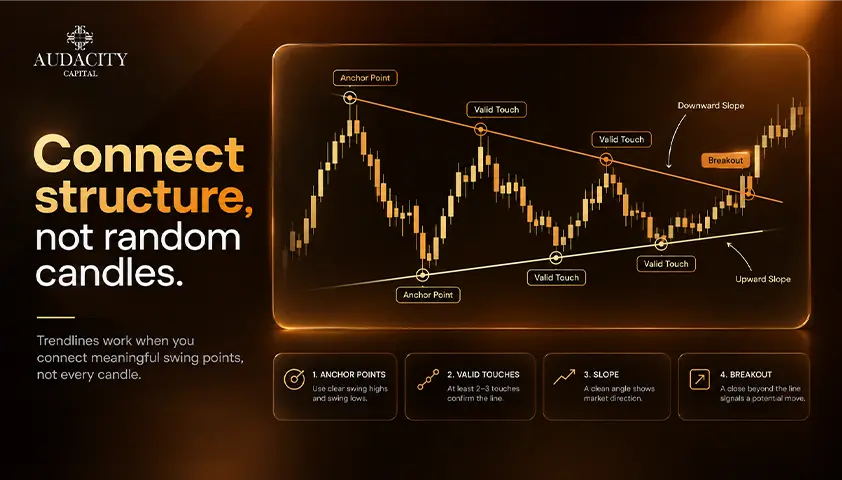
How to Draw Trend Lines
How to draw trend lines step by step, whether to use wicks or bodies, when a line is valid, and when to redraw versus accept a break.