


What Are Pips in Forex Trading? How Pip Value and Price Movement Work


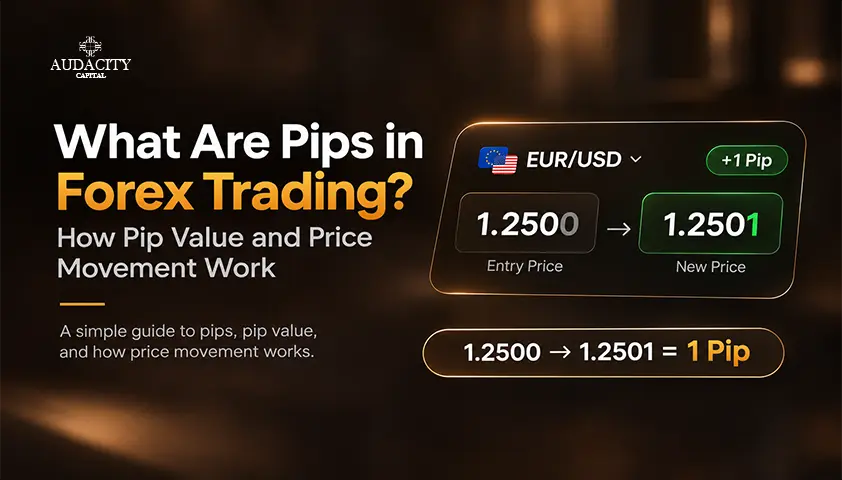
A pip is just the smallest standard move in a currency pair. Traders use it because forex prices rarely move in big jumps, so they need a simple way to measure the move. You will see pips everywhere, from the spread you pay to enter, to how far away you place your stop-loss.
One thing that confuses a lot of people is pip value. A pip does not equal a fixed amount of money. It just measures how far price moved. What that move is worth depends on your position size, the pair you trade, and the exchange rate. Once you get that, working out pip value becomes much easier.
What Is a Pip in Forex Trading?
Quotes carry long decimals, so describing every tiny change by its decimal value would wear anyone out. Traders count pips instead, and the convention is the same across the forex market. For a plain answer to what is a pip in forex trading, think of it as a standard unit of movement in a currency pair’s price.
In most pairs, 1 pip = 0.0001, the fourth decimal place. Pairs with the Japanese yen use another convention, so one pip equals 0.01 at the second decimal place. A non-yen pair moving from 1.2500 to 1.2501 has moved one pip, and a yen pair moving from 150.30 to 150.31 has done the same.
Knowing where the pip sits is only half of it, because traders also use the unit to put a move in context. Here is what they measure with it.
- Price movement: Pips show how far the exchange rate has moved.
- Profit and loss: The number of pips helps measure the result of a position.
- Spread: The spread, which is the gap between the buying and selling price, is commonly quoted in pips.
- Risk management: Stop-loss and take-profit distances are set in pips as well.
- Position size: The same pip move has a different cash impact when the trade size changes.
That is why the next step is to separate the size of a pip movement from the value of that movement in a trading account.
How Do Pips Work in Different Forex Pairs?
A pip doesn’t sit in the same decimal place on every pair, because it follows the way the pair is quoted. Most pairs quote four decimals, so you read the fourth decimal to measure a standard pip. Yen pairs quote two, which is why the same one-pip move looks different on the chart. Once you know that, reading pips in forex trading gets much less confusing.
Currency pair | Standard pip | Where to look |
EUR/USD | 0.0001 | 4th decimal |
GBP/USD | 0.0001 | 4th decimal |
USD/JPY | 0.01 | 2nd decimal |
GBP/JPY | 0.01 | 2nd decimal |
The only one you need to watch for is JPY. If it's in there, the pip sits in a different place. That's it. GBP/USD going 1.2500 to 1.2501? That's 1 pip. USD/JPY going 150.30 to 150.31? Also 1 pip. Looks different, same idea.
Many platforms show one more decimal than the table does. That digit is a fractional pip, and it doesn’t change the size of the standard pip. The currencies in a pair matter as well. The base currency comes first and the quote currency second, and the quote currency plays a big part when you later work out what a pip is worth in your account. That extra digit is the pipette, and it is worth a quick look on its own.
What Is a Pipette? Is a Pipette Different From a Pip?
A pipette is 1/10th of a standard pip; it is a fractional pip. When a platform quotes a pair with greater precision, with a pipette you have one more decimal place.
Pair type | Standard pip | Pipette |
Most non-JPY pairs | 0.0001 (4th decimal) | 0.00001 (5th decimal) |
JPY pairs | 0.01 (2nd decimal) | 0.001 (3rd decimal) |
A quote like 1.10542 on EUR/USD, or 150.307 on USD/JPY, ends with a pipette.
Pipette: The last digit
Use: Shows smaller moves and tighter spreads
Value: 1 pipette = 0.1 pip
Some platforms call it a fractional pip; others call it a pipette. The meaning is the same.
The pip is still the standard unit. The pipette just breaks it into smaller parts.
With the units clear, the next step is turning them into money. That is where pip value comes in.
How to Calculate Pip Value in Forex?
If you know a pair has moved 10 pips, it is only how far the price travelled. But it tells nothing about the money you made or lost. That’s the job of pip value, which ties the movement to the size of your position. Several things affect it.
- The currency pair and the pip size
- The position size
- The current exchange rate
- The currency your account is held in
When the quote currency matches your account currency, the sum is simple. Take EUR/USD with a position of 10,000 euros, where one pip is 0.0001.
10,000 × 0.0001 = $1 per pip
That position gains or loses $1 for each pip, assuming a USD account, so a 20-pip move is worth $20. When the quote currency differs from your account currency, you need one more step. Use the relevant exchange rate and convert the result into your account currency. Yen pairs follow the same logic, but their pip size is 0.01 and not 0.0001.
That’s why a trader who says “I made 30 pips” has only described the price movement. The money result stays unknown until you know the position size and the currencies involved.
Does Pip Value Change With Lot Size?
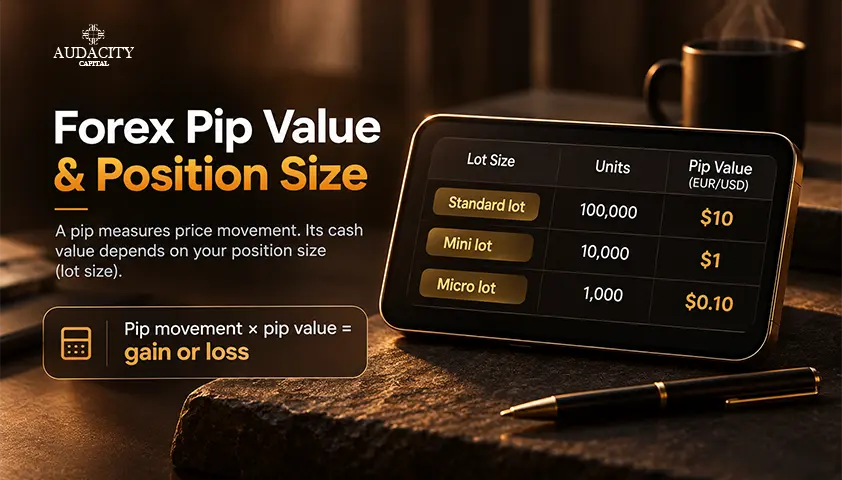
Yes. The number of pips stays the same when you change the lot size, and the money attached to each pip changes. Traders often talk about a move in pips before they think about the position behind it, and that’s easy to miss. A bigger position gives every pip a bigger financial effect.
Where the account currency and the quote currency match, the relationship is simple. On EUR/USD, with one pip at 0.0001, the three common lot sizes work out like this.
Lot type | Units | Value per pip |
Standard lot | 100,000 | $10 |
Mini lot | 10,000 | $1 |
Micro lot | 1,000 | $0.10 |
The exact amount still depends on the pair and the account currency, so this table doesn’t replace a real pip value calculation. It does show why pips alone say little about risk. A 20-pip stop-loss costs about $2 on a micro lot and about $200 on a standard lot.
The relationship also works backwards, and that’s where it helps most.
First, plan your prepared loss and post that to decide the stop-loss distance, along with the pop value to determine the position size.
For example, if you accept a $20 loss with a 20-pip stop, that needs $1 per pip, which on EUR/USD is a mini lot. Picking a lot size first and fitting the risk around it afterwards puts the trade in the wrong order. Once the stop distance, the pip value and the position size work together, pips become genuinely useful for risk management.
How Do Pip Movements Translate Into Forex Profit and Loss?
Once you know what a pip is worth, the next question is what happens when the market actually moves. A move in your favour adds value to the position, and the same move against you takes value away. The pip count alone won’t give you the size of the gain or loss, because position size matters just as much. So what is the meaning of pips in forex trading once money enters the picture? It is a standard way to measure the market’s move before you attach a cash figure to it, and the sum behind it is simple.
Pip movement × pip value = gain or loss
Whether a forex trade makes or loses money comes down first to direction. Buy EUR/USD and a rise helps. Sell it and a fall helps. But two traders catching the exact same 30-pip move can still make very different amounts. A mini lot at $1 per pip pays $30, while a standard lot at $10 per pip pays $300, and the same 30 pips against a buyer costs each of them the same amount. Pips still earn their place in four ways.
- They measure the distance between entry and exit.
- They show how large a favourable or unfavourable move was.
- They let you compare results between trades.
- They show how exposed a position is to price movement.
The pip supplies the measurement, and the position size gives that measurement its financial meaning. That’s why the next step is using pips to set your risk before a trade begins.
Using Pips to Set Forex Risk Before You Enter a Trade
Risk planning is where pips start earning their keep in a real trading plan. You may know exactly where you want to enter and where the idea stops being valid, but the gap between those two prices still has to be measured, and pips do that. A trader who asks what is a pip in trading usually hears about decimal places, yet the practical answer is a ruler for risk. Once the stop distance is known in pips, you can work out how big the position may be. The order of thinking matters.
- Choose the entry level.
- Where trade idea stops being valid, put the stop-loss.
- Use pips to measure the distance between the two.
- Work out what those pips are worth at the planned position size.
- Adjust the size until the maximum loss fits your limit.
A wider stop does not automatically mean a bigger loss. Take a $50 risk limit on EUR/USD. With a 25-pip stop, the trade can risk $2 per pip, which works out to two mini lots. Move the stop to 50 pips and the risk has to fall to $1 per pip, so the position drops to one mini lot. More room for the trade does not mean more money at risk.
The same principle applies whenever position size is calculated. Risk should be decided before the lot size. Otherwise, it is easy to choose a position that looks fine on paper and only later discover that the required stop makes the trade too large. The stop comes from the setup. The pip measures its distance. Position size turns that distance into actual money.
Pips, Pipettes and Spreads: What Is the Difference?
Anyone learning what is pip in forex trading soon meets two neighbours on the platform, the pipette and the spread. They sit close together on screen, but each answers a different question.
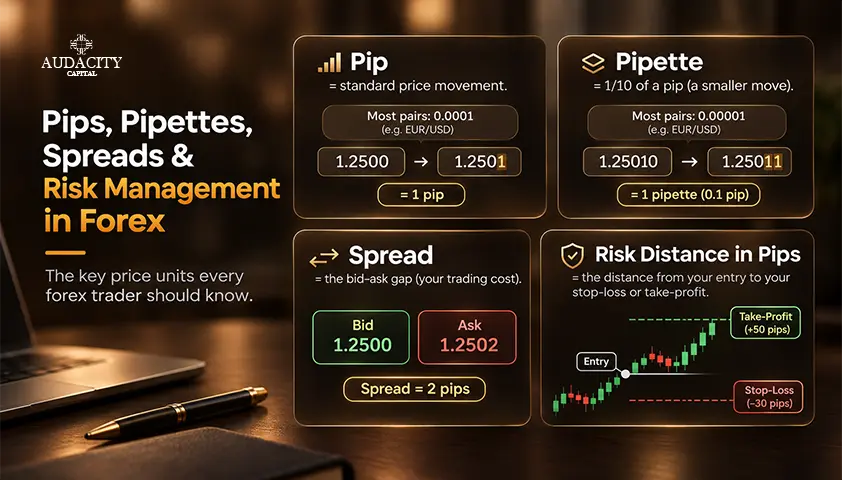
Term | What it measures | Why it matters |
Pip | Standard price movement | Shows how far the exchange rate has moved |
Pipette | One-tenth of a pip | Shows smaller moves in more detail |
Spread | The gap between the bid and ask prices | Shows the price difference you face when entering or exiting |
The spread is the odd one out, because it isn’t a unit of movement. It is a difference between two quoted prices, and platforms usually express it in pips. Say EUR/USD shows a bid of 1.10540 and an ask of 1.10552. The gap is 0.00012, so the spread is 1.2 pips, which costs $1.20 on a mini lot the moment you open the trade. Keeping the three terms apart stops you from treating a transaction cost as another measure of market movement.
Do Pips Matter in Every Type of Forex Trading?
Yes, because pips don’t belong to one trading style. Whether you read charts, follow economic events or hold positions for days, the move still gets measured in pips. What changes is how much weight the measurement carries.
- A scalper watches small pip moves closely, since the strategy depends on frequent entries and exits.
- A day trader uses pips for intraday targets and risk.
- A swing trader works with wider moves that may stretch over several days.
- A fundamental trader measures in pips how the market reacted to an economic event.
The strategy changes and the unit stays put, which is why pips work as a common language for describing what a pair actually did, whatever the reason for entering the trade.
Common Pip Mistakes That Can Distort a Forex Trade
Pips themselves are not complicated. The problems usually come from how they are interpreted. A trader may see a small pip movement and assume the risk is small, without checking the position size or the actual dollar value behind the move.
- Many traders treat pips as money, though ten pips earn or cost a different amount on every position because pair, size and account currency all change the result.
- An extra decimal can make a small move look bigger than it is, so make sure you know which digit marks the standard pip before you read a fractional pip as a full one.
- The value you calculate from the pair may not be in your account currency yet, and forgetting that conversion leaves the figure wrong.
- Raising the position size to squeeze more from small moves backfires, because a bigger size multiplies every pip, including the ones that go against you.
- A pip target shows where you want the price to go, and it makes that move no more likely, so it works as a plan and never as a promise.
Separate the price movement, the pip value and the position size, and most of these mistakes disappear.
A Simple Pip Reference for Forex Traders
When a calculation feels tangled, this table shows which figure leads to which.
If you know... | You can work out... |
Entry and exit prices | The pip movement |
Pip movement and position size | The potential trade result |
Currency pair and position size | The pip value |
Entry and stop-loss prices | The risk distance in pips |
Risk distance and pip value | The potential monetary loss |
Account currency | The pip value after conversion |
You don’t need to memorise every formula to use pips well. Knowing what each figure stands for, and when to convert currency or adjust size, covers most of it.

Trading Platform
Choose Your Trading PlatformConclusion
Pips are a small unit, yet they explain a lot about what is happening to a forex position. Once you know where the pip sits in a quote, connect that movement to pip value, position size and risk. A move of 10 pips tells you what happened to the exchange rate, while your size and direction tell you what it meant for your account. That link is what makes pips useful for judging results and setting risk levels. For readers who want to go further, Audacity Capital’s forex trading guides cover the calculations and the risk decisions that sit around them.
Frequently Asked Questions About Pips in Forex
Pips in forex trading are standard units that traders use to measure currency pair movement. Commonly, most currency pairs consider 1 pip = 0.0001. However, for yen pairs, 1 pip = 0.01.
0.0001 is 1 pip. The standard pip, for most non-yen pairs, sits at the fourth decimal place.
You can’t apply a single cash value to every pip, as the actual value depends on trade size, account currency, and currency pair.
Calculating pips in forex is easy. First, subtract the entry price from the exit price. Then divide the result by the pip size for that pair.
A buy from 1.1050 to 1.1075 gives 0.0025, which is 25 pips. A short position works the same way with the subtraction reversed.
Pips and pipettes are not the same, but they are related, and that’s what creates the most confusion. A pipette is smaller, at one-tenth of a standard pip, and it shows up as an extra decimal in the quote.
Not always. Traders who see the same 20-pip move can get different results, because they traded different sizes or different pairs.

Bereit, diszipliniertes Risiko auf Krypto anzuwenden? Entdecken Sie die neuen Krypto-Instrumente von Audacity Capital und bringen Sie Ihre Trading-Strategie mit.
Mehr erfahrenNewsletter
Treten Sie unserem Newsletter bei, um auf dem Laufenden zu bleiben.
Treten Sie unserer sozialen Gemeinschaft bei

Beginnen Sie Ihre Reise heute Mit unserer kostenlosen Testversion
Präsentieren Sie stolz Ihre Fähigkeiten und Leistungen durch Zertifikate und erhalten Sie Anerkennung für Ihre harte Arbeit und Ihr Engagement von potenziellen Investoren und Kollegen.
Kostenlose TestversionVerwandte Artikel

From Demo To Live: When Are You Ready To Go Live?


The First 30 Days: What New Traders Should Focus On (And Ignore)

Introducing Ability One: One Step To Funding With Static Drawdown

10 Best Futures Prop Firms for Swing Trading In 2026
Compare the best futures prop firms for swing trading in 2026 with overnight holding, flexible rules, fast payouts, and funded accounts.