



What Is Swap in Forex Trading? How Overnight Swap Works


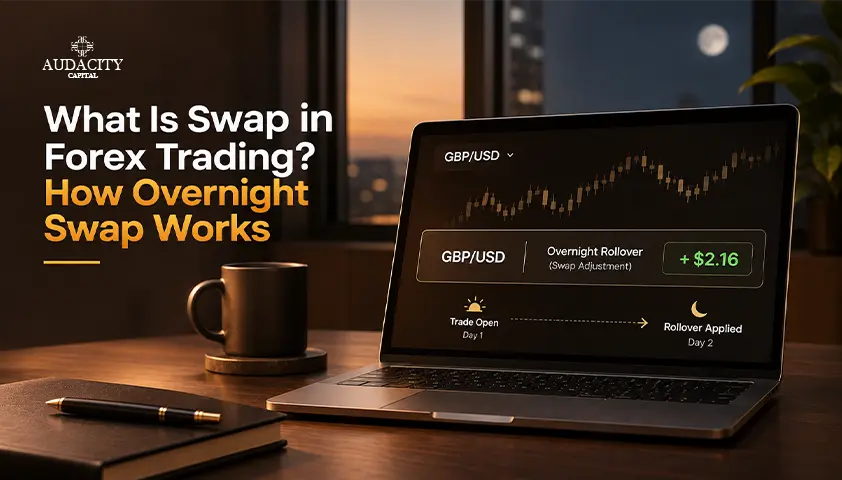
Swap in forex trading is the financing amount a trader may pay or receive for keeping a forex position open overnight. It is sometimes called an overnight charge, rollover or financing adjustment.
However, this amount varies by trade, and it depends on:
- The currency pair.
- Interest-rate conditions associated with the currency pair.
- Whether you are holding a long or short position.
- The terms & conditions of the broker/ trading provider.
Swap can have little to no practical effect for a short-term trader who closes positions within the same trading day. However, these daily adjustments can affect the final trading result when someone holds a forex position for several days.
What Is Swap in Forex Trading?
A forex position represents two sides of a transaction:
When you buy one currency, you are simultaneously selling another. Keeping that position open after the trading day means you continue to hold that currency exposure, and the provider applies an overnight financing adjustment to the account.
That adjustment is known as a Swap or Rollover.
To understand how swaps work across different financial instruments, read our detailed guide on swap in trading.
Consider a trader holding a GBP/USD position overnight. A long position means the trader is buying pounds and selling US dollars, while a short position reverses those exposures. The financing applied to each side is not necessarily the same, so the swap for a long trade can differ from the swap for a short trade.
The same currency pair can therefore have separate swap values depending on the direction of the trade.
There is another point beginners often miss. Swap is not determined by the currency pair alone. The provider's own financing rates and trading conditions also affect the amount that appears on the account.
With this, before traders hold a forex position overnight, they have three things to check:
- Position direction: If the trade is long or short.
- Applicable swap rate: The amount assigned to that position.
- Rollover terms: When the adjustment is applied and how the provider calculates it.
Once you learn these, swap is much easier to account for in every multi-day forex trade.
How Does Swap Work When You Hold a Forex Position Overnight?
When you keep a forex trade open overnight, the position enters the provider's rollover process. This is where the financing adjustment is applied. You are still holding the same currency position, but the cost of carrying that position into another trading day has to be accounted for.
It can be understood in four steps:
- You open a forex position.
- The position remains open when the daily rollover time arrives.
- The provider carries the position forward to the next trading day.
- A financing amount is added to or deducted from your account.
The amount may be described as a swap, swap rate, rollover or overnight financing charge. These terms are closely related in retail forex, although providers may use different wording and apply their own calculation methods.
This also explains why an intraday trader may barely notice swap. If the position is opened and closed before the relevant rollover point, there is generally no overnight adjustment under providers that use a daily rollover system. The exact cutoff depends on the provider.
For traders who hold positions for several days, the timing becomes more important. Weekend and holiday periods can also affect how many days of financing are applied at one time, depending on the provider's rollover schedule.
That is the practical meaning of swap in trading forex. It is part of carrying a forex position beyond the provider's daily rollover point.


Prop Trading Challenges & Rules
Free Prop Firm Trading CompetitionWhat Determines the Swap Rate in Forex?
Now that the rollover process is clear, the next question is what actually changes the amount applied to the account. The answer depends on more than the central-bank rates often mentioned when explaining swap in forex trading.
The interest-rate relationship between the two currencies is an important starting point. However, the final swap rate shown to a trader also reflects the currency pair, the direction of the position and the financing terms used by the trading provider.
A few points need to be checked before you hold a position overnight:
1. The currencies involved
Every currency pair has its own financing conditions. A swap value for EUR/USD will not automatically tell you what to expect from GBP/JPY or another pair.
2. Whether you are long or short
Providers normally publish separate financing values for buy and sell positions. One direction may receive a credit while the other carries a charge.
3. Your position size
The more exposure you carry overnight, the greater the potential financing adjustment.
4. The provider's terms
It’s not only the gap between two official interest rates that emerges as the final amount, but providers source and adjust financing rates according to their own pricing methodology.
5. How long the position remains open
Holding a position for several nights means you can apply the adjustment repeatedly. The number of days in a rollover can also change depending on weekend and holiday treatment.
Therefore, observe the actual swap values for the pair and position direction when you are checking swap in trading forex. Avoid estimating the cost from interest rates alone.
How Is Forex Swap Calculated?
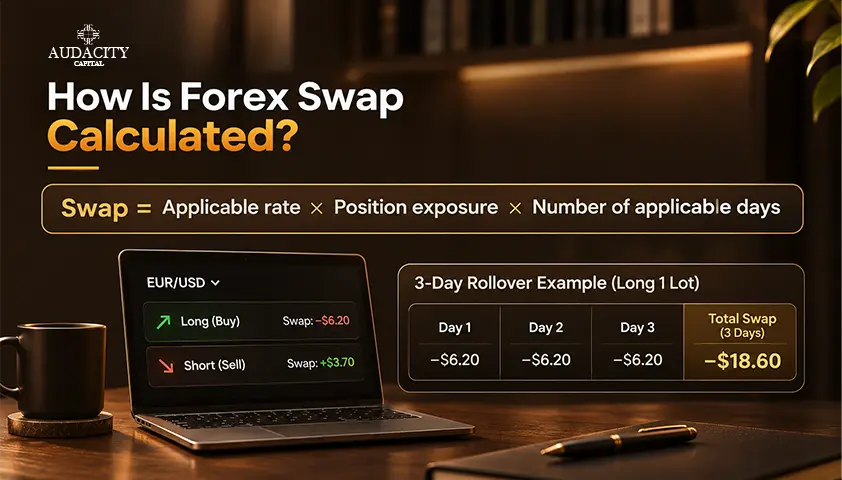
Calculating forex swap looks very simple on the surface. However, using the actual method depends on how the provider quotes and applies its financing rates.
Use this formula to calculate forex swap:
Swap = Applicable rate × Position exposure × Number of applicable days
The problem is that each part of that calculation needs to be understood correctly:
Rate can be presented as swap points.
The position can be measured in units or notional value.
The resulting amount may need to be converted into the currency used by the trading account.
Let’s understand it with an example: A trader holds a 10,000-unit position. The platform shows a swap value of -0.4 units for one applicable overnight period. If the same value applies for three days, the accumulated adjustment would be -1.2 units before any conversion required by the provider.
That is only an illustration. Do not use one broker's swap calculation as a universal formula for every forex account.
Beyond the above formula and example, expect the exact methodology to be more detailed. Many providers calculate financing using a day-count convention, the applicable financing rate and the position value.
This is also why traders should check the swap figures directly on the platform rather than trying to recreate them from central-bank rates.
When comparing swap in trading forex, check these four details:
- Swap value for the long position.
- Swap value for the short position.
- Unit used to quote the adjustment.
- Number of days included when the position remains open.
That gives you a much clearer idea of the actual overnight cost before you carry the trade forward.
Positive Swap vs Negative Swap: Do Traders Always Pay?
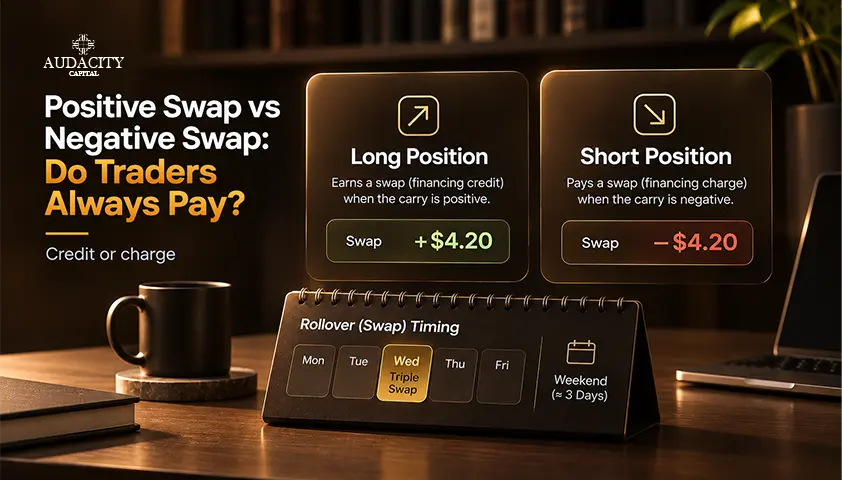
Swap is not always a charge. Depending on the currency pair, position direction and financing conditions, the overnight adjustment can either be deducted from or added to the trading account.
A positive swap means the position receives a financing credit. A negative swap means the trader pays a financing cost. The same currency pair can have different outcomes for long and short positions because each direction carries a different financing rate.
Position | Possible swap outcome |
Long EUR/USD | Credit or charge |
Short EUR/USD | Credit or charge |
But the result is not permanent. Swap values can change as financing conditions and provider rates change.
So, when checking what are swaps in forex trading, look at the current value for the exact currency pair and direction you intend to trade. Do not assume that a pair which previously paid a positive swap will continue to do so.
When Is Swap Charged in Forex Trading?
Swap is normally linked to the point at which a forex position passes through the provider's daily rollover time. A trade that is opened and closed in the same session may not get any overnight charge. A trade that stays open past the cutoff can. Your provider decides what that cutoff time is.
This makes the distinction fairly simple:
- Intraday position: Closed before the provider's rollover point, so no overnight swap under that provider's policy.
- Overnight position: Because it stays open through the rollover point, a financing adjustment may apply.
- Weekend holding: The provider may apply several days of financing together.
- Holiday periods: Settlement changes can result in an additional multi-day adjustment.
What Is Triple Swap in Forex Trading?
Triple swap sounds more complicated than it is. It usually refers to a single rollover adjustment that covers three days of financing, including the weekend period.
It is not a separate penalty and it does not mean the provider has changed the underlying daily swap rate to three times its normal value. The extra days are grouped together because the standard FX settlement cycle runs across days when the market is closed.
Wednesday is usually when this adjustment happens, but don't take it as a fixed rule. Public holidays and the settlement schedule for a particular market can change the day, or even how many days you get charged for.
If you regularly hold forex positions overnight, checking the provider's rollover calendar is more useful than trying to remember a fixed “triple swap day.”
How Does Swap Affect Forex Trading Costs?
Swap becomes more noticeable when a trader keeps positions open for several days. A single overnight adjustment may be small relative to the position's potential price movement, but repeated charges can become meaningful when the trade remains open for a longer period.
The effect is greater when:
- The position size is large
- The trade stays open for several nights
- The applicable swap is negative
- The expected price movement is relatively small
- The strategy regularly carries positions overnight
The opposite is also possible. A positive swap can add to the account while the position remains open. But that does not make the trade attractive by itself. A financing credit is nice, but it does not stop the pair from moving against you. And if it does, that loss can be much bigger than the credit. That is why you need to consider the swap with your holding period.
Price is what really moves your P&L; swap just adds or subtracts a little for holding overnight. And rates are not permanent; providers can change them.
For a trader holding positions for days or weeks, ignoring swap can leave an incomplete picture of the trade's potential outcome.
Swap and Carry Trading: What Is the Connection?
The connection between swap and carry trading comes from the same basic idea: holding one currency against another creates a financing difference.
A carry strategy generally seeks to benefit from that difference by holding a currency with a relatively higher interest rate while funding the position with a currency offering a lower rate. In a favourable setup, the financing adjustment can support the trade's return.
That does not make carry trading a simple way to earn interest. The exchange rate remains the larger risk.
A currency can fall enough to erase months of positive swap, while changes in market conditions can also reduce the financing advantage. Providers may adjust rollover rates as the underlying market changes.
For that reason, a trader considering a carry strategy needs to look beyond the swap figure and consider:
- The expected currency movement
- The stability of the interest-rate difference
- The likely holding period
- The financing terms
- The risk of a sharp move against the position
The swap may form part of the return, but the currency position remains the main source of market risk.
How Can Traders Check Swap Before Opening a Forex Trade?
Do not wait until your trade has been open for days to check the swap. Check it before you enter. Go to the pair's specifications and find the overnight financing for both long and short. Every platform shows it a bit differently, but the useful details usually include:
- Buy or long swap
- Sell or short swap
- Rollover time
- Triple-swap day
- Swap unit and rate
- Any additional financing charge
Some platforms display swap in points, while others show the amount or financing information in a different form. For example, swap may appear under the symbol specification in MetaTrader, while other platforms place rollover information within the market details.
Also check whether the quoted number matches your position size. A swap for a standard lot does not have the same cash effect on a much smaller trade. When you have that sorted, you can decide if keeping it open overnight fits your forex strategy.
How Can You Reduce the Cost of Forex Swaps?
Managing swaps starts with knowing when your trades are likely to incur them. If your strategy normally closes positions before the provider's rollover point, overnight financing may have little effect. If you regularly carry trades for several days, it becomes part of the trade's practical cost.
You can manage that exposure by:
- Checking swap before entering the position.
- Not looking at one figure but comparing the long and short rates.
- Keeping an eye on rollover around weekends and holidays.
- Avoiding unnecessary overnight positions.
- Adjusting position size when financing becomes a meaningful part of the expected return.
- Not depending on an old rate and reviewing the current financial terms of the provider.
Don’t treat a rate seen previously as permanent because, with market and financing conditions, swap rates can change.
The aim is simply to make overnight financing part of the decision before the position is opened.
Forex Swap vs Rollover: Are They the Same?
In retail forex, these two are closely connected. Swap usually refers to the amount credited or debited for overnight holding, while rollover describes the process of moving the position into the next trading day. You might also find it called an overnight financing charge or financing cost. Providers do not always use the same terminology. What matters is not what it is called. Check:
- When the provider applies the adjustment
- Whether the position receives or pays financing
- How the long and short rates differ
- How the amount is calculated
- Whether special weekend or holiday adjustments apply
So, when a forex platform uses the word rollover instead of swap, it does not necessarily mean that you are dealing with a different type of overnight cost.
Conclusion
Swap is one of those parts of forex trading that is easy to ignore when a position is only open for a few hours. It becomes harder to ignore when the same position stays open through several rollovers.
That is where knowing the rate, the direction in which it applies and the provider's rollover terms starts to matter. A trader who checks these details before entering the position has a much clearer idea of what holding the trade may involve.
If you want to look further into the subject, Audacity Capital's swap in trading guide goes into the swap deeply.
Frequently Asked Questions
Swap in forex trading is the overnight financing adjustment applied when an eligible forex position remains open beyond the provider's rollover time. Depending on the pair, trade direction and financing terms, it can be a charge or a credit.
Swaps in forex trading are the financing adjustments associated with carrying currency positions overnight. The long and short swap rates can be different.
Not necessarily in exactly the same way. A position normally becomes subject to swap when it remains open through the provider's specified rollover point. The timing and treatment vary between providers.
Triple swap is an adjustment where several days of financing are applied together to account for the weekend or settlement schedule. The exact day can differ between currency pairs and providers.
Some positions can receive positive swap, but that does not make swap a guaranteed source of income. Exchange-rate movements and changes in financing rates can have a much larger effect on the overall result.
Overnight financing policies vary. Some account types may have different arrangements, including swap-free structures, so traders need to check the specific terms before opening an account.
Open the currency pair's specifications in your trading platform or provider's market information. Look for the long and short swap rates and the applicable rollover conditions.

Bereit, diszipliniertes Risiko auf Krypto anzuwenden? Entdecken Sie die neuen Krypto-Instrumente von Audacity Capital und bringen Sie Ihre Trading-Strategie mit.
Mehr erfahrenNewsletter
Treten Sie unserem Newsletter bei, um auf dem Laufenden zu bleiben.
Treten Sie unserer sozialen Gemeinschaft bei

Beginnen Sie Ihre Reise heute Mit unserer kostenlosen Testversion
Präsentieren Sie stolz Ihre Fähigkeiten und Leistungen durch Zertifikate und erhalten Sie Anerkennung für Ihre harte Arbeit und Ihr Engagement von potenziellen Investoren und Kollegen.
Kostenlose TestversionVerwandte Artikel

10 Best Futures Prop Firms for Swing Trading In 2026
Compare the best futures prop firms for swing trading in 2026 with overnight holding, flexible rules, fast payouts, and funded accounts.


Introducing Ability One: One Step To Funding With Static Drawdown

Trading Psychology for Funded Traders: Pressure, Fear and Revenge Trading
Struggling with pressure and tilt? Master trading psychology for funded traders with concrete systems to avoid revenge trading and stay disciplined.

How To Choose The Right Prop Firm – A Complete Checklist
Learn how to choose the right prop trading company with our expert guide. Compare fees, rules, profit splits, and platforms to trade confidently.