


What Is Prop Trading? A Guide to Proprietary Trading



You must have come across the word prop trading in the funded account marketing ads on social media, but proprietary trading as a practice dates back much further than any of that marketing appeared.
The banks and specialized organizations were already engaged in proprietary trading with their own capital for decades in the financial markets, and the current retail version of it is just another step forward in that same direction.
So, what is prop trading, exactly? This article details what proprietary trading is, how it works, and who the people behind these trades are. It also provides a comparison of prop trading and other methods of engaging with the markets.
It is educational only, and trading involves substantial risk of loss.
Key Takeaways
- Traditional prop trading involves trading with a firm’s money on the firm's own account.
- Prop traders can trade in multiple market types including stocks, futures, forex, options, and commodities, depending on the type of firm.
- Risk management and performance management form an integral part of proprietary trading.
- There is a link between traditional institutional prop trading and modern retail-funded trading.
- Prop trading is not retail or agency trading in terms of capital source, risk ownership, and purpose.
What Is Prop Trading?
Proprietary trading is when a firm trades financial instruments with its own money, for its own benefit instead of on behalf of its clients.
It refers to the firm’s money in this context, and hence, a proprietary trade is executed with the firm's capital and any profit or loss belongs to the firm.
That is how it differs from the client’s business. If the firm trades on its own behalf, it takes the position in order to make a profit from market movements. It does not receive any commission for executing another person's orders.
The firm itself is the party involved in the trade, and not the intermediary.
Under the traditional structure, all the risk and the capital belong to the firm. The trader uses the funds under the conditions fixed by the firm. The firm bears all the risks in case the trade does not succeed.
If the trading succeeds, the gains go to the firm, and traders receive the remuneration depending on their performance. This is the proprietary trading definition in its most basic sense.


Audacity Capital Empowering Traders Since 2012
Join the Prop FirmHow Does Prop Trading Work?
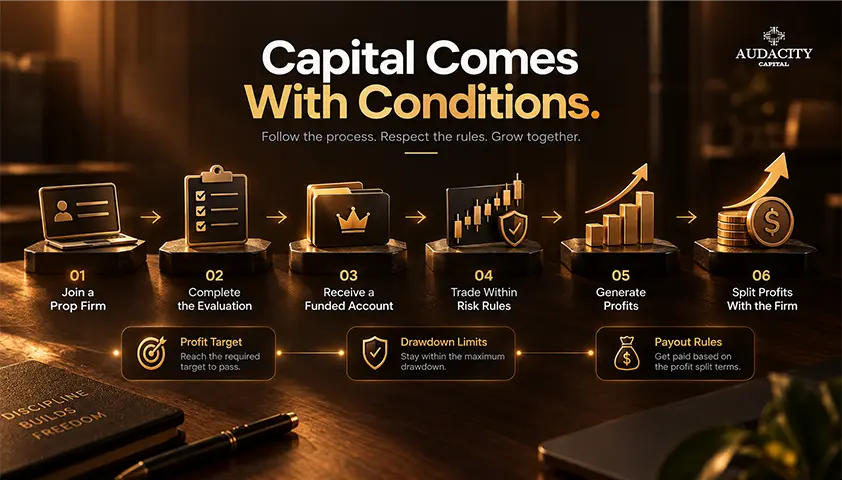
The process of proprietary trading has a specific sequence that will help one understand almost anything that takes place on the trading floor.
1. Capital/ risk allocation: The firm allocates a certain amount of capital or a risk budget.
2. Strategy selection: Trader determines the opportunities in the approved strategy.
3. Trade execution: Orders are executed within the risk profile of the firm.
4. Risk monitoring: Positions, exposure, and losses are constantly monitored.
5. Performance tracking: Profits and losses are documented and used to measure performance.
Therefore, when people ask how does prop trading work, this sequence provides a basis for the process.
The important part of this loop that newcomers fail to recognize is the risk budget. The firm will not give you capital hoping that you make a profit. The risk budget represents the amount of money the firm is willing to lose, and all else will stem from that.
Position sizing, leverage, and exposure levels do not depend on the traders' ambitions but depend on the risk budget. It determines how the trading process should be managed.
Institutional firms monitor exposure for all desks simultaneously, so an individual trader's positions become a part of the whole risk profile of the company.
An individual trader's book can either hedge or enhance another trader's book, and the firm manages the total.
Who Is a Prop Trader?
In simple terms, what does a prop trader do? It is someone who trades a firm's capital and is also responsible for the utilization of that capital. There are five tasks that recur in this job.
- Identifying and researching trading opportunities.
- Carrying out trades based on a specific strategy.
- Risk, position and exposure management.
- Monitoring results and adjusting to market trends.
- Following the firm's trading and risk controls.
Risk management is as vital as the ability to find trading ideas. An idea can be recognized by anyone. The ability of a proprietary trader is measured not only by the profitability of a single trade but also by his or her ability to minimize the risks associated with it.
Accountability is the key here, regardless of whether the trader is employed within a bank or an independent program.
Institutional Prop Trading vs Modern Retail Prop Trading
Ask what is prop trading today and you will get two quite different answers. Most readers have encountered proprietary trading via two very distinct paths, and it's easy to mix them up.
The traditional institutional model is based on internal desks or employed traders trading the firm's capital. Recruitment is selective, traders are typically employees and the firm is responsible for providing the money, infrastructure, and risk oversight.
Regulation reshaped this landscape in the United States.
The Volcker Rule, implemented as a result of the financial crisis of 2008 within the Dodd-Frank Act, imposed limitations on proprietary trading activities of banking institutions under certain conditions and exemptions.
The impact of the rule on the overall trading industry is somewhat complicated.
The modern retail-funded model is different in that regard. In this model, the trader is not employed but rather gains access to structured trading programs with some form of evaluation or simulation included.
This has significantly broadened the circle of participants in the activity.
Since the specifics of the model require a separate discussion, this article will be very brief and recommend that the reader consult a guide on what a prop firm is and how it works.
Institutional prop trading | Modern retail prop trading | |
Who trades | Employed traders or internal desks | Independent traders |
How access is gained | Recruitment and hiring | Structured programs, often with an evaluation |
Whose capital is used | The firm's own funds | Varies by program, often a simulated environment |
Relationship to the firm | Employment | Contractual |
Where to learn more | This article | The dedicated prop firm article |
What Markets Do Prop Traders Trade?

Proprietary activity spans most major asset classes, and the mix depends on the firm.
Stocks and equities:
Deep liquidity and clear pricing make equities a common home for directional and relative-value strategies.
Futures:
Standardized contracts and built-in leverage suit both short-term and macro approaches.
Forex:
A highly liquid global market traded across major currency pairs and international trading sessions.
Options:
Used to express views on volatility and direction, with risk that shifts as expiry approaches.
Commodities:
Energy, metals, and agricultural markets carry their own seasonal and supply-driven behavior.
Bonds and fixed income:
Interest-rate sensitivity and relative-value trades define much of the activity here.
Indices:
A way to trade broad market moves without picking individual names.
Crypto, where applicable:
High volatility and continuous trading hours, subject to the firm's mandate and local rules.
No single firm trades everything. The markets available depend on the firm's strategy, infrastructure, regulation, and risk mandate. The strategy usually determines which markets the firm trades.
Common Prop Trading Strategies
Firms and desks often specialize in a particular approach. That choice affects the markets they trade, their holding periods, and the risks they take. Here are five of the most common.
1. Arbitrage
Arbitrage seeks to profit from pricing or relative-value differences between related instruments or markets. If two connected assets drift out of line, a trader can capture the gap as it closes.
These opportunities are often small and short-lived, which is why speed and scale matter so much. The main risk is that the relationship between the instruments breaks down rather than reverting.
2. Market Making
A market maker provides liquidity by quoting both a price to buy and a price to sell, aiming to earn the difference known as the bid-ask spread. Repeated across many trades, that spread adds up.
The main risk is inventory. Holding a position while prices move against it can wipe out the spread earned many times over.
3. Quantitative and Algorithmic Trading
Quantitative trading uses statistical models, large data sets, and automation to identify and execute trades systematically. Algorithmic trading then carries out those decisions at speed and scale.
The main risks are model error and the chance that a pattern found in historical data simply stops working once real capital is behind it.
4. Global Macro Trading
Global macro trades broad economic, interest-rate, currency, and geopolitical themes, often across several asset classes and over longer holding periods. A trader might position for a shift in central-bank policy or a currency trend.
The main risk is being right about the theme but wrong about the timing, which can drain a position before the thesis plays out.
5. Directional Trading
Directional trading takes long or short positions based on an expected price move, using technical analysis, fundamental analysis, or both. This is the approach most retail readers will already recognize.
The main risk is straightforward: being wrong about direction and holding the position while the loss grows.
Prop Trading vs Retail Trading
There are a lot of differences between the two that can be drawn from various aspects, but the primary one lies in where the funding comes from.
In the case of a retail trader, the money comes from the individual who is trading and bears all the risks involved. In proprietary trading, the firm supplies the capital and sets the rules within which the trader operates.
That difference shapes almost everything else, which is why prop trading vs retail trading is such a common comparison for anyone weighing the two.
Prop trading | Retail trading | |
Source of capital | The firm | The individual trader |
Ownership of risk | The firm, within limits it sets | Entirely the trader |
Available capital | Typically larger | Limited to personal funds |
Rules and risk controls | Set and enforced by the firm | Set by the trader |
Infrastructure | Provided by the firm in institutional settings | Sourced by the trader |
Profit ownership | Shared under the firm's structure | Kept by the trader |
Trader independence | Limited by the firm's mandate | Full |
The main trade-off is independence versus external risk controls.
Proprietary trading gives the opportunity to have access to additional capital and infrastructure, but the trader works according to the firm’s policies.
Retail trading allows the trader to work independently, but the trader supplies his own capital and bears individual risks. Neither model is better in the abstract; everything depends on the needs of the trader in terms of independence, capital availability, and external risk control.
Prop Trading vs Agency Trading
Agency trading is the opposite of proprietary trading, which makes this comparison useful for defining them.
In proprietary trading, all transactions are made by the firm's own account, and the firm profits or loses from market movements directly.
In agency trading, the firm executes trades on behalf of clients and earns from providing that service, usually in the form of commissions or fees. It does not take the client's position as its own proprietary position.
Three differences separate them:
- Purpose: Proprietary trading seeks trading profit, while agency trading provides a service to clients.
- Capital ownership: Proprietary trading uses the firm's capital, while agency trading uses the client's capital.
- Risk exposure: Proprietary trading takes positions for the firm's own account, while agency trading executes trades on behalf of clients.
Firms that conduct both activities generally need controls to separate proprietary and client interests.
Benefits of Prop Trading

Proprietary trading carries real advantages, though most of them depend on the model in question.
Benefit #1: Access to larger trading capital or risk budgets, which lets a trader operate at a scale personal funds rarely allow.
Benefit #2: Professional tools, data, and infrastructure, mainly in institutional settings where the firm builds and maintains the trading stack.
Benefit #3: Structured risk controls that impose discipline, turning risk management into a built-in requirement rather than an afterthought.
Benefit #4: Reduced reliance on personal trading capital in certain models, which changes how much of a trader's own money is exposed, though this varies across models.
Benefit #5: Performance-based earning opportunities, where compensation is linked to results, again depending on the model.
These benefits do not apply to every prop trading model. Institutional firms provide different infrastructure and capital arrangements than retail-funded programs. Consider each benefit in the context of the specific model.
Risks and Limitations of Prop Trading
The main risks and limitations include:
1. Market losses and strategy risk, since any strategy can fail and no method removes the possibility of loss.
2. Strict risk limits and position controls that constrain how a trader can operate.
3. Performance pressure, because results are measured closely and continuously.
4. Limited freedom compared with fully independent retail trading.
5. Technology, execution, and model risk, where a system failure or a flawed model can cause damage on its own.
6. No guarantee of consistent profitability, in any model, under any firm.
The same risk controls can be both a benefit and a limitation.
The rules that protect the firm's capital restrict how a trader can trade, from position size to how long a drawdown can run before limits are hit. Whether that feels like protection or restriction depends entirely on the trader.
Check the detailed guide about Prop Trading Risk Rules
How Do You Become a Prop Trader?
There are two basic options, and they differ greatly in nature.
The classical institutional path usually goes via education, either in finance, economics, math, or a quantitative major, together with extensive market experience.
It may then involve internships or entry-level trading positions, and firm recruitment, which is quite selective.
The alternative modern independent path does not begin the same way. It starts with the development of a tested strategy, cultivation of solid risk management skills, and a trading track record before considering a proper funding trading program.
The track record and risk management skills come first. A program is something that a trader applies for when everything else has been taken care of. For how those programs are structured, see the dedicated prop firm article rather than treating it as a shortcut.

Audacity's Prop Trading Challenges
Free Prop Firm ChallengeIs Prop Trading Right for You?
Use the following as a self-assessment rather than a pass-or-fail checklist. Proprietary trading tends to suit people who share a particular set of traits.
- Strong risk management discipline that holds up under pressure.
- A repeatable trading process rather than a run of lucky calls.
- The ability to work under performance constraints and inside someone else's rules.
- Emotional control and consistency over long stretches.
- A clear-eyed understanding of losses, drawdowns, and capital preservation.
If a firm's rules feel restrictive, independent trading may suit you better.
Proprietary trading is not inherently superior. It suits traders who are comfortable with external rules, risk controls, and performance expectations.
Related Articles
Understanding Prop Trading Challenges & Rules
FAQ
No. Day trading describes a holding period, while prop trading describes whose capital is used. A prop trader might day trade or hold positions for weeks, depending entirely on the strategy the desk follows.
In the traditional model, the capital belongs to the firm, and the firm carries the risk. Arrangements in the modern retail-funded model vary from one program to the next, so the answer depends on which model you are looking at.
Rarely without preparation. The institutional route usually requires relevant education or experience, and the independent route requires a tested process first. Beginners generally spend time building skills before either path becomes realistic.
Proprietary traders operate across stocks, futures, forex, options, commodities, fixed income, indices, and sometimes crypto. Which of these are available depends on the firm and its mandate, and no single firm trades everything.
The difference comes down to capital and risk ownership. A retail trader funds the account and owns all the risk, while a prop trader deploys the firm's capital within limits the firm sets and shares any profit under its structure.
Yes, all three are traded in proprietary settings. In practice each firm offers a subset shaped by its strategy, infrastructure, and regulatory environment rather than the full range at once.
Through position sizing, exposure limits, defined loss limits, and real-time monitoring of open positions. In institutional settings, that monitoring extends across every desk, so each trader's exposure is measured against the firm's total risk picture.

Bereit, diszipliniertes Risiko auf Krypto anzuwenden? Entdecken Sie die neuen Krypto-Instrumente von Audacity Capital und bringen Sie Ihre Trading-Strategie mit.
Mehr erfahrenNewsletter
Treten Sie unserem Newsletter bei, um auf dem Laufenden zu bleiben.
Treten Sie unserer sozialen Gemeinschaft bei

Beginnen Sie Ihre Reise heute Mit unserer kostenlosen Testversion
Präsentieren Sie stolz Ihre Fähigkeiten und Leistungen durch Zertifikate und erhalten Sie Anerkennung für Ihre harte Arbeit und Ihr Engagement von potenziellen Investoren und Kollegen.
Kostenlose TestversionVerwandte Artikel

10 Best Prop Trading Firms in Malaysia in 2026
Compare the 10 best prop trading firms in Malaysia for 2026, ranked on swap-free accounts, payout speed, fees, and payments that work from Malaysia.

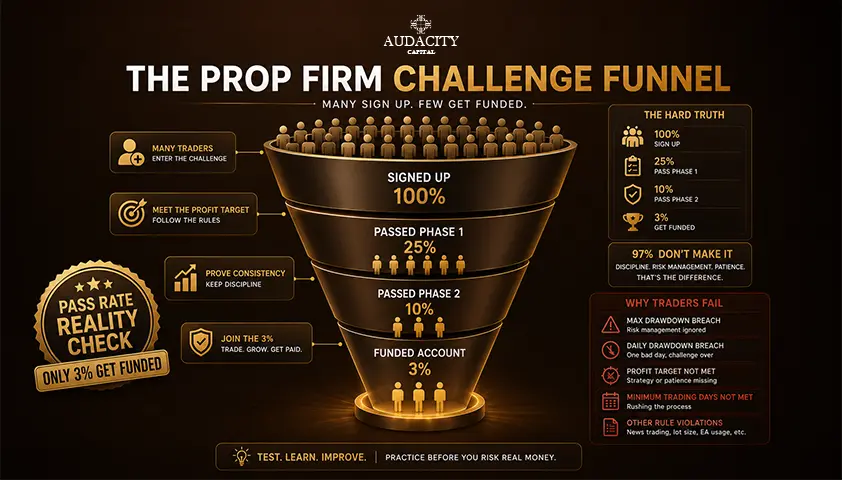
Prop Firm Pass Rate: What Percentage Actually Get Funded?
Learn the real prop firm pass rate, why estimates vary, how many traders get funded, and what the data says about payouts and repeat attempts.
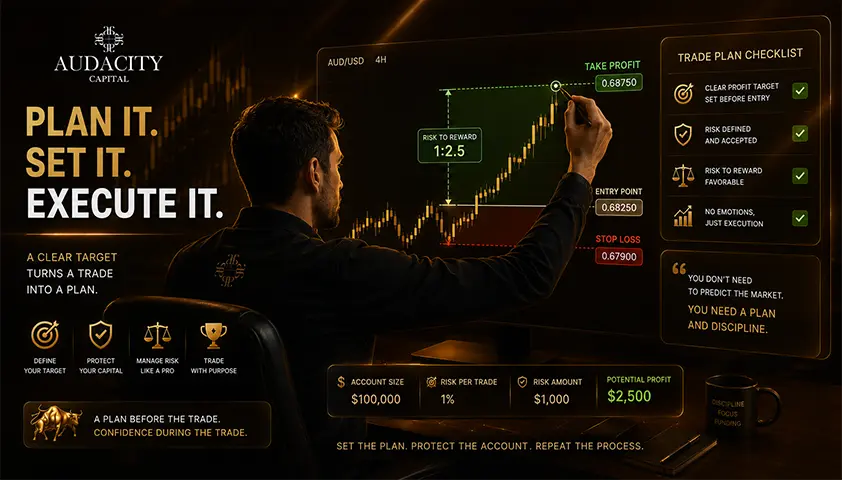
What Is Take Profit in Trading? A Detailed Guide for Traders
Learn what a take profit is, how to set one well using technical levels, risk-reward, and ATR, plus partial profits, trailing stops, and a funded-trader lens.

Best Local Payment Methods for Forex Prop Trading
Compare the best local payment methods for forex prop trading by region and learn faster, cheaper prop firm withdrawals with fewer delays.