



7 Best Forex Scalping Strategies for Faster Trade Decisions



Forex scalping is a short-term trading approach that focuses on capturing relatively small price movements in the currency market. Instead of holding positions for hours or days, scalpers typically open and close trades within minutes or, in some cases, seconds.
Because individual price movements are small, scalpers often rely on technical analysis, market structure, volatility, and strict risk management to identify potential trading opportunities.
There is no single strategy that works in every market condition. The most suitable forex scalping strategy depends on factors such as market volatility, liquidity, trading session, currency pair, and the trader's risk-management approach.
This guide explains seven commonly used forex scalping strategies, the indicators that can support them, and the factors traders should consider before using them.
Risk warning: Forex trading involves significant risk, and scalping can expose traders to frequent losses, transaction costs, and rapid market movements. The strategies discussed here are educational examples, not guarantees of profitability.
What Are Forex Scalping Strategies?
Forex scalping strategies are short-term trading methods designed to identify and potentially capture small price movements in currency pairs.
A scalper may hold a position for only a few minutes before closing it. Because the expected price movement is generally smaller than with swing or position trading, scalpers may take multiple trades during a trading session.
For example, a trader might look for a short-term move of several pips after a breakout, trend continuation, or reversal signal. The trader may then close the position once the predefined target or exit condition is reached.
A scalping strategy usually combines several elements:
- Market direction
- Price action
- Technical indicators
- Entry and exit conditions
- Stop-loss placement
- Profit targets
- Position sizing
- Trading costs
- Market volatility
The objective is not simply to make as many trades as possible. A structured approach helps traders define when to enter, when to exit, and how much they are willing to risk.
Why Use Forex Scalping Strategies?
Scalping requires fast decision-making, so trading without a defined process can lead to inconsistent results. A structured strategy can help traders approach short-term opportunities systematically.
1. Create a Structured Trading Process
Scalpers often need to make decisions quickly. Having predefined entry, exit, and risk-management conditions can reduce the need to make every decision from scratch.
For example, a trader may decide beforehand that a trade is only considered when price is above a particular moving average and momentum confirms the direction.
2. Identify Short-Term Trading Opportunities
Scalping focuses on relatively small price movements. Technical indicators and price-action techniques can help traders identify potential opportunities during periods of sufficient market activity.
However, a trading opportunity is not the same as a guaranteed profitable trade. Short-term price movements can reverse quickly.
3. Manage Risk More Systematically
A predefined stop-loss can help a trader determine the maximum amount they are willing to lose on an individual trade.
Risk management is particularly important for scalpers because a large number of trades can magnify the impact of poor decisions, excessive position sizes, or trading costs.
4. Reduce Unplanned Trading Decisions
A written strategy can provide rules for when to trade and when to stay out of the market. This can help traders avoid entering positions simply because the market is moving quickly.
When Is the Best Time to Scalp Forex?
There is no universally best time to scalp forex. Market conditions change throughout the day, and liquidity and volatility vary between trading sessions.
Many scalpers pay particular attention to periods when major financial markets overlap because trading activity can increase during these periods.
For example, the overlap between the London and New York sessions can experience significant activity in major currency pairs involving the US dollar and euro.
However, higher volatility also means greater potential for rapid price movements in both directions.
Before choosing a trading session, consider:
- Liquidity
- Average spread
- Volatility
- Major economic announcements
- Currency-pair characteristics
- Your own trading schedule
- Your ability to monitor positions
Traders should also be aware of major economic releases. Sudden price movements around news announcements can make short-term trading more difficult and can increase execution risk.
Best Timeframes for Forex Scalping
Scalpers commonly use lower timeframes to identify short-term market movements.
Commonly monitored timeframes include:
- 1-minute charts
- 5-minute charts
- 15-minute charts
However, using a lower timeframe does not automatically make a strategy better.
A practical approach can be to use a higher timeframe to understand the broader market direction and a lower timeframe to identify a potential entry.
For example:
15-minute chart → identify market structure
5-minute chart → identify setup
1-minute chart → refine entry
The appropriate combination depends on the strategy and the trader's objectives.
5 Popular Indicators for Forex Scalping
Technical indicators can help scalpers interpret price movement, momentum, volatility, and market direction.
However, indicators should not be treated as standalone signals that guarantee a successful trade.
1. Bollinger Bands
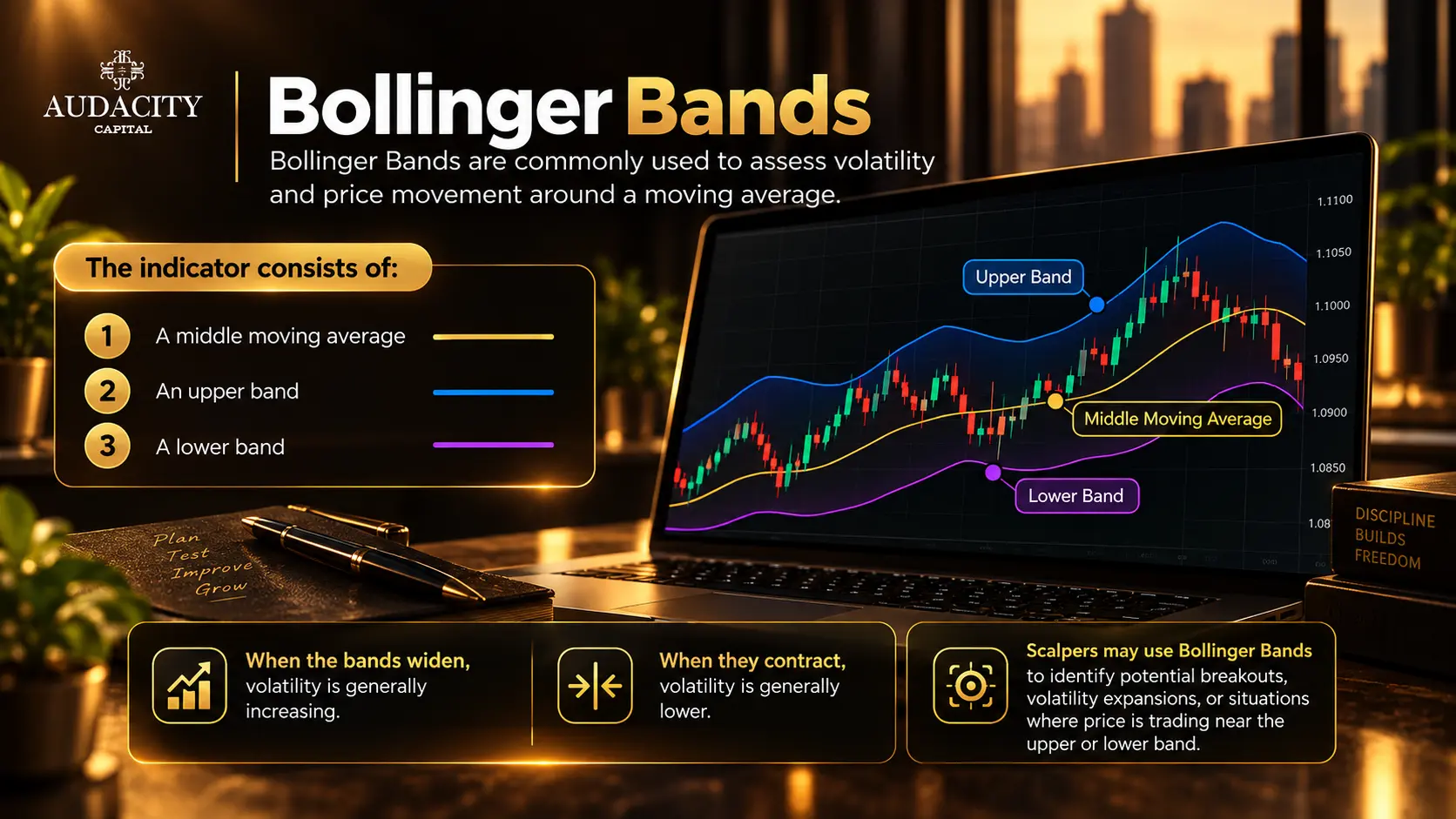
Bollinger Bands are commonly used to assess volatility and price movement around a moving average.
The indicator consists of:
- A middle moving average
- An upper band
- A lower band
The distance between the bands changes according to market volatility.
When the bands widen, volatility is generally increasing. When they contract, volatility is generally lower.
Scalpers may use Bollinger Bands to identify potential breakouts, volatility expansions, or situations where price is trading near the upper or lower band.
2. Moving Averages
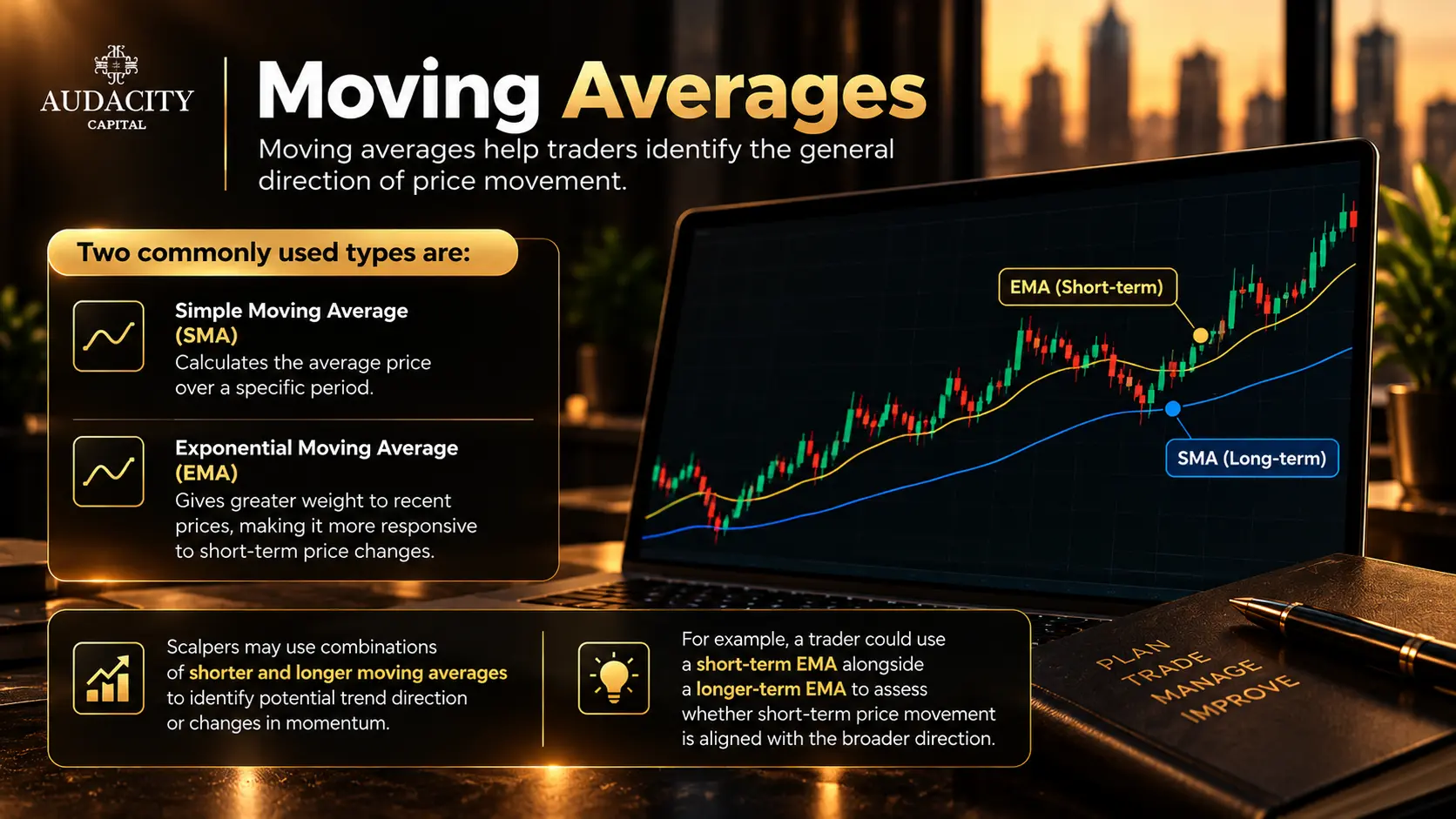
Moving averages help traders identify the general direction of price movement.
Two commonly used types are:
- Simple Moving Average (SMA)
- Exponential Moving Average (EMA)
An EMA gives greater weight to recent prices, which can make it more responsive to short-term price changes.
Scalpers may use combinations of shorter and longer moving averages to identify potential trend direction or changes in momentum.
For example, a trader could use a short-term EMA alongside a longer-term EMA to assess whether short-term price movement is aligned with the broader direction.
3. Stochastic Oscillator
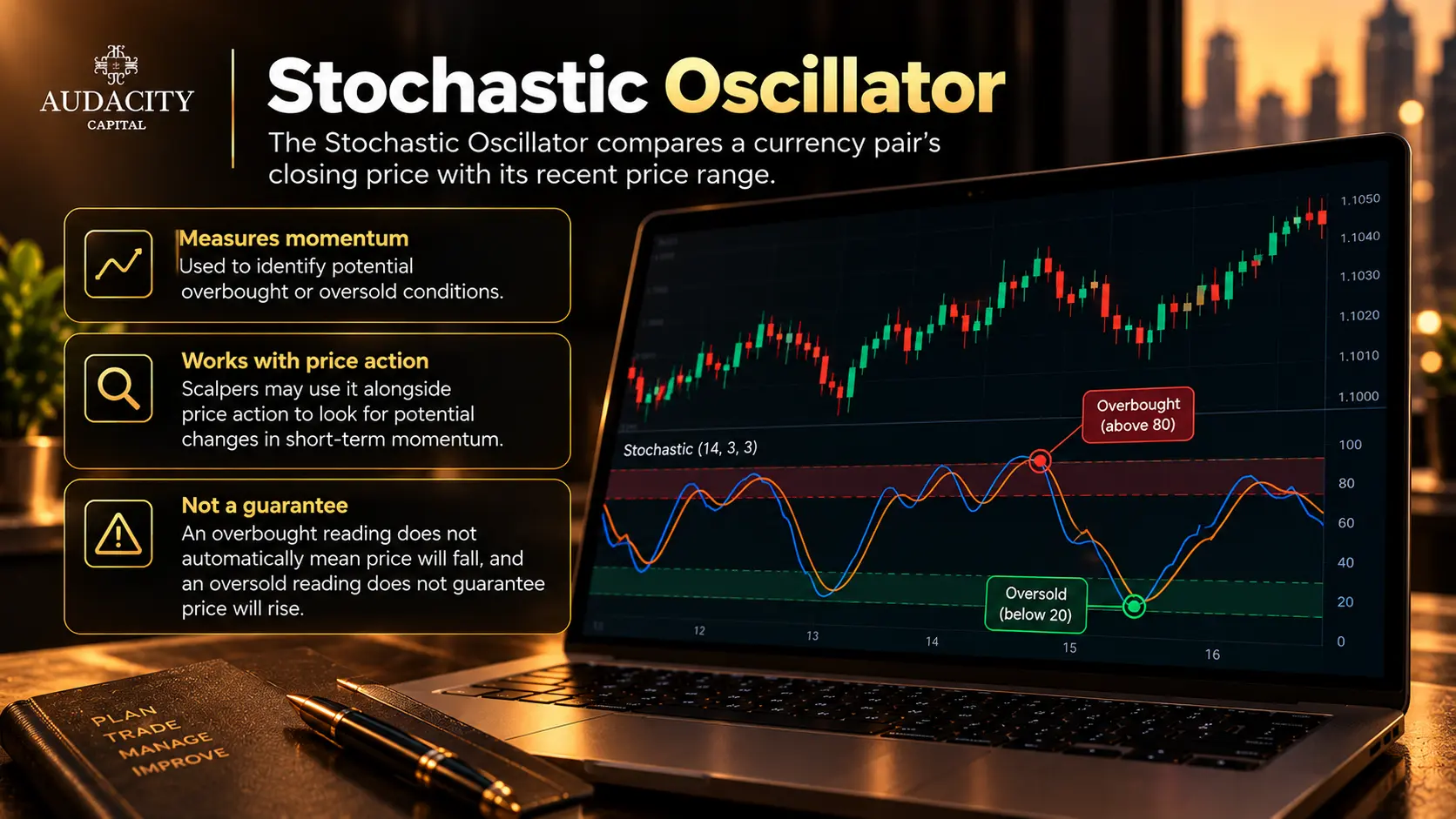
The Stochastic Oscillator compares a currency pair's closing price with its recent price range.
It is commonly used to identify momentum and potential overbought or oversold conditions.
Scalpers may use the indicator alongside price action to look for potential changes in short-term momentum.
However, an overbought reading does not automatically mean that price will fall, and an oversold reading does not guarantee that price will rise.
4. Parabolic SAR
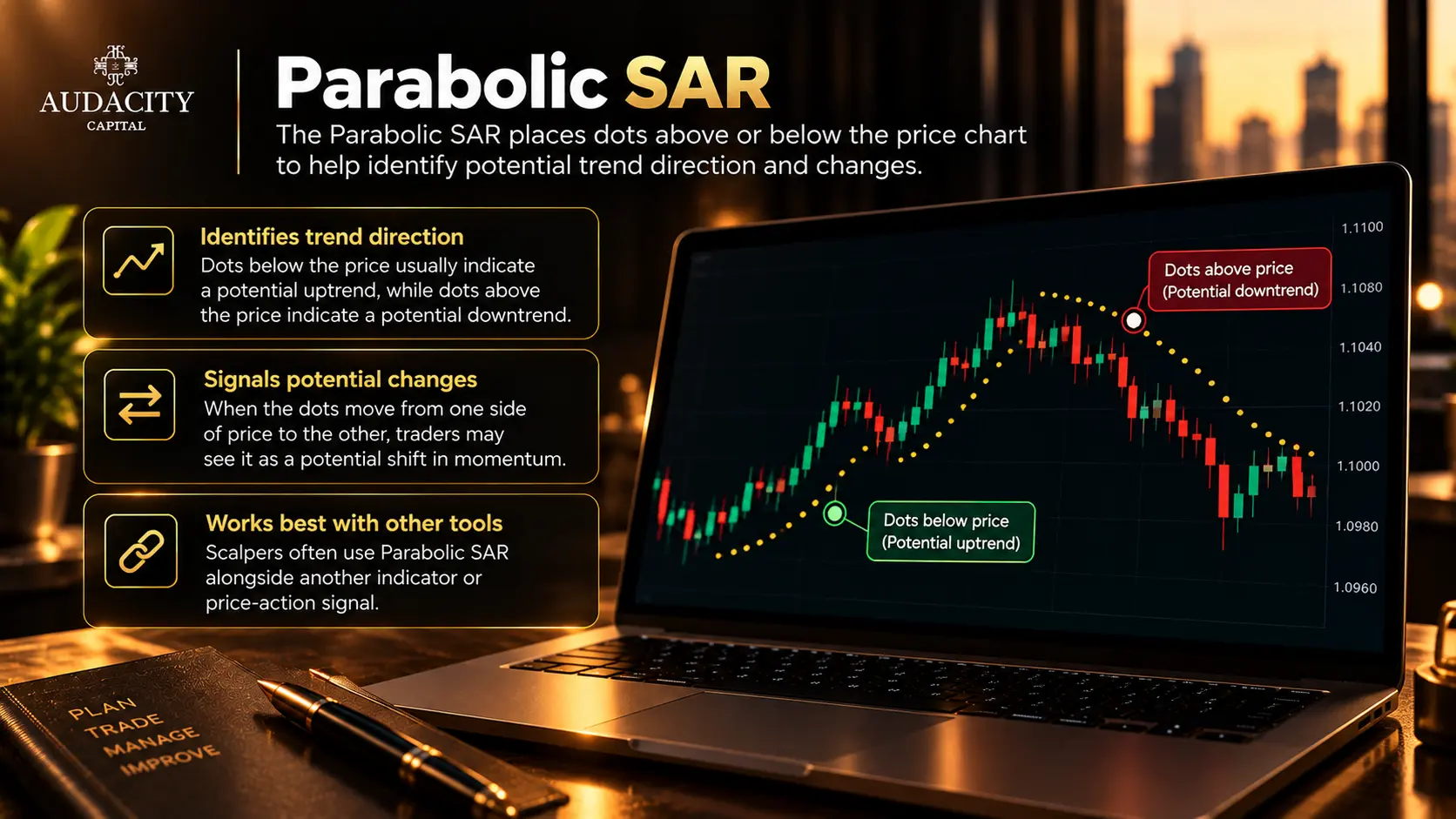
The Parabolic SAR places dots above or below the price chart to help identify potential trend direction and changes.
When the dots move from one side of price to the other, traders may interpret the change as a potential shift in momentum.
Scalpers sometimes use Parabolic SAR alongside another indicator or price-action signal rather than relying on it independently.
5. Relative Strength Index (RSI)
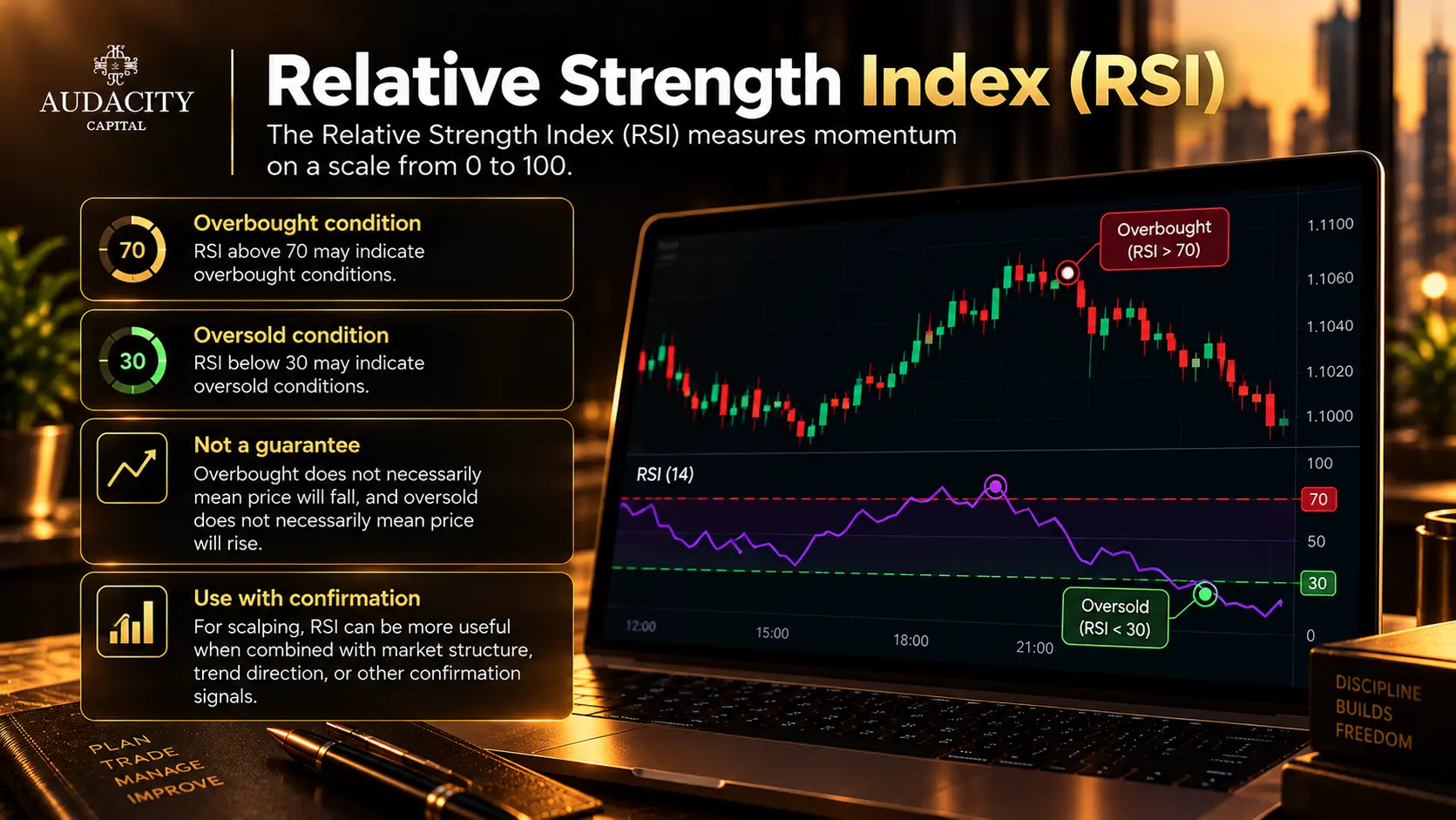
The Relative Strength Index, commonly known as RSI, measures momentum on a scale from 0 to 100.
The 70 and 30 levels are often used as reference points:
- Above 70 may indicate overbought conditions
- Below 30 may indicate oversold conditions
However, overbought does not necessarily mean that price must fall. Likewise, oversold does not necessarily mean that price must rise.
During strong trends, RSI can remain in overbought or oversold territory for an extended period.
For scalping, RSI can therefore be more useful when combined with market structure, trend direction, or other confirmation signals.
7 Forex Scalping Strategies
Different market conditions can require different approaches. The following are seven commonly used forex scalping strategies.
1. Trend Trading Scalping Strategy
Trend scalping involves trading in the direction of an established short-term trend.
Instead of trying to predict a reversal, the trader looks for opportunities to join an existing directional move.
For example, if a currency pair is forming higher highs and higher lows, a trader may look for potential long entries during short-term pullbacks.
How it works
- Identify the prevailing trend.
- Wait for a temporary pullback.
- Look for confirmation that the trend is continuing.
- Enter according to your predefined setup.
- Place a stop-loss based on the trading plan.
- Exit at the predefined target or when the setup is invalidated.
Potential advantages
- Can align trades with existing market momentum
- Provides a clear directional framework
- Can be combined with moving averages and price action
Potential disadvantages
- Trends can reverse unexpectedly
- Pullbacks can become full reversals
- False continuation signals can occur
2. Range Trading Scalping Strategy
Range trading focuses on price moving between identifiable support and resistance levels.
A scalper may look for potential buying opportunities near support and selling opportunities near resistance, provided the range remains valid.
How it works
- Identify a clearly defined trading range.
- Mark important support and resistance areas.
- Wait for price to approach one of those areas.
- Look for confirmation before entering.
- Place the stop-loss beyond the invalidation point.
- Consider exiting before or near the opposite side of the range.
Potential advantages
- Clearly defined trading boundaries
- Multiple opportunities may occur within an established range
- Risk levels can be defined around support and resistance
Potential disadvantages
- Breakouts can invalidate the range
- False breakouts can create losing trades
- Ranges may not remain stable for long
3. Momentum Scalping Strategy
Momentum scalping focuses on strong and relatively rapid price movements.
A trader may look for situations where buying or selling pressure increases and then attempt to participate while momentum remains strong.
Indicators such as moving averages, RSI, or volume-related tools may be used alongside price action.
How it works
- Identify a strong price movement.
- Assess whether momentum is supported by market conditions.
- Wait for an entry signal or brief pullback.
- Enter in the direction of momentum.
- Use predefined risk limits.
- Exit when momentum weakens or the target is reached.
Potential advantages
- Can capture strong short-term movements
- Entry and exit conditions can be relatively clear
- Can work well during periods of increased market activity
Potential disadvantages
- Momentum can disappear quickly
- Late entries can result in poor risk-to-reward conditions
- Sharp reversals can occur
4. Breakout Scalping Strategy
Breakout scalping involves trading when price moves outside an established support, resistance, range, or other technical level.
A breakout can indicate that market conditions have changed, but not every breakout develops into a sustained move.
How it works
- Identify a key support or resistance level.
- Wait for price to approach the level.
- Look for a confirmed breakout.
- Assess whether the breakout has sufficient momentum.
- Enter according to your trading plan.
- Set a predefined exit and risk level.
Some traders also wait for a breakout retest, where price returns to the broken level before continuing.
Potential advantages
- Can capture strong price movements
- Provides identifiable technical levels
- Works across different market conditions when a genuine breakout occurs
Potential disadvantages
- False breakouts are common
- Slippage can increase during fast movements
- Entering too late can reduce the potential reward
5. Pullback Scalping Strategy
Pullback scalping involves entering during a temporary retracement within a broader trend.
For example, during an upward trend, price may temporarily move lower before potentially continuing upward.
Rather than entering after an extended move, the trader waits for a pullback and looks for confirmation that the original trend may resume.
How it works
- Identify a short-term trend.
- Wait for a pullback.
- Identify potential support or resistance.
- Look for confirmation of trend continuation.
- Enter according to the trading plan.
- Set a stop-loss and profit target.
Potential advantages
- Avoids chasing an extended move
- Can provide defined entry areas
- Works well with trend-following techniques
Potential disadvantages
- A pullback can become a reversal
- The market may not provide a suitable entry
- Confirmation signals can appear late
6. Moving Average Crossover Scalping Strategy
This strategy uses two moving averages to identify potential changes in short-term momentum.
A shorter moving average reacts more quickly to recent price movements, while a longer moving average responds more slowly.
A trader may monitor when the shorter moving average crosses above or below the longer moving average.
How it works
- Select two moving averages.
- Monitor the relationship between them.
- Look for a crossover.
- Confirm the signal using price action or another indicator.
- Define the stop-loss and target.
- Exit according to the trading plan.
Potential advantages
- Easy to understand
- Can help identify short-term directional changes
- Can be combined with trend analysis
Potential disadvantages
- Moving averages are lagging indicators
- Sideways markets can produce repeated false signals
- A crossover does not guarantee continued price movement
7. Support and Resistance Scalping Strategy
Support and resistance are among the most commonly used concepts in technical analysis.
Support represents an area where buying interest has previously appeared, while resistance represents an area where selling pressure has previously emerged.
Scalpers can use these levels to structure potential entries and exits.
How it works
- Identify important support and resistance zones.
- Monitor price as it approaches the level.
- Look for a reaction or breakout.
- Confirm the setup using price action or an indicator.
- Define the invalidation point.
- Manage the position according to your risk plan.
Potential advantages
- Works without requiring many indicators
- Provides clear areas to monitor
- Can be combined with trend and range strategies
Potential disadvantages
- Levels can break unexpectedly
- Identifying significant levels can be subjective
- False breakouts can occur
How to Choose a Forex Scalping Strategy
There is no universally best forex scalping strategy. The appropriate approach depends on the trader and the market conditions.
Before selecting a strategy, consider the following:
1. Market Conditions
A trend-following strategy may be more appropriate when a clear directional move exists, while range trading may be more relevant when price remains within defined boundaries.
2. Trading Session
Consider the liquidity and volatility available during the session you plan to trade.
3. Currency Pair
Different currency pairs can have different spreads, volatility characteristics, and liquidity.
4. Trading Costs
Scalpers make frequent trades, so spreads, commissions, and other transaction costs can have a meaningful impact on results.
A strategy that appears profitable before trading costs may produce different results after spreads and commissions are included.
5. Risk Management
Determine how much capital you are willing to risk before entering a trade.
A strategy should include rules for:
- Position size
- Stop-loss
- Maximum daily loss
- Maximum number of trades
- Profit targets
- Conditions for stopping trading
6. Trading Experience
Scalping requires quick decision-making and close attention to market conditions. Beginners should understand the mechanics and risks of short-term trading before using a live account.
Common Mistakes Forex Scalpers Should Avoid
Having a strategy does not automatically eliminate trading risk. Scalpers can still make mistakes that affect their results.
Overtrading
Taking more trades does not necessarily increase profitability. Entering trades simply because the market is moving can lead to unnecessary losses.
Ignoring Trading Costs
Frequent trades mean frequent exposure to spreads and commissions. These costs should be considered when evaluating a scalping strategy.
Using Excessive Leverage
Leverage can increase both potential gains and potential losses. Excessive leverage can cause relatively small price movements to have a significant effect on an account.
Moving the Stop-Loss
Changing a stop-loss to avoid accepting a loss can turn a small planned loss into a much larger one.
Trading Without a Plan
Entering trades without predefined conditions can lead to inconsistent decisions and emotional trading.
Ignoring Economic Events
Major economic announcements can cause rapid price movements, wider spreads, and increased execution risk.
Forex Scalping vs Other Trading Styles
Scalping is only one approach to trading the forex market.
Trading Style | Typical Holding Period | Main Focus |
|---|---|---|
Scalping | Seconds to minutes | Small short-term movements |
Day Trading | Minutes to hours | Intraday price movements |
Swing Trading | Days to weeks | Larger market swings |
Position Trading | Weeks to months or longer | Longer-term trends |
The appropriate style depends on a trader's objectives, risk tolerance, available time, and trading plan.
Is Forex Scalping Profitable?
Forex scalping can be profitable for some traders, but there is no guarantee of consistent profits.
The strategy involves frequent trades, which means losses and trading costs can accumulate quickly. A trader needs to consider the relationship between winning trades, losing trades, average profit, average loss, transaction costs, and risk exposure.
For example, a strategy with a high win rate can still lose money if its average losing trade is substantially larger than its average winning trade.
This is why evaluating a scalping strategy should involve more than simply asking how many trades it wins.
Traders may consider testing a strategy in a demo environment or through historical data before applying it with real capital.
Final Thoughts on Forex Scalping Strategies
Forex scalping strategies provide traders with structured approaches for identifying short-term opportunities in the currency market.
Trend trading, range trading, momentum trading, breakout trading, pullback trading, moving average crossovers, and support-and-resistance strategies are among the approaches traders may consider.
However, no strategy works equally well in every market condition.
Successful implementation requires more than selecting an indicator or copying a trading setup. Traders should understand market conditions, account for spreads and commissions, use appropriate position sizing, establish clear stop-loss rules, and maintain disciplined risk management.
The goal should not simply be to take more trades. A structured scalping approach should help traders determine when to trade, when not to trade, and how much risk to accept when a setup does not work as expected.
Frequently Asked Questions
Forex scalping is a short-term trading approach where traders attempt to capture relatively small price movements in currency pairs. Positions are typically held for a short period, ranging from seconds to minutes or sometimes longer.
Common forex scalping strategies include trend trading, range trading, momentum trading, breakout trading, pullback trading, moving average crossovers, and support-and-resistance trading. No single strategy is suitable for every market condition.
Scalpers commonly use 1-minute, 5-minute, and 15-minute charts. The appropriate timeframe depends on the strategy, market conditions, and trading approach.
Commonly used indicators include Bollinger Bands, moving averages, the Stochastic Oscillator, Parabolic SAR, and RSI. Indicators are tools rather than guarantees of successful trades and are often combined with price action and risk management.
Scalping can be challenging for beginners because it requires quick decisions, close market monitoring, and disciplined risk management. Beginners should understand the risks and consider practising in a demo environment before using real capital.
There is no fixed number. Some scalpers may take only a few trades, while others may take many more. The number of trades should be determined by the strategy and available opportunities rather than an arbitrary daily target.
Yes. Scalping involves frequent trading and exposure to rapid price movements. Spreads, commissions, slippage, leverage, and repeated losses can significantly affect trading results.
News releases can create rapid price movements and increased volatility. Traders should understand the risks associated with trading around major economic announcements and check the rules and conditions of their broker or trading programme before doing so.

¿Listo para aplicar un riesgo disciplinado a las criptomonedas? Explore los nuevos instrumentos de cripto de Audacity Capital y traiga su estrategia de trading.
Aprender másBoletín
Únase a nuestro boletín para mantenerse al día.
Únete a Nuestra Comunidad Social

Comienza Tu Viaje Hoy Con Nuestra Prueba Gratuita
Muestra con orgullo tus habilidades y logros a través de certificados y obtén reconocimiento por tu arduo trabajo y dedicación de posibles inversores y compañeros.
Prueba GratuitaArtículos Relacionados

ICT Silver Bullet Strategy: Windows, Setup and Execution Rules
The ICT Silver Bullet windows, the setup step most guides skip, entry and stop rules, and what the published win rates rest on.


Martingale Strategy in Trading
How the martingale trading strategy works, what the doubling arithmetic actually costs, why position sizing cannot create an edge, and where it is banned.

Momentum Trading Strategy: A Comprehensive Guide
Master the core principles of a momentum trading strategy. Learn how to use key indicators, manage sharp-reversal risks, and master exit timing.
Opening Range Breakout Strategy: Rules, Setups and Examples
Learn how the opening range breakout strategy works, including ORB rules, 5, 15 and 30-minute setups, entry signals, stop losses and risk management.