


Momentum Trading Strategy: A Comprehensive Guide



Momentum trading strategy refers to the taking of trade positions in the direction of a substantial price move based on the idea that a price move with sufficient momentum is likely to keep going.
In other words, you buy strength to sell it higher, and you sell weakness to cover it lower.
Buying the already rising stock may seem contradictory, but the tricky thing here is exiting the trade. As you are holding extended moves, a sudden reversal may easily wipe out your gains of several winners in just one session.
In this guide, we will cover the concept of momentum trading, its types, indicators of momentum, the structure of a momentum setup, and the risks you have to price in.
Note: This is educational information and not financial advice. Momentum trading is effective in trending and volatile markets but not in choppy or sharp reversals. Nothing is certain, extended trend means a chance for its reversal, and most retail traders end up losing money.
What Momentum Trading Is
Momentum trading involves taking a trade based on the strength of the trend. The logic behind the approach is the notion that when the trend develops enough strength, it may continue until that force is used up. After that, the move will stall or reverse.
So, what is momentum trading? The simple answer is to buy high to sell higher and shorting low to cover lower.
Momentum trading is a cousin of trend trading. Both trades are on the strength side. Trend-following usually involves longer-term trends, whereas momentum trades rely on the force and speed of the current movement.
It is completely opposite to mean reversion that fades extremes and implies going back to the average price levels. Similar to trend-following, momentum also requires trending or volatile market environments to perform. In quiet, mean-reverting markets it tends to give back the edge.
Absolute vs Relative Momentum
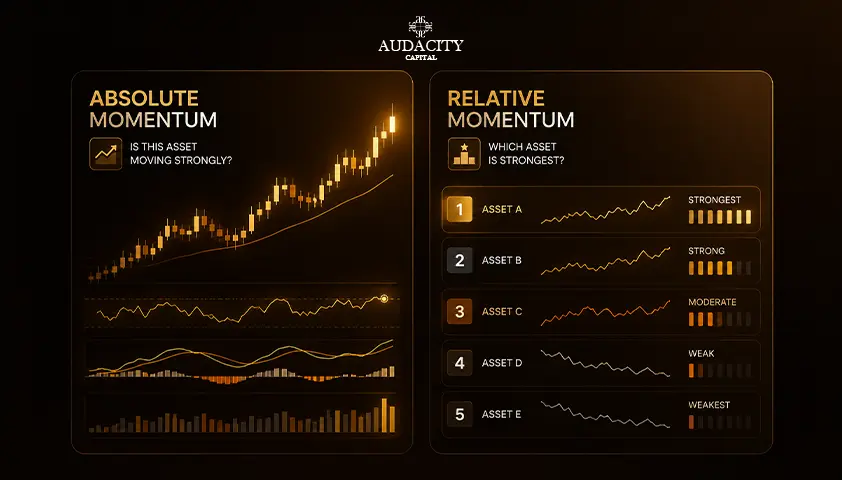
There exist two separate categories, and retail resources tend to confuse them frequently.
1. Absolute momentum
Also known as time-series momentum takes into account an asset's own trend. If an asset recently showed a positive return, a strategy may want to hold a long position. In case of a negative return, a strategy may shift to cash or take a short position, depending on its rules.
Studies have shown that there have been positive historical returns for time-series momentum strategies across equities, bonds, commodities and currencies. However, the returns have not been consistent and can experience large drawdowns around sharp market turning points.
2. Relative momentum
Also known as cross-sectional momentum involves ranking a group of assets against one another and favors the strongest while avoiding or shorting the weakest.
This is very close to the concept of relative strength: you are not assessing the upward trend in the asset by itself but whether it is trending up more strongly than its competitors.
Many systematic strategies combine the two. They first require a positive absolute trend, then select the strongest names from that group.
Frame these as historical factor behaviors, not predictions. Past performance does not guarantee future outcomes, and the momentum factor has produced long stretches of underperformance.
The Real Skill Is the Exit, Not the Entry
Most guides focus on entries. This is a misplaced focus.
In momentum trading, exits become important since this trading strategy keeps positions open through extended moves, and any rapid change could take away the gains, resulting in what most people refer to as momentum crash.
The truth is that every entry is into strength. But some strength remains and some is running out. Telling those apart is the actual skill.
It means context, confirmation, and having a proper exit are more important than the entry trigger you choose. A perfectly placed entry into an exhausting move will be lost. Even a mediocre entry into a strong trend may yield good results.
The solution is to know your exit point before you even get in. There are three tools that work together:
1. Trailing stop.
The trailing stop moves with the rally to capitalize on its progress while still allowing it room to grow. It may be based on a moving average, ATR multiplier, or swing pattern.
2. Momentum-loss signal.
This is a discretionary or systematic trigger indicating that the trend is weakening. Examples include short-term moving average dropping below the longer one, a momentum oscillator reversing after hitting an extreme level, or price falling back into its broken range.
3. Hard stop.
A static value that limits losses if there is a sharp gap or reversal, bypassing the trailing logic.
Position sizing underlies all of the above. Size the position first, so that one reversal does not wipe out your entire trading account.
In momentum trading, entry is the way in, but it is the exit and risk management that provides the edge, because you are constantly open to a reversal at any time.
There is no exit strategy that escapes every reversal. Each rule above must be tested in the market you trade prior to implementation.
The Tools: Indicators for Momentum
These are indicators used by traders to gauge the strength and velocity of a move. All of the settings below are examples and should be tested rather than blindly applied.
The core oscillators:
1. Relative strength index (RSI).
Measures the rate of the move on a 0 to 100 scale, and indicates overbought or oversold states at common thresholds. In strongly trending markets, RSI will remain at extreme levels for long periods, making it useful for context but not automatic reversals.
2. MACD.
Momentum is measured by means of a relationship between two moving averages and a signal line. Crossovers, zero-line crosses, and histogram activity are all indicators that reveal different things about changes in momentum.
3. Rate of change (ROC).
The simplest one of the three, measuring price percentage changes over a specified period of time. Used for ranking assets based on momentum and for spotting when momentum is decelerating.
The trend and confirmation layer:
1. Moving average crossover.
A shorter EMA crossing a longer one is a classic signal that momentum has shifted. It lags by design, which is a feature in strong trends and a weakness in choppy ones.
2. ADX.
Gauges trend strength without telling you direction. Combining a directional signal with a rising ADX filters out low-conviction environments.
3. Volume confirmation.
Strong moves on strong volume are more likely to be genuine. Volume confirmation is one of the cleaner ways to separate real breakouts from head-fakes.
4. Breakout.
A move through a defined range, level, or consolidation is a common momentum trigger, especially when accompanied by an expansion in volume and range.
No single indicator is enough. Combine two or three that measure different things, and always backtest on the specific market and timeframe you plan to trade.
How to Trade Momentum?
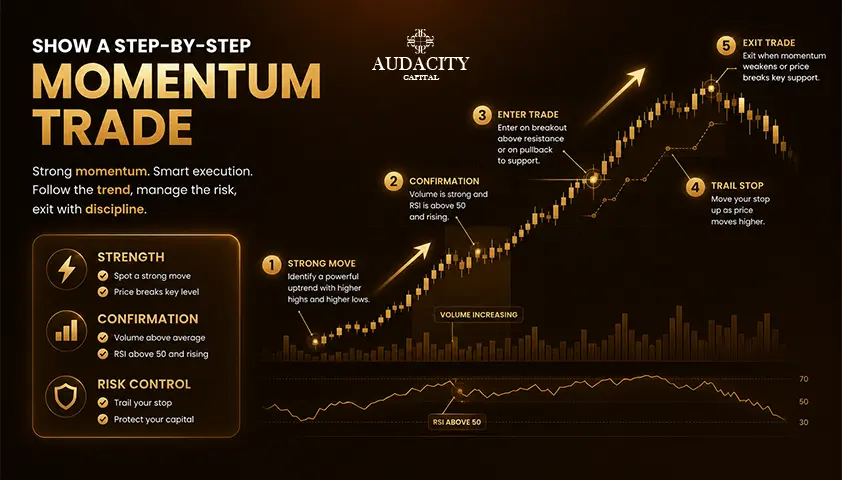
A workable momentum trading strategy follows a repeatable sequence. This is a framework for structuring your own testing, not a recommendation to trade any specific setup.
- Locate strength: Scan for markets where price is trending and volume supports the move. Cross-sectional ranking, sector or index leadership, and clean chart structure all help you filter.
- Confirm conviction: Look for agreement across a couple of indicators rather than relying on one. Volume behind the move, a rising ADX, and a directional signal from RSI, MACD, or ROC all raise the quality of the setup.
- Enter on a defined trigger: Common examples include a breakout above a range or prior high on expanding volume. Another is a shallow pullback into a moving average or prior support during an uptrend. Do not chase blindly after most of the move has already happened.
- Manage the trade: Trail a stop as the move extends. Exit when your momentum-loss signal fires or when the trailing stop is hit. Do not renegotiate your exit rules mid-trade because the chart "still looks strong."
- Size first, always: Set position size before the trade so a full stop-out is a survivable event, not a portfolio problem.
Every trigger, threshold, and stop distance in this framework is an example.
Test it on the market you actually trade, on the timeframe you actually use, and across different regimes before risking capital.
The Risks and Common Mistakes
The signature risk is the sharp reversal. Because momentum holds extended moves, a fast turn can erase gains in a fraction of the time it took to build them. As a factor, momentum has historically suffered severe drawdowns during rapid market reversals, especially at cyclical turning points. This is not hypothetical. It is a documented feature of the return profile.
The most common mistakes cluster around a few themes:
- Chasing late: Entering after most of the move has already happened, when other traders may be expecting the move to reverse.
- Whipsaws in choppy markets: Momentum signals fail in trendless ranges. Trading them anyway produces a stream of small losses that add up.
- Trading false breakouts: Entering on a level break without volume or trend-strength confirmation, then getting trapped when price snaps back inside the range.
- Skipping the stop: Overriding risk rules because the setup "looks too clean to stop out." This is the mistake that turns a manageable loss into an account-level event.
- Overtrading: Frequent entries drive up spreads, commissions, and mental fatigue, all of which erode edge.
Momentum has a well-documented historical return pattern. So does its reversal risk.
The way to see whether it fits your trading is to backtest it on historical data and forward-test it on a demo or simulated account before risking real capital.
No approach guarantees a positive outcome, and most retail traders lose money over time.
Conclusion
A momentum trading strategy buys strength to sell it higher, and it works best in trending, volatile conditions. But because it holds extended moves, the exit and risk management are the edge, not the entry. Get the exit wrong and even good entries bleed. Get the exit right and mediocre entries still compound.
The process holds together like this: first, separate absolute from relative momentum so you know which question you are answering. Confirm conviction with volume and a couple of indicators rather than one.
Enter on a defined trigger instead of chasing. Trail your exit and keep a hard stop in place. Size the position small enough that a reversal is survivable.
Finally, backtest and demo-test the whole approach before committing real capital.
Momentum is one approach among many. Treated with discipline, it earns its place. Treated as a shortcut, it produces the drawdowns it is famous for.
Frequently Asked Questions
It can be in trending, volatile conditions, but it fails in sharp reversals and choppy markets and carries real reversal risk. Profitability depends on strict confirmation, disciplined exits, and position sizing, and even then results are not guaranteed. Most retail traders lose money over time.
They overlap, since both trade in the direction of strength, but trend-following usually rides longer, established trends over weeks or months. Momentum can be shorter-term and focuses more directly on the speed and force of the current move, which means it often enters and exits faster.
They are opposites. Momentum buys strength, expecting continuation, and works best in trending, volatile markets, while mean reversion fades extremes, expecting a return to an average, and works best in ranges. Neither approach works in every regime, which is why traders often specialize in one.
Common tools are the RSI, MACD, rate of change, and moving-average crossovers, usually combined with volume and a trend-strength gauge such as the ADX. No indicator is universally best, and every combination should be tested on the specific market and timeframe you plan to trade.
It is a sharp, fast reversal that hits momentum positions hard, often at cyclical turning points. Historically, the momentum factor has suffered severe drawdowns during such reversals, which is why pre-defined exits and conservative position sizing matter more than any entry signal.
Absolute, or time-series, momentum looks at an asset's own trend and asks whether its recent return is positive. Relative, or cross-sectional, momentum ranks assets against each other and favors the strongest performers within a group. Many systematic strategies combine both.
Momentum can work across timeframes, from intraday trading to factor-style strategies held for several months. The right timeframe depends on the trader, market and cost structure. Shorter timeframes usually have more noise and higher trading costs, while longer timeframes require more patience through drawdowns.
Common methods are a trailing stop that follows the move, a momentum-loss signal such as a moving-average cross back or a momentum oscillator rolling over from an extreme, and a hard stop for a sudden reversal. Momentum trading for beginners especially benefits from defining all three exit conditions before entering, so the decision is not made under pressure.

Ready to apply disciplined risk to crypto? Explore Audacity Capital's new crypto instruments and bring your trading strategy.
Learn MoreNewsletter
Join our newsletter to stay up to date on features and releases.
Join Our Social & Community

Start Your Journey Today With Our Free Trial
Proudly showcase your skills and accomplishments through certificates and get recognition for your hard work and dedication from potential investors and peers.
Free TrialRelated Articles
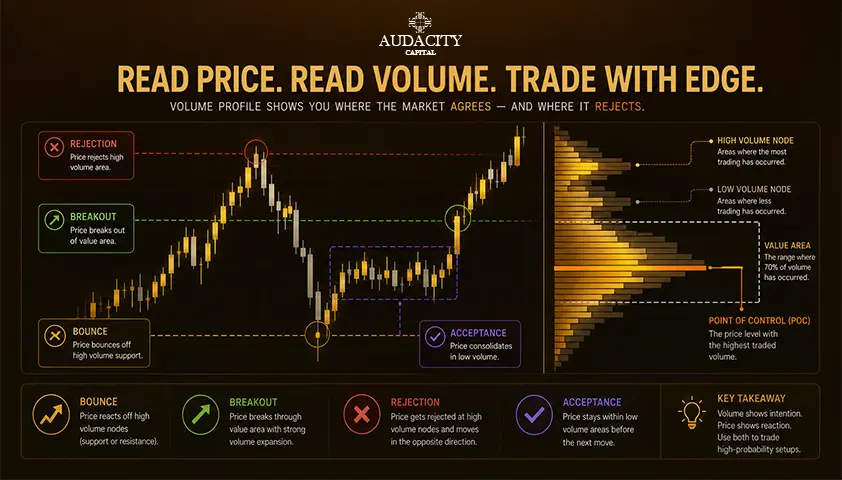
Volume Profile Trading Strategy Guide: Setups & Nodes
A Volume Profile trading strategy shows where the market spent the most volume. Learn POC, value areas, volume nodes, and 4 setups for ES, NQ, and forex.

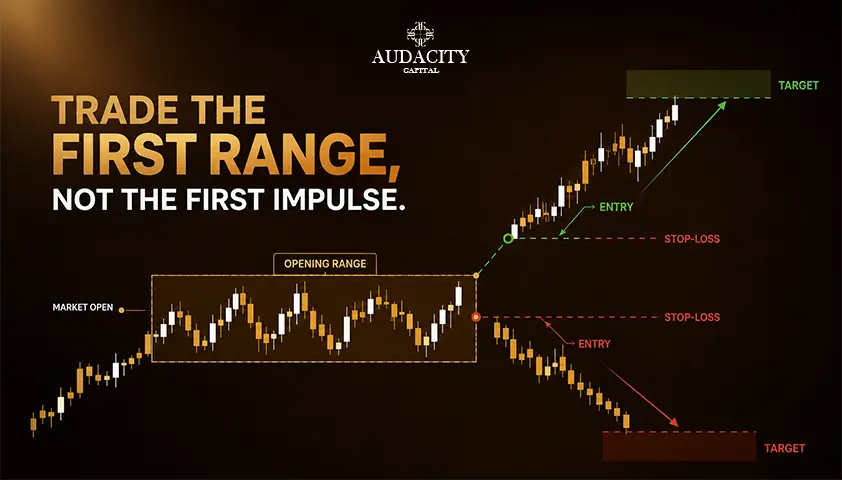
Opening Range Breakout Strategy: Rules, Setups and Examples
Learn how the opening range breakout strategy works, including ORB rules, 5, 15 and 30-minute setups, entry signals, stop losses and risk management.
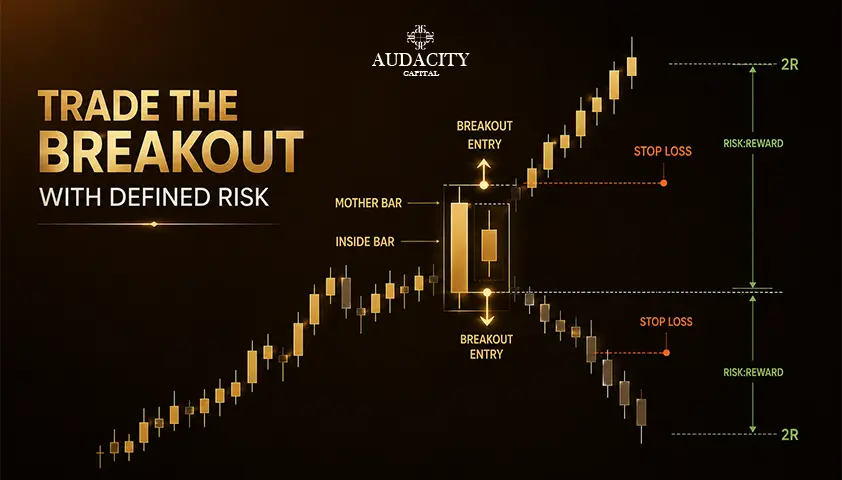
Inside Bar Trading Strategy: Rules, Entries and Risk Guide
Master the inside bar trading strategy with practical rules for pattern identification, entry triggers, stop placement, risk management, and testing.
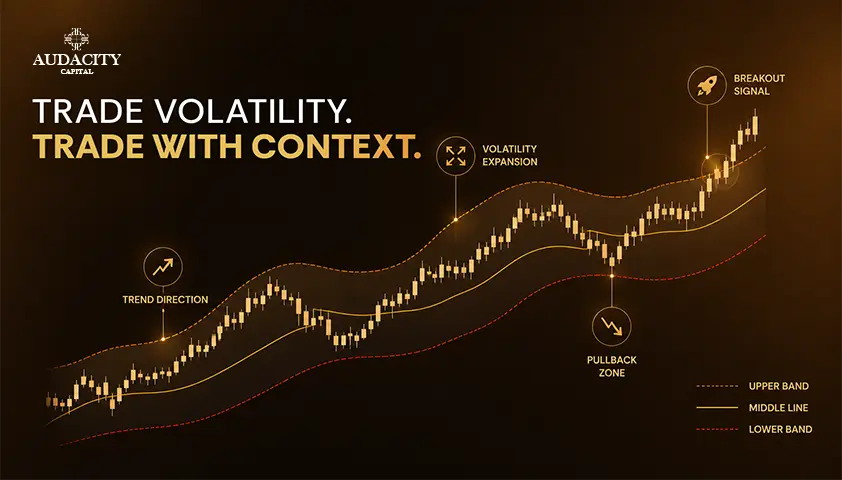
Keltner Channel Trading Strategy: How to Read Volatility With Context
Discover how Keltner Channels measure market volatility, spot trend pullbacks, and confirm breakouts. Includes setup rules, settings, and testing methods.