


How Much Does an Instant Funded Account Cost?(2026 updated)



An instant funded account cost comes down to one thing: a one-time, usually non-refundable fee that scales with the account size you choose, with no deposit of your own trading capital.
You pay the fee, you skip the evaluation, and you get immediate access to a funded account. Simple enough, until you notice the price tag.
Instant funding typically costs about 2 to 3 times what a challenge costs for the same account size.
The reason is straightforward though. You are paying for funding and the firm's risk from your first trade, not just an evaluation.
This guide gives you realistic ranges, the value math, and an honest answer on whether the premium is worth it for someone like you. All figures here are illustrative and a fee is a cost, not a guaranteed return.
What you are actually paying for
When you buy an instant funded account, you are paying a one-time upfront fee. A few older models, mostly in futures, use monthly pricing, but most instant accounts charge once.
That one-time fee is typically non-refundable if you breach the rules, which is a detail worth burning into your memory before you check out.
Here is the most important clarification: the fee is not a deposit of trading capital. You are not funding the account with your own money.
You are paying for immediate access to the firm's simulated capital and the right to skip the evaluation entirely.
That distinction matters, and it is exactly why "free instant funding" claims rarely hold up. Instant is not free, and the no-deposit instant funded account myth deserves its own scrutiny.
The single biggest driver of the price is account size. A $5,000 instant account costs far less than a $100,000 one, because the firm is putting more simulated buying power behind you.
The headline fee is also often just the starting point. Some firms charge extra for higher splits, faster payouts, or other features, so the number you see first is not always the number you pay. Treat the base fee as the floor, not the ceiling.
How much does an instant funded account cost?
So, how much does instant funding cost in practice?
The honest answer is that it varies widely by firm, account size, and discount, and it changes constantly.
The figures below are illustrative as of 2026 and must be checked live on the firm's own site before you decide anything.
With that caveat firmly in place, here is the rough picture:
Account size | Illustrative price range (verify live) |
$5,000 starter / teaser | As little as around $10 to roughly $65 |
$25,000 to $100,000 (mid-range) | Commonly low to high hundreds |
$400,000 (largest tiers) | Around $1,651 at one firm |
Tiny teaser sizes can start very low, sometimes around $10 for a $5,000 starter at some firms. Standard instant accounts commonly run from roughly $65 for a $5,000 account up into the four figures for the largest sizes.
The mid-range sizes most traders actually use, $25,000 to $100,000, commonly land somewhere in the low to high hundreds.
One more thing shapes the real instant funded account price: discount codes are nearly constant in this space. Promotions of 30 to 60 percent off appear regularly, so the price you actually pay is usually well below list.
The takeaway: the headline price alone is misleading. To judge value properly, you need a better metric.
The number that matters more than the price: cost per dollar of capital
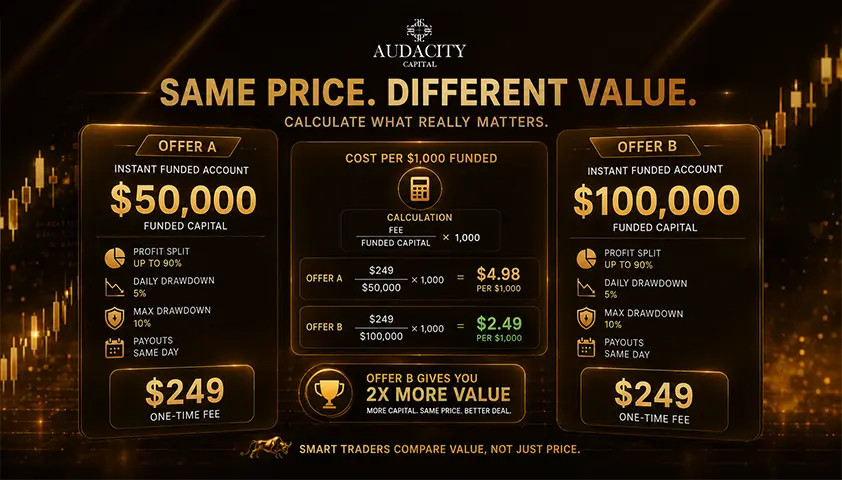
Smart buyers do not chase the lowest sticker. They measure cost per dollar of funded capital.
The calculation is simple: divide the fee by the account size to see how much you pay per dollar of buying power.
Watch what happens when you run the numbers:
- A $99 instant account on $2,000 of capital works out to about 4.95 percent cost-to-capital.
- A $315 instant account on $25,000 works out to about 1.26 percent cost-to-capital.
The larger, higher-priced account is actually far more capital-efficient per dollar. The cheaper-looking option costs you nearly four times as much per dollar of buying power.
This is why cost-to-capital beats sticker price as a comparison tool. A higher fee can deliver better value, and a low fee can quietly be the worse deal.
A lower cost per dollar of funded capital only pays off if you can actually trade the larger size sensibly within the rules.
A cheap-per-dollar big account you cannot manage is not a bargain. It is just more capital to breach.
So compare instant funded accounts on cost per dollar of capital, then sanity-check whether you can genuinely handle the size you are paying for.
Why an instant funded account costs more than a challenge
Now the question the title promised. When you weigh instant funding vs challenge cost, instant funding typically costs about 2 to 3 times a comparable evaluation for the same account size. As a rough illustration, a $100,000 evaluation might run around $540, while a $100,000 instant account might run around $850. Same capital, very different price.
Why? It comes down to risk and timing.
A challenge fee buys an evaluation, not funding. The firm only commits real capital after you prove yourself. And because industry data shows fewer than 10 percent of challenge traders ever reach a payout, the firm's risk on each challenge sale is low.
Most buyers never make it to the funded stage, so the firm can afford to charge less upfront.
An instant account flips that completely. The firm funds you and carries rule-violation risk from your very first trade.
There is no evaluation fee stage to filter out reckless traders. So the firm prices that risk, plus the speed premium, into a higher fee. It also usually pairs the instant route with a lower starting profit split (your share of the profits you generate) and tighter drawdown rules (the limits on how much your account can drop before it is breached).
Instant funding is not a cheap way to access capital. It is an expensive way to avoid an evaluation. You are paying for speed and certainty, not a discount.
That is the real reason the instant funding prop firm cost sits above the challenge price, and understanding it changes how you shop.
The real cost: total cost of ownership, not the sticker
The sticker price lies in both directions, so let's be even-handed.
First, a challenge is not automatically cheaper in practice. The real cost is the fee multiplied by the number of attempts it takes to pass. A $200 evaluation that takes three tries is really a $600 lesson.
A cheap challenge with harsh rules can burn through attempts fast, and suddenly the "budget" route is not so budget after all. That evaluation fee is only cheap if you pass quickly.
Second, the instant fee is non-refundable, and a breach means buying in again. Busted instant accounts do not reset. There is no free do-over.
So the reset / re-buy cost can stack on the instant side too, especially if the tighter drawdown rules catch you out early.
This is why you compare total cost of ownership, not the entry price. Total cost of ownership means the entry fee, plus any paid add-ons, plus the realistic cost of resets or re-buys, weighed against the profit split.
A higher-priced account with a better split can net you more than a cheaper one with a worse split. A cheap instant account with a brutal trailing drawdown can cost you a second non-refundable fee within a week.
What drives the price of an instant funded account

Once you understand what moves the fee, you can read any pricing page with confidence.
Here are the main levers:
Price driver | How it moves the fee |
Account size | By far the biggest driver. Bigger capital means a bigger fee. |
Profit split | A higher split, or upgrading your split, usually costs more, sometimes as a paid add-on. |
More lenient rules can cost more. Instant accounts tend toward tighter or trailing drawdowns. | |
Refundability | Some firms refund the fee after a set number of payouts, effectively making it free for consistently profitable traders. Instant fees are refunded less often than challenge fees. |
Paid add-ons | Higher splits, faster payouts, and performance protection often carry extra charges. |
Discount codes | Nearly constant in this space, and they swing the real price significantly. |
Activation fee | Some firms charge one on funding, some charge none. Read the fine print. |
The lesson is simple. Price the full package, not just the base fee.
Two firms can advertise the same headline number and end up costing very different amounts once discount codes, add-ons, and split upgrades are in the mix.
Is an instant funded account worth the higher cost?
An instant funded account is worth it for experienced, proven traders who value their time over the price difference and will respect tight rules.
You are buying immediate access, no evaluation pressure, no deadlines, and no risk of failing a challenge. If your time is worth more than the premium and your risk management is already disciplined, the extra cost can make sense.
It is not worth it in several common cases:
- For beginners. If you cannot reliably pass an evaluation, you will likely breach an instant account and lose a bigger fee. The evaluation is itself a useful sanity check on your risk management. Skipping it does not make you ready for funded capital.
- For undercapitalized traders treating instant as a cheap way to get leverage. It is the opposite, an expensive way to skip an evaluation.
- For scalpers and high-frequency traders. Instant accounts often come with lower leverage and tighter limits that can choke your strategy.
If you do go instant, here is how to get the best value:
- Compare on cost per dollar of capital, not the sticker.
- Use the near-constant discount codes. The list price is rarely the real price.
- Weigh the profit split, not just the entry fee. A better split can outweigh a higher fee.
- Favor a survivable rule set. A fixed static drawdown means fewer breaches and re-buys, which is real money saved.
- Start with a size whose fee you can comfortably afford to lose.
- Verify the firm's legitimacy and payout record first. A cheap account from a firm that does not pay is the most expensive option of all.
One last red flag worth repeating. An instant price well below typical evaluation fees is a reason to read every single rule, not a reason to celebrate.
The firm has to recover that cost somewhere, often through harsher rules or a lower split. This is a general pattern to watch for, not an accusation against any firm.
Audacity Capital: Value Through Transparency and Survivability
Audacity Capital's FTP is an instant route built around transparent, no-hidden-fee pricing, with a one-time fee that scales with the tier you choose. The value connection is worth making clearly, because it ties directly back to everything above.
The FTP uses a static drawdown, a fixed 5% daily limit and a 10% maximum. That matters for cost more than it first appears.
The biggest hidden expense in instant funding is breaching and having to buy in again. A fixed, predictable rule set is far more survivable than the tighter or trailing drawdowns common on instant accounts, which means fewer of those costly re-buys. Survivable rules are not just comfortable. They are cheaper over time.
Add the path to scaling toward larger capital and the regular bi-weekly payouts, and the picture sharpens.
None of this guarantees a profit or a return on your fee. Most traders still need genuine skill and discipline to keep a funded account.
But the honest message stands: judge the cost of an instant account by the total cost of getting and staying funded, not the sticker. A transparent fee paired with survivable rules is where the real value tends to live.
If that fits how you trade, take a closer look at the Funded Trader Program and verify the current fee, split, and rules for yourself before you commit.
FAQ
Yes, typically about 2 to 3 times more for the same account size. With a challenge you are paying for an evaluation, while with instant funding you are paying for immediate funding and the firm's risk from day one, usually with a lower starting split too. Figures are illustrative and vary by firm.
Usually not. Instant fees are typically non-refundable, especially if you breach, unlike many challenge fees that are refunded on your first payout. A few firms refund the instant fee after several payouts, so always check the specific policy before you buy.
It varies widely and is discount-dependent, but it commonly lands in the several-hundred-dollar range and is often roughly 2 to 3 times the price of a $100,000 evaluation. Verify the firm's current price rather than relying on any fixed figure, since prices change constantly.
It is the fee divided by the account size, and it is a better value measure than the sticker price. A higher-priced larger account can actually cost less per dollar of buying power, so a small cheap account can have a higher cost-to-capital than a larger, pricier one.
Because the firm funds you and carries rule-violation risk from your first trade, with no evaluation to filter out reckless traders. It prices that risk and the speed premium into a higher fee, whereas a challenge only commits the firm's capital after you have proven yourself.
Not necessarily. An instant account priced well below typical evaluation fees is a reason to scrutinize every rule, since the firm has to recover the cost somewhere. The lowest fee means nothing if the firm does not reliably pay, so weigh price against the rules and the firm's track record.
Sometimes. Watch for paid add-ons like higher splits or faster payouts, the cost of resets or re-buys if you breach, and the non-refundable fee itself. This is exactly why total cost of ownership matters more than the entry price.
A low-fee challenge is usually the cheapest upfront if you can pass, but the real cost is the fee multiplied by your attempts. Instant funding costs more yet removes the risk of failing and re-paying, so the cheapest route depends on how reliably you pass evaluations.

¿Listo para aplicar un riesgo disciplinado a las criptomonedas? Explore los nuevos instrumentos de cripto de Audacity Capital y traiga su estrategia de trading.
Aprender másBoletín
Únase a nuestro boletín para mantenerse al día.
Únete a Nuestra Comunidad Social

Comienza Tu Viaje Hoy Con Nuestra Prueba Gratuita
Muestra con orgullo tus habilidades y logros a través de certificados y obtén reconocimiento por tu arduo trabajo y dedicación de posibles inversores y compañeros.
Prueba GratuitaArtículos Relacionados
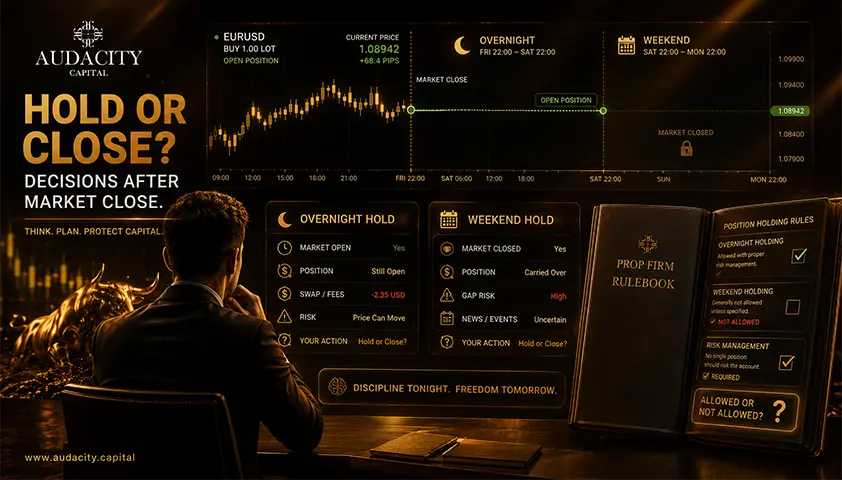
Can You Hold Trades Overnight or Over the Weekend on a Prop Firm?
Can you hold trades overnight or over the weekend on a prop firm? Learn the rules, risks, gap exposure, and which prop firms allow swing trading.


Do You Pay Taxes on Prop Firm Payouts? A Funded Trader's Guide
In almost every country, prop firm payouts are taxable income, not capital gains. Learn how they are taxed, what you can deduct, and why records matter.
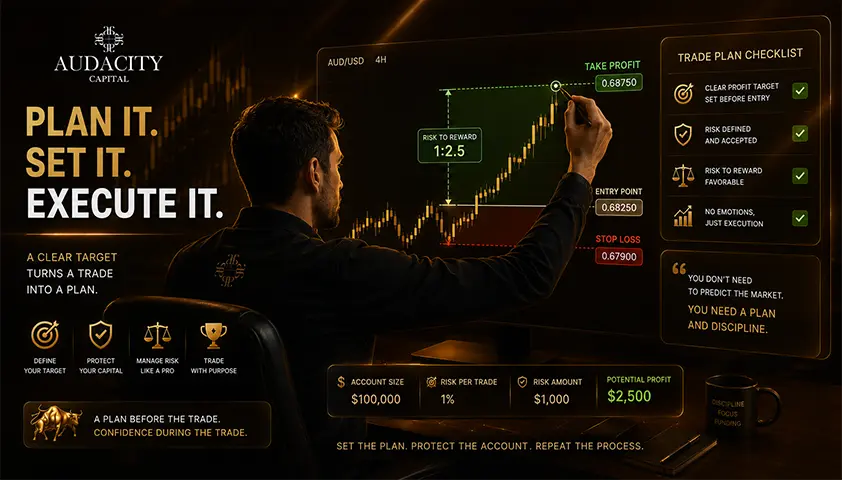
What Is Take Profit in Trading? A Detailed Guide for Traders
Learn what a take profit is, how to set one well using technical levels, risk-reward, and ATR, plus partial profits, trailing stops, and a funded-trader lens.

Best Local Payment Methods for Forex Prop Trading
Compare the best local payment methods for forex prop trading by region and learn faster, cheaper prop firm withdrawals with fewer delays.