


Best Options Prop Trading Firms in 2026: An Honest Map of Who Actually Funds Options



The honest bottom line Most “options prop firm” lists blur four very different businesses together. Genuine funding for listed options is rare and gated. The realistic route for most retail traders is options on futures, not single-stock options. And several firms marketed as options prop trading firms are forex or CFD shops that do not fund options at all. Full disclosure: Audacity Capital is a forex and CFD prop firm. We do not offer options trading. This guide exists to give options traders an honest map, not to sell you an options account we do not have. |
Can You Actually Trade Options at a Prop Firm?
Yes, but rarely the way most people picture it. A small number of firms genuinely fund listed options, and they tend to gate access behind interviews, licensing, or a capital contribution. Most of the firms that rank for options prop firm searches actually fund forex, futures, or CFDs and use “options” as a loose marketing label.
So before you pay any fee, the first question is not “which firm is best” but “does this firm fund the kind of options I trade at all?” Keep one reality in view throughout: most retail traders lose money, and most challenge accounts never reach a payout. A funded account gives you capital and structure, not an edge.
The Four Types of “Options Prop Firm” (and Which One You Want)
The phrase options prop trading firms gets attached to four business models that have almost nothing in common. Sorting them out is the single most useful thing you can do before spending money.
Type | What you actually trade | Access model | Example firms |
|---|---|---|---|
1. Professional / desk firms | Real listed equity and index options | Interview + license and/or capital bond | SMB Capital, T3, Maverick Trading |
2. Futures + options-on-futures | Futures and options on futures (ES, crude, gold) | Simulated challenge, then funded | Topstep, Elite Trader Funding |
3. Multi-asset CFD / crypto | CFDs and crypto perpetuals (no listed options) | Simulated challenge, then funded | FundedNext, BrightFunded, Velotrade |
4. Forex / CFD challenge firms | Forex and CFDs only (no options) | Simulated challenge, then funded | FTMO, The5ers, Audacity Capital |
1. Professional and desk options firms
These are the closest thing to a real trading-desk seat, and they fund actual listed options. The catch is access: you typically earn it through an interview, a licensing requirement, or a first-loss capital contribution, not a small evaluation fee. This is what most people imagine when they search for options prop firms, and it is also the hardest door to walk through.
2. Futures and options-on-futures firms
The most realistic accessible route. You pass a simulated evaluation, get funded, and trade futures and, at some firms, options on those futures (S&P 500, crude oil, gold). Platforms like Tradovate, NinjaTrader, and Rithmic support this. For an options-literate retail trader with no license or capital to post, this is usually the practical answer to “prop firms for options trading.”
3. Multi-asset CFD and crypto firms
These offer broad markets through CFDs or crypto perpetual futures. They can replicate some of the directional and volatility exposure options traders want, but they are not listed options. Treat them as a substitute, not the real thing.
4. Forex and CFD challenge firms (including us)
The largest group by far. They fund forex and CFDs and do not offer options at all. Audacity Capital sits here. If listed options are your actual goal, these firms, ours included, are the wrong tool, and we would rather tell you that than take your fee.
Why Real Options Funding Is So Rare

The shortage is not an accident. Listed options are harder to fund than forex or futures for structural reasons:
- Licensing. Real options market access needs a broker-dealer or market-maker framework, not just a platform login.
- Margin. Options use SPAN or Black-Scholes-style portfolio margin, not the flat leverage of a single forex lot.
- Non-linear payoffs. Your position moves with the underlying, with time, and with volatility all at once.
- Real-time risk. A firm has to track your net Greeks (Delta, Gamma, Theta, Vega) continuously, not just check your balance at the end of the day.
The retail challenge model was built on MetaTrader, DXTrade, and similar platforms designed for linear, single-multiplier instruments. Those platforms generally cannot run a live options risk engine, which is why most challenge-style options trading prop firms quietly route you into CFDs or futures instead.
The Genuine Options Prop Firms in 2026
Here are the firms actually worth a serious look, grouped by route. Terms change often, so confirm every figure on the firm’s own site before you pay.
Firm | Route | Instruments | Access model | Profit split |
|---|---|---|---|---|
SMB Capital | Desk | Equities, options, futures | Interview + desk requirements | Varies |
T3 Trading Group | Desk (broker-dealer) | Equities and options, multi-leg | SIE + Series 57 (sponsored) + capital | 50% to 90% |
Maverick Trading | Remote / hybrid | Equity and index options, spreads | Training + capital bond (~$5K) | Up to 80% |
Funder Trading | Instant / hybrid | Options and equities | Instant, no license | Trader majority |
Topstep | Futures | Futures + options on futures | Simulated challenge | Up to 90% |
Elite Trader Funding | Futures | Futures + options on futures | Simulated challenge | Trader majority |
If you want real listed options
SMB Capital is a New York desk that funds equities, options, and futures with training and mentorship; expect selective recruiting and professional requirements closer to a job than a challenge. T3 Trading Group is an SEC-registered broker-dealer (operating since 2003) that funds equities and options including multi-leg spreads, but requires SIE and Series 57 licenses (it can sponsor the exams) and often a first-loss capital contribution. Maverick Trading is a long-running, remote, education-led firm that funds equity and index options including spreads, iron condors, and calendars; expect a training program and a capital bond (around $5,000) rather than a license, which often makes it the most accessible door for a retail trader going pro.
One note on the elite names: market makers like SIG, Optiver, IMC, Jane Street, and Citadel Securities hire options traders as employees. They do not sell evaluations, so they are a career path, not a funded-account product.
If options on futures works for you
Topstep is the most established futures firm (12-plus years), funding CME futures and, on eligible programs, options on futures; confirm exactly which options contracts are eligible on funded accounts before buying. Elite Trader Funding offers dozens of contracts including options on futures tied to indices, currencies, and commodities, which makes it a practical, lower-barrier route to options-style exposure.
A word of caution
This space changes fast, and firms disappear. SurgeTrader, which still appears on many “best options prop firms” lists, ceased all operations in May 2024 after losing its trading-platform license. Before paying any firm, check that it is currently operating and has a clean recent payout record.
Stock Options vs Index Options vs Options on Futures

Searches for a “stock options prop firm” often hit a wall, because single-stock equity options are the hardest instrument to get funded for. A quick map:
- Single-stock options: the rarest at prop firms; mostly limited to the desk firms above (SMB, T3, Maverick).
- Index and ETF options: somewhat more available at those same desk firms.
- Options on futures (ES, NQ, crude, gold): the most accessible through retail challenge firms such as Topstep and Elite Trader Funding.
If you have been searching for funded options trading on individual stocks with no capital and no license, that exact product is close to nonexistent, and options on futures is usually the realistic substitute. One more distinction: “binary options” are a separate, heavily restricted product, not what legitimate options prop trading firms fund.
Profit Splits, Drawdown, and the Rules That Actually Matter
Across legitimate firms, profit splits typically run from 50% up to 90%, and sometimes higher on specific account types. But the headline split matters less than the rules that decide whether you keep an account long enough to get paid.
- Profit split. Sets your take-home, but an up-to-90% split is worthless if the rules do not fit your strategy.
- Drawdown model. Static (fixed from your starting balance) is more forgiving than trailing (which follows your high-water mark and tightens as you profit). For options and swing strategies that need room to breathe, this is often the most important rule on the page.
- What is allowed. News trading, overnight and weekend holding, and position or Greek limits vary widely. Strategies built around earnings or expiry need explicit permission to hold through those events.
No split or rule set makes anyone profitable. Most challenge accounts fail, and a funded account is capital and structure, not a guarantee.
What to Verify Before You Pay Any Fee
- Instrument access in writing. Confirm the firm funds the exact options you trade (single-stock, index, or options on futures). “Multi-asset” does not mean options.
- Platform and risk engine. Make sure the platform actually supports options and live Greeks, not just linear CFDs.
- Access requirements. License (for example, Series 57), capital bond, or interview? Know the real cost and time before you start.
- Drawdown model. Static or trailing, and when it resets.
- News and event policy. Confirm you can hold through the events your strategy depends on.
- The firm is real and paying. Check that it is currently operating and has a recent, clean payout record.
A Note on Audacity Capital (Full Disclosure)
To be straight with you: Audacity Capital is a forex and CFD prop firm built on MT5 and DXTrade. We do not offer options trading, and our platforms are not designed for listed options. So if single-stock or index options are your goal, the desk firms and futures-options firms above are where to look.
Where we can help is the part of this guide that applies to every firm: clear, transparent rules. If your real aim is funded trading with rules you can actually read, and you are open to trading forex and CFDs rather than options, our funded trader program uses a static maximum drawdown, a published daily loss limit, and no consistency rule, and you can test the whole thing for free in our monthly trading competition before paying anything. Funded terms reach up to 90% profit share, and U.S. residents can take part via DXTrade where permitted.
If you'd rather skip the evaluation process, Audacity Capital also offers Instant Funding with instant funded accounts. Experienced traders can start trading firm capital immediately without completing a traditional challenge while still benefiting from transparent trading rules, up to 90% profit share, and the opportunity to scale their funded account over time.
Trading, real or simulated, carries significant risk, and most retail traders lose money. Nothing here is investment advice.
The Bottom Line
The best options prop trading firms for you depend entirely on what you actually trade. If you want real listed options, look at the desk firms and be ready for an interview, a license, or a capital bond. If you want accessible options-style exposure, options on futures through a reputable futures firm is the practical path. And if a firm advertising options prop firm funding cannot tell you in writing which options you can trade and on what platform, walk away. Clear rules and honest answers are worth more than the biggest advertised profit split.
Related articles
Read more about our latest guide How Much Money Do You Need to Start Options Trading?
FAQs
Honestly, almost none. Legitimate single-stock options funding through a pure online challenge is close to nonexistent because of the exchange, clearing, and data infrastructure required. The realistic no-license routes are options on futures (Topstep, Elite Trader Funding) or a training-and-bond firm like Maverick Trading.
It depends on the route. Desk broker-dealers like T3 require SIE and Series 57, and may sponsor the exams. Futures-options firms and CFD challenge firms generally do not require a license.
No. They share Greeks and similar logic, but the underlying, contract specs, settlement, and tax treatment differ. Options on futures (ES, crude, gold) are far easier to access through prop firms than single-stock options.
An options prop trading firms provides you with the capital, platform, and risk oversight needed to trade at a professional level, while you contribute to the trading strategy and its execution. Please note that you’ll be expected to trade within defined limits at all times, and then share the profits with the prop firm.
That varies by country and by whether you are treated as a contractor or as trading the firm’s capital. This is not tax advice; confirm your situation with a qualified professional.
You can lose access and any pending payouts, as SurgeTrader’s traders found in 2024. Favor firms with a long operating history and a consistent payout record, and withdraw profits on schedule rather than letting them build up.
Usually not. Most offer CFDs or crypto perpetuals that behave like leveraged directional bets. If listed, multi-leg options matter to you, confirm in writing before paying.
Realistically, no. Genuine options firms screen for documented experience and discipline, and most challenge accounts fail. Build a tracked record on your own capital first.
Trading with a retail brokerage firm offers flexibility but limits you in terms of capital injection, standard margins, and higher frictions. The options trading prop firms supply the capital, charge lower commissions, and provide strict rules to help safeguard their funds. For this, you can expect limits on exposure, including on what you can hold overnight.
Examples of rules you can expect at such prop firms will include symbol-level Greek limits, daily loss and trailing drawdown rules, portfolio and net premium at risk caps. Most options prop firms will allow you to hold defined risks overnight, but will have a strict policy when it comes to naked short gamma.
Prop firms have a preference for defined risk structures with consistent sizing and tight loss limits. Their target is usually steady profits and losses over one-off spikes. You’ll do exceedingly well at these firms if you can proactively manage the Greek exposures, minimize slippage, and avoid large short gammas.
Yes. These are supported by many options trading prop firms. Some of the regular fixtures at such firms include complex strategies like iron condors, spreads, and calendars.

¿Listo para aplicar un riesgo disciplinado a las criptomonedas? Explore los nuevos instrumentos de cripto de Audacity Capital y traiga su estrategia de trading.
Aprender másBoletín
Únase a nuestro boletín para mantenerse al día.
Únete a Nuestra Comunidad Social

Comienza Tu Viaje Hoy Con Nuestra Prueba Gratuita
Muestra con orgullo tus habilidades y logros a través de certificados y obtén reconocimiento por tu arduo trabajo y dedicación de posibles inversores y compañeros.
Prueba GratuitaArtículos Relacionados

How Much Does an Instant Funded Account Cost?(2026 updated)
Sticker price tells only half the story. See what an instant funded account cost really covers, why it runs 2 to 3x a challenge, and if it's worth it.


Instant Funding vs the Challenge: Which Funded Account Should You Choose?
Two routes to a funded account, one honest comparison. See how instant funding vs challenge differ on cost, drawdown, and profit split, and which route fits you.

10 Best Prop Trading Firms in Malaysia in 2026
Compare the 10 best prop trading firms in Malaysia for 2026, ranked on swap-free accounts, payout speed, fees, and payments that work from Malaysia.
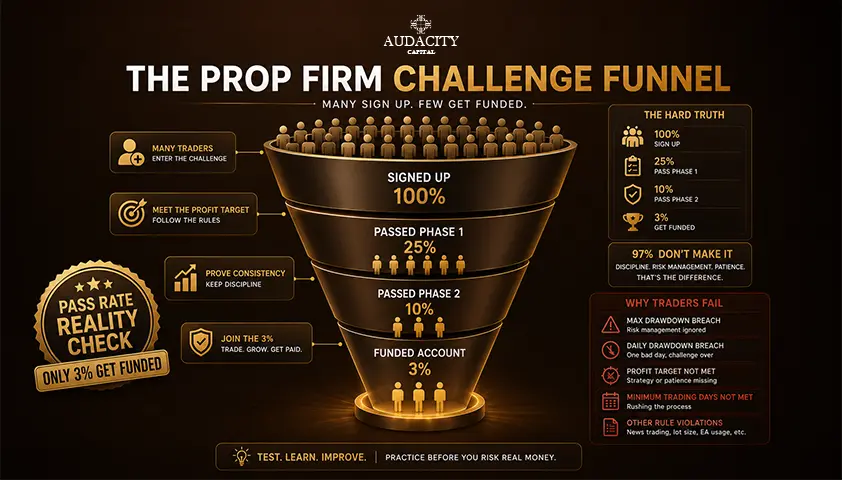
Prop Firm Pass Rate: What Percentage Actually Get Funded?
Learn the real prop firm pass rate, why estimates vary, how many traders get funded, and what the data says about payouts and repeat attempts.