


Prop Firm Trading No Eval: How Instant Funding Really Works (And Who It's Right For) (+ Best Firms 2026)



Most traders discover instant funding the same way — after failing a challenge. They hit the daily loss limit on day three, or they rushed the profit target with one oversized trade, or they simply couldn't handle three weeks of evaluation pressure while trading their normal strategy. Then someone mentions no-eval prop firms, and the question becomes obvious: why didn't I start here?
The answer is more nuanced than it first appears. Prop firm trading with no evaluation is real, legitimate, and genuinely useful — for the right trader. But "no eval" doesn't mean "no rules." It means the rules come with the account, not before it. Understanding that distinction is the difference between getting funded and staying funded.
This guide covers exactly how instant funding works, what the real tradeoffs are, who it's built for, and which firms deliver on the promise — with Audacity Capital's Funded Trader Program as the benchmark for what the model looks like when done properly.
Key Highlights
The search for the best prop trading no eval firm revolves around aligning your strategy with the firm’s rules, instead of the other way around. In your search, you’ll be focusing on:
- Funding tiers and pricing structures
- Reputation, transparency, and support
- Drawdown types and risk rules
- Restrictions, consistency rules, and news policies
- payouts, profit splits, and scaling paths
- Tradeable assets, liquidity, and platforms
What Is Prop Firm Trading No Eval?
A no-evaluation prop firm — also called instant funding — gives you access to a funded trading account immediately after paying a fee. There is no challenge phase, no profit target to hit on a demo account, and no waiting period before you trade live. You pay, you receive your account credentials, and you start trading the firm's capital under a defined set of risk rules, typically within 24 to 48 hours.
The term "no eval" covers several slightly different models:
- Pure instant funding: Pay a one-time fee and receive immediate access. No targets, no interviews, no evaluation of any kind.
- Knowledge-based entry: A brief application and interview to verify trading knowledge and strategy — no extended demo trading required. Audacity Capital's Funded Trader Program operates this way.
- Soft evaluation: A single-phase challenge with significantly relaxed targets before funding, sometimes positioned as "instant" due to its speed.
- Subscription model: A recurring monthly fee in exchange for ongoing funded account access.
What all of these share: you don't go through the standard multi-week, two-phase challenge process that evaluates your performance on a demo account before any capital is allocated.
How Instant Funding Actually Works ?

The mechanics are straightforward. You browse a firm's website, select your account size, pay the upfront fee, complete any identity verification (KYC), and receive your trading account. Most accounts are active within 24 to 48 hours of payment.
From that point, you trade under the firm's rules. The key word is under. Instant funding does not mean unrestricted trading. Every no-eval firm enforces a set of risk controls that govern every trade you take. The evaluation was the filter for most challenge-based firms; for instant funding firms, the rules are the filter.
The business model explained
When a prop firm requires you to pass a challenge first, it has seen evidence of your discipline and performance before allocating capital. It takes on relatively low risk. When a firm funds you without any evaluation, it takes on substantially more risk — it has no evidence of your trading quality. That risk is priced into the structure in two ways:
- Higher upfront fees — instant funding accounts cost significantly more than the equivalent challenge. A $100K instant funded account may cost 3–5× more than a $100K challenge entry fee.
- Stricter rules — to compensate for the absence of screening, instant funding accounts typically have tighter daily loss limits and stricter drawdown structures than the funded stage of a challenge-based account.
What "funded" actually means
Most retail prop firms — including most instant funding prop firms — run simulated funded accounts. Your trading happens in a mirror of real market conditions, but the capital is not deployed directly in live markets. When you earn profits, the firm pays you from its own revenue. This is a legal and widely accepted model, and it's perfectly fine as long as the firm has a reliable payout history and a transparent rulebook.
A smaller number of firms — including Audacity Capital — provide genuinely live capital allocation, routing orders through institutional liquidity providers. This means your trades execute in real market conditions with real pricing, not a simulation. It is a meaningful structural difference that directly affects execution quality.
The Real Tradeoffs — What Most Articles Don't Tell You
Every article about instant funding leads with the benefits: no challenge pressure, trade today, skip the demo phase. What gets buried is the list of tradeoffs that significantly affect whether the model makes financial sense for your situation.
Higher fees
This is the most significant cost difference. The absence of an evaluation is priced directly into the entry fee. A $25,000 instant funded account that costs $600 may be available as a challenge entry for $150–$200. For a trader who passes challenges consistently, the economics of instant funding are actually worse over time. For a trader who has failed multiple challenges and wants to stop paying reset fees, instant funding may become cost-competitive.
Tighter drawdown rules
Because the firm has not seen you trade before allocating capital, it manages its exposure with stricter daily loss limits. Where a funded account from a challenge-based firm might allow a 5% daily loss limit after passing, many instant funding accounts enforce 3–4%. The difference sounds small until you have a volatile day and the account terminates mid-session.
Lower starting profit splits
Many instant funding programs start traders at lower profit splits — 50–70% — compared to challenge-based programs that may offer 80% from day one. Some firms offer progression to higher splits after proving consistency, but the headline numbers seen in marketing often reflect the maximum, not the starting point.
First payout delays and caps
Read the payout terms before paying. Most instant funding accounts require a minimum number of trading days before the first withdrawal. Some cap the first payout at a specific dollar amount. These terms vary significantly between firms and are not always prominently advertised.
Scaling limitations at some firms
A number of instant funding firms cap maximum account sizes lower than challenge-based equivalents, or offer slower scaling tracks. For a trader whose goal is eventually managing six-figure institutional capital, the challenge route may provide a better long-term path at some firms.
Instant Funding vs Challenge Prop Firms — Full Comparison
Factor | No Eval / Instant Funding | Challenge / Evaluation |
|---|---|---|
Time to Funded Account | Immediate access, typically within 24–48 hours | Requires passing one or more evaluation phases, often taking days or weeks |
Upfront Cost | Higher entry fee, as the firm assumes risk from day one | Usually lower upfront cost, often refunded after the first payout |
Starting Profit Split | Typically 50–80% | Commonly 75–90% after successfully passing the evaluation |
Drawdown Rules | Often stricter, with tighter risk parameters and lower drawdown allowances | Can be more flexible once funded, depending on the firm's model |
Evaluation Pressure | No profit targets, time limits, or challenge phases to pass | Requires meeting profit targets while respecting trading rules |
Long-Term Scaling Potential | Varies by firm; some programs offer limited scaling opportunities | Generally stronger scaling plans at established prop firms |
Best Suited For | Experienced traders with a proven and well-defined trading strategy | Traders of all experience levels, particularly those building consistency and discipline |
Psychological Impact | Allows traders to focus purely on execution from day one | Adds pressure from profit targets, deadlines, and evaluation objectives |
Risk Management Requirements | Usually requires stricter adherence to risk limits from the outset | Risk management remains important but may offer more flexibility after funding |
Execution Quality | Depends on the firm's execution, liquidity providers, and trading conditions | Also depends on the firm's execution infrastructure and liquidity model |
The key insight the table doesn't capture: instant funding is not "easier." It removes the evaluation pressure, but it replaces it with the full weight of live rules from day one. Many traders who fail challenges for behavioural reasons — oversizing, revenge trading, ignoring the daily loss limit — fail instant funded accounts for exactly the same reasons, only faster and at higher cost.


Looking For A No Eval Prop Trading Firm ?
Join the Prop FirmThe 5 Rules That Apply to Every No-Eval Account
Rules vary between firms, but every serious instant funding provider enforces some version of these five controls. Know them before you start.
1. Daily Loss Limit
The maximum you can lose in a single trading day. Hitting this limit typically results in being locked out for the day or, at stricter firms, account termination. Common range: 3–5% of account balance. This is a hard stop — not a suggestion. Trading within 50% of this limit as your personal daily ceiling is sound practice.
2. Maximum Drawdown
The total loss permitted from the account's starting balance (or peak equity, depending on whether the firm uses static or trailing drawdown). Common range: 5–10%. Breach this and the account is closed immediately.
Static vs trailing drawdown — the most important distinction in any funded account:
- Static drawdown: Fixed from the initial balance. You always know exactly how much room you have.
- Trailing drawdown: The floor rises with your equity as you profit. It can tighten your safety margin as you make money. A $10K account with a 5% trailing drawdown has a $9,500 floor at the start — but if your equity grows to $10,800, the floor rises to $10,260. You now have less room than you think.
Always confirm which model applies before taking your first trade.
3. Profit Split
The percentage of your trading profits you keep. On no-eval accounts this typically starts at 50–80% and may scale upward with consistent performance. The firm keeps the remainder as compensation for providing the capital and absorbing trading losses up to the drawdown limit.
4. Payout Schedule and First Payout Rules
Most firms enforce a minimum period of active trading before the first withdrawal is permitted — often 5–14 days. Some cap the first payout. After that, payouts may be weekly, bi-weekly, or on-demand. Confirm the first payout terms specifically — they are frequently the most restrictive part of the rulebook.
5. Trading Restrictions
These vary significantly between firms and are the most strategy-relevant rules to read:
- News trading: Many firms restrict trading within a set window (typically 2–3 minutes) before and after high-impact economic releases. Some ban it entirely. If your strategy is news-driven, this is a non-negotiable filter.
- Overnight and weekend holds: Some firms require all positions to be closed at end of day or before the weekend. Swing traders need firms that explicitly allow holding overnight.
- EAs and automated strategies: Many firms allow EAs, but prohibit specific types such as latency arbitrage, tick scalping bots, or high-frequency strategies that exploit platform latency rather than genuine edge.
- Hedging: Allowed at some firms, prohibited at others.
Who Instant Funding Is Right For (And Who It Isn't)
The right fit
Experienced traders with a proven, documented strategy. If you have a backtested edge, three to six months of live trading history, and a clear trading plan you can articulate, instant funding removes evaluation friction without removing any of the skills you've built. You know you can trade. You don't need a challenge to prove it.
Traders frustrated by evaluation-specific rule mismatches. If your strategy involves news trading, overnight holds, or trading styles that conflict with specific challenge rules, you may have been failing challenges for structural reasons rather than trading quality reasons. Instant funding from a firm with compatible rules solves this directly.
Traders who have passed challenges before. If you have a track record of completing evaluations and know you have the discipline, instant funding is simply the faster and more efficient route to capital allocation.
Traders who want to eliminate time pressure. The psychological weight of evaluation time limits affects many traders' decision-making. Removing that pressure and trading in your normal style from day one is a genuine benefit.
The wrong fit
Traders still developing their strategy. An evaluation challenge has value as a discipline-building structure. Trading on a demo account with defined targets and drawdown rules is useful training. Bypassing it to access funded capital before your edge is proven costs money and accounts, not time.
Traders primarily motivated by avoiding failure. Instant funding removes the challenge. It does not remove the risk of account breach. If the reason you want to skip the challenge is because you're afraid of failing the performance test, that fear will follow you into the funded account.
Traders on a tight budget. If the higher upfront cost of instant funding is a meaningful financial pressure, the lower-cost challenge route is the more rational choice. Entering any funded account under financial strain increases the psychological pressure that causes poor decisions.
Traders who want institutional-scale capital quickly. For most serious traders, the challenge route at firms with strong scaling plans provides a better long-term path to managing $500K+ accounts, because the scaling economics post-challenge are typically more favourable.
What to Check Before Paying Any Instant Funding Fee

The no-eval market has grown rapidly, and not all firms that offer instant funding have the infrastructure, liquidity, or payout reliability to back it up. Run this checklist before any purchase.
1. How long has the firm been operating? This is the single most important trust signal in the category. A firm that has been paying traders for three or more years has demonstrated operational survival through market volatility. A firm launched in 2023 with aggressive marketing has demonstrated nothing yet. Check company registration and founding date.
2. Is there a verifiable payout history? Look for payout evidence beyond the firm's own website — Trustpilot reviews that specifically mention payouts, Reddit and Discord community discussions, third-party review sites. Verified community proof is more meaningful than a leaderboard on the firm's homepage.
3. What is the drawdown model, exactly? Static or trailing? Calculated from balance or equity? Intraday or end-of-day? The same headline "10% max drawdown" can mean very different things depending on the calculation method. Read the rules page, not just the marketing page.
4. What are the first payout terms? Minimum trading days, minimum profit required, payout caps on the first withdrawal. These are the rules most likely to catch traders off guard. If they're not clearly stated on the firm's website, ask before you pay.
5. What liquidity infrastructure does the firm use? Retail broker or institutional liquidity provider? This affects your spreads, execution speed, and the realism of your trading conditions. A firm that uses institutional liquidity will typically say so — it's a competitive advantage they'll advertise. If the firm doesn't mention its liquidity arrangement at all, assume retail broker conditions.
6. What platform does the firm support? MT4, MT5, DXTrade, TradingView, cTrader, Rithmic, Tradovate — confirm that the firm supports your platform before paying. Switching platforms mid-strategy is a disruption most traders underestimate.
7. Are your specific trading restrictions documented? News trading, EAs, overnight holds, hedging. Find the actual rules page, not the FAQ, and confirm your strategy is compatible before purchasing.
Best Prop Firm Trading No Eval in 2026
Audacity Capital — The Benchmark for No-Eval Done Right
In a market where most instant funding firms launched after 2020, Audacity Capital was founded in 2012. That is not a minor detail. It means Audacity has been funding traders and processing payouts through the 2015 Swiss Franc shock, the 2016 Brexit vote, the 2018 crypto crash, the 2020 COVID collapse, the 2022 rate hike cycle, and every period of market volatility in between. It has a verified track record of £2.4 billion in processed trading volume and an average monthly payout of £2.8 million. No other firm in the no-eval category can match that history.
Audacity Capital is headquartered in London's Canary Wharf — led by CEO Karim Yousfi since founding. The firm has received two awards from The International Investor for Excellence in Professional Trading and Excellence in Trading Innovation.
The Funded Trader Program — Audacity's no-eval route
The Funded Trader Program is Audacity's direct path to live funded capital without an evaluation challenge. As an instant funding prop firm, Audacity Capital offers traders a route to funded capital without a traditional demo trading challenge. The process works as follows:
- Apply with a demonstration of your trading history — at least three to six months of live account activity, evidence of consistent profitability and risk management, and a documented trading plan
- Interview — a video assessment with the Audacity team to verify your trading knowledge, strategy understanding, and approach to risk
- Receive live funded capital — typically within 24 hours of approval
This is not the same as a pure no-questions-asked instant funding model. The FTP filters for trader quality through knowledge and experience, not through a demo trading challenge. The result: funded traders on the FTP are allocated live capital through Audacity's institutional liquidity infrastructure — not a simulated environment.
Join our free monthly prop trading competition
Free Prop Firm Trading CompetitionWhat makes Audacity's model structurally different
Institutional liquidity — not retail broker routing. Audacity partners with an institutional liquidity provider for tight spreads, zero commissions, and zero swap fees. This is a real, day-to-day execution advantage. Many newer instant funding firms route orders through retail brokers with wider spreads and potential markup. The difference compounds significantly across hundreds of trades per month.
Live capital allocation. Most instant funding accounts are simulated — payouts come from firm revenue, not live market activity. Audacity's FTP provides live funded capital. Your orders execute in real market conditions, not a mirror environment.
Scaling to $2 million. At every 10% profit milestone, the account size doubles. A trader starting at $15,000 who consistently delivers has a structured path to institutional-scale capital — $30K, $60K, $120K, $240K, $480K, and beyond. Audacity offers scaling up to $2 million across programs, one of the highest ceilings in the category.
Bi-weekly payouts, same-day processing. Withdrawals approved by Audacity's risk management team are processed the same day into the trader's wallet. Traders can withdraw the full balance or reinvest into new accounts.
No time limits. Traders on the FTP work at their own pace — there is no arbitrary deadline creating pressure to trade outside of strategy.
2026 rule updates. Audacity updated its programs significantly for 2026: the consistency rule has been removed, news trading is now allowed (with a 3-minute window rule around major events), weekend holding is permitted, EAs are allowed, and copy trading is permitted when the master account is manually traded.
Audacity Capital FTP — Key Specs
Feature | Audacity Capital — Funded Trader Program |
|---|---|
Founded | 2012 (14+ years operating) |
Account Sizes | $7,500 / $15,000 / $60,000 (scaling up to $2 million) |
Starting Profit Split | 50%, scaling to 80%+ based on performance |
Daily Loss Limit | 5% |
Maximum Drawdown | 10% Absolute Drawdown |
Trading Platforms | MT5 & DXTrade |
Payout Frequency | Bi-weekly payouts (same-day processing upon approval) |
News Trading | Allowed (3-minute restriction around major economic events) |
EAs & Automation | Allowed |
Copy Trading | Allowed (master account must be manually traded) |
Overnight & Weekend Holding | Allowed |
Liquidity Model | Institutional Liquidity |
Commission | Zero Commission |
Swap Fees | Zero Swap Fees |
Availability | Available in 140+ Countries |
Trading Volume Processed | £2.4 Billion+ |
Average Monthly Payouts | £2.8 Million+ |
Scaling Potential | Up to $2 Million in Trading Capital |
Best For | Traders seeking immediate funding, flexible trading conditions, and long-term scaling opportunities |
Honest assessment — watch-outs
The starting profit split of 50% on the FTP is lower than many newer firms' headline figures. This reflects the live capital model and institutional infrastructure — the firm is providing genuine funded trading conditions, not a simulated payout from revenue. The split scales with performance, and the execution conditions mean a larger share of a smaller gross profit may still exceed a larger share of an inflated simulated figure.
The platform selection — MT5 and DXTrade — means traders who prefer TradingView or cTrader will need to adapt. This is a legitimate constraint for some traders.
The video interview requirement for the FTP means it is not appropriate for traders without documented live trading history. Traders who are newer to live markets should consider Audacity's Ability Challenge route instead — which starts at $90 for a $10,000 account with a 15% max drawdown, and leads to the same live funded environment on the same infrastructure.
Other No-Eval Firms Worth Considering in 2026
The following firms offer legitimate instant funding options for specific trader profiles. None has Audacity Capital's 14-year operating history or institutional liquidity model, but each has features that suit particular trading styles.
GOAT Funded Trader
GOAT offers instant funding with no consistency rule, on-demand payouts, and profit splits reaching 100% after scaling. Account sizes start from $1 (the $1 Blitz account), making it accessible for testing the model. The firm has processed significant payouts and has a vocal community presence.
Best for: Traders who want maximum payout flexibility and no consistency restrictions. vs Audacity Capital: Newer firm (launched ~2022), simulated accounts vs live capital, no equivalent institutional liquidity infrastructure.
The 5%ers
The 5%ers offer instant funding alongside their evaluation programs. They have operated since 2016, are available to US traders, and have a structured scaling plan reaching $4 million. Their Hyper Growth program is one of the more credible instant funding options for serious scalers.
Best for: US-based traders, traders focused on long-term scaling. vs Audacity Capital: Solid firm with a longer track record than most, but uses retail broker routing rather than institutional liquidity.
Funding Pips (Zero Program)
Funding Pips' Zero program offers true instant funding with some of the most competitive entry fees in the market — starting from $36. It suits traders who want to test the instant funding model without a large upfront commitment.
Best for: Budget-conscious traders testing instant funding for the first time. vs Audacity Capital: Lower cost but significantly shorter operating history (~2022) and smaller institutional infrastructure.
Blue Guardian
Blue Guardian operates an instant funding model with 24-hour payout processing and account sizes from $2K to $20K. They have $20M+ in verified payouts and clear rules. The entry-level account sizes work well as a testing ground.
Best for: Traders who want fast payout processing and low account size minimums. vs Audacity Capital: Good operational transparency but newer firm, retail broker execution.
Conclusion
Prop firm trading with no evaluation is not a shortcut. It is an alternative structure — one that trades evaluation pressure for higher fees and stricter live rules. For experienced traders with a proven edge who want to eliminate demo trading friction and trade with funded capital from day one, it is a rational and often superior choice.
The market for instant funding has grown rapidly, and most of the firms offering it launched within the last three years. Many will not survive the next market stress cycle. Choosing a firm purely on the basis of headline profit split percentages from a company with no operating history is one of the most common and most expensive mistakes in this space.
Audacity Capital has been funding traders for 14 years, processing billions in trading volume, and paying traders monthly through every significant market event of the past decade. Its Funded Trader Program provides live capital through institutional liquidity infrastructure — not a simulated environment — for traders who meet its experience threshold. The starting profit split is lower than some competitors. The execution quality, institutional track record, and scaling potential are higher than all of them.
If you have the trading history and the documented edge, the application takes less time than a single evaluation phase. The result is live funded capital, institutional-grade execution, and a scaling path to $2 million — backed by a firm that existed before most of its competitors were founded.
FAQ
A no-eval model is where you get instant access to a trading account without having to undertake a multi-step evaluation challenge. Please note that the instant-funded accounts will still require you to abide by various risk parameters, including consistency rules, daily and overall drawdowns.
Start by matching the prop trading firm’s rules to your trading system. Assess the funding tiers and fees applicable, and compare the drawdown models available. It will also be a good idea to look at the supported assets and platforms at each prop firm.
Its benefits are many and include: you get to start immediately without having to pass multi-week challenges. The account comes with predictable payout schedules and risk.
Yes. These accounts will come with minimum trading days, subscription fees, and tighter daily max losses.
Each account will have its pros and cons; the best account for you will be determined by your trading edge and risk profile. Make sure to conduct thorough research before making a choice.

Ready to apply disciplined risk to crypto? Explore Audacity Capital's new crypto instruments and bring your trading strategy.
Learn MoreNewsletter
Join our newsletter to stay up to date on features and releases.
Join Our Social & Community

Start Your Journey Today With Our Free Trial
Proudly showcase your skills and accomplishments through certificates and get recognition for your hard work and dedication from potential investors and peers.
Free TrialRelated Articles

Do You Pay Taxes on Prop Firm Payouts? A Funded Trader's Guide
In almost every country, prop firm payouts are taxable income, not capital gains. Learn how they are taxed, what you can deduct, and why records matter.

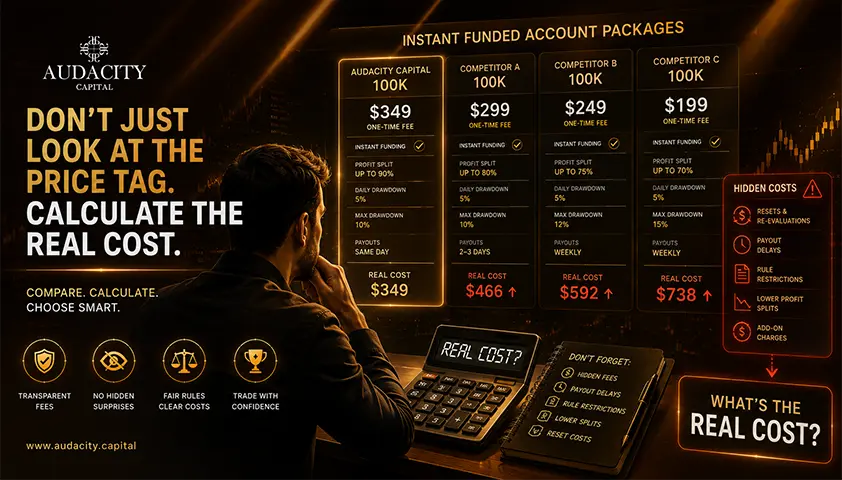
How Much Does an Instant Funded Account Cost?(2026 updated)
Sticker price tells only half the story. See what an instant funded account cost really covers, why it runs 2 to 3x a challenge, and if it's worth it.

Instant Funding vs the Challenge: Which Funded Account Should You Choose?
Two routes to a funded account, one honest comparison. See how instant funding vs challenge differ on cost, drawdown, and profit split, and which route fits you.

Best Local Payment Methods for Forex Prop Trading
Compare the best local payment methods for forex prop trading by region and learn faster, cheaper prop firm withdrawals with fewer delays.