


How Do Prop Firms Make Money? Revenue Streams Explained



Here is the true answer that most prop-firm pages won’t tell you upfront: prop firms earn money through a few clearly identified streams, mostly challenge and evaluation fees, subscriptions, profit-sharing programs, and trade commissions.
And here's the kicker that fuels all your skeptical Reddit threads: a substantial portion of that money is earned by traders paying for an evaluation and failing to succeed.
The majority of challenges are unmet. Most of the funds you hear about are simulated, not actual market positions.
Understanding how these business models work is important before purchasing any evaluation or funded trading program.
So how do prop firms make money, anyway? In this guide, we explain each of these revenue streams, the reality of simulated accounts, and the mechanics behind the A-book versus B-book, and then present you with the part that actually matters: a clear framework for sifting out a legitimate, aligned firm from a predatory one.
What Is a Prop Firm?
Let's untangle one of the sources of confusion first. "Prop firm" has two different definitions.
The first meaning is the literal one. A traditional or professional proprietary trading firm trades its own funds in the real markets and retains the profits.
They are investment firms that allocate capital to in-house traders and generate revenue from trading performance. This was the initial "prop" in proprietary trading.
The second definition is the one that most people are using these days when they ask, “how do prop trading firms work?” It refers to the modern funded-account or evaluation model that has become increasingly popular among retail traders.
Traders typically pay a fee to participate in an evaluation process, and once they pass, they receive a funded account and share the profits with the firm.
This article will be mostly about the retail model, as that is the one everyone is talking about and is often debated within the trading community.
But we'll cover both so that you never get confused by the two definitions again.
Traditional prop firm | Retail prop firm | |
Capital source | Own, investor, or borrowed capital | Trader-paid fees, firm capital |
Who trades | Salaried in-house traders | Anyone who passes an evaluation |
Where the money comes from | Real market trading performance | Evaluation fees plus profit splits |
How Traditional Prop Firms Make Money (the Original Model)
The traditional proprietary trading companies do make money, as the name implies. They engage in trading in real markets using their own money or investors and borrowed capital in different kinds of trading methods.
They retain the profits after covering their expenses and remunerate their own traders with a profit share, salary, or bonus system.
That is, they earn from actual market trading performance.
That's the actual proprietary trading that the retail model is named after. It's a useful context, but it's not the story in and of itself, so let's get on to the model you've come here to learn.
Check our latest guide about How to Pass a Prop Firm Challenge
How Modern (Retail) Prop Firms Make Money
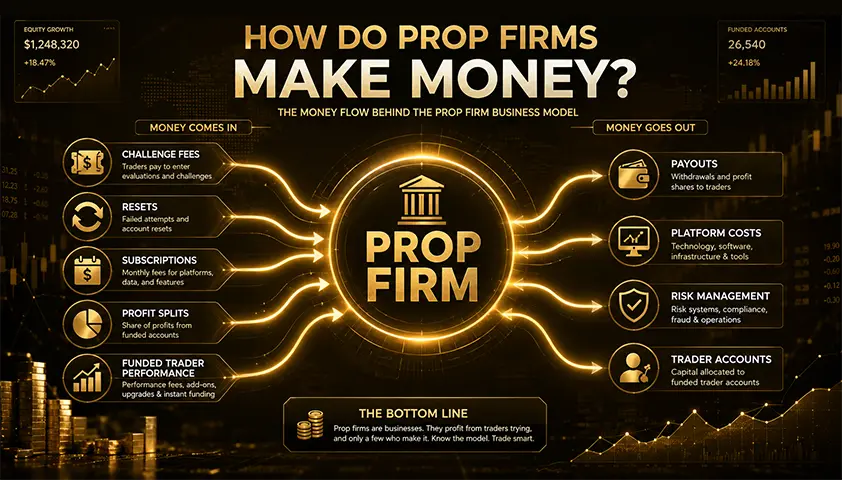
The retail prop firm model combines multiple revenue streams, including evaluation fees, profit-sharing arrangements, subscriptions, and trading-related revenue, depending on the firm's business model.
That one move answers virtually everything about the prop firm business model, including the parts that make people suspicious.
Let's take a look at the revenue streams, one by one. Note that any fee figures below are illustrative and vary widely by firm.
1. Challenge and Evaluation Fees (the Primary Stream)
For many retail prop firms, evaluation fees represent an important source of revenue. However, the significance of each revenue stream varies between firms. Traders are charged a one-time fee to participate in an evaluation, anywhere from about $40 for a modest $5,000 account to about $3,000 for a $200,000 to $500,000 account.
This is what makes this stream so strong.
Many traders do not successfully complete evaluations. Pass rates vary significantly between firms and are rarely independently audited, so treat any specific figure a firm quotes with caution. Many also try again after failing, which turns evaluation fees into a predictable, consistent, and substantial source of revenue.
This is one reason evaluation fees are often discussed when traders assess whether a firm's interests are aligned with their own.
2. Subscription and Monthly Fees
Some platforms charge monthly subscription fees for data feeds, customer support and the usage of the platform.
Some firms, particularly in the futures space, charge recurring subscription fees for platform access, data feeds, or additional services.
3. Profit Splits on Funded Accounts
On a funded account, the firm keeps a share of the profits a trader makes. The splits often range from 10 to 30 percent for the firm, which means that the trader's return is 70 to 90 percent.
This is the “We Earn When You Earn” aligned stream.
One way traders evaluate a firm's incentive structure is by understanding the balance between evaluation-fee revenue and long-term profit-sharing arrangements. One of the most obvious indicators of a firm's true incentive alignment with yours is the size of this stream compared with other revenue sources within the business model.
4. Trading Costs, Spreads, and Partnerships
Prop firms can also generate profit from spreads, commissions or mark-up on trades, broker and liquidity-provider partnerships, and volume rebates. There are affiliate and referral programs, too.
These are secondary streams, but they are legitimate.
5. Add-Ons: Instant Funding, Resets, and Upgrades
Lastly, there are the add-ons. Profits from instant-funding accounts where one does not need the evaluation process, challenge resets that offer one more chance without having to buy new accounts, and account add-ons or upgrades are all examples of additional profits.
So which stream earns more money?
That's usually challenge and evaluation fees. This is the whole truth behind the business model and explains why incentive alignment is important.
Do Prop Firms Want You to Fail? Aligned Versus Predatory Models
Let us answer the question YOU really have.
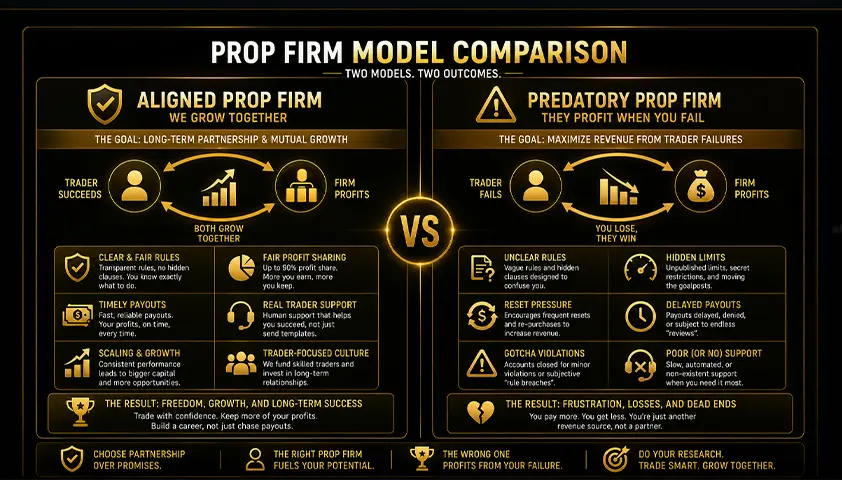
One of the most common questions traders ask is whether prop firms benefit when traders fail. The answer depends on the firm's business model, revenue structure, and long-term objectives. The straightforward answer is: It all depends on the firm’s model.
Some firms rely heavily on evaluation-fee revenue, while others place greater emphasis on long-term trader success, profit sharing, and account growth. Understanding these differences can help traders evaluate whether a firm's interests align with their own. The warning signs include unrealistic profit expectations, rules designed to trip you up, inconsistent or selective rule enforcement, delays or disputes at payout, limited evidence of long-term trader success or funding activity, and constant pressure to buy the next account.
An aligned or sustainable model desires that you pass and trade well. That is because profit splitting with funded-traders, reputation and referrals are repeatable and long-term sources of income.
A firm that trades this way will Supports long-term trader development and funding opportunities, and consider a profitable trader as an asset, not a competitor.
Below are some quick differentiator points:
Aligned firm behavior | Predatory firm behavior |
Realistic, clearly stated targets | Unrealistic goals set to trip you up |
Consistent rule enforcement | Selective, shifting enforcement |
Proven, on-time payouts | Delayed or denied payouts |
Copies winners to live capital | Limited evidence of trader success or payout history |
Treats profitable traders as assets | Pushes you to keep buying accounts |
How to Tell a Legitimate Prop Firm From a Predatory One
This is the section you want to save for later. Use it as a self protection checklist prior to paying someone.
✅ Green flags to look for:
- Transparent, realistic rules and profit targets.
A decent profit target and a clear cut drawdown limit – no hidden conditions in the fine print.
- Clear disclosure of simulated versus live.
A company that clearly labels their accounts as demo or live, demonstrates respect.
- Proven, consistent payouts.
This is the one test that is most important. Look for legitimate payout evidence, third-party evaluations and published payout reports. Anyone can promise. Very few have a track record.
- A fair, clearly stated profit split.
You should know what you keep before you pay.
- Stable rules.
No changing the rules and no selective enforcement after you start trading.
- Real, responsive customer support.
A human that you can contact if things go wrong.
- A genuine track record and a real company behind the brand.
In this category, history is important.
- Reasonable fees, refundable where promised.
And the company lives up to that commitment.
🚩Red flags to avoid:
- Ambiguous but seemingly unattainable goals.
- Open-ended or vague answers to the question of simulated accounts.
- A lack of payout proof that can be verified (or a payout complaint history).
- Changing rules after the money has been placed.
- Pressure tactics to force you to reset and open new accounts.
The one thing that's easiest to develop is to read the fine print before you pay, and check the payouts before you believe the marketing.
Where Audacity Capital Fits
Audacity Capital offers a roadmap for traders to hone their skills with our funding programmes.
Through its funding programs, Audacity Capital shares in trading performance while offering traders the opportunity to earn a percentage of generated profits, creating a more aligned relationship between the firm and successful traders.
We also run a free monthly trading competition that lets traders prove their skills and compete to win a free funded account challenge, with no entry fee required.
If you want to trade funded capital with a firm whose model rewards your success rather than your failure, then you have found your match with Audacity Capital.
FAQ
Most prop firms provide a simulated account for evaluation and many of them offer demo trading of a funded account which is a copy of a successful and consistently profitable trader. It depends on the firm and clear disclosure of simulated vs. live is a big trust signal. Directly ask the question prior to paying.
In one answer yes. Challenge fees from failed evaluations account for a big portion of revenue for most retail companies, and many traders will go back to attempt if they fail.
This is exactly why incentive alignment is crucial, and how much of a company's profits are derived from fees versus a true profit split.
Often, very. Fees and profit-sharing yield revenues regardless of any one trader's success, so a strong firm will make money even if a majority of traders fail. That's a neutral fact and not an accusation about the business model.
The retail model is legal and legitimate when the simulated nature and the rules are disclosed. Legitimacy varies from firm to firm, so judge each one on verifiable payouts, transparency, and whether its incentives align with yours rather than against you.
Because skilled funded traders generate profit-split revenue, build the firm's reputation, and drive referrals. Most capital stays simulated until a trader is proven, at which point a firm running an aligned model copies that trader to live capital, since a consistent winner is an asset worth funding.
A broker earns from spreads and commissions on the money you deposit and trade yourself. A proprietary trading firm charges for evaluations and shares profits on its own capital, so the relationship and the incentives are structured differently from the ground up.
Yes, at legitimate firms traders do get paid. The single most important step before you pay is verifying payout proof, through published reports, third-party reviews, and a genuine track record, rather than relying on marketing claims alone.
Churn-model firms effectively benefit when you fail, because their revenue leans heavily on repeated fees. Sustainable firms want you to pass and trade well, since their durable income comes from profit splits, reputation, and referrals. That difference is the entire point of doing your due diligence.

Prêt à appliquer un risque discipliné aux cryptos ? Explorez les nouveaux instruments crypto d'Audacity Capital et apportez votre stratégie de trading.
En savoir plusNewsletter
Rejoignez notre newsletter pour rester informé.
Rejoignez Notre Communauté Sociale

Commencez Votre Voyage Aujourd'hui Avec Notre Essai Gratuit
Affichez fièrement vos compétences et réalisations grâce à des certificats et obtenez la reconnaissance de votre travail acharné et de votre dévouement auprès d'investisseurs potentiels et de pairs.
Essai GratuitArticles Connexes

Do You Pay Taxes on Prop Firm Payouts? A Funded Trader's Guide
In almost every country, prop firm payouts are taxable income, not capital gains. Learn how they are taxed, what you can deduct, and why records matter.


Best Local Payment Methods for Forex Prop Trading
Compare the best local payment methods for forex prop trading by region and learn faster, cheaper prop firm withdrawals with fewer delays.
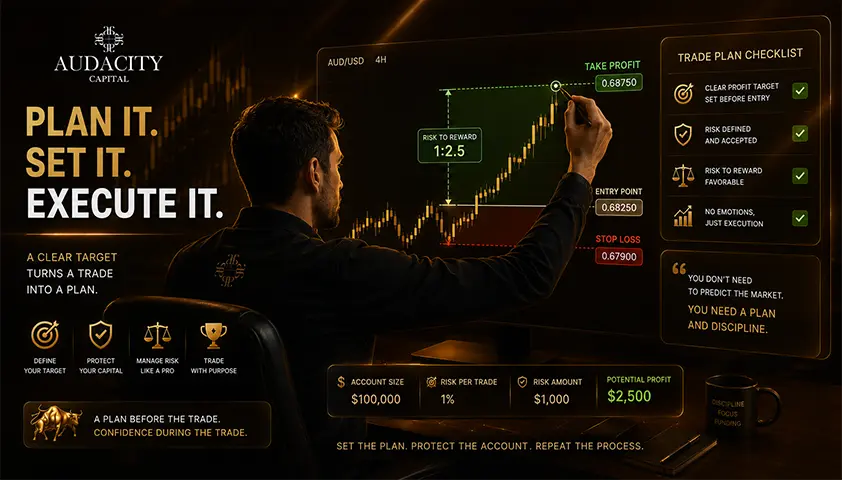
What Is Take Profit in Trading? A Detailed Guide for Traders
Learn what a take profit is, how to set one well using technical levels, risk-reward, and ATR, plus partial profits, trailing stops, and a funded-trader lens.

10 Best Prop Trading Firms in Malaysia in 2026
Compare the 10 best prop trading firms in Malaysia for 2026, ranked on swap-free accounts, payout speed, fees, and payments that work from Malaysia.