



What is Commission in Forex Trading?


Introduction
When trading forex, there are various costs involved. These may include spreads, commission, overnight financing fees, and other costs set by your broker. Although these costs may seem low, they can add up, especially when you are taking multiple trades.
A commission is a fee charged by a forex broker for executing a trade. It is typically based on how much you are trading and can be charged both when opening and closing a position. Not all brokers charge in the same way; some will charge a commission fee and offer tighter spreads. Others will offer commission-free accounts but have a wider spread.
Understanding the differences will help you to compare brokers and get the right trading account. Lower commission doesn’t always mean lower overall trading costs, as there are other factors such as spreads.
This guide will help you understand what is commission in forex trading, how commission works, how to calculate it, and how it compares to spreads. We’ll also look at other costs and what you should be looking out for when evaluating an account.
What Is Commission in Forex Trading?
Commission in forex trading is a fee charged by a broker for facilitating the buying and selling of currency pairs. Commission is one of the direct costs you will incur as a trader, and it is a fee separate from the spread.
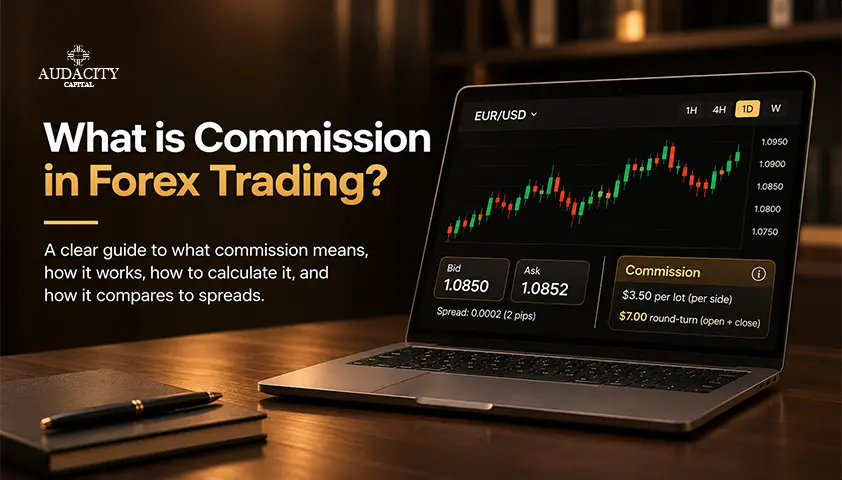
Most brokers will charge you commission based on how much you trade, typically in multiples of lots. A common example may be $3.50 per standard lot traded, so if you open a 1-lot position and close it, you will be charged $7 commission. This will depend on your broker's commission policy.
Commission is often deducted automatically from the account. It can be charged when opening a position, closing a position, or both. Some brokers will show the commission you are paying in your transaction history within the trading platform.
The fee you pay varies depending on the type of account you have and the broker you use. Raw spread or ECN-style accounts will generally have lower spreads and include a commission. Standard accounts do not have a separate commission, but will have wider spreads to compensate for the higher costs of trading for the broker. Other factors could include what instrument you are trading, account conditions, and the number of trades you make.
Understanding volume is also very important, because generally speaking, the more lots you trade, the higher the commission. So, for example, if you are trading several standard lots, you can end up paying a lot more commission than if you were trading micro lots, even if you have the same account type. Knowing how lot sizes affect commissions will help you estimate transactional costs and know how you can reduce the trading costs.
How Does the Commission Work in Forex Trading?
Forex commission will generally depend on the amount you are trading and your broker's rates. When opening a position, your broker may charge you commission. If your account requires commission on both sides, then you will be charged again when closing your position. Knowing how commissions work will make it easier to work out the total cost of completing the trade.
Commission Per Side
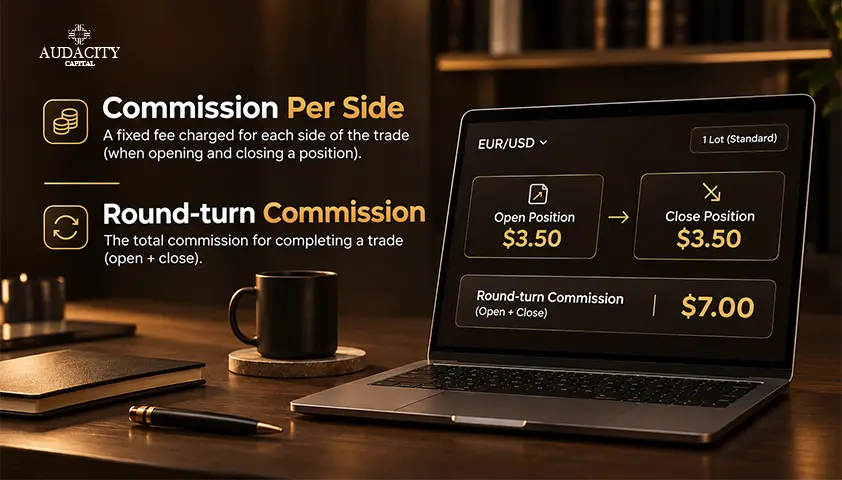
Commission per side means that a fixed amount will be charged for each side of the transaction. If the broker charges a fixed amount for a trade being opened, then another fixed amount will be charged for closing the trade. For example, if the commission is $3.50 per standard lot per side, then opening a one-lot position will cost $3.50. Closing the position will cost another $3.50. These will be shown as different amounts in the trading account.
Round-Turn Commission
This is simply the total cost of opening and closing a position. Using the previous example, if a trader pays $3.50 per side, then they will have paid a total of $7 in round-turn commission for completing a one lot trade. Some brokers will show their commission rates as round-turn whilst others will show the per-side amount. Always check what type of commission you are being charged to avoid underestimating the potential costs of opening and closing trades.
Trade Size | Commission Per Side | Round-turn Commission |
1 Standard Lot | $3.50 | $7.00 |
1 Mini Lot (0.1 lot) | $0.35 | $0.70 |
1 Micro Lot (0.01 lot) | $0.035 | $0.07 |

Unlock 85% Profit Share
Get Funded Up To $2mActual charges vary between brokers. Larger positions generally attract higher commissions, making trade size an important consideration when calculating forex trading expenses.
What Are the Different Types of Forex Commission Structures?
Forex brokers will charge you a commission to execute trades. How much you pay will depend on their pricing, account type, how much you trade, and sometimes the instrument. Knowing how they charge you can help you compare accounts and know roughly how much you'll be paying to place trades. Common forex commission types are:
Fixed Commission
Fixed commission is a set amount of money that you pay for each trade. It is usually based on how many lots you trade and will remain the same no matter what happens in the market as long as your broker does not change their rates. If the broker charges $3.50 per standard lot per side, then this will be what they charge per trade. Fixed commission can help traders work out approximately how much they need to pay.
Variable Commission
Variable commission means the cost will vary depending on the conditions of your trades. This could depend on the instrument you are trading, your account type, how many trades you take, or how the broker sets their pricing. It can vary between different instruments and account types. Traders should check the commission fee structure of their broker to see what rates apply to their favorite currency pairs.
Tiered Commission
Tiered commission means that different commission rates are charged depending on your trading volume. Brokers will often offer lower commission rates to those traders who trade larger volumes each month or fall into certain account categories. For example, a trader may pay $3.50 per lot, but if they trade larger volumes that qualify for a reduced rate, they will only pay $3.00 per lot. This can be beneficial for active traders, but you need to ensure that you can trade enough to qualify for this.
Percentage-Based Commission
This type of commission is calculated based on the percentage of the transaction value. For example, the broker may charge 0.1% of the value of a qualifying transaction. This type of commission is more common in other financial markets and some setups but is not as common in retail forex accounts where lot-based commissions are popular. Before getting an account, you should consider how the percentage will be charged and if it will be on one or both sides of the transaction.
Commission Free
Trading on commission-free accounts means that there will not be any separate commission fee when opening and closing trades. Brokers will often have larger spreads to compensate for not earning commission and will charge commission in other ways depending on the account. While commission-free accounts do not charge commission, it is still possible to pay more due to increased spreads, overnight financing, and other applicable fees. Comparing these costs is important when choosing which account to trade on.
What Is the Difference Between Commission and Spread in Forex Trading?

Commission and spread are two different charges that you will encounter in forex trading. Both will affect your overall costs, but will depend on how your broker prices their deals.
Commission is a fee that the broker will charge to complete a transaction. It tends to be dependent on the number of trades and may be applied when opening and closing your position. The spread, on the other hand, is the difference between the bid price (sell price) and the ask price (buy price). This is typically shown in pips and will show on the prices when entering and exiting positions. The spread is normally included in the prices that the broker quotes.
Commission | Spread |
Separate transaction fee | Difference between bid and ask prices. |
Often calculated per lot. | Usually measured in pips. |
May be charged on opening and closing | Reflected in quoted prices |
Common on raw-spread accounts | Applies to forex pricing generally |
How do both costs affect a trade?
Suppose a trader opens a one-standard-lot EUR/USD position with a broker charging $3.50 commission per side and offering a 0.5-pip spread. Assuming one pip is worth $10 for this position, the spread cost is approximately $5. The round-turn commission is $7, bringing the combined cost to approximately $12, excluding overnight financing and other charges.
This example shows why traders should consider both commission and spread when comparing forex accounts. An account with a lower commission may still be more expensive if it offers wider spreads.
Other Costs to Consider When Trading Forex
In addition to commissions and spreads, some brokers will also charge you other fees depending on the account you have, how much you trade, and the payment methods you use. You should be aware of the following fees:
Overnight / Swap Fees: These are fees that are charged if you leave a position open past your broker's rollover time. The amount of the fee will depend on the interest rate difference between the two currencies, the size of the position, and your broker's overnight financing rates. Swap fees mean that you will be charged for leaving a position open.
Currency Conversion Fees: These may be applied when you make a deposit/withdrawal or trade in a currency other than your account’s base currency. Your broker or payment provider may charge you a fee for converting between currencies.
Deposit/Withdrawal Fees: Some brokers or payment providers will charge you a fee to process deposits and withdrawals. The amount can vary depending on the payment method, currency, and your broker's policies.
Inactivity Fees: Some brokers will charge you if you do not use your account for a certain period of time. These will vary between brokers, so it is advisable to check your broker's terms and conditions before opening an account.
Understanding these costs will help traders know the full cost of trading in the forex markets. A low commission account may still be costly due to high overnight rates, currency conversion fees, and withdrawal fees. Comparing all of the costs will help you understand exactly what a broker is charging and will help you make more informed decisions when choosing an account.
How Does Forex Commission Affect Different Trading Strategies?
Forex commission can impact different strategies, depending on how often a trader opens and closes positions and how long they hold their positions for. Strategies that have a lot of transactions will incur more commission costs, whereas strategies with fewer transactions put more focus on overnight funding and other costs.
Scalping
The idea of scalping is to open multiple positions and close them quickly to profit from small price movements. As you will be making numerous trades, it is easy for commission fees to add up. If you were to make 20 trades on standard lots at $7 commission per trade, your commission would be $140. Scalpers should look closely at the commission per lot and spreads when comparing account types.
Day Trading
Day trading usually means opening and closing positions within the same trading day. You will still be charged commission on any completed trades. If you are opening and closing your trades, then you should factor in all the trading costs that will be incurred. Tracking trading costs helps traders evaluate their trading performance more accurately over a given period of time. If you take 2 trades in a day and the commission fee for opening and closing a standard lot trade is $8, then you will have $16 in total commission.
Swing trading
Swing trading is when you hold your positions for a few days or weeks. This can give a bigger price movement. As you will be making fewer trades than scalping or day trading, your total commission could be less. However, when holding positions overnight, you may have to pay swap/ overnight financing charges. This could increase your costs over a few days. Swing traders should therefore consider both transaction commission and overnight financing when evaluating their trading costs.
Ultimately, traders should choose an account structure that suits their trading frequency, position sizes and holding periods rather than focusing on commission rates alone.
Why Do Brokers Charge Commissions in Forex Trading?
Forex brokers receive commissions so they can make money from the services they provide to their clients. Some forex brokers will include more of these fees within their spreads, while others will have a separate commission fee to help them cover some of their costs.
Operational Costs
Brokers must pay for various ongoing expenses. Brokers have to pay for the upkeep of trading platforms, servers, payment systems, and other technologies that allow clients to trade on the forex market. Brokers may also have to pay for customer support teams, invest in developing their services, and trade monitoring systems. By charging commission, they can manage to offset some of these costs.
Regulatory Compliance
Brokerages in regulated markets will have certain compliance requirements to follow in order to meet the requirements of the relevant financial authorities. These could include keeping proper records, reporting transactions, risk management measures, and client protection measures. This will involve having staff, systems, and administration in place. Although there may not be specific commissions charged for meeting compliance requirements, they can contribute to the overall income used by the brokerage firm.
Access to Liquidity Providers
Many forex brokers have links with liquidity providers (such as banks and other financial institutions) to provide currency rates and execute trades. Maintaining these connections involves commercial and technological arrangements. Brokers may also pay for access to liquidity and trade execution. Using commission-based pricing can help cover these costs, especially on accounts with tighter spreads.
Commissions are one source of income for brokers. While the reasons for and costs of commissions will vary from firm to firm, it is important to check the pricing details provided by your broker. It is essential to compare the commission rates, spreads, execution, and any other relevant charges before depositing your money into a broker account.
What Do Traders Get When They Pay Forex Commissions?
By paying a commission, you can have access to the services of your broker. These services and advantages will vary depending on the broker, account, and services you are receiving. You will not necessarily get a better service or results by paying more commission. Potential advantages could be:
Access to Competitive Trade Execution
Some commission-based accounts have tighter spreads and direct access to liquidity providers. This may be preferable for traders looking for the best execution conditions and who want to control their transaction costs. However, just because you are paying a commission doesn’t mean that your orders will be executed any quicker or that you won’t experience slippage. Before choosing a broker or program, you should consider how quickly your orders are executed, how they are handled, and what the broker's execution policy is.
Access to 24/7 Customer Support
Brokerage fees can be used to support client service. Depending on the broker, clients can have access to support teams who can help with any issues they have with their account, queries about the platform, and technical issues. Brokers can also provide educational resources, market commentary and trading guides to help clients understand what is happening in the market. This will vary between brokers.
Access to Regulated Brokerage Services
Choosing a properly regulated broker can provide certain protections under the rules of its licensing authority. These may include requirements relating to client fund handling, financial reporting, and fair business practices. Commission payments contribute to the broker's overall operating revenue, but they do not guarantee regulatory protection. Traders should independently verify the broker's license and the protections available in their jurisdiction.
Advanced Trading Tools and Platforms
Some brokers offer more advanced charting tools, technical indicators, real-time data, and automated trading tools which can help you trade more effectively. Some tools will be included in your account while others will incur additional charges.
Ultimately, you need to consider what services are provided within your account. Just because you pay higher commissions does not mean you will get better trading conditions.
Commissions in Prop Firm Trading
The commission structure varies between traditional forex brokers and prop trading companies. Traditional forex brokers will typically charge traders a commission based on their pricing structure. This can include fixed costs per lot size when opening and closing a trade or as part of an extended spread.
Prop firms, on the other hand, do not charge any standard commission to gain access to their capital but will instead offer traders a range of funding options alongside rules and conditions they must follow. Traders will then receive an agreed percentage of their eligible profits.
It is important to know the difference between a profit split and commission. A split refers to the amount of profit you receive from your trading activity. Whereas commissions are trading costs.
Traders need to know that there can still be trading costs involved when trading with a prop firm. Funded traders should know what spreads, commissions, swaps, and other charges apply to them before they start to open positions on a funded account and how it might affect drawdowns.
Conclusion
Understanding how commissions in Forex trading works can help you understand how much it actually costs to open and close a position. However, this is just one element of the cost of trading. You should take into consideration the spreads, swaps, and any other fees that apply.
Before choosing a broker or prop firm, calculate what the cost could be based on your trading volume, instruments, and frequency of your trades. This makes it easier to understand if the account pricing structure works with your trading style.
Frequently Asked Questions
It is a transaction fee charged by a broker or trading provider for executing forex trades.
It is commonly calculated using a fixed fee per lot traded, per side or round-turn.
Not always. It depends on the account's pricing structure.
Neither is automatically better. Compare the combined trading costs to determine which offers better value.
Yes. Some accounts offer zero-commission trading but may charge wider spreads or other fees

Pronto ad applicare un rischio disciplinato alle criptovalute? Esplora i nuovi strumenti crypto di Audacity Capital e porta la tua strategia di trading.
Scopri di PiùNewsletter
Iscriviti alla newsletter per restare aggiornato.
Unisciti Alla Nostra Community Social

Inizia Il Tuo Viaggio Oggi Con La Nostra Prova Gratuita
Mostra con orgoglio le tue abilità e i tuoi risultati attraverso certificati e ottieni riconoscimenti per il tuo duro lavoro e dedizione da potenziali investitori e colleghi.
Prova GratuitaArticoli Correlati

Swing Trading vs Day Trading: Key Differences Explained
Compare swing trading vs day trading, including strategies, costs, risks, time commitment, and prop firm rules to choose the right trading style.


10 Best Futures Prop Firms for Swing Trading In 2026
Compare the best futures prop firms for swing trading in 2026 with overnight holding, flexible rules, fast payouts, and funded accounts.

Introducing Ability One: One Step To Funding With Static Drawdown

Are Volumes Useful In Forex Or Not?
Learn how trading volume helps forex traders confirm trends, identify market strength, and improve decision-making with practical insights.