


FX Options Trading: How It Works in Forex Markets?


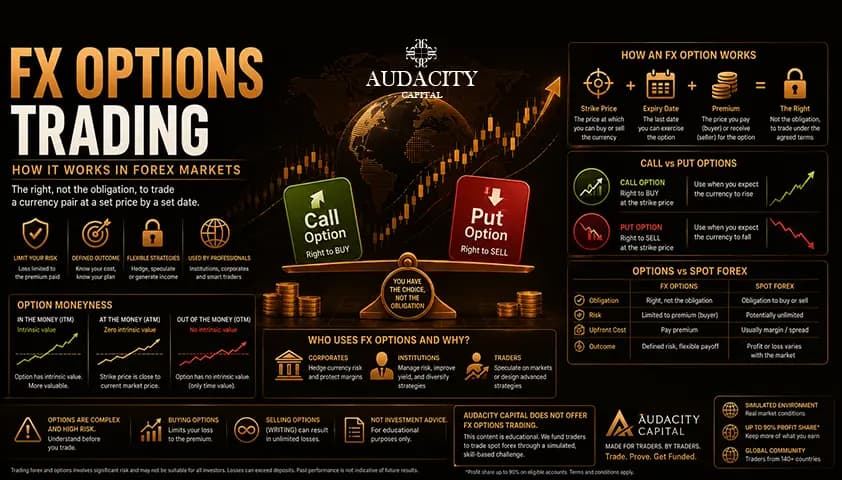
FX options trading is the buying and selling of contracts that give you the right, but not the obligation, to trade a currency pair at a set price by a set date, in exchange for an upfront fee called the premium.
It's primarily employed by hedge funds, corporates and banks to reduce currency exposure risk and by a small group of advanced retail speculators who have mastered options pricing.
If you've noticed “forex options” being advertised in ads or on YouTube, here's the truth: many of those ads aren't about real FX options.
It's for binary options, which is a completely different product that's illegal for retail traders in some of the biggest markets and associated with numerous frauds.
This guide explains what real FX options are, how they are quoted, where they're really done, who trades them, and how you can avoid the marketing trap.
A note before we go further: this article is educational only. Audacity Capital is a proprietary trading company specializing in Spot forex and CFD trading and doesn't deal in FX options. Options are complicated high-risk derivatives, and this isn't investment advice.
What is FX options trading?
An FX option is a derivative contract that gives the holder the right, but not the obligation, to buy or sell a currency pair at a fixed price (the strike) on or before a set date (expiry), in exchange for a non-refundable premium paid up front.
A useful way to think about an FX option is as an insurance policy on an exchange rate.
The premium is the cost of that protection. If the market moves your way, you "claim" by exercising the option. If it doesn't, you will forfeit your policy and you will only lose what you paid.
A few things to keep in mind from the start.
- You are always trading a currency pair, such as EUR/USD or GBP/JPY, never a single currency in isolation.
- FX options are always based on a currency pair rather than a single currency in isolation.
- And there are only two basic building blocks: calls and puts.
Calls vs puts, and the four positions
A call option gives you the right to buy the pair at the strike. You buy a call if you expect the base currency to strengthen against the quote currency.
A put option is an option that allows you to sell the pair at the strike. You buy a put when you expect the base currency to weaken against the quote currency.
These two contracts have been used to create four positions, and they don't have a symmetrical risk profile. This is one of the most crucial things that you should know before even approaching options.
When buying a call or put, your maximum loss is limited to the premium paid.
If you buy a call or buy a put, your maximum loss is limited to the premium you pay, while your maximum gain can be quite substantial. When you sell (or write) a call or sell a put, you collect the premium up front, but you take on the obligation on the other side of the contract.
That commitment can end up costing you a lot more than the premium, should the market turn against you.
The lesson here: The purchase of an option is limited to the premium.
Buying an option caps your risk at the premium. When writing an option, potential losses can greatly exceed the premium received.
Position | Market view | Maximum risk | Maximum reward |
Buy a call | Pair will rise | Premium paid | Large, theoretically uncapped |
Buy a put | Pair will fall | Premium paid | Large, capped at strike falling to zero |
Sell a call | Pair will not rise above strike | Potentially very large | Premium received |
Sell a put | Pair will not fall below strike | Potentially very large | Premium received |
Writing options is not an easy undertaking.
That's where most retail blowups in options occur, because this risk is asymmetric in a manner that is not visible until a sharp move occurs.

The language of FX options
Below is the vocabulary you will need prior to reading any provider page or strategy guide. Forex options explained properly start with these terms.
Term | Plain-English meaning |
Strike price | The agreed exchange rate at which the option can be exercised. |
Option premium | The non-refundable price the buyer pays the seller for the contract. |
Expiry / expiration | The date and time the option contract ends. |
Notional | The size of the underlying currency amount the option covers. |
In the money (ITM) | A call is ITM if the market rate is higher than the strike. A put is ITM if its market rate is lower than the strike. |
At the money (ATM) | The market rate is equal to or close to the strike. |
Out of the money (OTM) | A call is OTM when the rate is below the strike. A put is OTM when the rate is above. |
Intrinsic value | The amount by which the option is already in the money. |
Time value | The added value that is associated with time left and uncertainty before the expiration. |
European style | Can only be exercised at expiry. |
American style | Can be exercised at any time up to expiry. |
Bermudan style | Can be exercised on specific dates between issue and expiry. |
Exercise | Choosing to use your right under the contract. |
Let it expire | Doing nothing, so the option ends with no further action. |
Note: The distinction between in the money and out of the money is important as it directly affects the value of the option at any point in time.
How do forex options work in pricing terms?
If you are wondering how do forex options work when it comes to price, the foundation is a single formula:
Premium = Intrinsic Value + Time Value.
Intrinsic value is the part of the premium that reflects how far in the money the option is right now. If a EUR/USD call has a strike of 1.0800 and the market is at 1.0850, the intrinsic value is 50 pips worth of notional. An out-of-the-money option does not have an intrinsic value.
Time value is all the rest. It shows how much time is left until the expiration and the volatility of where the rate may go in that period.
Implied volatility is the factor that drives the most – it's the market's expectation of how far the pair is going to move. The higher the implied volatility, the higher the premium, since there's a bigger swing priced in.
Other drivers include the time remaining (more time means more time value) and how far the strike sits from the current rate.
Time value erodes as expiry approaches. This is known as time decay and is why an option buyer can be correct in their call but lose money if it doesn't come through in time.
These sensitivities are handled by professionals with the Greeks. At a high level:
- The delta is a measure of the premium's sensitivity to a one-unit change in the underlying rate.
- Gamma is a measure of the change in delta as the rate moves.
- Theta represents the time value loss in a day as the expiration nears.
- Vega is the sensitivity to changes in implied volatility.
- Rho measures sensitivity to interest-rate changes.
To grasp the idea of an option, you don't need to know the Greeks, but you do need them to properly value an option.
That gap between "understanding" and "valuing" is one reason options are considered advanced.
FX options vs spot forex, forwards, and futures
To better understand what is an fx option, it is best to compare it to the other methods traders and businesses use to gain access to currencies.
Instrument | Obligation? | Upfront cost | Expiry | Maximum risk |
Spot forex | Yes, open position | Spread / margin | None, open-ended | Can exceed initial margin |
Forward | Yes, binding | None up front | Fixed date | Full exposure to adverse move |
Future | Yes, binding | Margin | Fixed date | Margin calls, large losses possible |
FX option (buy) | No, your choice | Premium | Fixed date | Premium paid |
FX option (sell) | Yes if exercised | Receive premium | Fixed date | Potentially very large |
Spot forex vs forex options is the comparison most retail traders care about.
Spot provides ongoing exposure without expiration, and you can lose more than the individual premium would have cost you.
An option charges you the premium upfront but sets a ceiling on the amount you can lose on the trade, but it also keeps the amount you can gain the same if the trade is successful.
The trade-off is honest: options buy you flexibility and insurance, but you pay for both.

Why people actually trade FX options
There are two real-world scenarios and neither one is "easy income". They are hedging, speculation, and typically used by institutions, corporates and a smaller number of sophisticated retail traders.
1. Hedging currency risk
Hedging currency risk is by far the dominant use of FX options.
The idea is to avoid losing on a bad move and still be able to profit from a market reversal.
An example: A US company owed a European supplier €1,000,000 due in three months. The finance team is worried about the euro rising against the dollar, which would make the bill more expensive in USD.
They buy a EUR call (USD put) at a strike of 1.0800 and pay a premium. If the euro rises to 1.1200 at expiry, they exercise the option and effectively cap their cost at 1.0800. If the euro falls to 1.0500, they let the option expire, lose only the premium, and buy euros at the cheaper market rate.
It was a downside cap, but it didn't take away the upside. That's the corporate logic, and why the global FX options market exists.
2. Speculation by advanced traders
The second use is expressing a directional or volatility view with defined risk when buying.
Expect a rise? Buy a call. Expect a fall? Buy a put.
Expect a big move but not sure which way? There are also option structures for that.
Here is the honest explanation. The defined-risk benefit applies to buying. The premiums on FX options can be high compared to the move required to break even, and an option bought can still expire worthless, resulting in a complete loss of the premium.
Many traders who "buy options to limit risk" continue to bleed capital over time due to the time decay of the positions.
Vanilla vs binary options, and the marketing trap
This is the most important honest section in this guide.
The options described so far are vanilla call and put options. They are legitimate and widely used in institutional and corporate finances and traded all over the world.
Binary options, sometimes branded as SPOT or single-payment options, are something different. They are all-or-nothing bets.
If a specific condition is met by expiry, such as a pair trading above a level, the contract pays a fixed amount. If not, the holder loses the premium. The payoff is structured like a wager, not like an insurance policy.
Many of the "forex options" being promoted online, especially the ones that guarantee low-risk and high-yield profitability through a sleek online platform, are not plain vanilla options. It is a binary option.
The regulatory record here is direct.
The European Securities and Markets Authority (ESMA) banned the sale of binary options to retail clients in the EU in 2018. The UK's Financial Conduct Authority (FCA) made its ban permanent in 2019.
Other regulators have imposed similar restrictions. The bans were a response to the structural problems of the product and widespread fraud connected to binary brokers. Verify the current rules in your own market before acting.
The takeaway is simple: when you see vanilla vs binary options discussed in the same breath, they are not two flavors of the same thing. They are different products with different risk structures and very different reputations.
If a platform is offering fixed, high payouts on "forex options" with one-touch decisions and short countdown timers, treat it as a red flag.
Where FX options are actually traded, and who can access them?
The retail-access question is where most broker pages quietly skip over the truth.
1. OTC (institutional, over-the-counter)
The bulk of the global FX options market is over-the-counter. Banks, corporates, and funds trade customizable contracts directly with each other or via dealers. The flexibility is the appeal: any pair, any strike, any expiry, any notional.
The drawback is opacity.
Spreads are set by the dealer, transparency on pricing is thin, and the structures are not designed for small retail accounts.
Practitioners like FXStreet have been blunt that they would not recommend trading spot-FX options this way for retail because the playing field is not level.
2. Exchange-traded (regulated retail route)
The genuinely regulated, retail-accessible route is exchange-traded options. These include options on FX futures, traded on venues like the CME Group, and options on currency ETFs, traded on US options exchanges.
These contracts are standardized, transparent, and regulated, with implied volatility benchmarks like CME's CVOL available to inform pricing.
Note: you usually need a futures or options brokerage account, not a spot-forex account.
The retail bottom line
Most retail spot-forex brokers do not offer true FX options. Some providers route what they call "FX options" through CFD contracts, which is a synthetic exposure.
Others, like CMC Markets, openly state on their own pages that they do not offer the product at all.
A retail trader who genuinely wants to trade vanilla currency options typically needs to open a different type of account, with a futures or options broker, and meet their eligibility requirements.
That is rarely advertised on broker landing pages. It is the part worth knowing before you go shopping.
The real risks of FX options
Be straight about the downsides before you commit any capital or even any study time.
1. Complexity.
Valuing an option requires understanding pricing, volatility, and the Greeks. Without that, you are guessing at what you are paying for.
2. Buying vs writing asymmetry.
Writing options carries potentially very large losses. This is the most common source of retail options blow-ups.
3. Time decay.
You can be right on direction and still lose money if the move takes too long. Theta works against the buyer every day.
4. Total premium loss.
An option that expires out of the money pays nothing. Lose the full premium repeatedly across many trades and the costs add up fast.
5. Liquidity and spread costs.
OTC products and options on exotic pairs can have wide spreads and patchy liquidity, which makes entry and exit expensive.
The phrase "limited risk" is half-true. Yes, the buyer's loss on any one contract is capped.
No, that does not mean buying options is a safe strategy if you are doing it without an edge.
Is FX options trading right for you?
For corporates hedging real cash flows, FX options are a powerful and appropriate tool.
For experienced traders with the right account, the right capital, and a tested understanding of pricing, they offer ways to express views that spot trading cannot.
But for most retail forex traders, they are an advanced detour.
The skills that move the needle long-term, a tested strategy, strict risk management, defined risk per trade, and discipline, are the same skills spot trading rewards.
If those are still being built, build them first. Adding options on top of an unproven process tends to compound mistakes faster, not slower.
Where Audacity Capital fits ?
To be clear, Audacity Capital does not offer FX options trading. We are a proprietary trading firm focused on spot forex and CFD trading, and this article is provided for educational purposes only.
What we do offer is a structured pathway for traders to demonstrate their skills through our funding programs using MT5 or DXtrade.
Traders can choose from the Ability Challenge (two-step evaluation), Ability One (one-step evaluation), or the FTP funding program, depending on their preferred route to funding.
We also run a free monthly trading competition that gives traders the opportunity to compete on a public leaderboard and win funded account prizes.
Explore the funded trader pathway →
FAQ
Some professionals do, but they are typically working inside institutional desks with deep pricing models, risk systems, and capital behind them. For retail traders, options are complex, costs add up quickly, and most do not turn it into a reliable living. Treat any "consistent income" pitch around options with skepticism.
You need enough to cover the premium on the contracts you want to buy, plus the right account type. Exchange-traded FX options usually require a futures or options brokerage account with its own minimums and approvals. There is no universal figure, and provider rules vary widely.
Regulators including ESMA in the EU (2018) and the UK FCA (2019) restricted retail sales of binary options because the all-or-nothing payoff structure consistently produced losses for retail clients, and because the sector was tied to widespread fraud and unlicensed brokers. Rules differ by jurisdiction, so verify current local rules before acting.
Some do, but often through CFD wrappers rather than true exchange-traded contracts. Others state plainly that they do not offer them. Genuine vanilla FX options usually require a futures or options brokerage account, not a standard spot-forex account.
If the option is in the money at expiry, it will typically settle in your favor automatically, depending on the provider's rules. If it is out of the money, it expires worthless and you lose the premium you paid. Always check the specific settlement rules on the contract.
Implied volatility is the market's expectation of how much a currency pair will move before expiry. It is the single biggest driver of the time-value portion of the premium, which means higher implied volatility leads to more expensive options, all else equal.
If you are buying an option, no. Your loss is capped at the premium you paid. If you are writing or selling an option, yes. Your losses can be far larger than the premium received, which is why selling options is not a beginner activity.
No. Spot forex gives you direct, ongoing exposure to a currency pair with no expiry. An FX option is a contract giving you the right, but not the obligation, to trade that pair at a set price by a set date, in exchange for a premium.

Pronto ad applicare un rischio disciplinato alle criptovalute? Esplora i nuovi strumenti crypto di Audacity Capital e porta la tua strategia di trading.
Scopri di PiùNewsletter
Iscriviti alla newsletter per restare aggiornato.
Unisciti Alla Nostra Community Social

Inizia Il Tuo Viaggio Oggi Con La Nostra Prova Gratuita
Mostra con orgoglio le tue abilità e i tuoi risultati attraverso certificati e ottieni riconoscimenti per il tuo duro lavoro e dedizione da potenziali investitori e colleghi.
Prova GratuitaArticoli Correlati
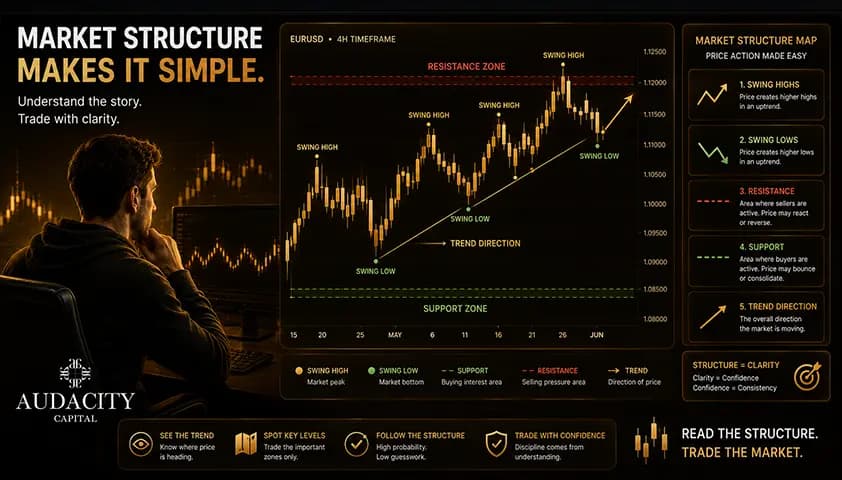
What Is Market Structure in Forex Trading?
Market structure in forex explained simply: swing highs and lows, BOS and ChoCh, support and resistance, plus how to read and trade it with discipline.

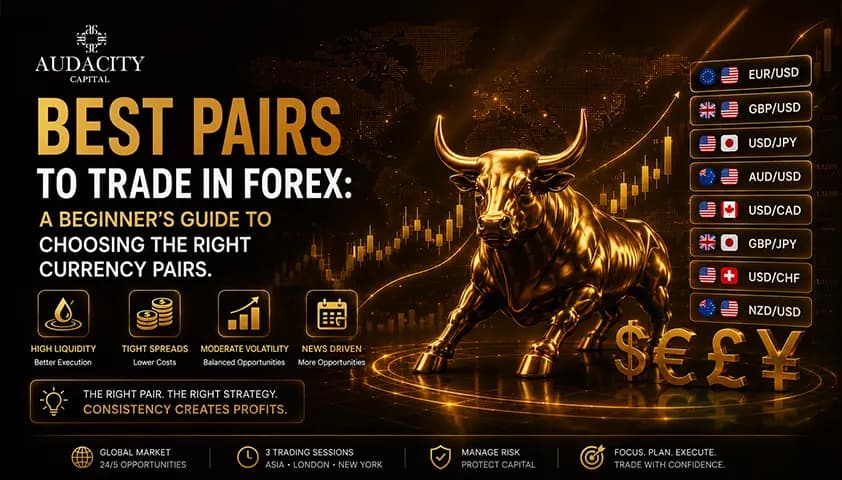
Best Pairs to Trade in Forex: A Beginner's Guide to Choosing the Right Currency Pairs.
Discover the best pairs to trade in forex, including major, minor, and exotic currency pairs. Learn how to choose the right forex pairs based on your trading style and experience.
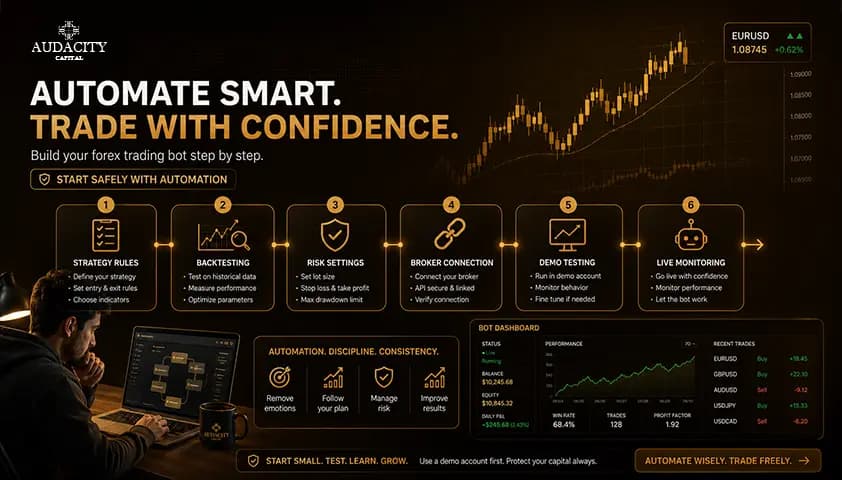
How to Get Started With Automated Forex Trading
Learn how automated forex trading works, choose or build an EA, backtest it, use a demo account, and launch with practical risk controls.
Best Forex Trading Sessions and Times for Funded Traders
Plan your Forex trading around the best time to trade forex globally. Get market data analysis for the time of the day with highest or most volatile trades