



10 Most Volatile Currency Pairs in Forex


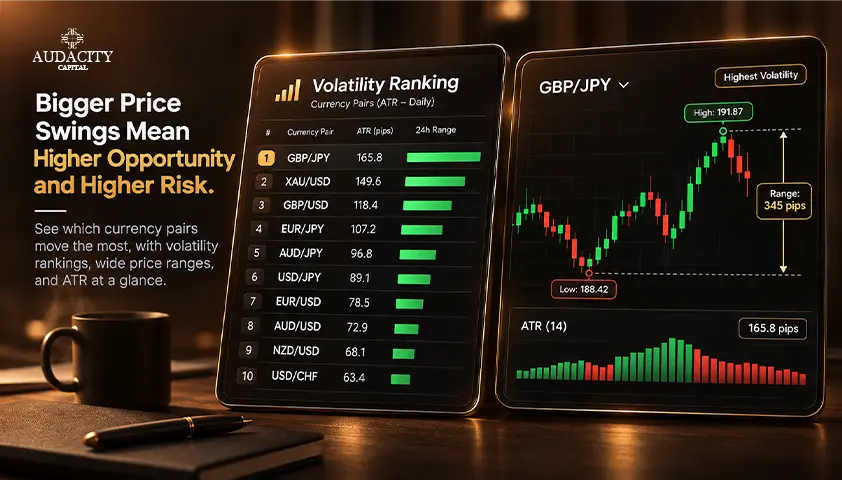
Most volatile currency pairs refer to those pairs that experience the highest and fastest price changes within a certain time frame.
Examples of current most volatile pairs include emerging-market pairs such as USD/ZAR and USD/MXN and active crosses such as GBP/JPY and AUD/JPY pairs.
It is important to point out that forex volatility is not static. It means that the most volatile pair during one quarter may become less volatile during another quarter. Thus, any ranking loses its meaning without an accompanying time measure.
In this guide, we will look at the most volatile pairs, measures of volatility, factors that affect volatility, the least volatile pairs, and risks that come with trading them.
What Are the Most Volatile Currency Pairs?
Most volatile forex pairs are those that exhibit the greatest price swings in a specified period of time, which may be a day, week or month.
Forex currency volatility can be measured using various metrics such as average true range, average daily range, historical volatility, and implied volatility.
The ranking is not constant, but the below list includes currency pairs that have consistently been part of the high volatility currency pairs. Always verify your data from the latest sources before using the list below.
Currency Pair | Pair Type | 14-day ATR (% of price) | Main Volatility Drivers | Risk Note |
USD/ZAR | Exotic | [x.xx%] | Commodities, SA inflation and rates, politics, risk sentiment | Wider spreads, thinner liquidity |
AUD/JPY | Cross | [x.xx%] | China-linked demand, yen safe-haven flows, BoJ policy | Sharp moves when risk appetite flips |
GBP/AUD | Cross | [x.xx%] | UK vs Australia rates, growth, commodities | Active across multiple sessions |
GBP/JPY | Cross | [x.xx%] | BoE vs BoJ policy, UK data, risk mood | Large intraday ranges, stop-out risk |
NZD/JPY | Cross | [x.xx%] | RBNZ expectations, carry trades, Asia-Pacific demand | Carry unwinds cause sudden repricing |
USD/MXN | Exotic | [x.xx%] | US-Mexico trade, rate gaps, oil, EM sentiment | Gap risk around political events |
CAD/JPY | Cross | [x.xx%] | Oil, BoC vs BoJ, risk sentiment | Energy and risk shocks can stack |
GBP/NZD | Cross | [x.xx%] | UK data, RBNZ, commodity sentiment | Wide ranges, often wide spreads |
EUR/NOK | Cross | [x.xx%] | Oil and gas, Norges Bank, ECB | Lower liquidity than major EUR pairs |
AUD/NZD | Cross | [x.xx%] | RBA vs RBNZ divergence, regional data | Usually calm; spikes when RBA/RBNZ paths diverge |
Data as of [date], source: [source]. Measured as 14-day ATR on daily candles, expressed as a percentage of price (ATR ÷ price × 100).
10 Most Volatile Currency Pairs Explained
1. USD/ZAR (US Dollar / South African Rand)
The rand is a typical high-beta emerging-market currency. It moves according to commodity prices (metals and minerals exported by South Africa), inflation and interest rates expectations, politics and economics, and overall risk sentiment.
When investors become nervous, they will usually try to sell off emerging-market currencies, and the rand may be one of them.
Remember that such exotic currency pairs typically offer bigger spreads and lower market liquidity compared to major pairs. Verify if it's indeed on your list using the latest ATR or average daily range figures.
2. AUD/JPY (Australian Dollar / Japanese Yen)
This currency pair is widely used as a risk-sentiment indicator. The Australian dollar depends on commodity prices and the Chinese economy, while the yen strengthens when markets become jittery and falls when risk appetite returns.
The result is the currency pair's volatility. Changes in Bank of Japan policy add to the list of reasons. Volatility may rise around the time of Asian session economic releases and central bank announcements since both currencies are most active at that time.
3. GBP/AUD (British Pound / Australian Dollar)
Price volatility in the pair could be affected by the disparities between the UK and Australia in terms of growth rates, inflation, and interest rates. The Australian economy’s reliance on commodities and China-linked demand make these economies quite dissimilar.
GBP/AUD trades two regional forex trading sessions (Asia-Pacific and London), which increases the activity throughout the session.
4. GBP/JPY (British Pound / Japanese Yen)
Popularly referred to as “the Beast” or “the Dragon” by traders, GBP/JPY is characterized by large intraday fluctuations.
Differences in policy outlook between the Bank of England and Bank of Japan, UK economic data, Japanese policy surprises, and global risk sentiment are some of the factors driving this pair.
The downside is that large fluctuations come with greater stop-out and leverage risks. Position size that looks good in EUR/USD can look very different here.
5. NZD/JPY (New Zealand Dollar / Japanese Yen)
Economic ties of New Zealand with commodity markets (primarily dairy) and Asia-Pacific demand, and the RBNZ’s rate outlook are extremely important.
Combining this with the yen's function as a funding currency and its status as a safe-haven during risk-off periods results in a pair that is susceptible to carry-trade conditions. Unwinding of carry trades often leads to abrupt and volatile repricing.
6. USD/MXN (US Dollar / Mexican Peso)
A number of factors influence the peso, including US–Mexico trade relations, differences in rates, oil prices, domestic policies, and investor sentiment toward other emerging markets.
This currency pair is liquid for emerging markets standards and is quite widely traded. However, it can show greater range than major currency pairs, particularly during election time or in times of trade news.
7. CAD/JPY (Canadian Dollar / Japanese Yen)
Canada's energy exposure meets with Japan's extremely risk-sensitive yen. Expectations from the Bank of Canada and the policy of the Bank of Japan play another part.
This pair may have strong moves when energy prices and sentiment are moving in the same direction.
8. GBP/NZD (British Pound / New Zealand Dollar)
Two currencies from two different economic cycles and central bank policies can produce large ranges.
UK data and BoE policy drive one side, while the RBNZ outlook, commodity sentiment, and economic data from New Zealand’s Asia-Pacific demand drive the other.
The NZD is a smaller and less liquid currency, therefore spreads can widen when things heat up.
9. EUR/NOK (Euro / Norwegian Krone)
The krone is highly correlated to oil and gas prices, Norges Bank policy, and broader European conditions, while the euro responds to ECB policy and the economic data within the eurozone.
Liquidity is less compared to major EUR pairs which can make the pair move a little more, especially when energy markets get unsettled.
10. AUD/NZD (Australian Dollar / New Zealand Dollar)
This is usually a quiet pair among the cross currency pairs, but it can become very volatile once the policies from RBA and RBNZ diverge.
Variations in economic data from Australia and New Zealand, and commodity exposures, can cause periods of high volatility. Approach this pair as a sleeping pair till policies diverge.
What Is Forex Volatility?
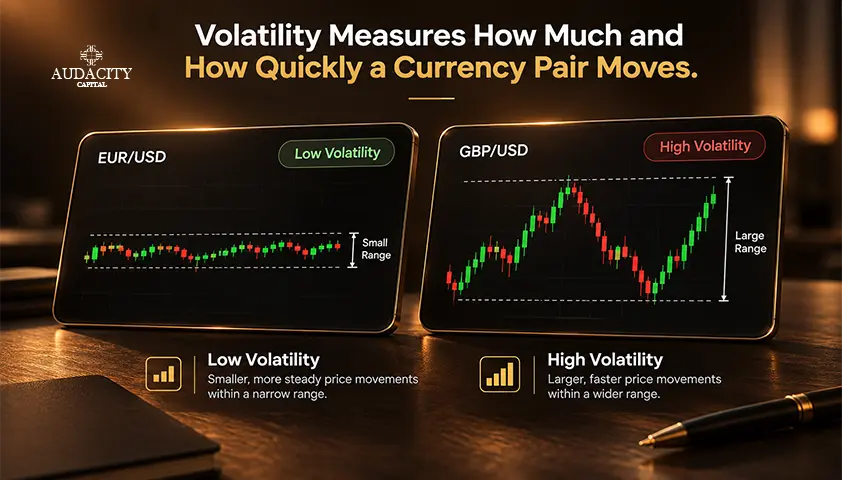
Forex volatility is the extent to which a currency pair exchange rate fluctuates over time.
Volatility can be divided into two major types:
- High volatility means bigger changes in the price level within a certain period of time. The price can go up and down rapidly, even in just a few minutes.
- Low volatility means smaller and slower price changes. Its exchange rate can be contained in a relatively narrow price range for several hours or even days.
Volatility is neither good nor bad by itself. It may provide an opportunity for big price changes, but it may also create risks related to execution, stop-loss hits, and slippage, as well as the use of excessive leverage.
How Is Currency Pair Volatility Measured?
There are multiple indicators that traders can employ when comparing volatility currency pairs. Here is an overview of some of them.
Average True Range (ATR)
The average true range estimates the average trading range for a pair during a certain period of time (14 is a common default).
This indicator considers gaps between sessions, which provides a more accurate estimate than High-Low range. To compare pairs with different exchange rate values, traders may express ATR as a percentage of the current exchange rate.
Average Daily Range
The average daily range is a range in pips or as a percentage of how far the currency pair travels per day. Beware of comparing pips of a pair with another pair: a 120-pip move on EUR/USD is not comparable with 120 pips on a pair valued in hundreds like GBP/JPY.
Historical Volatility
Historical volatility relies on past price movements (standard deviation of returns) to assess the volatility of the pair over a specified lookback period, usually 30 or 90 days. This will tell you what has already happened.
Implied Volatility
Implied volatility is forward-looking. It is calculated through options pricing and shows what the market thinks about future movements. Implied volatility tends to increase before significant events, like central bank meetings or elections.
Tip: For any ranking or comparisons, use one consistent metric and lookback period. Mixing ATR for one pair with implied volatility for another makes the figures incomparable.
What Makes a Currency Pair Volatile?
There are several factors that drive currency pairs into volatility:
- Interest rate announcements and central-bank expectations. Unexpected results or even a change in sentiment may cause rapid currency movements.
- Big economic reports. Inflation, employment, and GDP figures affect rate expectations.
- Geopolitical events and political uncertainty. Elections, wars, trade disputes may lead to unexpected repricing.
- Commodity prices. The currencies like AUD, CAD, NZD, NOK and ZAR are frequently correlated with the commodities their countries export.
- Global risk sentiment. Risk-on and risk-off shifts affect the yen crosses and the emerging-market currencies particularly hard.
- Liquidity differences. Less liquid markets are more responsive to smaller transactions, and this is the reason for the importance of market liquidity.
- Unexpected policy news or intervention. The central banks can surprise the market without any prior notice.
- Economic divergence. In case two countries diverge in terms of growth, inflation or interest rate policies, the pair between them usually becomes more volatile.
Which Types of Currency Pairs Are Usually the Most Volatile?
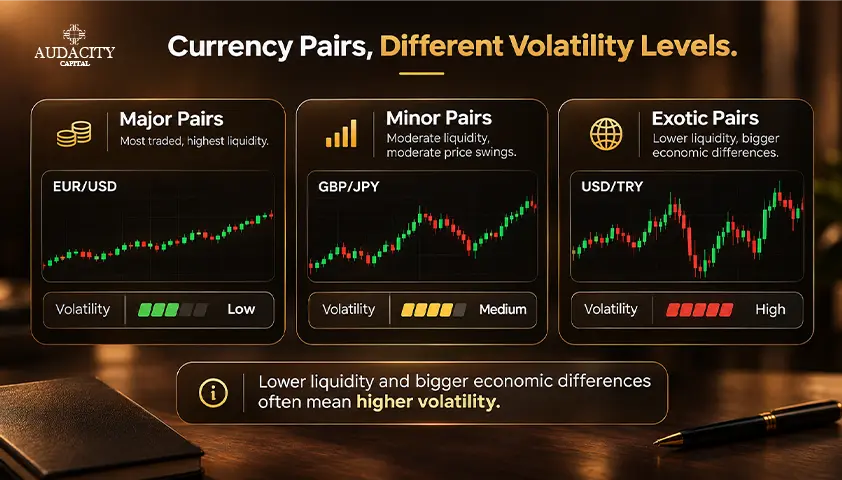
Forex pairs are basically classified into three types, major, minor and exotic. The volatility is different in each pair depending on their liquidity, economic conditions and trading activity.
Major Currency Pairs
Major currency pairs include the US dollar and another widely traded currency.
Examples of major pairs include:
- EUR/USD
- GBP/USD
- USD/JPY
- USD/CHF
- AUD/USD
- USD/CAD
- NZD/USD
These pairs are generally highly liquid with tight spreads. But they can face considerable levels of volatility when economic and central-bank reports come out.
For instance, GBP/USD and USD/JPY might face volatile situations when monetary policy expectations change.
Minor or Cross Currency Pairs
Minor currency pairs do not contain US Dollar. They are also known as cross currency pairs.
Some examples of these pairs include:
- GBP/JPY
- EUR/GBP
- AUD/JPY
- GBP/AUD
- EUR/AUD
- GBP/NZD
These pairs have more volatile prices compared to some major pairs due to their combined currencies with varying economic and monetary policies.
Yen crosses and commodity crosses can be especially volatile during changes in global risk sentiment.
Exotic Currency Pairs
Exotic currency pairs are made up of one major currency and one currency of an emerging or small economy.
They include the following pairs:
- USD/ZAR
- USD/TRY
- USD/MXN
- USD/SEK
- USD/NOK
The exotic pairs may see significant percentage changes due to the effects of economic uncertainty, political events, inflation, and interest rate differentials. They may also have wider spreads and low liquidity compared to major pairs.
What Are the Least Volatile Currency Pairs?
When you compare the most and least volatile currency pairs, the least volatile ones include EUR/USD, USD/CHF, USD/JPY, and many other highly liquid majors.
Please make sure that the current data is verified before concluding any list as complete, because the ranking changes.
Why are these pairs less volatile?
There are a few reasons:
- Higher liquidity: There will be more buyers and sellers who can take in large orders without affecting the price.
- Advanced economy: Strong financial systems can give more stability to the economy.
- Similar economic situation: If two economies have similar growth rates and policies, then the currencies may not show many sharp changes.
- Market participation: Major pairs attract more institutional and retail trading activity.
Low volatility does not mean there are no risks involved. Even EUR/USD and USD/CHF can show many sharp price changes during unexpected economic announcements, political developments or financial crises.
When Are Forex Currency Pairs Most Volatile?
The volatility is not constant at all times during the day. It is generally high when liquidity and participation are high, and forex trading sessions determine this trend:
1. London Session
The London session is one of the busiest sessions in forex trading.
It is significant for EUR and GBP pairs due to the active participation of European banks and financial institutions.
GBP/USD, EUR/USD, GBP/JPY and EUR/GBP are some of the pairs that may have increased volatility.
2. New York Session
The New York session is an addition of activity to the market, especially for USD-related pairs.
Important economic news from the USA, including inflation, employment and Federal Reserve announcements, can lead to price movements.
USD/CAD, EUR/USD and GBP/USD are some of the pairs to consider.
3. London-New York Overlap
High market activity
London-New York overlap period is usually characterized by high market activity in foreign exchange trading.
This is because both markets operate at the same time, which boosts market participation and liquidity.
It occurs between 12:00 – 16:00 UTC during daylight saving times in the USA and UK, and 13:00 -17:00 UTC during standard times. Exact hours change around daylight-saving transitions.
4. Asian Session
The Asian session is critical in pairs involving Japanese yen, Australian dollar, and New Zealand dollar.
Pairs like USD/JPY, AUD/JPY, NZD/JPY and AUD/USD become more active when economic information is released in Japan, Australia and New Zealand.
5. Major Economic Announcements
Markets become very volatile especially when:
- Decisions made by the Federal Reserve on interest rates.
- Announcements by the Bank of England.
- Meetings of the European Central Bank.
- Policies by the Bank of Japan.
- Inflation reports.
- Employment figures.
- GDP reports.
Traders should also track any sudden geopolitical events and central bank interventions.
The important point is that the busiest period depends on which currencies are being traded. AUD/JPY might be busier in Asia, while GBP/USD tends to wake up in London. Do not assume that all currency pairs have their busiest periods at the same time.

Are You Looking For A Funded Trader Program?
Funded Trader ProgramWhat Should Traders Consider Before Trading Highly Volatile Currency Pairs?
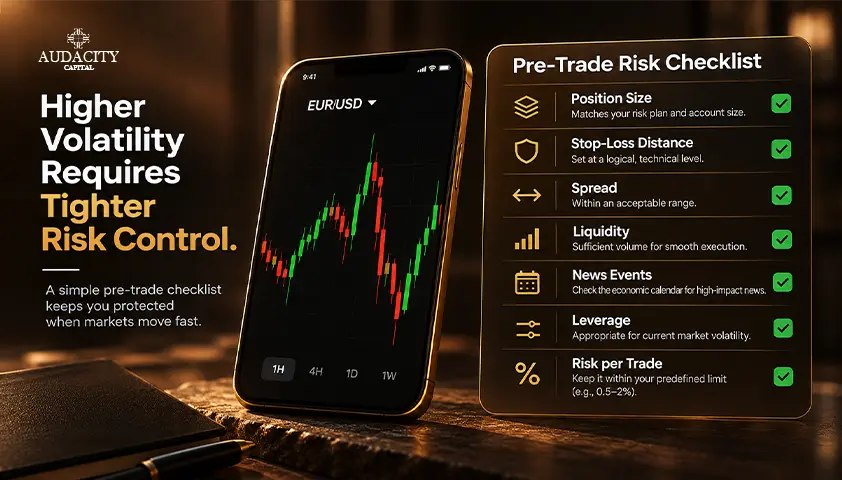
Volatility is not a guarantee of profit. Consider it a risk factor first.
- Use small positions in case of increased volatility to avoid losing from a regular move.
- Consider larger stop-loss distances in case of increased volatility. If a wider stop is needed, reduce your position size to keep the potential monetary loss within your risk limit.
- Review spreads and liquidity, especially for exotic currency pairs where it may affect your trading performance.
- Do not use too much leverage. Leverage increases both profit and losses and volatile pairs make that more dangerous.
- Stay up to date on the economic calendar and central bank announcements so that you won’t be surprised by any major announcements.
- Consider slippage near major announcements when the trade might get filled at a less favorable price.
- Reassess volatility regularly. Old rankings may deceive you; check ATR or historical volatility frequently.
A highly volatile currency pair is not necessarily a good or profitable one. It all depends on your trading strategy, risk appetite, execution environment, and timing.
For many traders, a less volatile pair that fits their strategy will be better than a highly volatile one that doesn’t.
Frequently Asked Questions
There is no permanent answer to that question. Emerging currency pairs such as USD/ZAR and actively traded crosses such as GBP/JPY have had wide ranges in the past, but which forex pair is the most volatile depends on the time period and the measure of volatility.
The exotic currency pairs, along with certain yen and commodity crosses, tend to be the ones with larger average movement. See the comparative table above and update it with recent figures instead of taking anything for granted.
No, they are usually more volatile due to low liquidity and higher risks, but volatility varies with time, and not all exotic pairs are always more active than all majors or crosses.
GBP and EUR crosses tend to become more volatile during the London session, although the ranking may vary depending on the market conditions.
The main tools are average true range, average daily range, historical volatility, and implied volatility. You should use one method when comparing volatility across pairs.
No. High volatility means bigger moves but also bigger risks. Profitability will depend on your strategy, timing, trading costs, and risk management.
Guides About Currency Pairs
- The Best Forex Currency Pairs to Trade
- Best Days to Trade Forex
- Best Currency Pairs to Trade in the Sydney Forex Session
- Best Currency Pairs to Trade in the Forex Asia Session
- Best Currency Pairs to Trade in the New York Session
- Best Currency Pairs to Trade in The London Session
- Best Forex Currency Pairs to Scalp
- Forex Currency Pairs With Lowest Spreads
- Forex Exotic Currency Pairs
- ing Forex Currency Pairs
- Correlated Forex Currency Pairs
Check Our Funded Trader Program

Pronto ad applicare un rischio disciplinato alle criptovalute? Esplora i nuovi strumenti crypto di Audacity Capital e porta la tua strategia di trading.
Scopri di PiùNewsletter
Iscriviti alla newsletter per restare aggiornato.
Unisciti Alla Nostra Community Social

Inizia Il Tuo Viaggio Oggi Con La Nostra Prova Gratuita
Mostra con orgoglio le tue abilità e i tuoi risultati attraverso certificati e ottieni riconoscimenti per il tuo duro lavoro e dedizione da potenziali investitori e colleghi.
Prova GratuitaArticoli Correlati

10 Best Futures Prop Firms for Swing Trading In 2026
Compare the best futures prop firms for swing trading in 2026 with overnight holding, flexible rules, fast payouts, and funded accounts.


Introducing Ability One: One Step To Funding With Static Drawdown

How To Choose The Right Prop Firm – A Complete Checklist
Learn how to choose the right prop trading company with our expert guide. Compare fees, rules, profit splits, and platforms to trade confidently.

From Demo To Live: When Are You Ready To Go Live?