


How to Keep a Trading Journal as a Funded Trader


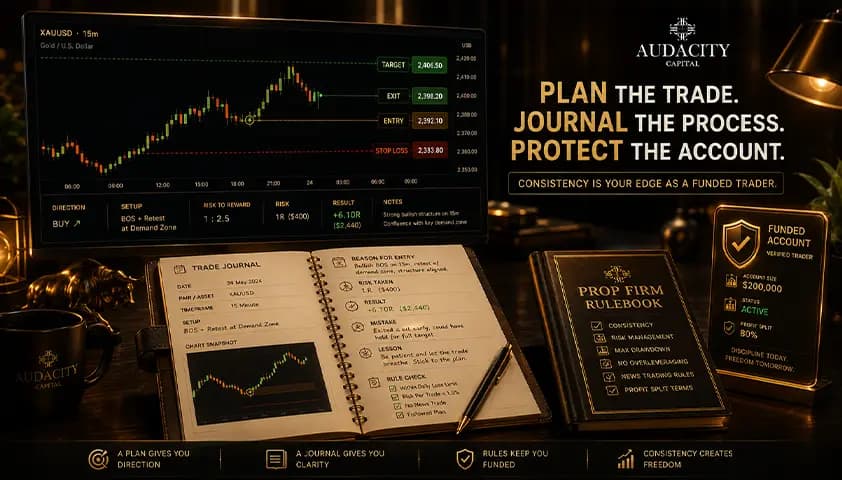
A regular trading journal answers one question: how did I trade today?
A funded trader's journal has to answer a more urgent one: am I about to lose my account?
That difference changes everything. When you trade firm capital, you are not just trying to be profitable, you are trying to be profitable inside strict rules where a single bad session can end the account, often across more than one account at the same time.
So a funded journal is less a diary and more a real-time instrument. It tracks your distance from the limits and surfaces the habits that quietly blow accounts.
This guide covers why a funded journal is different, what to track, the emotional layer, how to keep one without paying for an app you will never open, how to review it, and the mistakes to avoid.
So let’s get started!
Why a funded trader needs a different kind of journal
A normal trade log is retrospective. It records what happened so you can improve later.
On other hand a prop firm trading journal has to do that too, but it also has to work in real time as a compliance tool, because the rules can end your account in a single session.
Here are the constraints a funded trader journals around that a retail trader never faces:
Constraint #1: Daily loss limit: the maximum you can lose in one session. Breach it and the account is gone, regardless of how profitable you were the day before.
Constraint #2: Max drawdown: the floor of your equity cannot fall below over the life of the account. On some firms this is a static number. On others it is a trailing drawdown, a floor that moves up with your profit, so a winning streak can actually tighten your remaining buffer.
Constraint #3: Profit target and deadline: the gain you need to hit, sometimes within a time window, to pass or progress.
Constraint #4: Multiple accounts: every rule above multiplies when you run more than one account at once.
The practical upshot is the heart of a trading journal for funded traders: the most important number in your journal is not your profit, it is your remaining distance to each limit before your next trade.
A simple visual flag at, say, 80% of your drawdown buffer is what stops one bad trade from becoming a violation.
Regular journal vs funded journal
Regular journal asks | Funded journal also asks |
How did I trade today? | Am I about to lose my account? |
Was that a good trade? | How much room do I have before the daily loss limit? |
What is my P&L? | What is the updated drawdown floor after that winning session? |
What can I improve next time? | Which account is closest to a violation right now? |
Drawdown and loss limits are not there to trip you up. They are guardrails, and your journal is the tool that helps you respect them on purpose rather than by luck.
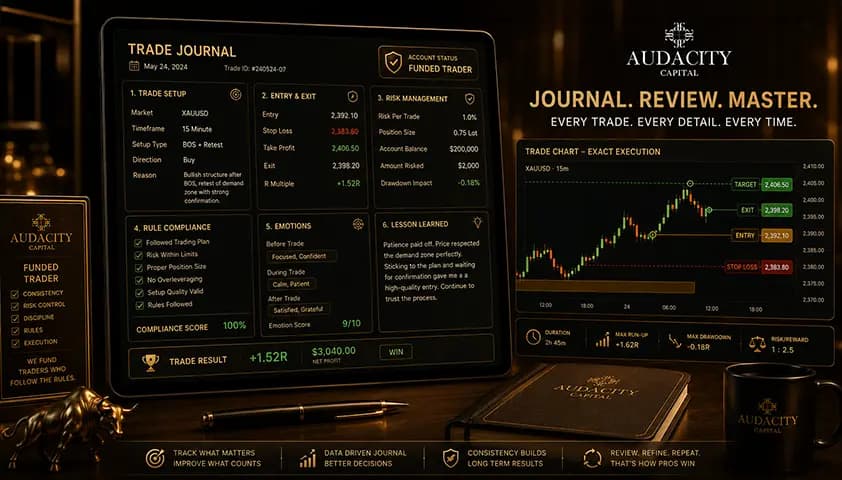
What to track in a funded trading journal?
This is the core of learning how to keep a trading journal that actually keeps you funded.
Track the fields in two groups, then use the copyable table below. Two rules before you start.
First, keep it to around five minutes per trade. An over-complex journal gets abandoned, and an abandoned journal is worthless.
Second, the funded-specific fields are what turn a diary into a compliance tool. Skip them and you are back to a basic P&L log.
The standard fields (what any good journal has)
These are the columns every solid journal includes:
- Date and time
- Instrument
- Direction (long or short)
- Entry and exit price
- Position size
- Stop and target
- Planned risk-to-reward
- Actual P&L, in currency and in R
- Setup or strategy name
- A screenshot of the chart at entry
These answer one question: was this a good trade by my own rules?
One detail matters more than it looks. Log your P&L in R, meaning multiples of the risk you took, not just the dollar amount.
A trade that makes you two times your risk is comparable across every trade and every account size, while a dollar figure is not.
The funded-specific fields (what keeps you funded)
These are the fields a regular journal skips, and they are the reason a funded journal exists:
1. Cumulative intraday P&L and remaining daily budget before the trade. This is your live distance to the daily loss limit, not the trade result after the fact.
2. Current distance from the max drawdown floor. On trailing-drawdown firms, log the updated floor after every winning session.
A winning session can raise the floor and shrink your buffer, which is the compounding risk most traders never see coming.
3. Evaluation phase and that phase's exact target and rules. Reset the template at phase transitions so you never size against the wrong target.
4. A rule-check note or timestamp confirming you verified you had headroom before entering.
5. Account name, if you run more than one.
6. An emotional-state tag (covered in the next section).
7. A mistake or rule-adherence tag: did I follow my plan, did I break a personal limit?
One useful note for traders here at Audacity Capital: because there is no consistency rule, you do not need a consistency-tracking field, even though many journal guides still tell you to add one. That is one less column to maintain.
What to track (copyable)
Field | What it is | Why it matters |
Date / time | When you traded | Spot time-of-day patterns |
What you traded | Find your best and worst markets | |
Direction | Long or short | Detect directional bias |
Entry / exit | Your fill prices | Measure execution |
Lots or contracts | Track position sizing drift | |
Stop / target | Your planned risk | Confirm a defined-risk plan |
Planned R:R | Risk-to-reward | Judge trade quality before P&L |
P&L (currency + R) | Result, two ways | Comparable across accounts |
Setup name | The strategy used | Find your edge |
Remaining daily budget | Distance to daily loss limit | Real-time risk management |
Distance to drawdown floor | Headroom on max drawdown | Avoid the account-ending breach |
Phase | Evaluation stage | Size against the right target |
Rule-check note | You verified headroom | A record you stayed compliant |
Emotional tag | Your state on entry | Surface behavior patterns |
Mistake tag | Did I follow the plan? | Track discipline, not just P&L |
The emotional layer: tracking the trader, not just the trade
A journal that only records prices and P&L misses the thing that actually blows funded accounts: behavior.
Journaling makes invisible habits visible. The revenge trade right after a loss. Adding to a loser to "fix" it. The lot size that quietly creeps up after a winning streak.
The method is simple. Tag every trade with a single emotional state: calm, anxious, excited, frustrated, bored, or revenge. After fifty to a hundred trades, filter your results by that tag.
The payoff is concrete. You might find your revenge trades win far less often than your calm ones. That turns vague advice like "stop revenge trading" into a number you cannot argue with.
How to actually keep a Journal: tools and setup
Here is the money-saving truth most journal articles bury: you do not need a paid app with ten tabs. A free spreadsheet or a Notion page works. And during an evaluation you earn nothing, so every dollar spent on a tool comes straight from your own pocket.
There are two honest options:
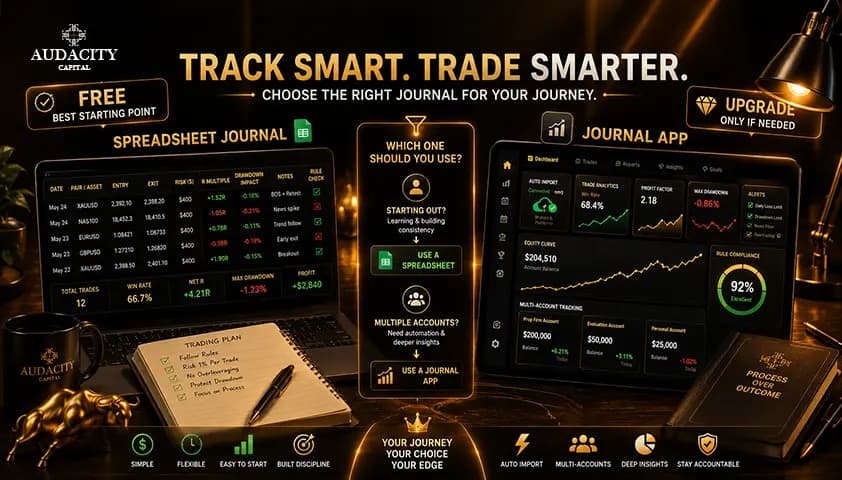
1. A spreadsheet (free). Full control, manual entry, and you build the columns from the table above. This is the best place to start, full stop.
2. A dedicated journal app. These add automated trade import from your platform, dashboards, drawdown alerts, and multi-account views. Useful mainly once you run several accounts or want the automation to save you time.
Here is a quick comparison between a spreadsheet vs dedicated app
Spreadsheet | Dedicated app | |
Cost | Free | Often subscription, sometimes one-time |
Automation | Manual entry | Auto-import available |
Alerts | None (build your own flags) | Real-time drawdown alerts common |
Multi-account | Manual tabs | Consolidated views |
Best for | Starting out, full control | Several accounts, automation |
The honest decision rule: start with a spreadsheet. Only upgrade to a paid app if multi-account tracking or automated import genuinely saves you time, not because an app promises to pass your challenge for you.
No tool does that. Pricing models vary and change often, so always check current terms before you commit. Good risk management and disciplined position sizing come from the data you review, not the price of the software you review it in.
How to review your journal?
Logging trades you never review is wasted effort. The value is entirely in the review. This is the single thing that separates a useful journal from a dead one.
Start with the metrics that matter:
1. Win rate: the share of trades you win.
2. Expectancy: your average outcome per trade in R. This is the number that matters most, because a trader with a 40% win rate and big winners can easily out-earn a trader with a 60% win rate and tiny ones. (See our risk-to-reward guide for the full breakdown.)
3. Average R and profit factor.
4. Performance broken down by setup, by time of day, by instrument, by emotional tag, and by account.
Then run a review cadence:
Sample Review cadence
When | What to check |
After every session | Each account's distance from its limits before the next session |
Weekly | Patterns: which setup, time, or emotional state is making or losing money |
Monthly | Each account's overall performance, what is working, and whether each account is worth keeping |
Add one funded-specific habit: debrief every evaluation, pass or fail. That data is your most concentrated learning, and the same patterns that fail you in a challenge will follow you into a funded account if you ignore them.
This is the loop the whole article builds toward, and it is the actual work: log, review, spot the pattern, make a rule, then check next month whether the rule worked.
That trade review loop is where journaling stops being a chore and starts changing your results.
Common journaling mistakes funded traders make
Most journals fail for predictable reasons. Each one below comes with the fix:
Mistake #1: Only logging P&L, or only logging losing days. Fix: log every trade with the full fields, so you catch the trailing-floor compounding and the emotional patterns a P&L-only log hides.
Mistake #2: Never reviewing it. This is the number one mistake. A log you do not review is not a journal.
Fix: schedule the review cadence above and treat it as non-negotiable.
Mistake #3: Not resetting the template at phase transitions.
Fix: reset targets and rules when you change phase, so you never size against the wrong number.
Mistake #4: Skipping the rule-check note.
Fix: add the timestamp confirming you verified headroom, so there is a record you stayed compliant.
Mistake #5: Making it so complex you abandon it.
Fix: keep it to around five minutes per trade.
Mistake #6: Quitting after a week. Patterns only show up over dozens of trades.
Fix: commit to the long game; the payoff takes patience.
Mistake #7: Treating the evaluation like a personal account.
Fix: journal only the trades you would take on funded capital, not aggressive trades you would never risk life.
Conclusion
Done right, a funded journal does more than record your trades, it keeps you trading inside the rules.
Track your live distance to every limit instead of just your P&L, log the standard fields alongside the funded-specific ones, and tag your emotions so the habits that quietly blow accounts stop hiding from you.
None of it needs a paid app. A free spreadsheet does the job, and Audacity has no tool to sell you, so the only cost is your time.
What turns all that logging into results is the part most traders skip: the review.
Log, review, spot the pattern, make a rule, then check next month whether it worked.
The clearer your firm's rules, the easier that loop is to run, and when it comes to Audacity Capital, we keep our numbers transparent so you always know the exact figures your trading journal is measuring you against.
If you want rules you can actually plan around, take a look at what a funded account with Audacity looks like.
FAQ
No. A free spreadsheet or Notion page works fine to start, and the discipline of logging and reviewing matters far more than the tool itself. A paid app is mainly worth it once you need automated import or real-time alerts across several accounts.
Your distance from the daily loss limit and max drawdown before each trade, your remaining daily budget, which evaluation phase you are in, and, on trailing-drawdown firms, the updated drawdown floor logged after every winning session.
Yes. A spreadsheet with the right columns, including your distance from each limit and an emotional-state tag, covers everything you need. Dedicated apps mainly add automated import and alerts, which help most when you run multiple accounts.
It makes the habits that blow accounts visible in your own data, like revenge trading after a loss or oversizing after wins. Once you can see the pattern, you add a concrete rule to stop it before it costs you the account. It improves decisions, but it does not guarantee passing.
Tag each trade with one emotional state such as calm, anxious, or revenge, then after fifty or so trades filter your results by tag. Seeing that your revenge trades lose far more often than your calm ones turns vague advice into a number you can act on.
Start during the evaluation. That data is your most concentrated learning, and the same habits that fail you in the challenge will follow you straight into the funded account.
Track each account separately against its own rules, so you always know each one's distance from its limits, then look at your combined exposure. Mixing accounts in one undifferentiated log is how traders miss a violation on one of them.
Expect it to take dozens of trades, often fifty to a hundred, before clear patterns emerge. That is why quitting after a week is the most common mistake. The value compounds with consistency.

Pronto ad applicare un rischio disciplinato alle criptovalute? Esplora i nuovi strumenti crypto di Audacity Capital e porta la tua strategia di trading.
Scopri di PiùNewsletter
Iscriviti alla newsletter per restare aggiornato.
Unisciti Alla Nostra Community Social

Inizia Il Tuo Viaggio Oggi Con La Nostra Prova Gratuita
Mostra con orgoglio le tue abilità e i tuoi risultati attraverso certificati e ottieni riconoscimenti per il tuo duro lavoro e dedizione da potenziali investitori e colleghi.
Prova GratuitaArticoli Correlati
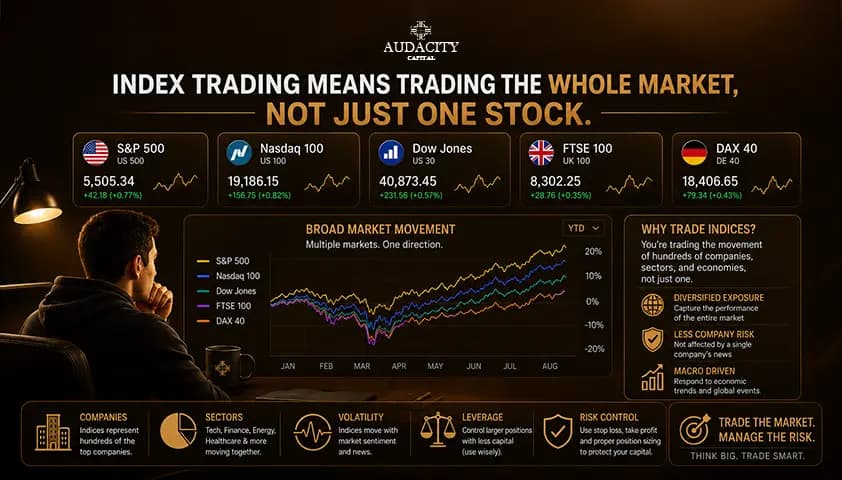
How to Trade Indices: A Beginner's Guide
Learn how to trade indices, choose the right instrument, calculate position size, plan entries and exits, and manage leverage and event risk.

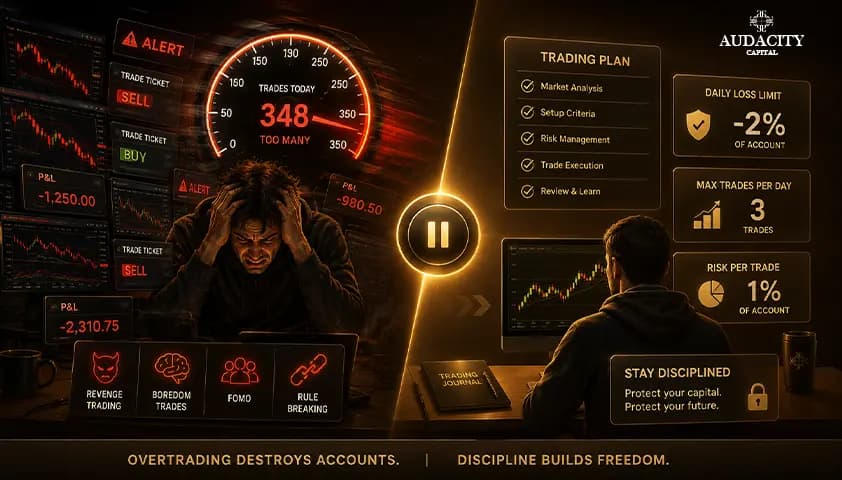
What Is Overtrading (and How to Stop It)
Overtrading means taking trades your plan doesn't justify. Spot the 7 signs, measure what it costs from your journal, and install rules that stop it for good.
%2520Trading__webp__orig.webp&w=1920&q=75)
Smart Money Concepts (SMC) Trading Explained
Learn how SMC trading uses market structure, liquidity, order blocks and fair value gaps, plus a practical setup process and key limits.

10 Best Prop Firms in South Africa in 2026
Compare 10 prop firms for South African traders by rules, payouts, platforms, costs and eligibility checks before buying.