


10 Best Futures Prop Firms in 2027: Compare Costs, Drawdown and Payouts



A low evaluation fee can look like a great deal until you get hit with a drawdown rule or payment limit. That is why choosing the best futures prop firms goes beyond comparing account sizes or promo codes.
In this article, we list the 10 top futures prop firms of 2027 based on their drawdown policies, evaluation and activation fees, payment structures, consistency policies, platform compatibility, and account specifications.
Here you will find the prop firm that fits your trading style and all the facts to consider prior to paying for evaluation. It's about the actual rules rather than marketing gimmicks.
Last verified: October 27, 2026. Pricing and account rules are subject to change; see official firm sources for current terms.
How We Ranked the Best Futures Prop Firms
To compare the best prop firms for futures, we studied six major criteria which affect trading costs, flexibility, and account terms.
First, we analyzed the criteria used for the prop firm evaluation, namely the profit target, minimum trading days, time frame, and milestones to become funded.
Second, we compared the risk management terms, like static drawdown, EOD drawdown, intraday trailing drawdown, daily loss limits, and maximum loss limits.
Third, we compared the additional costs besides the challenge fee, such as subscription, reset fee, account activation fees, licensing fees, and market data fee.
Fourth, we assessed the payout terms, including payout share, first-payout conditions, withdrawal conditions, payout frequency, and consistency conditions.
We also checked other factors, including platform support, futures market availability, position restrictions, and clarity of published rules.
10 Best Futures Prop Firms in 2027
These firms serve different trading needs and their strengths have been highlighted below.
Firm | Best Suited For | Starting Price | Drawdown and Payout Highlights | Supported Platforms |
Topstep | Structured evaluations | $49/month for 50K Standard | Maximum Loss Limit; 90/10 payout split | TopstepX |
Apex Trader Funding | Multi-account strategies | Check latest pricing | EOD or intraday option | Rithmic, Tradovate and other supported integrations |
MyFundedFutures | Daily Payout Eligibility | Check current pricing | Rapid EOD utilizes EOD trailing drawdown | Multiple platforms are supported |
Tradeify | Flexible funding solutions | Check current pricing | Select, Growth and Lightning have different drawdowns | Multiple supported platforms |
Take Profit Trader | PRO payout access | Check current Test pricing | EOD Test rules; separate PRO conditions | Multiple supported platforms |
Alpha Futures | Multiple funding models | Check current pricing | Account-specific consistency rules | AlphaTrader and supported integrations |
Bulenox | Cost-conscious comparisons | Check current pricing | Rules vary by Master account | NinjaTrader and other supported options |
Earn2Trade | Education and Structure | From $75 for Trader Career Path | EOD drawdown on Gauntlet Mini | NinjaTrader, Tradovate, TradingView and others |
Elite Trader Funding | Various structures for evaluation | Check current pricing | Account-specific drawdown and payout terms | Check current list of platforms |
Lucid Trading | Various funding options | Check current pricing | LucidFlex has specified payout criteria | Various platforms supported |
The price depends on the structure of the account, so compare the overall cost and rules of the specific account you want to purchase.
1. Topstep: Best for an Established Evaluation Process
Topstep is one of the few that provide a clear route for evaluation for funded trading.
Its Trading Combine program has accounts for 50K, 100K, and 150K with Standard subscription fees of $49, $99, and $199 per month, respectively. They also have a No Activation Fee option that is more expensive on a monthly basis.
Passing involves meeting the profit goal without going beyond the Maximum Loss Limit. The evaluation involves a 55% consistency requirement. However, once your best trading day exceeds 55%, you should make even more money to pass.
In the case of the Standard Express Funded Accounts, the profit sharing stands at 90/10. Typically, it takes about five profitable trading days of $150 each to place the payout request while under the Standard program there is an activation fee of $149 for each Express Funded Account.
Main advantage: Well-established evaluation process with disclosed prices.
Main disadvantage: Subscription costs may add up when you fail to pass.
Best for: Traders interested in a structured evaluation process.
2. Apex Trader Funding: Best for Active and Multi-Account Traders
The flexibility of Apex Trader Funding is in the variety of account setups and evaluations that are designed for the needs of active traders who know about proper position sizing and account limits.
Account size, promotional price, and evaluation fee differ from one program to another. Some accounts have end-of-day trailing drawdowns, others have intraday trailing requirements. The difference is important since intraday equity highs and unrealized gains can impact the loss allowance.
In order to understand the terms of withdrawal at Apex, compare the profit share with the number of qualifying days, payout limits, consistency requirements, and activation fee.
Apex operates on Rithmic, Tradovate, NinjaTrader, and TradingView trading platforms, although you need to check the list of current integrations.
Main advantage: Different account configurations for different trading preferences.
Main disadvantage: Different rules may apply to different account generations, making older reviews unreliable.
Best for: Traders comparing account rules and multi-account restrictions.
3. MyFundedFutures: Best for EOD Drawdown and Payout Options
MyFundedFutures offers several ways of funding, one of which is Rapid EOD, based on the end-of-day trailing drawdown.
The documented Rapid EOD 50K plan aims at making a profit of $3,000 while setting a $2,000 maximum loss limit.
The evaluation period lasts for 4 trading days and includes a 30% consistency rule. In the funded simulation phase, the EOD trailing level is set at $100 according to the documentation.
Payout is based on the profit buffer achievement, and the 50K plan requires a $2,100 buffer for the first withdrawal. Further withdrawals can be made if net profit achieves $500 above the last withdrawal, starting from a minimum of $500.
Another good thing about this firm is that there is a 90/10 profit split and no activation fee. This may be suitable for traders who consider end-of-day drawdowns. However, it will not ensure quick payments.
Main advantages: End-of-day drawdown management and payout policy.
Main disadvantage: It will take some time to earn enough profits.
Best for: Traders who comply with buffer and consistency criteria
4. Tradeify: Best for Flexible Evaluation and Payout Models
Tradeify offers several ways to access its futures funding programs. You can choose between Select, Growth and Lightning Funded. The latter one does not include the evaluation stage.
Every model has specific requirements: Select is based on the end-of-day drawdown and 40% consistency in the evaluation. Growth requires daily loss criteria, whereas Lightning has particular funding and payout criteria. Make sure you check current prices, account sizes and allowed contract sizes.
Tradeify also offers various payout models. Select has the Flex and Daily options, and Growth and Lightning have their own policies.
Lightning applies 90% distribution on the allowable requested profit but requires profit targets, consistency, and withdrawal limits. Published terms for Select and Growth indicate that there is no activation fee.
Main advantage: Wide variety of evaluation and payout models.
Main disadvantage: Some payout models may be permanent, and a lost Lightning account needs replacement.
Most suitable for: Those traders who wish to check payout limitations and drawdown rules before signing up.
5. Take Profit Trader: Best for a Defined PRO Payout Process
Take Profit Trader leads you through its Test evaluation to PRO accounts, so it is a good choice for those who need to learn the withdrawal process first.
There are several types of Test accounts with monthly prices, offers, and reset costs that differ depending on your choice; hence, it is essential to check the latest checkout terms.
The Test accounts work with an end-of-day drawdown and a 50% consistency criterion. In contrast, PRO accounts have their own set of requirements, meaning, your evaluation criteria may not be fully applicable when you move to PRO accounts.
The published PRO policy includes an 80/20 profit split and withdrawals allowed starting from day one, provided you fulfill the required buffer and other criteria. PRO+ accounts have a completely different structure, including 90% profit split.
Main advantage: A clear progression from evaluation to PRO trading.
Main limitation: Being able to make a withdrawal request does not mean that you have accumulated enough profit.
Best for: Traders who know the differences between Test, PRO, and PRO+.
6. Alpha Futures: Best for Multiple Funding Models
Alpha Futures has different account types: Standard, Advanced, Zero, and Direct accounts allowing traders several options to match their strategy with the funding procedure.
The Direct Account, even though there is no need for an evaluation, has its own trading and withdrawal rules. Target profits, loss limitations, consistency rules, and drawdown methods depend on the selected account.
The official documentation mentions a 90% share of withdrawals, but payout period, profit limit, qualifying days, and activation fee vary for each type of account.
Integrations like AlphaTrader allow you to work with futures contracts, but make sure your platform allows it before subscribing.
Main advantage: Several possible ways to fund your trading through different types of account.
Main limitation: Exemption from an evaluation does not mean exclusion from any payout requirements or risks.
Recommended for: Traders who want to find their own funding model that matches their trading style and profit distribution.
7. Bulenox: Best for Cost-Conscious Traders
For traders who consider pricing and account structure, Bulenox is another decent choice. The company provides a variety of Master accounts in terms of size and evaluation type, but note that these details can vary over time.
When you calculate the total cost of evaluations, take into account discounts, reset fees, and subscription fees. Some other parameters you should consider include maximum allowed loss, trailing drawdown calculation, daily limits, and contract limits.
Conditions of the payouts are also important to check, therefore, make sure to confirm the profit split, minimum withdrawal, payout caps, activation fee, and qualification requirements.
Bulenox supports platforms such as NinjaTrader and Rithmic-connected software, although platform licenses and market-data fees can increase your costs.
Advantage: It offers another point of comparison for evaluation costs.
Disadvantage: Promotions and account versions make previous comparisons irrelevant.
Suitable for: Traders who calculate the likely cost of multiple attempts rather than choosing the lowest advertised fee.
8. Earn2Trade: Best for Education and Structured Progression
Earn2Trade attracts those who appreciate educational resources and a step-by-step evaluation process.
Earn2Trade provides the following programs: Trader Career Path ($75) and Gauntlet Mini ($85). Initial accounts offered by the Trader Career Path are worth $25K, $50K, and $100K.
Profit targets, contract limits, and drawdown rules depend on the program and the account size. Drawdown and risk rules of Gauntlet Mini are based on the EOD system.
Earn2Trade claims weekly withdrawals starting from $100 depending on the account conditions. A profit share depends on the type of an account and withdrawal amount. Its activation fee is deducted from profits rather than charged upfront.
The platforms available are NinjaTrader, Tradovate, TradingView, Rithmic, etc. Some of them need separate licensing.
Primary benefit: Lots of educational resources and an excellent evaluation process.
Main drawback: Fees for the evaluation, platform license, and data can be quite expensive.
Ideal for: Traders looking for progression and learning materials.
9. Elite Trader Funding: Best for Multiple Evaluation Structures
Elite Trader Funding provides several futures evaluation processes as well as a range of account types.
Look into the details of your selected account, which include the profit target, maximum loss, trailing drawdown rules, daily loss limits, and contract limit. They can differ between programs and account generations.
The requirements for the payouts need to be carefully examined as well, which include minimum trading days, withdrawal eligibility, payout limit, consistency requirement, and activation fee.
Do not assume that the requirements for the funded stage are similar to the evaluation one. Make sure that you have access to the platform and contracts such as MES, MNQ, ES, and NQ.
Main advantage: Diversity of evaluation structures allows using different trading approaches.
Main disadvantage: Old reviews may relate to the products no longer in use or incorrect payout conditions.
Best for: Traders interested in comparing the full terms of all available programs prior to payment.
10. Lucid Trading: Best Alternative for Flexible Funding Routes
Lucid Trading offers another route for traders considering future funding programs and account types.
Lucid Trading accounts differ in terms of profit goals, drawdown systems, and maximum contracts, and you can compare these parameters against the funding route you've chosen.
Lucid Flex offers a 90/10 profit split. Payouts occur according to the criteria where traders must have five qualifying profitable days during each payout period and a net positive profit for that period.
The minimum payout is $500, and payout ceilings are set depending on the account size. Different Lucid accounts may have other criteria.
Supported platforms include Rithmic, Tradovate, NinjaTrader, TradingView, and Quantower. Please check the current supported platforms and any additional fees for licenses and data.
Main advantage: Several funding options and a well-defined LucidFlex payout structure.
Main limitation: Requirements for qualifying days and payout ceilings can affect withdrawals.
Suitable for: Traders who like to compare the latest drawdown, payout, and platform requirements before choosing an option.
Which Futures Prop Firm Is Best for Your Trading Style?

The best futures prop firm depends on what you need from the program.
Your priority | Firms to compare | Key consideration |
Established evaluation | Topstep | Subscription and activation costs |
Beginner education | Earn2Trade | Educational materials and cost |
EOD drawdown | MyFundedFutures, Tradeify Select | How the threshold moves |
Multiple accounts | Apex Trader Funding | Account limits and payout restrictions |
Flexible payout routes | Tradeify, Alpha Futures | Buffers, caps, and required trading days |
Lower entry cost | Topstep, Earn2Trade | Recurring fees and resets |
Clear PRO payout procedure | Take Profit Trader | Buffer and withdrawal rules |
Other options for funding | Lucid Trading, Elite Trader Funding | Existing rules and supported platforms |
You should select the firms according to your needs. In case you need a possibility to withdraw profits regularly, compare payout procedures; if your strategy can accept changes in profits, pay attention to drawdowns. The table can help you choose two or three firms for a closer comparison.
What Are Futures Prop Firms?
Futures prop trading firms allow traders to demonstrate their abilities using programs with specific profit targets and risk constraints.
The process usually begins with a prop firm evaluation, during which one should reach a profit target while complying with drawdown, contract limit, and minimum trading days.
After passing the evaluation, traders may become eligible for a funded futures account or a simulated funded account. While some firms offer a share of the profits made in simulated environments, a live funded account is based on live trading. Please note that passing an evaluation does not mean automatic access to live capital.
In contrast to the traditional futures brokers, who offer access to markets through brokerage accounts, prop firms create their own programs with corresponding payout schemes.
Such programs can provide access to higher nominal buying power without depositing the total amount of the advertised account size.
This means that the advertised account size cannot be withdrawn or lost. The actual trading limits depend on the drawdown rules, contract limits, and payout requirements.
Futures Prop Firm Drawdown Types Explained
Drawdown shows the extent to which an account can fall without reaching its maximum allowed drawdown level. Understanding all drawdown models will help you choose the right futures prop firm based on your trading strategy.
End-of-Day Drawdown
End-of-day (EOD) drawdown is usually reevaluated based on the performance of the account at session close. If the drawdown is a trailing one, then the threshold increases every time the account reaches a new closing high.
As it does not monitor every intraday equity peak, it leaves some margin for short-term fluctuations. However, calculation methods and threshold locks vary by firm.
Intraday Trailing Drawdown
An intraday trailing drawdown can increase if the account equity reaches a new high during the trading day. The unrealized gains can make the threshold grow even if there is an open position.
If the market goes against the trader, then the remaining loss allowance can be smaller than expected, which would pose challenges that allow gains to fluctuate before closing out a position.
Static Drawdown
The static drawdown approach holds the loss threshold constant as the trading account increases, thus simplifying calculations despite daily loss limits and restrictions posed by particular contracts.
Drawdown Type | How It Works | Relative Flexibility |
End-of-day | Threshold recalculated at day’s end | Moderate to high |
Intraday trailing | Moves with open equity during the day | Lowest |
Static | Fixed loss line | High, with clear boundaries |
There is no ideal model that will suit all traders. The choice depends on the individual trading approach, holding time and risk management style.
What to Compare Before Choosing a Futures Prop Firm
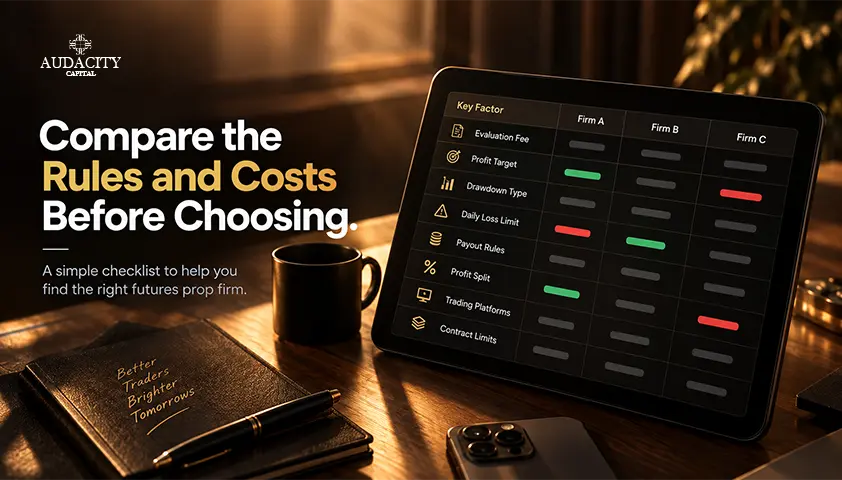
1. Evaluation Cost vs. Total Cost
Do not forget that the advertised evaluation fee is just a small portion of the overall expenses. The monthly subscription goes on until you pass or terminate it. In addition, there is a reset fee and activation fee for the account.
Consider commission fees, platform license, market data and payment fees. Calculate the total cost of several attempts because not everybody passes at the first attempt. Compare the reduced cost with the total cost and check the account limitations.
2. Payout Rules and Profit Split
The profit split describes the process of dividing eligible profits, but does not imply prompt payouts. Study the conditions of payout eligibility, the minimum amount of the profits for the first payout, payout frequency, minimum withdrawal and payout limit.
Some companies need a profit buffer or a certain number of successful trading days before they are paid out. Study the payout processing time and the possible payment methods because the latter may be fast after approval, but getting this approval may take some time.
3. Consistency Rules
Consistency rule constrains the amount of your profits made on a single day of trading or measures performance in some other way. Calculation differs from company to company.
If one good trading day makes up for most of your profits, you may need more qualifying days. You should check whether this rule is applied for evaluation, funding, or both.
4. Platforms and Market Access
Make sure that your trading platform, such as NinjaTrader, Tradovate, Rithmic, TradingView, or Quantower is supported. Rithmic is also an option if you require market-data and order routing services.
Verify if exchanges like CME, CBOT, COMEX, or NYMEX are available since products vary by account.
5. Contract and Position Limits
E-mini futures (ES and NQ) offer more contract exposure than Micro E-mini futures (MES and MNQ). Micro contracts allow smaller positions but still include some risk. Verify your maximum contract and position limits before you trade.
6. Evaluation Time Limits and Minimum Trading Days
There is no set deadline for some platforms while others impose inactivity limits. There is also the requirement for minimum trading days for you to qualify.
Look out for both criteria before payment is made. Achieving the target early might not be enough if you have not reached your minimum trade days or failed to meet a consistency level.
Are Futures Prop Firms Worth It?
Futures prop firms give you access to a trading program without you needing to fund the whole account balance required for that advertised program. They allow you certain risks, scaling capacity, and profit share.
The drawbacks include having to make evaluations several times, account closure upon any violation of the rules, and limitations on withdrawing profits. The funded stages will also at times be simulations only, so review the program's structure before committing.
Prop firms cannot replace the good strategy and proper risk management system. It's essential to test the strategy and contract limits with the same drawdowns before buying the account.
Evaluations costs and living expenses should be separated and shouldn't be used for choosing an account based on its headline balance alone.
For those traders who have repeatable results, the program may serve as a framework.
Traders who improve their strategies will profit more from trading simulations before paying for evaluations.
FAQs About the Best Futures Prop Firms
The best futures prop firms depend on your needs. You can try Topstep because of its proven evaluation process, MyFundedFutures because of its end-of-day payouts, or Earn2Trade because of its educational materials. The choice is up to you depending on cost, drawdown, payout, and platform.
The best futures prop firms for beginners will have proper rules of evaluation, reasonable costs, and valuable training materials. Topstep Futures and Earn2Trade are examples of such firms. You should consider such criteria as minimum number of trade days, maximum drawdown, subscription cost, and conditions for earning payouts when comparing options.
MyFundedFutures Rapid EOD and Tradeify Select are the futures prop firms that have end-of-day drawdown rules. Some other prop firms offer end-of-day models on some particular accounts. It is always important to check current evaluation and funded-stage documentation prior to purchasing.
There are several futures prop firms that fund ES, NQ, MES, and MNQ contracts. But not all accounts allow you to trade these contracts.
Always check which contracts are allowed, scaling restrictions and the commissions. With micro contracts, traders are able to trade smaller positions compared to E-mini contracts.
Both types of options exist. Most futures prop firms offer simulation evaluation and start the funding phase with a simulated account.
Traders may be eligible for payouts as per the terms agreed by the firm. Refer to the terms to know about transition to live trading if and when possible.
The Rapid EOD program of MyFundedFutures has no activation fee. Tradeify claims to have no-activation-fee options, while Topstep has No Activation Fee path at a higher price. Confirm current pricing and conditions before purchase.
Timing is dependent not just on processing speed but also on payout eligibility. There are accounts that allow you to request a payout every day once you hit the buffer. Others may have winning days or profit target criteria.
Look at the minimum withdrawal, payout cap, consistency requirements, and payment methods to estimate your first payout time frame.

暗号資産に規律あるリスクを適用する準備はできていますか?Audacity Capitalの新しい暗号資産商品を探索し、あなたの取引戦略を持ち込んでください。
詳細を見るニュースレター
ニュースレターに登録して最新情報を入手。
ソーシャルコミュニティに参加

関連記事
What Is Take Profit in Trading? A Detailed Guide for Traders
Learn what a take profit is, how to set one well using technical levels, risk-reward, and ATR, plus partial profits, trailing stops, and a funded-trader lens.


Instant Funding vs the Challenge: Which Funded Account Should You Choose?
Two routes to a funded account, one honest comparison. See how instant funding vs challenge differ on cost, drawdown, and profit split, and which route fits you.

Do You Pay Taxes on Prop Firm Payouts? A Funded Trader's Guide
In almost every country, prop firm payouts are taxable income, not capital gains. Learn how they are taxed, what you can deduct, and why records matter.

10 Best Prop Trading Firms in Malaysia in 2026
Compare the 10 best prop trading firms in Malaysia for 2026, ranked on swap-free accounts, payout speed, fees, and payments that work from Malaysia.