


Opening Range Breakout Strategy: Rules, Setups and Examples


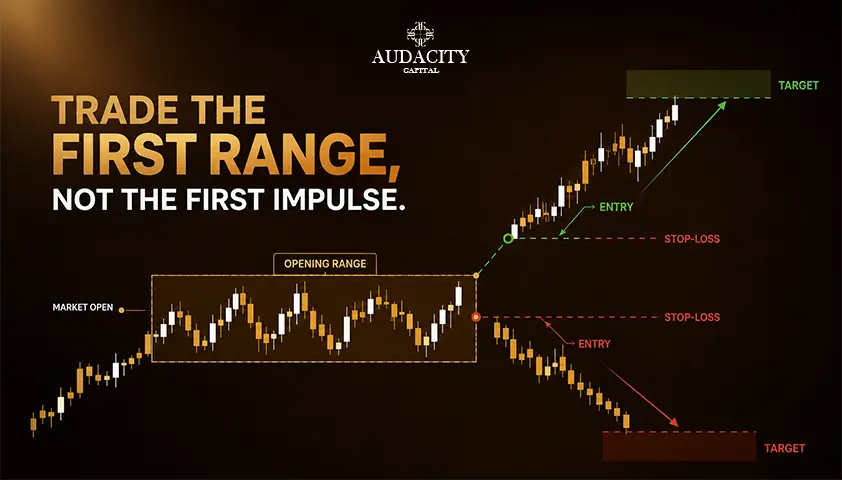
An opening range breakout strategy marks the highest and lowest prices during a pre-defined period after the trading session opens, then looks for a move beyond those levels.
The idea is simple, which is one reason traders use it across stocks, indices, forex, and crypto.
The results, however, depend heavily on how you define the rules. A 5-minute range with a wick trigger behaves differently from a 15-minute range that waits for a candle close. Add a 30-minute range with a retest, and you're testing another system altogether.
This article treats the opening range breakout strategy as a set of testable rules and walks through the variables you need to define before your next session.
What Is an Opening Range Breakout?
An opening range breakout starts with two simple steps. First, mark the highest and lowest prices made during a set period after the session opens. Once that window ends, those two levels become your reference points for the rest of the session.
A breakout happens when price moves beyond either side of the opening range. But not every trader defines that move the same way.
You might enter when a wick breaks the level, wait for a candle to close outside it, or wait for the breakout and a retest. That choice can materially change the results of the strategy.
Imagine that you have a shaded box on your chart that is placed at the beginning of the session, with the high marked on top and the low marked on the bottom. From there, the ORB setup is simply about deciding what you'll do when price breaks out of that box.
Which Opening Range Should You Use: 5, 15 or 30 Minutes?
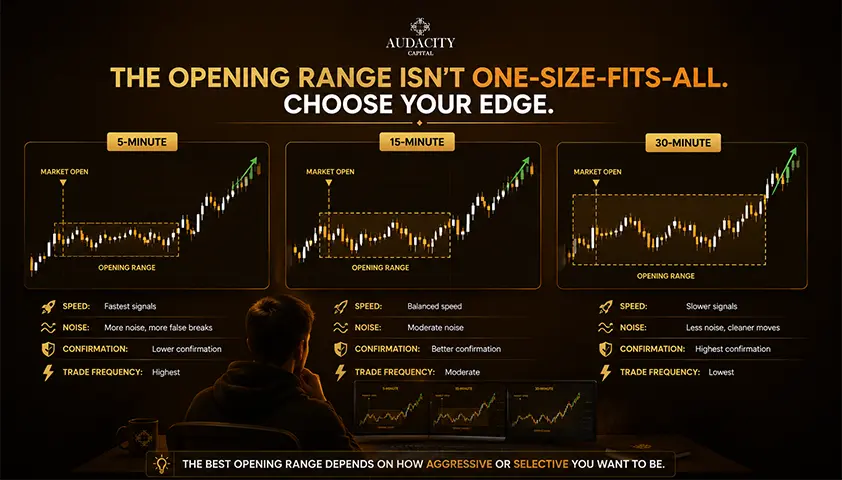
There isn't any one best window. Every option sacrifices speed for information.
Window | Speed | Typical Range Width | Opportunities | Main Trade-off |
5 minute ORB | Earliest signal | Narrow | More triggers | More noise, more false starts |
15 minute ORB | Balanced | Moderate | Fewer triggers | Later entry than 5-minute |
30 minute ORB | Latest signal | Wide | Fewer triggers | Wider stops, less session left |
A shorter window will provide you with earlier warning but will also miss out on more information. A longer window delays the trade and typically creates a larger price box. That affects both stop distance and position size.
If you're trading 24/7 such as in forex and crypto, clarify which trading session open will matter. Do not mix an overnight range, a premarket range and a regular trading hours open without saying so in your rules.
Choose one of the definitions for your backtest and stick with it. Changing the window after seeing the day is hindsight, not a strategy.
The Core ORB Rules to Define Before You Trade
You should be able to write the entire rule set on one card before taking your first ORB strategy trade. There are seven questions that must be answered.
1. Market and session.
State the instrument and exact open you're using. The Nasdaq futures at 9:30 New York time are not the same as EUR/USD at the London open.
2. Opening window.
Select the number of minutes to be used for the high and low, and maintain the same throughout.
3. Breakout trigger.
Determine if the wick touch, candle close outside the range, or break and retest are required for entry.
4. Direction rule.
Trade both sides or only along the direction of a pre-defined trend, gap or higher time frame bias.
5. Stop rule.
Pick the opposite side of the range, a structure within the range, or a buffer that has been tested.
6. Exit rule.
A defined R-multiple, opening range projection, nearby support and resistance, or trailing method.
7. Session controls.
Set the latest entry time, the maximum number of attempts and whether news windows set during this period are excluded.
If you can't define any of the seven above, then you do not have a strategy, but just a concept.
3 Opening Range Breakout Setups to Backtest
These are three testable versions and not a ranking. Assume the same session for all three, so as to isolate the differences in entry logic, not in the market.
1. Close-Confirmed Breakout
Wait for a candle to close outside the opening range before entering. This keeps a quick wick through the level from triggering a trade. The disadvantage is that the stop distance is increased and the entry time delayed when placed on the other side of the trade.
2. Breakout and Retest
Similar to the above, wait for price to break the level, come back to it, and hold to enter. Breakout retest can help to better the entry location and lower the risk per trade, but many good breakouts never come back to retest. You give up some trades in order to have better entries.
3. Narrow-Range Momentum ORB
Trade only when the opening range is relatively narrow compared with a predefined volatility measure, such as ATR. Then require volume confirmation on the breakout candle. Consider these factors as filters that need testing.
Setup | Trigger | Advantage | Main Failure Mode |
Close-confirmed | Candle close outside range | Filters intrabar wicks | Later entry, wider stop |
Break and retest | Break, then return and hold | Better entry, tighter risk | Many breakouts do not retest |
Narrow-range momentum | Narrow box plus volume push | Explosive moves when it works | Fewer trades, more skipped days |
How to Confirm an ORB Without Adding Too Many Filters
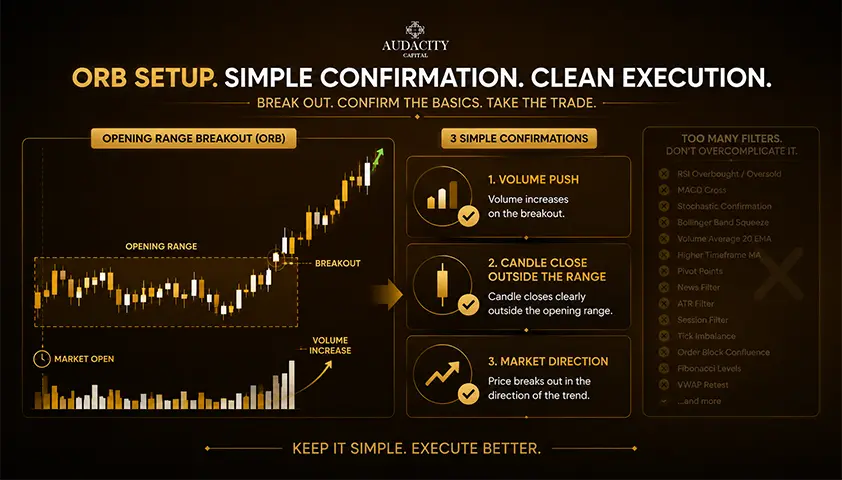
Each filter must address one particular failure case. The candle close takes care of the quick level probe. The relative volume filter determines whether there is actual participation in the move.
The range width filter keeps the strategy from trading on a box that has exhausted itself during the period's expected price move.
The problem is piling on every filter you can think of until only textbook cases remain. Each filter you throw in results in fewer trades and more danger of overfitting your backtest. Begin with the bare minimum ruleset. Test one filter at a time and decide on its out-of-sample success before adding another.
Trend context, gap direction, volume, and ATR are all valid variables. But when combined together in a checklist, they often leave only the perfect hindsight setups.
Stop Loss, Profit Target and Position Size for ORB Trades
Focus on invalidation, not reward. The stop loss and profit target must be derived based on where the trade idea fails and not the other way around.
Three common stop strategies:
- The opposite side of the opening range. Simplest logic, but wide ranges lead to wide stops.
- Structural level within the range. Lower risk, more chances of being stopped out prematurely.
- A Volatility buffer beyond the level. ATR-based buffer, tested specifically for the instrument.
Three common exit strategies:
- Fixed R multiple, such as 1R or 2R based on the stop loss distance.
- The opening-range projection, where the target is equal to the opening range size plus the breakout level.
- Nearest support or resistance, using structure from the previous session or larger time frame.
Do not tie yourself into an arbitrary 1:2 ratio simply because it sounds professional. Find out what works best with your entry.
Position sizing maintains constant dollar risk as stop level fluctuates. The calculation is simple:
Position size = planned dollar risk ÷ risk per share, contract, or unit.
Adjust for contract multiplier/pip value if applicable.
For example, a stop at 40-point on a wide 15-minute time frame would require a smaller position than a 15-point stop on a narrow time frame, even if the strategy and dollar risk is the same.
When the Opening Range Breakout Fails
False breakout conditions are part of the strategy, not a bug. Price can cross the range, trigger entries, and return inside because the first move lacked follow-through or because the opening range was poorly defined for that session.
Watch for these caution conditions:
- An unusually wide opening range that has already used most of the session's expected move.
- Repeated breaks on both sides within a short period.
- Very late breakouts near the end of the trading window.
- Thin participation and low volume on the breakout candle.
- Scheduled events that distort the first move, such as central bank statements or major economic releases.
The bigger problem is repeated re-entry.
A maximum-attempt rule, such as two attempts per session, prevents a choppy morning from turning one clean setup into a string of revenge trades.
Common ORB Trading Mistakes
- Changing the opening window from day to day based on what would have worked.
- Treating any wick through the level as a confirmed breakout when your tested rule requires a candle close.
- Chasing price after it has already moved well beyond the planned trigger level.
- Ignoring range width and using the same position size on a very wide opening range.
- Adding filters after a small backtest until past results look perfect, without any out-of-sample check.
- Re-entering repeatedly after false breaks with no maximum-attempt rule in place.
Each of these traces back to the same root cause: rules that were not fixed before the session started.
Conclusion
The opening range breakout trading strategy is a framework, not one fixed system. A 5-minute breakout with a close trigger is a different strategy from a 30-minute breakout with a retest, and each needs its own testing.
The practical sequence is the same across every version: define the session and opening window, choose one trigger, set your stop and exit rules, then test the exact ruleset over a meaningful sample before risking real capital.
If you are learning how to trade opening range breakout setups inside a funded environment, the discipline shifts from "does this work" to "can I execute it consistently."
Audacity Capital's funded trader programs, including 2 step challenge, one step challenge, and the Instant funding, give traders room to apply a defined ruleset with structured risk parameters. Discipline built at the backtest stage is what carries through when real capital is on the line.
Take the Next Step in Your Trading Journey
Ready to test your order flow skills? Enter our Free Monthly Trading Competition for a chance to win a Free Funded Account.
Frequently Asked Questions
The opening range starts at the exact session open you have defined in your rules. For US stocks and index futures, that is usually 9:30 AM New York time. For forex and crypto, traders often use the London or New York open, but the choice must be fixed in the strategy, not decided daily.
Neither is universally better. A 5 minute ORB delivers signals earlier with a narrower box, while a 15 minute ORB waits longer but gathers more information. Backtest both on your instrument and time period before deciding, and hold the window fixed once chosen.
No, a candle close is one trigger option among several. Some versions of the ORB trading strategy enter on a wick touch, others require a close outside the range, and others wait for a retest. The correct answer depends on which trigger your tested rules specify.
Yes, the framework applies to any market with a defined session. Futures traders often use the regular US cash open, while forex traders use the London or New York open. Range widths and typical volatility will differ, so parameters tested on one instrument do not transfer automatically to another.
That depends on your definition. Traditional versions of the opening range breakout use only regular-hours prints, but some traders track premarket highs and lows as separate reference levels. What matters is consistency: choose one method and apply it every session.
Common choices include the opposite side of the opening range, a structural level inside the range, or a volatility-based buffer such as a fraction of ATR. Each changes trade frequency, average loss size, and stop-out behavior. Test which framework fits your entry style rather than defaulting to one number.
There is no single, universal success rate. Results change with the market traded, time period, opening window, entry trigger, exit method, transaction costs, and filters applied. Any specific percentage without those variables attached should be treated with skepticism, and backtesting opening range breakout rules on your own data is the only way to get numbers you can trust.

暗号資産に規律あるリスクを適用する準備はできていますか?Audacity Capitalの新しい暗号資産商品を探索し、あなたの取引戦略を持ち込んでください。
詳細を見るニュースレター
ニュースレターに登録して最新情報を入手。
ソーシャルコミュニティに参加

関連記事
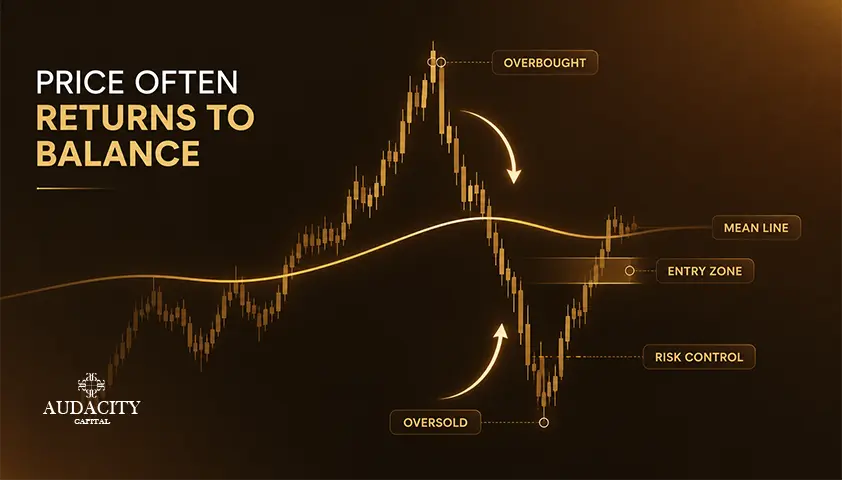
Mean Reversion Trading Strategy Explained (2026)
Prices that stretch too far tend to snap back to an average, but only in the right market. Learn the tools, the setup, and the trend risk.


Martingale Strategy in Trading
How the martingale trading strategy works, what the doubling arithmetic actually costs, why position sizing cannot create an edge, and where it is banned.
Keltner Channel Trading Strategy: How to Read Volatility With Context
Discover how Keltner Channels measure market volatility, spot trend pullbacks, and confirm breakouts. Includes setup rules, settings, and testing methods.
Volume Profile Trading Strategy Guide: Setups & Nodes
A Volume Profile trading strategy shows where the market spent the most volume. Learn POC, value areas, volume nodes, and 4 setups for ES, NQ, and forex.