


What Is Pre-Market Trading? Hours, Strategy & How to Trade


Imagine this: A company announces its earnings before dawn, beats expectations, and the stock has already gone up by 8% hours before the regular session opens. Traders are already buying and selling that stock hours before the opening bell. That early window is the pre-market.
This is what we define as pre-market trading: pre-market trading is the buying and selling of stocks before the regular market opens, which in the US means before 9:30am ET, through electronic networks rather than the main exchange.
This guide will explain the actual hours, how it works, what you can trade, the actual risks, how to do it step-by-step, and the honest answer on whether it's worth your time.
What is pre-market trading? (the simple definition)
Pre-market trading is just one half of what in the finance world is called extended-hours trading, i.e., any form of trading that occurs outside the main 9:30am to 4:00pm ET session.
The other one is after-hours trading, which runs after the closing bell rings. The pre-market trading period allows you to react to overnight and early morning news before the market opens.
Be prepared for surprises, as this type of trading does not work like the regular ones. First off, this is about only US-listed stocks and exchange-traded funds (ETFs), then, it relies on electronic networks rather than the actual exchange, and finally, it is usually thin and volatile.
Just a reminder for foreign exchange (forex) and commodities traders: their markets do not really have anything like "pre-market". Both of those markets offer trading almost 24/7 during the week, so there is no early session to wait for. Pre-market is a concept unique to the stock and ETF markets.
Pre-market trading hours
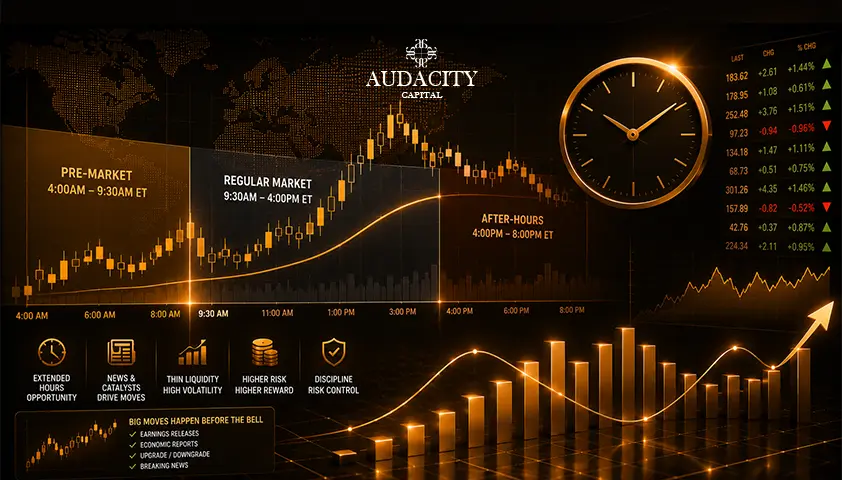
Pre-market trading hours in the US usually extend from 4:00am to 9:30am ET, although the actual trading begins after 7:00am because that is the time at which earnings results or economic releases are expected. The following is an overview of a typical trading day.
- Pre-market: 4:00am to 9:30am ET
- Regular session: 9:30am to 4:00pm ET
- After-hours: 4:00pm to 8:00pm ET
An important red flag: brokers are not all the same. Most will not open at 4:00am, some do not start until 7:00am. Verify your own brokers’ extended hours before planning your trades. Remember that these are US hours and in Eastern Time, so adjust for your own time zone.

How does pre-market trading work?
So what happens behind the scenes during pre-market trading?
Pre-market trades do not go into the central order book of the primary exchange; they are matched via electronic communication networks (ECNs).
An ECN is basically an electronic mechanism that matches the buy/sell orders between the participating parties.
This is where the trap lies that a lot of beginning traders fall into. During the pre-market hours, there are relatively few participants and no market makers standing by to ensure liquidity.
(A limit order is a buy or sell order to execute only at specified prices and helps prevent you from filling at crazy prices due to lesser liquidity.)
The order book in pre-market sessions is pretty thin, so the execution of even small orders can affect the price dramatically. "Fair value" has yet to be established as the market processes overnight developments. Use the pre-market to discover the price, rather than to set the price.
Which assets can you trade pre-market?
Let's look at what you can actually trade.
Generally tradable: large-cap stocks from the US, especially megacaps, and well-known ETFs. They have enough trading volume prior to the market opening.
Generally not practical or not allowed: small-cap or micro-cap stocks that are not highly traded and have often no volume and very wide spreads in the pre-market and options, which most brokers limit to the regular session.
The bottom line: It's a good idea to trade only liquid securities before the markets open, as illiquid securities will penalize you on the bid-ask spread—the difference between what buyers will pay and what sellers will accept.
Pre-market vs. after-hours vs. the regular session
A comparison of all three windows should make things clearer. The main difference between pre-market vs after-hours trading lies in timing and catalyst: the former usually leads up to the opening of trading at 9:30am, while the latter responds to news on earnings after closing.
Regular session traders operate in between both with maximum liquidity.
Feature | Pre-market | After-hours | Regular session |
Typical US hours | 4:00am to 9:30am ET | 4:00pm to 8:00pm ET | 9:30am to 4:00pm ET |
Low, rising into open | Low, fading late | Highest | |
Wide | Wide | Tightest | |
Main catalysts | Overnight news, macro data | Earnings, late filings | Full news cycle, institutional flow |
Order types | Mostly limit | Mostly limit | Full menu |
Why trade pre-market?
There are genuine reasons for traders using this session:
- React to news fast: earnings, guidance updates, M&A headlines, and macro prints usually arrive before 9:30am ET.
- Time-zone flexibility: Since pre-market coincides with afternoon European market and Asian evening, it works well for those trading from outside the US.
- Early price discovery: pre-market prints provide information on the potential opening range and support/resistance levels.
- Position management: Risk management: There is a window to hedge and manage your positions ahead of regular market sessions.
The risks of pre-market trading
Be just as clear-eyed about the downside:
- Thin liquidity and wide spreads: chasing price might lead to costly slippage.
- High volatility and gaps: small volume may swing price hard in either direction.
- Headline whipsaws: a second wave of news may reverse the early move entirely.
- Order limitations: limit-only orders are common, and stops and market orders may be prohibited.
- Incomplete price discovery: institutions wait for the 9:30 am auction window, and this can upend everything.
Tie this back to the earlier point: with no market makers, your order may simply not fill. These factors create a level of added risk for traders in pre-market hours compared to normal trading. This guide is for educational purposes only, not financial advice.

How to trade pre-market: a step-by-step approach
Below are practical steps to prepare yourself for pre-market trading:
Step 1: Confirm your broker's access and exact window. Know when your platform opens for extended-hours trading.
Step 2: Build a catalyst watchlist the night before or early morning, focused on earnings and scheduled data. No catalyst usually means no edge.
Step 3: Use limit orders and set a maximum price you are willing to pay or accept.
Step 4: Trade smaller size than you would in the regular session, to respect the thin liquidity.
Step 5: Set your exit and invalidation level before you click. Identify in advance at what point you are wrong.
Step 6: If you are new, practice on a demo first before risking anything real.
*This guide does not constitute trading advice; no strategy gives a guarantee on results, and pre-market comes with extra risks.
Does pre-market trading affect the opening price?
Often, yes. High pre-market volume based on a clear catalyst tends to anchor the official opening price, because the trading reflects genuine demand or supply.
However, low or contradictory pre-market volume may be reversed at the actual open around 9:30 ET when the institutions and auction start dictating the price.
What it all means for traders: use the pre-market for scenario planning, but not for certainty. Plan for both continuation and reversal at the open, and you will not get blindsided when the real volume arrives.
Is pre-market trading worth it?
Well, here’s the answer to this question. Pre-market trading may give you more options and let you position early on clear news, but it favors prepared and disciplined traders over impulsive ones.
If you’re just getting started, treat it as an advanced step. Learn to trade the regular session well first, then add pre-market selectively, with small size or on a demo, once your process is tested.
Observe the pattern: volatile and thin markets are exactly where risk management and a trading system differentiate winners from losers.
That is the same principle that sits at the heart of evaluated, disciplined trading.
Frequently asked questions
The US pre-market usually operates between 4:00am and 9:30am ET, concluding right at the regular market opening bell. Trading volume picks up from about 7:00am as news reports and economic numbers roll in. However, most brokers will not open until much later than 4:00am so confirm your own broker's extended-hours window.
Pre-market trades are executed through ECN (electronic communication network) platforms, not the main market. There are fewer participants and no market makers, so a trade only fills if someone takes the other side at your price. Most brokers allow limit orders only, which protects you from filling at extreme prices in a thin market.
Yes, but it is considered a more advanced form of trading. Pre-market trading is thin, volatile, and requires limit orders, thus punishing mistakes more harshly than normal trading. It would be wise to master normal trading first with a demo account, and then venture into pre-market trading.
Because the pre-market has no market makers guaranteeing liquidity, your order only fills if another participant is willing to trade at your exact price. With few buyers and sellers active, limit orders frequently sit unfilled. This is normal in thin sessions, not a platform fault. Adjusting your limit price can help, within reason.
Yes. Low volume means even small trades can swing prices sharply, and spreads are wider than in the regular session. Overnight news is still being priced in, so moves can reverse quickly. This elevated volatility is a defining feature of the pre-market and a key reason it carries more risk.
In some cases, yes. Large trading volumes during the pre-market with a solid catalyst will determine the opening price for the day. However, if it is low or conflicting to the previous trend, then chances are high that the stock will retrace at 9:30am ET. Use pre-market action to frame scenarios, not to assume the open is settled.

暗号資産に規律あるリスクを適用する準備はできていますか?Audacity Capitalの新しい暗号資産商品を探索し、あなたの取引戦略を持ち込んでください。
詳細を見るニュースレター
ニュースレターに登録して最新情報を入手。
ソーシャルコミュニティに参加

関連記事

PnL in Trading - What is PnL in Trading?
Learn what P&L in trading means, how to calculate it, the difference between realized and unrealized P&L, and how prop firms use P&L.


What Is a Breaker Block in Trading? A Complete Guide for 2026
Learn what a breaker block is in trading, how bullish and bearish breaker blocks form, how to identify them, and how traders use them in SMC and ICT.
Volume Spread Analysis (VSA) Explained
Learn how volume spread analysis uses price range and volume to reveal supply and demand. Master key signals, market context, and limits.

Cross Trading — What Is Cross Trading?
Learn what cross trading is, how it works, its types, benefits and risks, and why cross-account trading is prohibited by many prop firms.