



Low Spread Currency Pairs: 7 Forex Pairs With the Lowest Spreads


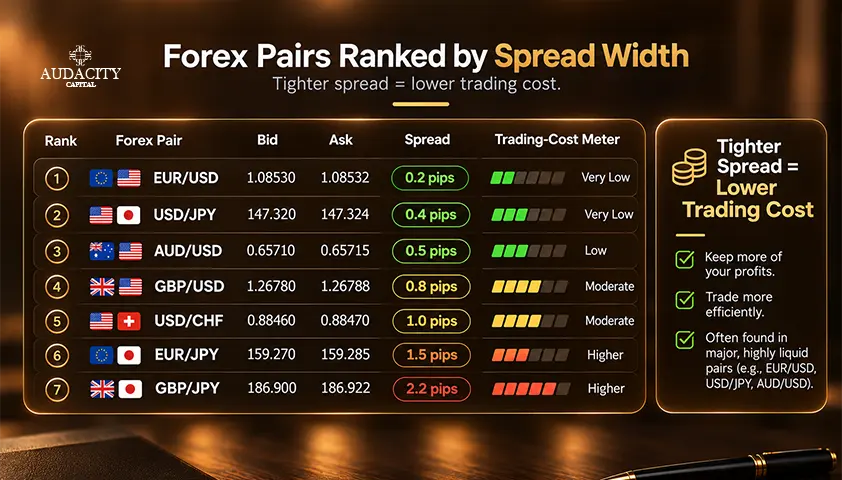
Trading low spread currency pairs can help lower transaction costs, especially for the traders who enter and exit positions frequently.
Some of the forex pairs with the lowest spread include EUR/USD, USD/JPY, and AUD/USD because of their liquidity and trading activity.
However, the currency pairs with low spreads may depend on market circumstances, trading hours, and even on the pricing policy of the brokers.
In this guide, you will find information about seven forex pairs with lowest spreads, explains their trading costs, and shows how to identify favorable spread conditions.
Which Forex Currency Pairs Have the Lowest Spreads?
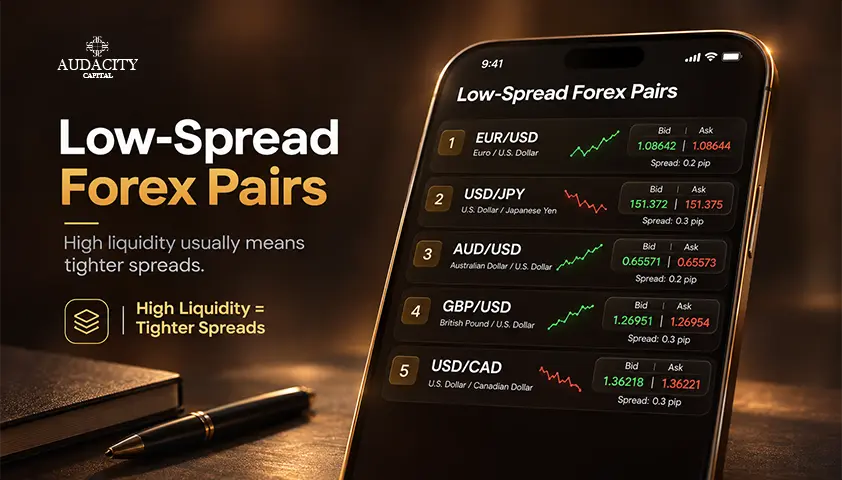
Among the forex currency pairs, EUR/USD tends to have one of the lowest spreads, followed by other highly traded pairs like AUD/USD, USD/JPY, GBP/USD, and USD/CAD.
This is because of high market participation, which normally keeps the spread between the buying and selling price quite small.
According to the Bank for International Settlements (BIS), the daily turnover of the foreign exchange was estimated at $9.6 trillion in April 2025. But this does not imply that all currency pairs have equal levels of liquidity and spreads.
Forex Pairs With the Lowest Spreads: Comparison Table
The table below gives the comparison of seven lowest spread currency pairs in terms of their average spreads observed on July 9, 2026. The data is collected from the standard or similar trading account of one broker for nine-hours during the research involving 19 brokers.
Currency Pair | Observed Average Spread | Relevant Trading Sessions |
EUR/USD | 0.86 pips | London–New York overlap |
AUD/USD | 0.88 pips | Sydney and Tokyo |
USD/JPY | 0.91 pips | Tokyo and New York |
USD/CAD | 0.98 pips | New York |
GBP/USD | 0.99 pips | London–New York overlap |
USD/CHF | 1.00 pip | London and New York |
NZD/USD | 1.18 pips | Sydney and Tokyo |
Source: Rintrade, Lowest Spread Forex Brokers 2026. Observations: July 9, 2026. Source updated: November 4, 2026.
Note: These are historical average quoted spreads of one broker’s standard or equivalent account in a wider 19-broker analysis; they are not live spreads and not market average spreads either. The actual spreads vary depending on the broker, account used, and market conditions. The spreads don't include commission and other trading costs. Trading time indicates active market periods, but not the minimum spread periods available in the research.
What Does the Comparison Show?
EUR/USD had the lowest average spread of 0.86 pips, followed closely by AUD/USD at 0.88 pips and USD/JPY at 0.91 pips. These three currency pairs have the lowest average spread quotations among the seven currency pairs being observed.
NZD/USD had the highest average spread of 1.18 pips, with a spread difference of 0.32 pips from EUR/USD.
Though this difference might seem quite insignificant, spread costs could add up for traders that enter and exit trades often. But a pair with the lowest spread quotation doesn't always convert into the lowest total cost of trading.
7 Forex Currency Pairs With the Lowest Spreads
The below seven pairs have been ranked in increasing order based on the average spreads shown above. The spread might vary depending on the time of day, liquidity, and market conditions.
1. EUR/USD: Average Spread of 0.86 Pips
EUR/USD had the lowest average spread of 0.86 pips. It is characterized by high liquidity and volume which facilitate competitive pricing especially when the London and New York markets overlap. However, the only challenge is that economic announcements might widen the spread temporarily.
2. AUD/USD: Average Spread of 0.88 Pips
AUD/USD has the second-lowest average spread of 0.88 pips, just 0.02 pips higher than EUR/USD.
Active trading periods in the Asia Pacific region will facilitate tight spreads, but news releases from Australia and the Reserve Bank of Australia may increase trading expenses.
3. USD/JPY: Average Spread of 0.91 Pips
The USD/JPY has an average spread of 0.91 pips, which makes it the third lowest spread currency pair in this case. Active trading hours can help achieve tight spreads; however, Federal Reserve and Bank of Japan statements can increase spreads.
4. USD/CAD: Average Spread of 0.98 Pips
The USD/CAD recorded an average spread of 0.98 pips and it was slightly lower than GBP/USD spread for this instance.
Active trading within North America can result in tight spreads; on the other hand, the economic figures and data releases from USA and Canada can cause wider spreads.
5. GBP/USD: Average Spread of 0.99 Pips
GBP/USD recorded an average spread of 0.99 pips which was marginally higher than the spread of USD/CAD by just 0.01 pips. This currency pair takes advantage of strong liquidity in London-New York overlap. Additionally, there can be wide spreads in relation to Bank of England related events and economic events.
6. USD/CHF: Average Spread of 1.00 Pip
This currency pair recorded an average spread of 1.00 pip. Liquidity is expected to be high during active trading hours of the US and Europe; however, USD/CHF spreads can be affected by the announcement from the Swiss National Bank and changing market sentiments.
7. NZD/USD: Average Spread of 1.18 Pips
NZD/USD recorded the largest average spread of all seven currency pairs with 1.18 pips against EUR/USD of 0.86 pips. The currency pair enjoys good liquidity during active trading in the Asia/Pacific region, but can widen in less active hours or around Reserve Bank of New Zealand announcements.
What Is Considered a Low Spread in Forex?
A low forex spread refers to the situation where there is not much difference between the price at which a currency pair can be bought and the price at which it can be sold.
This difference is referred to as the bid-ask spread and is usually measured in pips.
Let's take the following hypothetical EUR/USD quote, for example:
- Bid price: 1.10000
- Ask price: 1.10010
- Spread: 0.00010, or 1 pip
For a standard lot of EUR/USD, which equals 100,000 euros, 1 pip equals about $10.
In other words, 1 pip spread equals approximately $10 spread fee for a said position, in case of average execution and without any extra fees applied.
But what is a good spread in forex?
There is no such fixed boundary applicable for each pair separately. One pip can be considered competitive for some currency pairs but very expensive for others.
Traders need to know the differences between three types of figures:
- Minimum spread: The narrowest spread that can be quoted or seen and is usually valid for a short time.
- Average spread: The average quoted spread over a certain period of time.
- Floating spread: A variable spread that changes with liquidity, volatility and market conditions.
Typical spread values are generally more useful than advertised minimums in terms of the assessment of average transaction costs.
When Are Forex Spreads the Lowest?
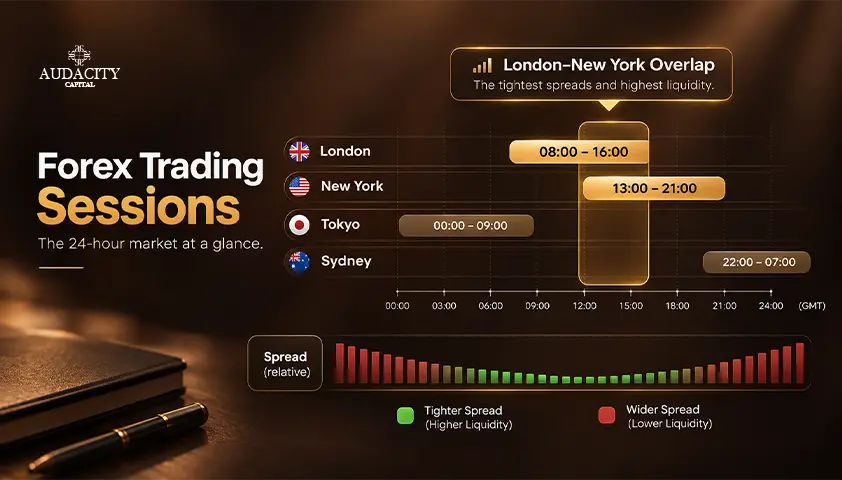
Narrow spreads usually occur when there are lots of traders trading with a currency pair. High liquidity may help to trade at competitive rates for the buyers and sellers. However, the best trading time depends on the currency pair.
London-New York overlapping time frame
It is a relatively liquid period for EUR/USD and GBP/USD pairs. The active involvement of both financial centers may help to keep the spreads low.
Tokyo session
USD/JPY currency pair is usually characterized by high liquidity during Japanese market hours. It may be considered when analyzing the spreads of this currency pair.
Sydney and Asian sessions
AUD/USD and NZD/USD currency pairs may profit from the active participation of the regional market; however, the narrowest spreads cannot be guaranteed in these time frames.
North American session
USD/CAD usually sees good activity when US and Canadian markets are operating.
It should be noted that trading sessions are not the only factor that affects spreads' conditions. Important economic news can lead to temporary widening of the spread even during very liquid periods.
Traders should pay attention to the actual spread in their trading session rather than relying on published averages.
Why Do Forex Spreads Widen?
Forex pairs which usually have low spreads can also increase in cost due to an increase in the bid-ask difference. This happens with changes in liquidity, volatility, and prices.
The main reasons include:
1. Low liquidity
Low liquidity is usually associated with higher spreads as liquidity providers can give wide quotes when there are fewer buyers and sellers on the market. This can happen in low activity periods, holidays, and daily rollover.
2. Major economic events
Interest rate decisions, employment rates, inflation data can lead to increased uncertainty on the market. Spreads can increase before, during or after the news release.
3. Market volatility
Market volatility makes it more challenging for liquidity providers to maintain tight spreads. Even popular currency pairs such as EUR/USD may face temporarily increased spreads.
4. Daily rollover
Liquidity may decrease during the transition between trading days. Brokers and liquidity providers may offer wider quotes during this time, thus increasing costs of entering or exiting a trade.
5. Broker pricing and execution
Brokers use various liquidity providers, accounts, and pricing models. Therefore, there can be different spreads for a currency pair on different platforms.
The historical average spread for a currency pair is useful information; however, it doesn’t ensure the spread for the execution of orders.
How Much Do Forex Spreads Cost?
The spread influences the transactional cost in that the trader buys at the ask price and sells at the bid price.
The spread affects the transaction costs in the sense that the trader buys at the ask price and sells at the bid price.
In order to assess the impact, let’s take into consideration a hypothetical order of one standard-lot EUR/USD.
In this case, each pip change will cost the trader approximately $10.
EUR/USD Spread | Approximate Spread Cost for 1 Standard Lot |
0.5 pips | $5 |
1.0 pip | $10 |
1.5 pips | $15 |
2.0 pips | $20 |
These are indicative figures and are not the exact quotes offered by the brokers. Commissions, slippage, interest rate costs and other fees are not taken into account.
The difference between a 0.5-pip and 2-pip spread is $15 per standard lot. For traders who enter and exit positions frequently, these cost differences can accumulate.
However, a small spread does not always guarantee the lowest costs of trading. For example, consider two accounts offering the following indicative prices on EUR/USD:
Trading Cost | Account A | Account B |
Spread | 0.3 pips | 1.0 pip |
Spread cost for one lot | $3 | $10 |
Round-turn commission | $7 | $0 |
Total estimated transaction cost | $10 | $10 |
Although Account A has a much narrower spread, both the accounts feature the same estimated costs prior to any slippage and other fees.
That is why traders should consider comparing spreads and commissions when trading forex.
In case of currency pairs where the quoted currency is USD, such as EUR/USD and GBP/USD, one pip will be worth $10 for a standard lot in a USD-denominated trading account. In case of pairs like USD/JPY, USD/CAD, and USD/CHF, the dollar value of one pip varies depending on the exchange rate.
How to Find Forex Pairs With the Lowest Spreads
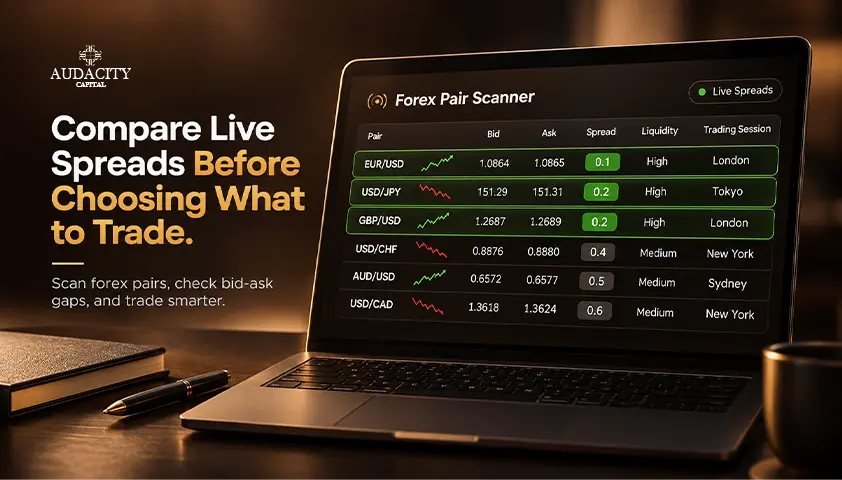
Finding the cheapest forex pairs to trade is about more than just considering the smallest spreads offered by a broker.
The following factors should be taken into consideration.
1. Start with with popular currency pairs
Firstly, compare EUR/USD, USD/JPY, GBP/USD, AUD/USD, and other currency pairs rather than unpopular currency pairs. This will be helpful to begin with searching for economical spreads.
2. Compare average spreads instead of minimum spreads
A broker can offer you the minimum spread starting from 0.0 pips, but it is not always possible to use it. Focus on average spreads during a certain period of time.
3. Compare spreads during the trading sessions that suit you
A particular currency pair may be cheap in one session and expensive in another one. It is better to compare the spreads at the same time on various days.
4. Include commissions and execution costs
Make an evaluation of your expected total costs by taking into account quote spread, commission in your account and slippage. There are cases when spreads accounts are not necessarily cheaper than ordinary accounts.
5. Check the history of spread behavior
If there is any historical data of spreads behavior, check the behavior of the spreads during the usual hours, when the important news is released and the rollover takes place.
Thus, you can understand which pairs will give you the opportunity to operate with the lowest spreads not only in favorable periods but also when you intend to trade.
The pair with the lowest spreads is not always the best pair to trade. The other factors such as your trading frequency, execution demands and price movement are also important.

Are You Looking For A Funded Trader Program?
Join Our Funded Trader ProgramConclusion
EUR/USD, AUD/USD, USD/JPY, and many other major pairs may be quite cost-effective in terms of their spreads; however, the cheapest forex pairs to trade will depend on the broker, account type, and trading environment.
The cheapest currency pairs are not necessarily those that are promoted as having the lowest minimum spread. Pricing, commissions, spread quality, and trading hours all affect costs.
Traders can make more accurate decisions on cost-efficient forex pairs by considering all these aspects and analyzing spreads under various market conditions.
Risk notice: Reduced transaction costs cannot guarantee the absence of market risks. Forex trading, especially when leveraged, can result in substantial losses.
Forex Currency Pairs In Depth
- The Best Forex Currency Pairs to Trade
- Best Days to Trade Forex
- Best Currency Pairs to Trade in the Sydney Forex Session
- Best Currency Pairs to Trade in the Forex Asia Session
- Best Currency Pairs to Trade in the New York Session
- Best Currency Pairs to Trade in The London Session
- Best Forex Currency Pairs to Scalp
- Forex Exotic Currency Pairs
- Trending Forex Currency Pairs
- Correlated Forex Currency Pairs
- The Most Volatile Forex Currency Pairs
Check Our funded Trader Program
Frequently Asked Questions
The EUR/USD currency pair is often regarded as the forex pair with the lowest spread due to its high liquidity and involvement. However, what gives the lowest spread varies on the particular broker, account and trading conditions. Traders need to make a comparison of current and average spreads in order to choose.
EUR/USD, USD/JPY, GBP/USD, AUD/USD and many other pairs trade with spreads under 1 pip via certain brokers. However, spreads change and are not permanent. Commissions also need to be taken into consideration.
A 1 pip spread may be considered appropriate for some forex currency pairs and accounts; however, it can be rather expensive for others, whose spreads are usually lower. The best way to judge it would be to compare the average prices for the identical instrument with similar accounts.
Forex pairs with low spreads are advantageous for scalping since many transactions are carried out, which makes transaction costs highly significant. However, one must take into account the execution speed, slippage, commissions, liquidity, and volatility. Low spreads do not necessarily ensure profits from scalping.
No. The forex spread changes during the day depending on liquidity and market conditions. It tends to be lower at times when there is high activity in the market and may rise at times of major news releases, quiet periods, and rollover time. Actual pricing depends on the broker and instrument.

Pronto para aplicar risco disciplinado em cripto? Explore os novos instrumentos de cripto da Audacity Capital e traga sua estratégia de trading.
Saiba MaisNewsletter
Junte-se ao nosso boletim para ficar atualizado.
Junte-se à Nossa Comunidade Social

Comece Sua Jornada Hoje Com Nosso Teste Gratuito
Mostre com orgulho suas habilidades e conquistas através de certificados e obtenha reconhecimento pelo seu trabalho árduo e dedicação de potenciais investidores e colegas.
Teste GratuitoArtigos Relacionados

Momentum Trading Strategy: A Comprehensive Guide
Master the core principles of a momentum trading strategy. Learn how to use key indicators, manage sharp-reversal risks, and master exit timing.

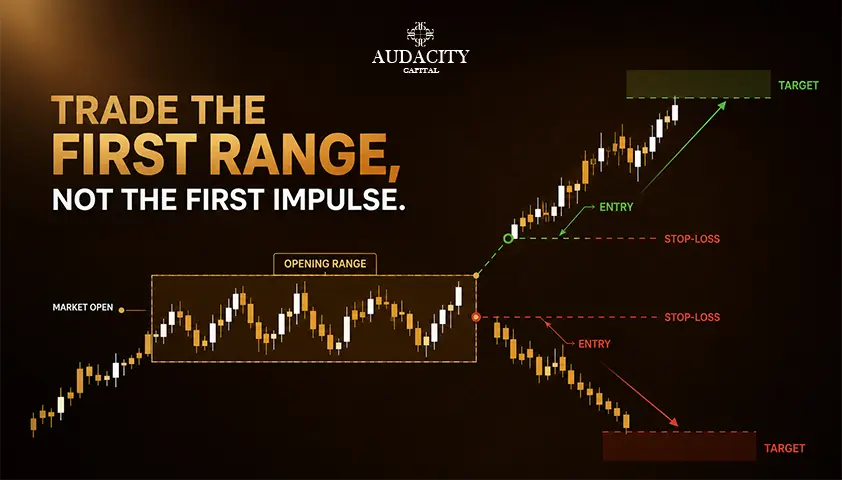
Opening Range Breakout Strategy: Rules, Setups and Examples
Learn how the opening range breakout strategy works, including ORB rules, 5, 15 and 30-minute setups, entry signals, stop losses and risk management.

Martingale Strategy in Trading
How the martingale trading strategy works, what the doubling arithmetic actually costs, why position sizing cannot create an edge, and where it is banned.
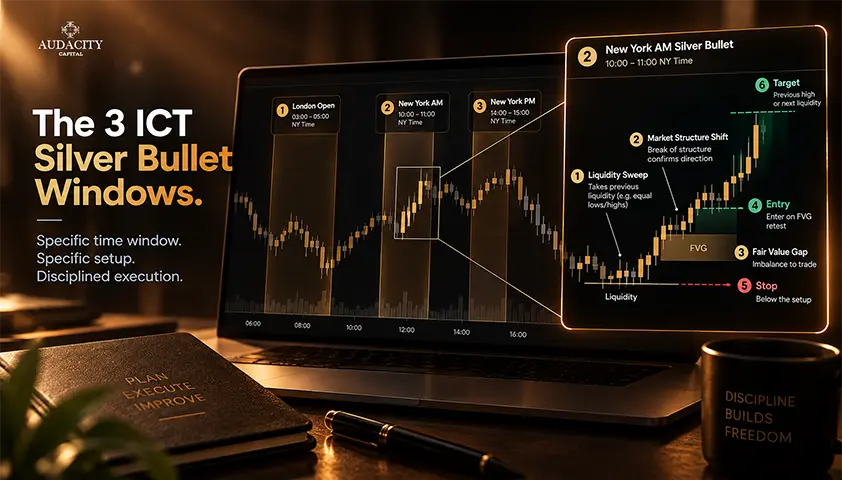
ICT Silver Bullet Strategy: Windows, Setup and Execution Rules
The ICT Silver Bullet windows, the setup step most guides skip, entry and stop rules, and what the published win rates rest on.