


One-Step vs Two-Step Prop Firm Challenges: Which Model Actually Fits You



One-step and two-step challenges both lead to the same destination (a funded account in which you trade company capital) but they get there on different terms.
There's no overall winner. It's a trade-off, and the best one for you depends on your trading style, rather than which model the company has in its stock.
The trade-off in one line is similar to this. One-step challenge equals quick funding, one hurdle, often tougher drawdown, and a higher cost. Two-step Challenge equals more distance, two obstacles, less per phase goal, more room for losses and typically lower cost.
Both values the same: tested edge, disciplined risk management, and patience. Both of them are not a get rich quick scheme and most traders who attempt these lose.
This guide explains one step vs two step prop firm decisions dimension by dimension and then includes the added layer of nuance that most prop firms don't even discuss: the “phase” factor is not the whole story.
What is a one-step prop firm challenge?
A one step prop firm challenge is a single-phase evaluation. As soon as you hit the profit targets (typically 8-10%) and you're still in the drawdowns, you get funded. No second round of verification to pass.
A profit target is simply a percentage increase that the firm expects you to be able to achieve to demonstrate your trading skills. Drawdown is the maximum amount that you are permitted to lose before your account is breached, whether from your starting balance or from your equity high.
The advantage of a one-step model is its simplicity and quickness. If you are disciplined in your trading, you should get there in 10-20 days. This clarity makes it attractive to day traders and scalpers who can generate returns quickly as well as to traders who have an edge and wish to gain access to capital without undergoing a long evaluation process.
The trade-offs are real. The challenge fee is generally much higher on a one-step challenge and the amount of the drawdown is very low, usually 5-6 per cent, or sometimes trailing which is explained below. So it's also a single shot to a higher target, which means that even more accounts drop off before reaching it and if you miss, then you are required to buy the challenge back.
In a nutshell (typical, depends on the firm):
- Profit target: around 8 to 10 percent (single)
- Drawdown: 5-6% typically, sometimes trailing
- Time to funding: about 10-20 days
- Cost: higher upfront for the speed
What is a two-step prop firm challenge?
Two step prop firm challenge is a two-phase assessment and it's the most common prop firm challenge that traders have experienced.
The first phase is referred to as a Challenge, and it requires you to reach a profit target of around 8 percent, but could be as high as 10 percent and as low as 5 percent, depending on the firm. This is proof that you can earn returns.
The Verification (Phase 2) is at a lower target (typically 5 percent, sometimes 4-5 percent) and the same risk rules. This is a testament to Phase 1 being a skill, and not a lucky streak. In order to access a funded account, you have to pass both steps of this prop firm test.
This is a longer route, and may take 30-45 days.
The appeal is because of the lowered per-phase pressure. If a target is broken up into two goals, then each individual target seems less daunting than it would if it were one big target.
Two step models also tend to have larger drawdowns, sometimes up to 10 percent, sometimes static equity, and other types of drawdown, and give you more breathing room when you make a loss. And for the identical account size, the price of this is typically lower than the comparable one-step.
The trade-offs: two hurdles, a longer timeline and the uniquely frustrating experience of not passing Phase 2 after clearing Phase 1. This is usually a return to Phase 1, but some companies may have a discounted re-entrance charge; see the policy before purchasing.
At a glance (typical, varies by firm):
- Profit target: approx. 8% (Phase 1) and approx. 5% (Phase 2)
- Drawdown: typically 10%, often static
- Time to funding: about 30-45 days.
- Cost: typically lower initial rates for the same account size
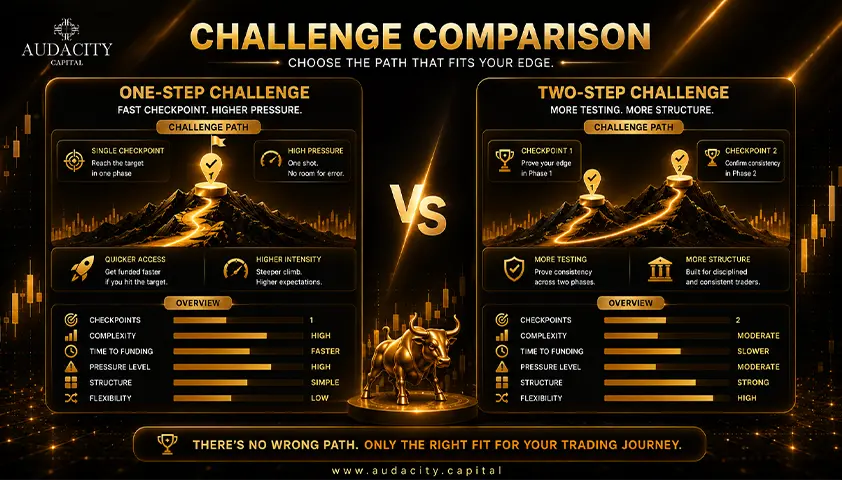
One-step vs two-step: the key differences
Here is your part of the question, the per dimension comparison. We will walk each dimension equally and then tie it together in a master table. These figures are indicative and could differ from company to company, so it should be seen as a guideline and not a guarantee.
1. Speed to funding
This is the most obvious distinction. A one-step challenge is faster as there is only one phase to complete, typically in 10-20 days. A two step challenge will take longer, usually 30-45 days, as it has two parts to complete. If time is more important than money, then one-step is the better choice.
2. Profit targets
A one-step challenge is a single target, typically about 8-10 percent, that puts all the pressure into a single push. The requirement is split in a two-step challenge (around 8% in Phase 1 and around 5% in Phase 2). That division helps to alleviate stress on any one phase but adds a second obstacle that you cannot avoid.
3. Drawdown rules
One of the major practical differences and one of the most overlooked. The one-step challenges are normally tougher and may require a 5-6 percent trailing drawdown. Two-step challenges often provide more space, typically about 10 percent, and often static.
The drawdown rule affects the amount of time you have to be wrong and can outweigh the target itself. Combine that with a conservative risk/reward strategy, in which survival trumps optimization, and you're covered on both fronts.
4. Cost (and retries)
Two-step challenges generally cost less up front, one-step challenges cost more for the speed, with the same account size. The greater cost differential, however, is reflected in failure. Typically, the one-step failure results in the trader repurchasing the entire challenge. Sometimes, two-step Phase 2 failure is accompanied by a discount retrial. If you compare prices, take into the cost of a second attempt, not just the sticker price.
5. Difficulty and pass rates
This one's up for debate, so, let's be honest. Generally the industry consensus suggests that two-step challenges have higher overall pass rates and greater pass rates in Phase 2 especially because the targets in each phase are lower and filter out the undisciplined traders.
The reasoning is that a one-step's single higher target means more accounts blow before reaching it. Treat this as industry consensus, not hard fact. Pass rates are highly dependent on firm, account size and trader. Both models are not necessarily easier; the factor that will really determine it is self-discipline.
6. Psychology
Clarity and decisive execution is rewarded with a one-step challenge. It works best for traders who stick to their trading plan and don't second guess all their trades. A two step challenge is more staged and can be more effective at building better habits over time, but it requires you to endure two periods of pressure, instead of one. Understand the type of stress that works best for you.
7. Profit split
Profit split is the piece of profits that you retain after funding. Some one-step programs will provide a high split, up to 100 percent on a first cut of profits as a launch incentive. Two-step programs tend to begin at about 80% and include the scaling step.
Don't try to focus on just the split. Compare it with drawdown, cost, payout schedule, and scalability as it does not benefit anyone to split too much on a structure that does not suit your trading style.
Master comparison (typical, varies by firm)
Dimension | One-step | Two-step |
Phases | One | Two (Challenge + Verification) |
Profit target | ~8 to 10% (single) | ~8% then ~5% |
Drawdown | Often 5 to 6%, sometimes trailing | Often ~10%, frequently static |
Time to funding | ~10 to 20 days | ~30 to 45 days |
Upfront cost | Higher | Usually lower |
On failure | Repurchase whole challenge | Sometimes discounted retry |
Pass rates | Often cited lower (consensus) | Often cited higher (consensus) |
Best for | Decisive, fast traders with a proven edge | Patient, systematic, value-oriented traders |
But phase count isn't the whole story
Here's the nugget that will save you even more grief than any target percentage: the one-step vs two-step challenge debate is overrated.
Two things often shape your day-to-day trading as much as, or more than, the number of phases.
1. The drawdown type.
A trailing drawdown moves up as we gain equity, creating a higher floor beneath you. This might seem harmless until a winning streak raises the floor, and a more typical pullback snaps the account when the floor follows you up.
A static drawdown does not alter from your starting account balance, meaning that a green day will not increase the noose.
The practical effect: A one-step with trailing drawdown may be more difficult to trade than a two-step with a fixed drawdown, regardless of phase count.
2. The consistency rule.
Many models, typically one-step models, limit the percentage of profit that can be generated from a single day. Consistency rules can be a bad fit with actual trading, especially if your strategy is lumpy with a few good days making up the month.
For a detailed explanation of the consistency rule and how traders fail to apply it correctly, check our in-depth guide on the consistency rule.
Evaluate in this order: rules first (drawdown type and any consistency rule), then structure (cost, split, scaling), then phase count.
If you get that aspect right, the question of which prop firm challenge is better is often answered for itself.
Which one should you choose?
Always match the model to the trader, rather than to the marketing.
A one-step challenge tends to fit:
- Traders that have a tried and tested advantage, and don't require a long runway to prove it.
- Day traders and scalpers who make money fast.
- Traders who put value on speed and time over saving money.
- People with (relatively) fixed position sizing, narrow stops and low emotional variability.
- Traders with decisive personalities who are ready to take risk for a higher drawdown with a higher cost for quick access.
A two-step challenge tends to fit:
- Patient, methodical traders.
- Swing traders and structured intraday traders.
- Those still developing their risk management strategy.
- Traders seeking lower per-phase targets, increased drawdown space and reduced initial cost.
- Traders who want to gradually make progress and are not afraid of a longer timeline.
So, the straight answer. The tested edge and disciplined risk management is more important than the choice of the model.
Both models are not an easy route, and both working models are rewarding similar elements: a defined strategy, controlled risk, and consistent execution.
If you want a practical playbook for clearing either one, our guide on how to pass a prop firm challenge covers the process in detail.
On beginners specifically: a one-step challenge is structurally simpler as there is only one phase to understand. However, a two-step challenge's lower pressure per phase will create a stronger, more manageable habit.
So, don't pick on the experience level. Choose on whether your edge is genuinely proven and on how you trade day to day.
Quick decision matrix:
If you are... | And you value... | Lean toward |
Fast intraday with a proven edge | Speed | One-step |
Methodical or swing-based | Drawdown room | Two-step |
Still refining your risk | Lower per-phase pressure | Two-step |
Decisive with tight risk control | Time over cost | One-step |
A note on instant funding (the zero-step option)
There is a third model worth a quick mention. Instant funding skips the evaluation entirely. You pay a higher upfront fee and start trading funded capital immediately, with no proving phase at all.
It suits very experienced traders who value immediate access and have no interest in a drawn-out evaluation. The trade-offs are predictable: a higher cost, often stricter rules or a lower initial split, and the reality that you are still trading a simulated account and remain bound by drawdown from day one.
It is the zero-step context around this whole discussion, not a replacement for the one-versus-two-step decision, but it is good to know it exists.
Where Audacity Capital fits
This is where offering both models pays off for you rather than for us.
Audacity Capital runs two paths: Ability One, the one-step route, and Ability Challenge, the two-step route. Instead of being funneled toward a single firm's only model, you choose the one that matches how you actually trade.
Both paths share the same trader-friendly terms. There is no consistency rule on either model, removed in the January 2026 relaunch, so a lumpy strategy will not be penalized on either route.
A funded account gives you capital and structure. It does not hand you an edge. That part is still on you, which is exactly how it should be.
Whichever model fits your style, the next step is simple: review how Ability One and Ability Challenge work, check the current targets, drawdown, and costs on the live program pages, and pick the path that matches your trading.
FAQ
It is contested. Two-step challenges are often cited with better overall pass rates, because Phase 1 filters out undisciplined traders and the per-phase targets are lower. But one-step challenges fund faster. Neither is inherently easier, and the outcome depends far more on your style, edge, and discipline than on the model.
For the same account size, two-step challenges are usually cheaper upfront, while one-step costs more for the speed. The bigger difference shows up on failure: a one-step failure usually means repurchasing the whole challenge, while a two-step Phase 2 failure sometimes comes with a discounted retry, so factor retries into the price.
Often yes. Because the firm takes on risk faster with no second verification, single-phase models frequently use tighter or trailing drawdown, sometimes around 5 to 6 percent. Two-phase models tend to offer more room, often around 10 percent and frequently static.
With disciplined trading, roughly 10 to 20 days for a single-phase route and 30 to 45 days for a two-phase route, since the second phase adds time. These ranges vary by trader and firm and are not guaranteed.
It is mixed. A single-phase route is structurally simpler with only one target to clear, but a two-phase route's lower per-phase pressure and staged approach can build better habits early. A tested edge matters more than the experience label, so choose on how your strategy actually performs.
Usually no. A breach in the second phase typically means restarting from the first phase, although some firms offer a discounted retry. Always check the retry policy before you buy so a failure does not cost you the full price again.
Yes. Ability One is the one-step path and Ability Challenge is the two-step path, so you can choose the model that fits your trading style rather than being limited to a single structure.
Trailing drawdown moves up as your equity grows, locking in a higher floor that can cut a winning run short. Static drawdown stays fixed from your starting balance. The type often matters more for day-to-day trading than the phase count, so check it before anything else.

Pronto para aplicar risco disciplinado em cripto? Explore os novos instrumentos de cripto da Audacity Capital e traga sua estratégia de trading.
Saiba MaisNewsletter
Junte-se ao nosso boletim para ficar atualizado.
Junte-se à Nossa Comunidade Social

Comece Sua Jornada Hoje Com Nosso Teste Gratuito
Mostre com orgulho suas habilidades e conquistas através de certificados e obtenha reconhecimento pelo seu trabalho árduo e dedicação de potenciais investidores e colegas.
Teste GratuitoArtigos Relacionados

How Much Does an Instant Funded Account Cost?(2026 updated)
Sticker price tells only half the story. See what an instant funded account cost really covers, why it runs 2 to 3x a challenge, and if it's worth it.

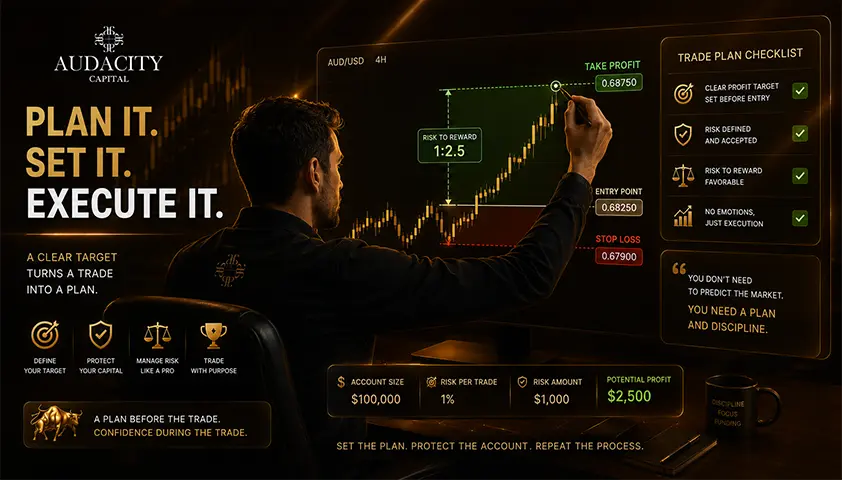
What Is Take Profit in Trading? A Detailed Guide for Traders
Learn what a take profit is, how to set one well using technical levels, risk-reward, and ATR, plus partial profits, trailing stops, and a funded-trader lens.

Are Funded Accounts Legit? An Honest, Balanced Answer
Some funded account firms are real, some are scams. Find out if funded accounts are legit, how to spot a payout-denying firm, and what to check before you pay.

Best Local Payment Methods for Forex Prop Trading
Compare the best local payment methods for forex prop trading by region and learn faster, cheaper prop firm withdrawals with fewer delays.