


How to Pass a Prop Firm Challenge in 2026 - Complete Guide



When it comes to passing a prop firm challenge, do not try to hit the profit target fast and try to protect your account.
That's it for the game.
A challenge is NOT a strategy puzzle, nor a race to a number. It's a test of risk management and discipline first, and home runs second, and the firm is watching to see if you can keep losses under control or not.
This is a fact most traders don't talk about on marketing pages: most traders lose.
The rate of passes in the industry stands somewhere between 5-10%. Traders do not usually fail because the profit target is impossible to achieve.
They lose when they hit a drawdown ceiling or when they lose emotional discipline and go chasing the number, take revenge trades or blow up when they're almost there.
In this guide, we will be going through the entire playbook, one step at a time and the mindset change you need to make that separates successful traders from those who repeatedly fail evaluations.
No hype, no guaranteed-pass nonsense, just the down-to-earth habits that will increase your chances.
How a prop firm challenge actually works
A prop firm challenge is also known as a prop firm evaluation and is a structured test.
You open a demo account or a simulation account; and you trade the account until you reach a certain profit level, without ever touching any drawdowns or rules the firm sets. Upon successfully achieving the target without breaking any rules, you will receive a funded trading account with a profit share, meaning you will receive a pre-agreed portion of all profits you make.
The goal of a company's evaluation is simple: to back disciplined traders.
For a more detailed breakdown of the business model that is hidden behind the scenes, you can read our breakdown of how prop firms make money.
There are three common structures for most evaluations:
Structure | Profit target (typical) | Notes on rules |
One-step | Around 8 to 10 percent | Single phase, same drawdown applies throughout. |
Two-step | Phases 1: 8 to 10 percent, Phases 2: 5 to 8 percent | Same risk throughout both phases, lower target in Phase 2. |
Instant funding | No traditional evaluation phase | Stiffer ongoing regulations, typically more restrictive drawdown. |
Note: The numbers are illustrative and may vary among firms. Always check the exact numbers for the program you are buying.

How to pass a prop firm challenge: the step-by-step playbook
This is the playbook and it's designed to be defense-first. Go through each step, and follow the pre-challenge checklist at the end before you place a single trade.
The risk percentages are based on examples and for education purposes only, not as advice, and not a pass guarantee.
Understand the rulebook by heart (and create a checklist!)
Before you make a trade, read all the rules. Next create a checklist to ensure that nothing is overlooked.
At minimum, write down
- the profit target,
- the daily loss limit,
- the maximum or overall drawdown and how it is measured,
- the minimum trading days, any consistency rule,
- maximum lot or position limits,
- news-trading rules,
- weekend and overnight holding rules,
- time limits,
- and banned strategies like certain EAs, copy trading, HFT or some specific hedging.
The biggest mistake that you can make in this entire process is breaking a rule that you never read. Don't let it be the end of your challenge.
2. Know your drawdown type (static versus trailing)
Understand how the firm calculates drawdown limits, as this can significantly affect risk management throughout the challenge.
A static drawdown is measured from your starting balance and does not move.
A trailing drawdown follows your peak equity, so as you bank profit, the floor rises with you.
The problem is you can be up on the challenge, give some of it back, and still fall short of the floor on a profitable run. Treat trailing drawdowns with greater caution and check out our article on survival over optimization to understand how it affects each of your moves.
3. Set your own limits tighter than the firm's
Choose a personal daily stop that is way below the firm's daily drawdown. consider setting a personal daily stop below the firm's limit, such as 2%–3% if the firm's limit is 5%.
That buffer absorbs slippage, widening spreads, and weekend gaps that would otherwise push you over the official line.
Take the limit of the firm as the cliff edge, never the destination! You never want to be trading right against it.
4. Risk small per trade (0.5% to 1%)
Maintain a small and consistent risk per trade. Many disciplined traders risk 0.5% to 1% per trade and they use a position-size calculator to ensure they know the risk in advance. This example is for educational purposes only and should not be interpreted as trading advice.
Small position sizing allows a normal losing streak to remain within your buffer and never put your account in jeopardy.
Small risk allows you to stay in the game for long enough to see your edge manifest itself. That's the whole idea!
5. Aim for the target slowly (it is a marathon)
Don't attempt to pass in a couple of days. Many challenges have no time restriction or a generous one, resulting in a constant 0.5% to 1% per day compound until the goal is met without being forced to make a single trade.
Rushing is the reason traders over-risk and violate drawdown. Patience is not a weakness here. It is the strategy.
6. Trade only the proven edge (less, better setups)
A challenge is not the place to experiment. Trade your proven strategy and your highest-quality setups only, and take fewer trades, not more.
One of the most common reasons for failure is overtrading and attempting to make a trade based on a marginal setup. If not sure, don't enter.
The trade you skip can never breach your drawdown.
7. Follow the consistency rule.
Many companies have a consistency rule in place that limits the amount of profit from a single trade or a single day, typically around 30% to 50%.
The goal is to encourage consistent performance rather than relying on a single large winning trade.
Distribute your profits over several trading days. Construct the target using many small victories, rather than one big swing.
Note: Some prop firms implement consistency rules, while others do not. Audacity Capital currently does not have a consistency rule. Always review the specific rules of your chosen funding program before trading.
8. Get your psychology right (no revenge trading)
Revenge trading is one of the most common causes of account breaches and failed evaluations. The solution is not emotional, it is structural.
Once you reach your daily loss limit or daily objective, end the day's trading.
Be careful of the 80-to-90-percent trap, which is when traders lose their money while near the finish line, either due to fear or overconfidence.
Take breaks. Keep a journal. Treat each day as a new day, as yesterday's actions do not control today's choices.
Good trading psychology isn't about being relaxed. It's about rules that make the emotional choice difficult.
9. Scale down as you approach the target
Once you are approaching your profit target, consider reducing risk and protecting accumulated gains rather than increasing position size to finish quickly.
10. Simulate the exact challenge first
Do a demo with the same account size, and use the exact rules the firm has, as if it were live money, before you pay.
This will reinforce good habits and will expose any opportunity to break the rules at no cost, compared to discovering it on a paid attempt.
Pre-challenge checklist
Before you begin, go through this. Save it, print it and share it.
A phase-by-phase game plan
It's one thing to know how to do it. It's another thing to know what to do at each stage.
Let's see how disciplined behavior changes across the evaluation.
Stage | What to do |
Early | Risk small, build a cushion above the floor |
Mid | Keep risk constant, remain selective and watch the floor |
Near target | Scale down, protect the pass |
Between phases | Review, tighten, do not loosen |
Early: construct a cushion gradually
Take small risks and establish a buffer above the drawdown floor before moving towards your target.
Do not swing for the goal on the first time out. The early days are all about keeping your distance from the drawdown floor, so the rest of the challenge can play out.
Mid: control the drawdown
Don't change your risk and be selective. Be sure to remain at a safe distance from the drawdown floor and pay extra close attention if you are on a trailing drawdown as banking and profit taking can slowly bleed margins.
Bank progress steadily. Avoid rushing to the finish as the goal is near.
Near the target: protect the pass
Tighten up and defend the near pass while inside about 10% of the goal. The 80-90% trap resides here and it's here where discipline is most critical.
Between phases: do not loosen up
The worst part of a two-step evaluation is the psychological stage following successful completion of Phase 1.
As relief starts to set in, discipline relaxes, and Phase 2 is usually a more difficult one.
Take advantage of the open gap as a time for reviewing. Review your Journal, cut out the setups that did NOT live up to your standards and bring in the positive ones for Phase 2, not the average ones.
Choosing the right challenge (and a firm that pays)
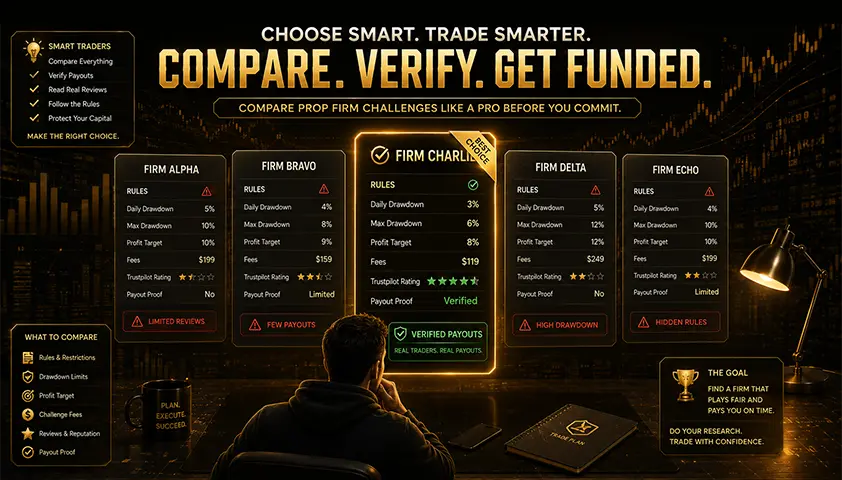
Passing matters less if you pass with a firm that is not worth passing. So choose well on both fronts. 4 things that will help you out -
1. Account size: Pick a size you can realistically manage. Do not over-buy a large account for the headline number.
2. Structure: Choose one-step, two-step, or instant funding based on how you actually trade and how much pressure you handle well.
3. Rules that fit your style: If you hold overnight or trade the news, only buy a challenge from a firm that allows it. Forcing your style into the wrong rulebook is a slow way to fail.
4. A firm that pays: Look for clear rules, a transparent payout process, and a genuine track record of paying funded traders.
One hard red flag: anyone selling a guaranteed pass method, signal, or EA. Passing cannot be guaranteed by anyone, and these offers often violate the rules or are outright scams. Walk away.
Why most traders fail (and the mindset that fixes it)
Here is the honest answer to why traders fail prop firm challenges, and the reframe that fixes it.
Estimates often place the pass rate around 5 percent to 10 percent. Many traders do not fail because of their strategy alone; they fail because of poor risk management and emotional decision-making. They fail on risk management and psychology.
The target is achievable.
It is the daily and maximum drawdown limits that catch people, especially trailing drawdown that moves with their equity.
The common failures are predictable:
- Over-risking to chase the target faster.
- Not knowing the rules and breaching one by accident.
- Revenge trading after a loss.
- Breaching drawdown on a single oversized position.
Now the mindset shift, which is the real heart of this article.
The rules are built around loss prevention, not profit. So the evaluation is not asking whether you are a great trader.
It is asking whether you are a controlled one.
A clean 8% over 20 days with zero rule violations beats a flashy 5 day pass with three near misses, every single time. Defense first. Profit follows.
After you pass: staying funded is the real test
Passing is step one, not the finish line.
The funded stage introduces a different challenge: maintaining discipline without the pressure of a profit target. Without the pressure of a target to chase, the very discipline that got you through can quietly loosen.
Plenty of traders pass the evaluation and then lose the funded account by breaching a rule or trading carelessly once the urgency is gone.
The real goal was never the pass. It is consistent payouts over time, and that only comes from carrying the same defense first habits into the funded stage and keeping them there.
Put the playbook to work with a firm that rewards discipline
The defense-first discipline this guide teaches is exactly what Audacity Capital's evaluation is built to reward.
Audacity Capital's funding programs are designed to reward disciplined risk management and consistent execution. Clear drawdown rules around a 5% daily limit and a 10% maximum, a consistency rule on competition accounts, and a minimum number of trading days, so a pass reflects real, repeatable habits rather than one lucky session.
Verify the current figures for your program on the live site before you start.
Audacity offers funded trading programs, scaling opportunities for consistent performers, and free education through Trader University.
Our free monthly competition is a no-cost route to earning a funded challenge, a low-pressure way to put this playbook into practice.
FAQ
There is no need to rush. Many challenges have no time limit or a generous one, so building the target steadily over weeks is usually safer than a few aggressive days. The exact timeline depends on the firm and the structure you choose.
Estimates are often cited around 5 to 10 percent, and sometimes under 15 percent, though figures vary by source and firm. The key takeaway is that most traders fail, and they fail on risk management and psychology far more often than on the target itself.
Some firms technically allow it, but it is not advisable. Passing in one day usually means over-risking, and many firms enforce a consistency rule that prevents a one-day pass anyway. A controlled, multi-day approach protects your account far better.
A common illustrative range is 0.5 to 1 percent of the account per trade, sized with a position-size calculator. This is educational guidance, not financial advice, and the right number depends on your strategy and the firm's rules.
You typically lose the challenge fee. Many firms offer a paid reset or let you re-attempt, and some refund the original fee on a later payout once you are funded. Check your specific firm's policy before you buy.
It is rarely the target. The hardest part is staying inside the drawdown limits and managing your psychology, especially in the final stretch when the pass is close and the temptation to push hardest is strongest.
No. A challenge runs on a demo or simulated account. You only gain capital access after passing, and even at the funded stage, trading is often simulated under the firm's structure.
Many firms ban EAs, copy trading, and HFT during the challenge, while others permit them under specific conditions. Always check the rules, because using a prohibited method can void the account regardless of your result.
Often, yes. The funded stage tests discipline without the motivation of a target to chase, and many traders who pass the evaluation still lose the account afterward. Consistent payouts over time, not the pass itself, are the real measure of success.

Pronto para aplicar risco disciplinado em cripto? Explore os novos instrumentos de cripto da Audacity Capital e traga sua estratégia de trading.
Saiba MaisNewsletter
Junte-se ao nosso boletim para ficar atualizado.
Junte-se à Nossa Comunidade Social

Comece Sua Jornada Hoje Com Nosso Teste Gratuito
Mostre com orgulho suas habilidades e conquistas através de certificados e obtenha reconhecimento pelo seu trabalho árduo e dedicação de potenciais investidores e colegas.
Teste GratuitoArtigos Relacionados

Are Funded Accounts Legit? An Honest, Balanced Answer
Some funded account firms are real, some are scams. Find out if funded accounts are legit, how to spot a payout-denying firm, and what to check before you pay.


How Much Does an Instant Funded Account Cost?(2026 updated)
Sticker price tells only half the story. See what an instant funded account cost really covers, why it runs 2 to 3x a challenge, and if it's worth it.

Instant Funding vs the Challenge: Which Funded Account Should You Choose?
Two routes to a funded account, one honest comparison. See how instant funding vs challenge differ on cost, drawdown, and profit split, and which route fits you.

Do You Pay Taxes on Prop Firm Payouts? A Funded Trader's Guide
In almost every country, prop firm payouts are taxable income, not capital gains. Learn how they are taxed, what you can deduct, and why records matter.