



Best Forex Technical Analysis Books


Introduction
Understanding the ins and outs of technical analysis is an important part of forex trading. The best forex technical analysis books will help you know how the forex market behaves, especially when it comes to chart patterns, technical indicators and trends. This will allow you to analyze the price movement of currency pairs, read the market, and create strategies based on historical price data.
Learning technical analysis is not just about memorizing patterns and how the indicators work. It's really about being able to understand how to read the signals, understand what is happening in the market, and how to utilize technical analysis on various currency pairs. The best way to learn is by finding the correct resources to read, especially if you're a beginner.
Whether you are a complete newbie or want to improve your technical analysis skills, reading the right book will give you a more structured way to analyze the forex markets. In this guide, we take an in-depth look at 8 of the best books on forex technical analysis and what they can teach you.
8 Best Forex Technical Analysis Books to Consider

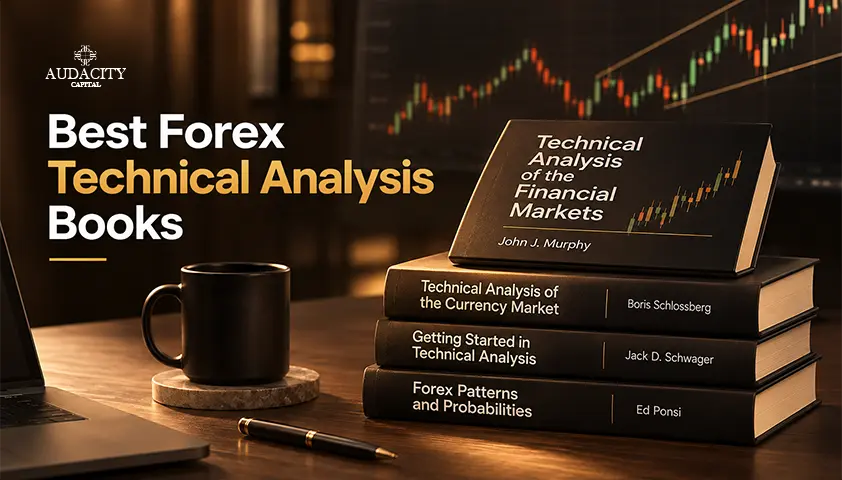
Technical Analysis of the Financial Markets – John J. Murphy
An extremely well-known book among traders is Technical Analysis of the Financial Markets by John J. Murphy. While this book looks at a variety of Financial Markets, it provides an excellent base for any trader wanting a comprehensive forex technical analysis book.
The book covers all the basic concepts of technical analysis, including trendlines, support and resistance levels, chart patterns, moving averages, and technical indicators. It also shows how you can analyze patterns like head and shoulders, triangles, and double tops to provide potential indications of market direction changes. The book also goes into detail about volume, momentum indicators, MACD (Moving Average Convergence Divergence), and RSI (Relative Strength Index).
These principles can be used by forex traders to help analyze forex pairs. Understanding support and resistance helps to see where there might be more buying/selling pressure at certain price levels. Using moving averages helps you to see the trend of the market.
Overall, this book is great for beginners looking to improve their knowledge of technical analysis, but also experienced traders wanting to improve on their chart-based analysis. One thing to note is that this book can be applied to multiple financial markets. So, some of the examples and explanations aren’t exactly specific towards forex trading. You may need to look elsewhere for more information on how the concepts can be applied within the currency market.
Technical Analysis of the Currency Market – Boris Schlossberg
Technical Analysis of the Currency Market by Boris Schlossberg is highly relevant to Forex traders. This is because it is specifically about technical analysis in the Currency Market. Within the book, you will learn how to use technical analysis (chart analysis) within the forex market to identify potential trading opportunities.
This book covers many aspects of the Currency Market, including identifying trends, understanding ranges, and identifying potential price reversals. You will also learn about many technical analysis tools you can use within the forex market. These include Fibonacci, moving averages, MACD (Moving Average Convergence Divergence), stochastic, and Bollinger Bands. All of which can help you analyze different aspects of the market, including momentum, volatility, and potential price changes.
By learning about different tools in the market, traders can use the Fibonacci retracements to find areas of support and resistance in forex. The MACD can be used to understand momentum and any changes in trend. Bollinger Bands can also be used to help understand volatility. This helps create a more structured approach to analyzing pairs such as EUR/USD and GBP/USD.
This book can be useful to traders looking to understand more than just the general concepts of technical analysis. However, understanding how to use the indicators and strategies cannot guarantee accurate predictions. Practicing how to interpret the indicators and testing your strategies in different market conditions is what traders should focus on.
Getting Started in Technical Analysis – Jack D. Schwager
A great place to start when looking at Technical Analysis is ‘Getting Started in Technical Analysis’ by Jack D. Schwager. This book gives an introduction to analyzing price charts, which can be a great source of information to help you understand how to utilize this technique.
Throughout the book, Schwager takes you through the basics of charting, such as different types of charts, trend lines, support and resistance levels, moving averages, and technical indicators. He also explains a few common chart patterns such as head and shoulders, triangles, and double tops/bottoms to help you understand how price can behave to indicate trend continuations/reversals. Volume is also an important factor that is discussed.
The information in the book gives forex traders a good base to analyze the currency pairs. For example, knowing if there is an upward trend and knowing where the support levels are will help traders see if the currency pair is holding up or failing.
The book is very helpful for beginners. It doesn’t just talk about the patterns on the charts but also advises on where to put stop losses, price targets, and when to get out. Schwager has also introduced trend-following and countertrend systems. He also has a section on 82 trading rules and market observations that give some practical advice on how traders can create their own trading routine.
Forex Patterns and Probabilities – Ed Ponsi
Forex Patterns and Probabilities: Trading Strategies for Trending and Range-Bound Markets by Ed Ponsi provides insight into using technical analysis in real-world forex trading. Instead of just looking at chart patterns and technical indicators, the book gives an explanation of how traders can identify market conditions and create strategies for different price actions. This book is very helpful when learning about the different approaches needed when dealing with trending and range-Bound Markets.
In part two, Trading Strategies for Trending Markets, Ed Ponsi talks about how to identify trends, the anatomy of a trend, and how to use multiple timeframes. He introduces the FX-Ed Trend Technique, which looks at how to identify and filter out trends. Part three, Non-Trending Trading Techniques, looks at intraday breakouts, flags and pennants, volatility breakouts, and fake breakout strategies.
A particularly useful chapter is Chapter 8, where Ponsi covers how to use Fibonacci levels in conjunction with trends in the market. The book also has a section titled "Overbought Does Not Equal "Sell,"” which explains how just because a market is overbought does not mean we can sell.
The book gives many practical examples of how to analyze forex pairs, identify trade setups and how to plan entries, stop losses and exits. This would be suitable for traders who understand the basics of technical analysis and want to improve their approach or have an edge when trading in different market conditions. As a trader, it is wise to first test the strategies discussed in the book before committing your money.
Day Trading and Swing Trading the Currency Market – Kathy Lien
Day Trading and Swing Trading the Currency Market: Technical and Fundamental Strategies to Profit from Market Moves by Kathy Lien is a practical book on technical and fundamental analysis. It provides insight into how exchange rates can be affected by economic developments, market conditions, and price movements.
The book has many chapters surrounding technical trading strategies. For example, chapter 8 discusses Multiple Time Frame Analysis. This shows how traders can analyze price movements on different time frames on their chart to identify any potential trading opportunities. Chapter 9 discusses Trading with Double Bollinger Bands. This trading strategy helps traders analyze market trends and volatility. Other strategies include fading double zeros, inside day breakouts, 20-day breakout, channel, and Perfect Order strategy, which uses moving averages to analyze the direction of the trend.
The book also covers currency correlations, economic data, and major currency pairs (such as EUR/USD, GBP/USD, and USD/JPY), helping provide traders with an understanding of why certain pairs will react differently to market conditions and how fundamental data can be used to complement chart analysis.
Day traders will benefit from the strategies in the book as it will allow them to analyze short-term price movements and identify potential entry and exit points. Swing traders will also benefit from the multi-timeframe analysis and trend-following strategies included. Some strategies will require a good understanding of technical indicators and market conditions. However, some of the examples given in the book using market data and economic data may need updating before applying its lessons to current forex conditions.
Japanese Candlestick Charting Techniques – Steve Nison
‘Japanese Candlestick Charting Techniques by Steve Nison is a great resource for traders. Steve Nison has played an important part in introducing these Japanese Candlestick charting techniques to Western traders.
The book explains how to create and read candlestick charts. It covers the different elements of a candlestick such as open, close, high, and low, ensuring traders understand what they mean. It also discusses various patterns that can occur in candlestick charts. These include reversal patterns like dojis, hammers, engulfing patterns, and continuation patterns like morning stars, evening stars, and shooting stars.
The hammer pattern can show that there may be buying pressure after a drop in price. Whereas the shooting star can indicate that there is increasing selling pressure after an increase in price. However, these patterns need to be confirmed by looking at the price action following the trend.
Nison highlights the importance of looking at candlestick signals as part of a bigger picture. He covers how candlesticks can be used alongside traditional Western technical analysis tools such as trend lines, support and resistance, Fibonacci retracement, and oscillators. This book explains the concept of convergence, which looks for several technical indicators to confirm a similar view on the market.
These techniques can be used by Forex traders when analyzing pairs like EUR/USD and GBP/USD. A Japanese Candlestick Charting Techniques book would be suitable for a beginner wanting to learn how to analyze charts, but also for an experienced trader wanting to improve their price action skills. However, candlestick patterns cannot be guaranteed to give a certain price movement, and it is important to consider the overall market trend and price structure.
Technical Analysis Explained – Martin J. Pring
Technical Analysis Explained: The Successful Investor's Guide to Spotting Investment Trends and Turning Points by Martin J. Pring is a great book that will improve your understanding of technical analysis. It will help traders understand how various indicators and charting techniques can be used to analyze market behavior in order to spot trends and potential turning points.
The book covers many key topics such as trend analysis, support and resistance, moving averages, chart patterns, and momentum indicators. A large section is also dedicated to oscillators and how they can be used to find out if price is gaining or losing momentum. Tools such as the Relative Strength Index (RSI), Moving Average Convergence Divergence (MACD), Directional Movement System, and Parabolic indicator are discussed.
The concepts in the book can be used in forex trading to analyze currency pairs. They help determine how strong certain price movements are. For example, RSI helps you analyze momentum in the market and determine if any overbought or oversold conditions may be present. MACD will also help you determine how momentum is changing and if any trend changes may be on the horizon. Using them alongside Moving Averages can give you a broader picture of the market.
This book by Martin J. Pring would be suitable for intermediate and experienced traders who already know how to analyze charts. Beginners may struggle to understand the book if they do not have any technical analysis knowledge. But the book is generally great for grasping technical analysis concepts, especially when you already have an idea of what technical analysis entails. Aside from forex trading, the book can also be used for stocks, commodities, and other financial markets.
Encyclopedia of Chart Patterns – Thomas N. Bulkowski
Encyclopedia of Chart Patterns by Thomas N. Bulkowski is a detailed reference guide which explores how various Chart Patterns can form. In contrast to beginner books on technical analysis, this book places great importance on the historical performance of the patterns.
The book looks at many different types of chart patterns, including head and shoulders, double tops and bottoms, triangles, flags, pennants and wedges. It explains how to identify these patterns, how to determine whether they are bullish or bearish, and what they could mean for the market. Bulkowski also uses historical market data to examine factors such as breakout rates, failure rates, price targets, and performance after a breakout.
One of the key points the author highlights is the need to verify chart patterns. Using statistical observations, the author compares different chart pattern formations and explains why certain patterns are more consistent. This encourages traders to become more evidence-based in their approach to chart patterns.
These concepts can be used by Forex traders when analyzing currency pairs. If a trader identifies a double top pattern close to a resistance level, they may look into this as it could be a sign of a bearish reversal. Similarly, if an ascending triangle pattern is identified, this could be a sign of increasing buying pressure. However, just because a pattern has occurred in the past doesn't mean it will occur the same way in the Forex market.
This book is particularly useful for experienced traders who want to study chart formations more systematically and understand their statistical characteristics. Since many of Bukowski’s examples are drawn from historical price patterns, forex traders should independently test the patterns using currency-market data before incorporating them into their strategies.
How to Choose the Best Forex Technical Analysis Book

The best book for forex analysis depends on your trading experience and goals. Some books will teach you how to read charts whilst others will go into more advanced topics such as indicators, systems and market behavior. When choosing which book to buy, take note of these points:
Consider Your Level of Experience
As a beginner, you would benefit most from books that explain the basics of trading. This includes how to read charts, understand price movement, identify trend lines, support and resistance levels, and basic technical indicators. A great beginner’s book is Getting Started in Technical Analysis by Jack D. Schwager.
If you are an intermediate trader, you may wish to look into books that explain specific strategies, momentum indicators, candlestick patterns, and market trends. Advanced traders would benefit from looking at more specific reference books such as Encyclopedia of Chart Patterns by Thomas N. Bulkowski that looks at different Chart Patterns and their past performance.
Identify the Technical Analysis Skills You Want to Develop
Different technical analysis books will cover different topics. Try to find a book that covers the area you want to improve on.
- Chart patterns and price action – Find a book that explains chart patterns like triangles, head and shoulders, flags, and double tops.
- Candlestick patterns – Find a resource that covers candlestick patterns like dojis, hammers, engulfing, and shooting stars.
- Technical indicators/oscillators – Find a book that explains technical indicators like RSI, MACD, stochastic indicators, and Bollinger Bands.
- Trend identification – Find a book that explains how to identify trends using trendlines, moving averages, support/resistance, and market structure.
- Forex strategies – Find a book that shows you how to use technical analysis concepts together to create and assess your trading setups.
If you know what you want to learn from a book, you won’t end up buying multiple books that cover similar topics or concepts.
Consider the Author's Experience and Teaching Approach
The author's background and ability to explain complex concepts will affect how useful the book is. Research the author's background in financial markets, technical analysis, or trading education. Books that give real examples, are easy to understand, and cover how the tools work are ideal. Resources that provide real market examples from history and practice questions will help you understand how technical concepts work in different situations.
Check Whether the Book Is Relevant to Forex Trading
Some technical analysis books are focused more on stocks, commodities, or general financial markets. Many of the principles involved in charting can be applied to any market; however, there are some specific considerations when analyzing currencies, such as trading sessions, correlations, and how currencies react to economic news. Check if there are any examples of Forex in the book or if you will need extra resources to apply the knowledge.
Ultimately, the best books for forex technical analysis should match your current knowledge while helping you develop practical skills. Consider starting with one suitable book, practicing its concepts on historical charts, and gradually exploring more specialized material as your understanding improves.
Conclusion: Choosing the Right Forex Technical Analysis Book
The best books for forex technical analysis will give you an insight into how to understand price movement, identify trends, read indicators, and recognize chart patterns. A good book will depend on your experience level as a trader and what skills you want to improve. Beginners may want to start with some basic books, while intermediate and advanced traders can look at more in-depth books. Books that specialize in forex strategies, momentum indicators, and advanced chart analysis.
You will need to put these books into practice to gain any real skills. You can do this by looking at live charts, trying out different methods using demo accounts, and keeping a trading journal. Before committing your hard-earned money, explore the forex technical analysis books mentioned above to gain the right forex trading knowledge.
Frequently Asked Questions
Technical Analysis of the Financial Markets by John J. Murphy is a comprehensive resource covering major technical analysis concepts.
Yes. Beginner-friendly books explain chart reading, indicators, trends, and technical analysis fundamentals.
Encyclopedia of Chart Patterns by Thomas N. Bulkowski is a useful resource for studying chart formations.
Yes. They provide foundational knowledge that traders can apply when analyzing forex markets.
There is no fixed number. Start with one or two foundational books and practice on a demo account before risking real money.

Pronto para aplicar risco disciplinado em cripto? Explore os novos instrumentos de cripto da Audacity Capital e traga sua estratégia de trading.
Saiba MaisNewsletter
Junte-se ao nosso boletim para ficar atualizado.
Junte-se à Nossa Comunidade Social

Comece Sua Jornada Hoje Com Nosso Teste Gratuito
Mostre com orgulho suas habilidades e conquistas através de certificados e obtenha reconhecimento pelo seu trabalho árduo e dedicação de potenciais investidores e colegas.
Teste GratuitoArtigos Relacionados

Developing A Practical Trading Plan
Learn how to develop a practical trading plan that improves discipline, risk management, and consistency. Step-by-step guide for serious traders.


Can You Ignore Fundamental Analysis?

Is Crypto Less Risky?

Why Ex Military Are Good Traders?
Discover the new career opportunity for ex-military: trading. Banks and trading firms are hiring veterans for the trading floor.