


What Is Full Porting in Trading?


Introduction
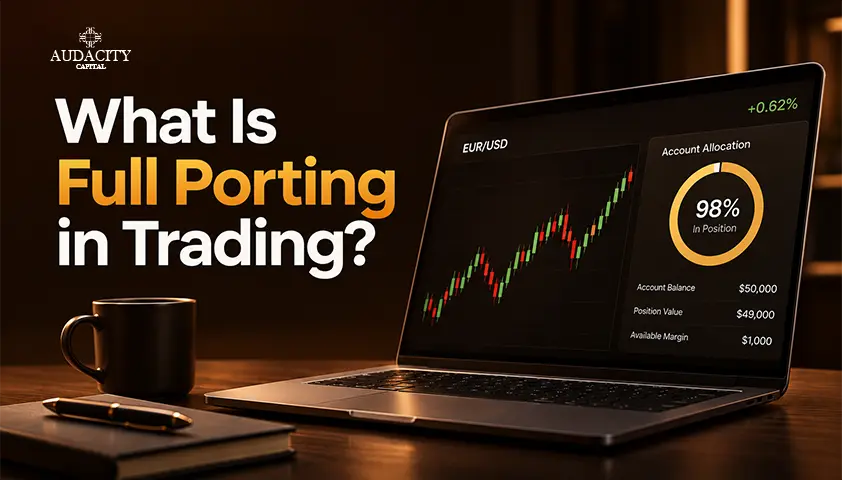
Full porting in trading refers to putting your whole account, portfolio, or max buying power into one trade. It is very common in retail trading communities and often used by day traders, futures traders, and crypto traders when talking about highly leveraged trades. It can mean betting almost your whole investment or trading capital on one asset, using the maximum leverage or going in for the biggest size your broker/prop firm will allow you to.
While full porting may seem like a great way to increase potential profits for traders, it exposes you to much greater market risk. If the market goes against you by a few pips, you can suffer large amounts of losses, margin calls, liquidations, and potentially lose your funded account. It is important to understand the difference between your buying power and actual risk.
In this guide, we will explain what full port means in trading, how it works in various financial markets, why traders use it, and look at some examples and risk management methods that you can use to make more informed trading decisions.
What Is Full Porting in Trading?
Most beginner traders may not have heard of the term full port in trading. So, what is full porting in trading? It is simply when you use all or almost all of your available trading capital, buying power, or position size to trade a single position or trade idea. Traders will place the majority of their capital into one market opportunity. Many traders do this to maximize potential gains from a price movement. However, sometimes the trade doesn’t go as planned, which is a potential downside of this style of trading.
When traders talk about full porting in trading, they simply mean going all in or going for maximum position size. What traders should keep in mind is that full porting is not an official trading strategy, order, or financial term used in the financial markets. Full porting, in trading, can represent different things depending on the instrument being traded, the account structure, and the trading environment.
For example, a stock trader might use nearly their entire cash balance to purchase shares in one company. A futures trader could open the maximum number of contracts permitted by their account, while a cryptocurrency trader might allocate most of their portfolio to one digital asset. In a prop firm environment, full porting could involve risking most of the remaining drawdown allowance on a single position.
Different Ways to Full Port in Trading
Essentially, full-porting means putting nearly all your available trading capital into a single opportunity. However, there are a few different ways you can achieve this.
- Using the entire available cash balance: This is where you put almost all of your available cash into one asset.
- Committing maximum buying power: This is where you use all of your buying power available, which may involve using borrowed money.
- Opening the largest permitted position: This is when you open the biggest position you are allowed to by your broker, exchange, or prop firm.
- Risking most of the remaining drawdown allowance: This is when a funded trader puts on a trade with a high risk of losing most, if not all, of the remaining loss they are allowed.
These situations are related but not identical. But what’s important for traders to understand is that full porting can be done in various ways. Full porting does not only involve risking your entire trading capital; even using your maximum buying power is still full porting. Sometimes traders could full port, thinking it’s just another type of risk.
How Does Full Porting Work in Trading?
Full porting involves putting all of your capital or drawdown limit into one trading opportunity. The amount you commit depends on how much capital you have in your account, along with your buying power, leverage, and position limit. This can vary between different financial markets but essentially means you are taking on a large amount of risk with one trading decision. Here are a few scenarios to help you understand what is full port in trading and how it works:
Full Porting with Your Entire Trading Balance
This involves using the vast majority of your available account balance to open one position. For example, if you have a $10,000 stock trading account, you may buy shares in one company using $9,500 of your account balance. This leaves just $500 of available cash. The majority of your account's capital is now invested, so if the share price falls, you will be negatively impacted as the majority of your account's invested capital is exposed.
Full Porting with the Maximum Leverage
Leverage allows you to trade more than your account balance. So, if you have $5000 and have 10:1 leverage, you could trade up to $50,000, depending on the broker's requirements. Using your full buying power will not necessarily mean you are risking your full $5000. This will depend on how much price moves, your position size, margin requirements, and risk management. Remember, leverage can increase your losses quickly and cause you to get liquidated.
Full Porting in Futures and Prop Firm Accounts
Futures traders can full port by trading the maximum number of contracts that their account margin permits. This can lead to large losses if the market moves against them slightly, as they have exposure to the underlying asset. Traders in prop firms can also risk most of their available daily/max drawdown on one trade, meaning that they could break the rules of their account with one negative move.
Full Porting in Options and Cryptocurrency Trading
Options traders may commit their entire trading budget to one contract or options strategy, exposing most of their allocated capital to one market outcome. Cryptocurrency traders may concentrate nearly their entire portfolio in one digital asset, such as Bitcoin or Ethereum. If its price falls significantly, the portfolio can experience substantial losses, particularly when leveraged positions are involved.
Why Do Traders Go Full Port in Trading?
There are many reasons why traders decide to go full port. Some do it because they believe that by putting their entire capital into one trade, they will get the maximum return from a great opportunity. Others, however, take large positions due to pressure and bad money management. Below are some common reasons traders take excessive positions.
Overconfidence in a Trading Opportunity
Overconfidence can cause traders to have an extremely high conviction in a certain market setup. Having had some winning trades or seeing a strong technical setup, they will be very confident that they will not lose on their next trade. This can cause them to invest most of their capital in one opportunity. However, traders should understand that even if they have done good research on the setup, they can still lose due to unexpected economic news, changing market sentiment, or a sudden reversal.
Fear of Missing Out (FOMO)
When traders feel like they need to get into a market opportunity due to the fear of the price moving significantly without them, they may fall into this trap. This can be made worse by seeing the price rising fast, the latest news coming out, and people talking about it on social media. Traders may get into positions quickly and overexpose themselves rather than waiting for the right conditions. They may even go in with full buying power to try to get as much of the expected price movement as possible.
Revenge Trading After a Loss
Revenge trading is when traders place impulsive and poorly planned trades to make up for losses they have incurred. They may increase the size of their position so that they can make up for their losses quickly. For example, if a trader has lost $500, they may place a much larger position to make up their losses in one trade. This can cause much larger losses if the market goes against them again. It can leave you with nothing left in your account or potentially exhaust your remaining drawdown allowance.
Wanting quicker profits
Some traders go all in because they want to make large profits in a short amount of time. This may be more prevalent with those who have less capital to trade with or set ambitious financial goals. Going bigger can seem like an easy way to achieve your trading goals. However, by going bigger, you are increasing your risk of losing money. Seeking fast profits can reduce your long-term consistency as a trader.
Following Influential Traders and Online Communities
Social media and online trading communities often show images of big positions and great gains. These positions are often copied by retail traders who do not understand the size of the trader's account, their experience, risk tolerance, or financial resources. Most of the time, traders ignore losses that are not shown and end up copying the position size of another trader, not knowing they could put their accounts at risk of huge losses.
What Are the Risks of Full Porting in Trading?
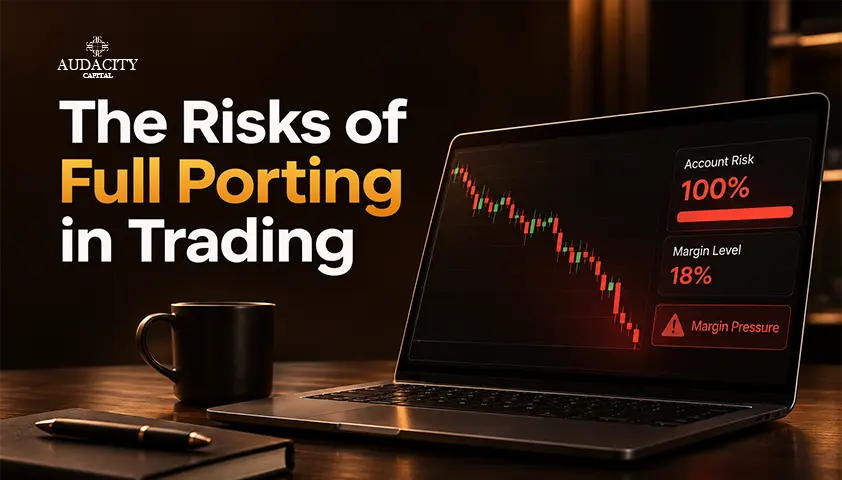
If you full port your stake into a single position, you are automatically exposed to a large amount of risk. Whilst you may make large profits from a successful trade, you could also face severe consequences if the market moves against you. Those who use large positions may struggle to control their losses and maintain their discipline. It is important to understand the risks involved in full porting before putting large amounts of capital into a single trading opportunity.
Significant Capital Losses
If a trader puts most of their capital into a single trade, then they can suffer large losses. If for example, the trader puts $9000 of their $10,000 into one stock and it drops by 10%, they will lose $900. With no leverage or extra charges, this is 9% of their account. A larger drop could mean that they have lost a large chunk of their capital and have less to play with in the future.
Increased Exposure to Leverage and Liquidation
Combining full porting with high leverage can be very dangerous. Leverage is used to increase your exposure to the market; however, it also increases your risk. If the market goes against you, then your account equity may drop below your broker’s maintenance margin requirements. This could cause you to get a margin call or be forced to liquidate your position, meaning that you could be forced out of your position at an unfavorable price. Also, losses can build up very quickly if the market is volatile.
Breaching Prop Firm Drawdown Rules
Traders will be subject to risk control rules when trading on funded/evaluation accounts. These include a daily loss limit and maximum drawdown limit. If you were to full port your account, it can be very hard to stay within these limits. You may have a large position that takes up most of your drawdown limit. If you risk your entire $2000 drawdown limit on one trade, and it goes against you, you may lose access to the account. Depending on the rules of the firm, you may also be disqualified if you temporarily breach or violate any other trading conditions.
Limited Portfolio Diversification
Full porting creates a lack of diversification due to putting all of your money into one asset. For example, if you are trading in cryptocurrencies and put almost all of your money into Bitcoin, you will be very exposed to any issues that may arise. This could include unexpected regulations, security issues, market sentiment, or liquidity issues. Although you will still be exposed to risk, diversifying your assets can help lower your exposure to one investment.
Emotional Pressure and Poor Trading Decisions
Big positions can cause a great amount of pressure. Seeing a large amount of the account balance swing around can cause fear and make you exit a position too early. Overconfidence can also prevent you from exiting a losing position when the circumstances of your trades no longer apply. Some people will also increase their stop loss or completely change their trading strategy to avoid taking a loss. These emotional reactions can cause a risky position to become a bad trading decision.
Is Full Porting a Good Trading Strategy?
Overall, full porting can be seen as a high-risk trading activity, as it puts large amounts of capital or buying power into one position. While profits can be greater, the risks are also double the gains. As an aspiring trader, you should understand that full porting in trading does not have a structure or method to identify opportunities in the market as other strategies do. There are no rules for entering the market, sizing positions, or setting risk limits.
Using all of your capital does not guarantee that you will have a higher chance of being successful. There are many variables to consider when trading, such as price, liquidity, economic factors, and unexpected events. Even if you have done technical or fundamental analysis to back up your trade decisions, the market can still go against you, and there is nothing you can do to bring back your money.
Also, it is important to note that having strong conviction about your setup does not mean you should risk too much. You can have high confidence in your analysis whilst controlling the size of your position and placing a fixed stop-loss. Conviction should not be used as an excuse to risk everything on the market.
Even experienced traders have lost trades from time to time. While they may have strong analytical skills and risk management systems in place, they cannot control the uncertainty of the market. Therefore, before entering any position, you should evaluate your account balance, appropriate position size, potential losses, leverage requirements, and applicable broker or prop firm restrictions.
Ultimately, protecting trading capital and maintaining consistent risk controls are generally more sustainable priorities than committing everything to a single opportunity.
How to Manage Risk and Avoid Full Porting
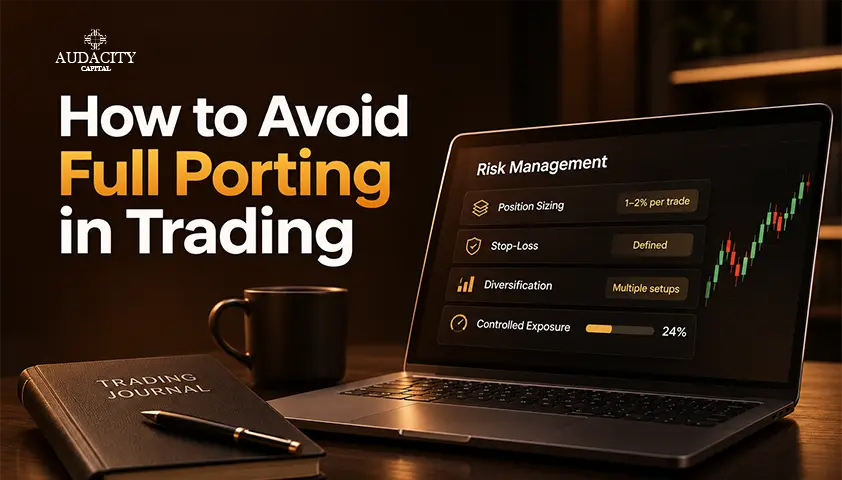
To avoid full porting in trading, you must have strict risk rules in place and stick to them. Instead of putting the majority of your available funds into one opportunity, work out how much you can afford to lose, then size your positions accordingly. You also want to keep enough funds in your account to take future trades. Below are some ways to help you avoid overexposure in the financial markets:
Use a Consistent Risk-Per-Trade Rule
Every trader should have a set amount that they will risk per trade. If you have a $10,000 account and decide to only risk 1% on each trade, then you will only plan to lose $100 per trade. This helps remove any emotional decisions when determining how big a position you want to take. The amount of risk you decide to take will depend on your circumstances, experience, and any restrictions your account has.
Calculate Position Size Before Entering a Trade
Position sizing can help you work out what size you want to take based on how much risk you are comfortable with. You should take into consideration your account equity, how much difference there is between your entry price and stop-loss, and how much money you are willing to lose. If you are willing to lose $100 and your stop-loss is $2 away from your entry price, then you should generally have 50 shares in your position (excluding any fees and slippage). This helps make it easier to manage your exposure.
Set Daily and Maximum Loss Limits
As a trader, you should set your own daily and overall loss limits so that you don’t wipe out a large chunk of your capital on a streak of losing trades. Ideally, you should set these lower than what your broker/prop firm will allow. If you’re trading funded accounts, it’s important to know how drawdown is calculated (balance, equity, or trailing). If you hit your loss limit, you should stop trading.
Avoid Excessive Leverage
Leverage should be used with caution as it increases your exposure to the markets. Before placing any leveraged trades, you should be aware of what margin requirements, liquidation levels, and potential losses you are facing. By keeping leverage low and having enough equity in your account, you can reduce the chance of your positions being liquidated.
Diversify Trading Exposure
By diversifying your trading, you will be able to spread out your risk by investing in numerous assets/ instruments/ opportunities. This is about not putting all your eggs in one basket. It won’t fully remove the risk, particularly if the assets are highly correlated. This is because the risk of them being impacted in the same way increases losses.
Keep A Trading Journal
Keeping a trading journal helps you see if you are making any similar patterns of taking on too much risk. You should write down how big your positions are, how much risk you are taking, and why you entered the trade. You should also write down why you exited the trade and how you were feeling whilst trading. This will show if you’re making decisions based on FOMO, overconfidence, or revenge trading. By journaling consistently, it allows you to become more disciplined within your trading and helps you follow a more consistent risk management strategy.
Conclusion
Full porting in trading refers to investing the majority of your capital, purchasing power, or trading capacity into one position. While this may be tempting to some traders looking to make large returns, doing so will increase your exposure and financial implications if you encounter an adverse market movement. This can cause you to have a large reduction in account equity, face liquidation, or cause you to fall below drawdown limits within your prop firm.
Traders should always look to size their positions sensibly and limit their risk. By setting strict stop-loss limits, understanding leverage, and having a structure to your trading, you can limit your exposure. No matter how good the trading set-up appears, there will always be an element of uncertainty. In order to be a successful trader, you need to manage your potential losses carefully.
FAQs
Full porting means committing all or nearly all available trading capital, buying power, or permitted position size to one trade or market opportunity.
It means using most or all available trading resources on a single position rather than distributing exposure across multiple opportunities.
Yes. Both expressions generally describe committing nearly everything available to one trading opportunity, although the precise meaning depends on the context.
Generally, yes. Full porting is not inherently illegal, but traders must comply with applicable broker, exchange, and financial regulations.
Yes. If a leveraged position loses value and account equity falls below maintenance margin requirements, the broker may issue a margin call or liquidate the position.
It depends on the firm's rules. Some restrict maximum position sizes, leverage, or drawdown, making oversized trades a potential account violation.
Some traders use 1% or less of their account balance as a risk guideline. The appropriate amount depends on individual circumstances.

Готовы применить дисциплинированный риск к криптовалютам? Изучите новые криптоинструменты Audacity Capital и примените свою торговую стратегию.
Узнать большеРассылка
Подпишитесь на нашу рассылку.
Присоединяйтесь к нашему сообществу

Начните свое путешествие сегодня с нашей бесплатной пробной версией
С гордостью демонстрируйте свои навыки и достижения с помощью сертификатов и получайте признание за свой тяжелый труд и преданность делу от потенциальных инвесторов и коллег.
Бесплатная пробная версияПохожие статьи
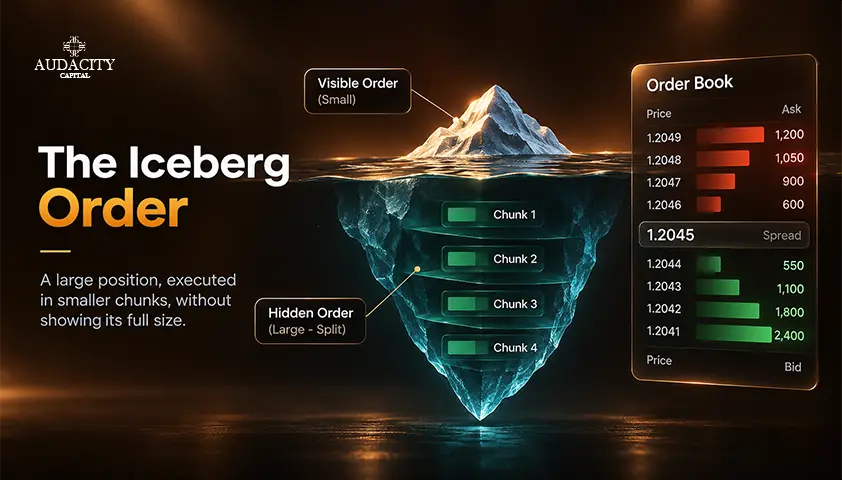
Iceberg Orders Explained: How Hidden Large Orders Work
Learn what iceberg orders are, how they work, why traders use them, how to spot possible iceberg activity, and how execution varies by platform.

Bid and Ask Price Explained: What Every Trader Needs to Know
Learn what bid and ask prices mean, how spreads affect trading costs, why spreads widen, and how to manage them when trading forex and other markets.
Calmar Ratio: Meaning, Formula and Examples
Learn what the Calmar Ratio means, how to calculate it, interpret results, and compare it with Sharpe and Sortino ratios.
Overfitting in Trading: Signs, Causes & How to Avoid It
Learn what overfitting in trading means, why strategies become overfit, the warning signs to watch for, and how to build more robust trading systems.