


Margin Account Requirements in 2026


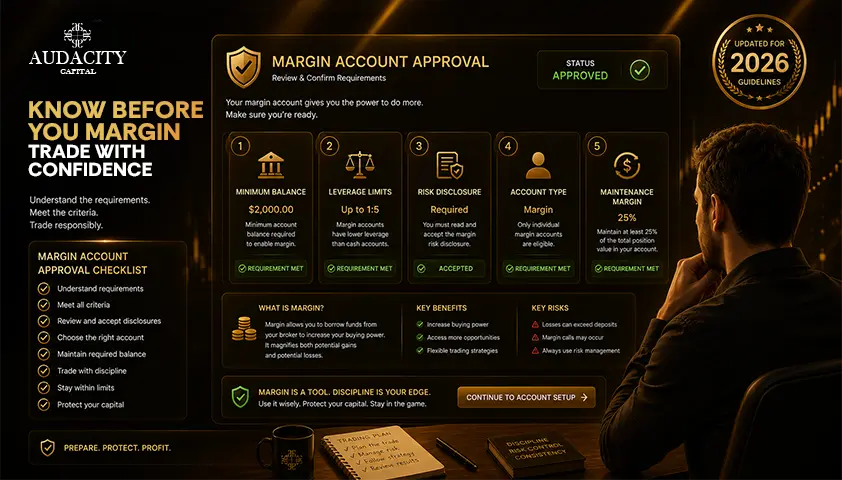
A margin account allows you to trade with more money than you have by borrowing from your broker, thus raising your buying power, but also entails real requirements and real risks.
But in 2026, there was a big change in the rules. If you have read older articles that still quote a $25,000 day-trading minimum, they are now out of date.
This guide will take you through:
- what a margin account is,
- the margin account requirements you need to open and keep one,
- the major 2026 pattern-day-trader change,
- how margin works in forex and CFDs,
- the risks involved,
- and how a funded account differs.
All of this is in accordance with the rules that are in effect after June 2026.
What is a margin account?
A margin account is a type of brokerage account in which you can borrow funds from your broker to make trades. Your existing securities act as collateral, allowing you to open larger positions than you could with cash alone.
Compare it with a cash account. In a cash account, you are only allowed to trade what you have settled and own. Borrowing isn't allowed, so your position size can only be limited by your available balance.
It is easier and less risky, but restricts market exposure.
The power of a margin account is leverage, which basically means that you are borrowing money to make your trades larger.
Leverage works both ways. It enhances your profits if your trade succeeds and it enhances your losses if your trade fails. That's the basic relationship of any margin account and explains why it has regulations to ensure your protection and your broker's. Next, we will be talking about those rules.
Margin Account Requirements: The Key Rules
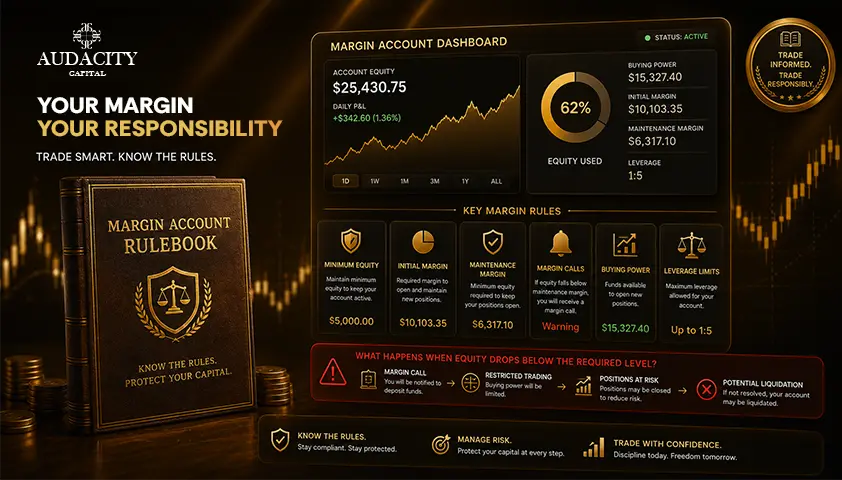
The SEC's Regulation T, along with FINRA, establishes the basic requirements for margin trading for US equity traders. Here are the five you must know and they are clearly explained.
1. The $2,000 minimum equity requirement.
Under a long-standing FINRA rule, you need at least $2,000 in equity to open and maintain a margin account. This is the benchmark. Remember this number, since it is often misinterpreted as another number we will clear up in the following section.
2. Regulation T initial margin (generally 50%).
Initial margin (Regulation T) refers to the amount of some purchase that you must pay for yourself in advance. For most equity purchases, that is at least 50%. So to buy $10,000 of stock, you put up at least $5,000 and can borrow the rest from your broker.
3. FINRA maintenance margin (generally 25%).
Once an account is opened for a position, there is a minimum requirement that must be maintained. It is usually at least 25% of the current market value of your long positions. Often, brokers need to have more on volatile or concentrated positions.
4. House requirements.
Brokers can institute their own more stringent standards in addition to the ones imposed by regulators. Your broker's percentages may be higher than the baseline due to these “house requirements” which could increase the initial or maintenance percentages, particularly with more volatile stocks.
5. Margin calls.
A margin call is a situation where the equity in your account drops below the maintenance level. If it does, you will need to add cash or close out positions to reach the necessary level. Otherwise your broker can sell your positions for you.
Requirement | General level | Set by |
Minimum equity to open | $2,000 | FINRA |
Initial margin | ~50% of purchase | Regulation T |
Maintenance margin | ~25% of position value | FINRA |
House requirements | Broker's own (usually higher) | Your broker |
Margin call trigger | Equity below maintenance level | FINRA / broker |
These are rules that apply to US stocks, and the rules regarding day trading have been dramatically modified in 2026.
Note: It varies by implementation, always check exact figures with your own broker. The next section addresses what's changed and why it's important.
The Big 2026 Change: The $25,000 Day-Trader Minimum is Gone
Starting June 4, 2026, FINRA discontinued the pattern-day-trading framework and the $25,000 minimum equity requirement. The change was implemented via FINRA Regulatory Notice 26-10, which the SEC adopted, and which replaced the previous system with a new intraday margin model.
Here are the things that were taken out:
- There is no longer a $25,000 minimum to day trade in a margin account.
- Brokers don't tally your day trades or the old rule of four day trades in five business days.
- The special 4x day-trading buying power tied to the pattern-day-trader designation is gone.
This is what replaced it:
Rather than the previous day trading rules, you must now keep at least a 25% maintenance margin the entire trading day, not just at the close of the market. That's where the words intraday margin enter the picture: your margin is now subject to monitoring throughout the day, not just at settlement.
Brokers take one of two routes to ensure this:
- Real-time monitoring, which prevents trades from putting a margin deficit in place as they occur.
- End-of-day calculation, which is where the broker checks your account at the end of the day and gives you a margin call the following day if you were not up-to-par.
There are two practical notes that come into consideration.
Firstly, there is an 18-month phase-in through October 20, 2027, so brokers are rolling this out at different times. Some have adopted it in early June 2026, others are in the transition phase.
Secondly, since monitoring is now done in real time, margin calls might come quicker than before.
Now the clarification that trip-ups the vast majority of people.
The $25,000 minimum was not cut to $2,000, it was removed. These are two numbers that are completely different. The $25,000 was the previous day-trading cap, which is no longer in effect.
The $2,000 is the long-standing minimum to open any margin account, and it still applies. Don't be fooled by treating them both as the same figure, this is the greatest mistake made regarding this change.
The application of the new rules varies from broker to broker, so ask your broker before you trade what they do.
How Margin Works in Forex and CFD Trading
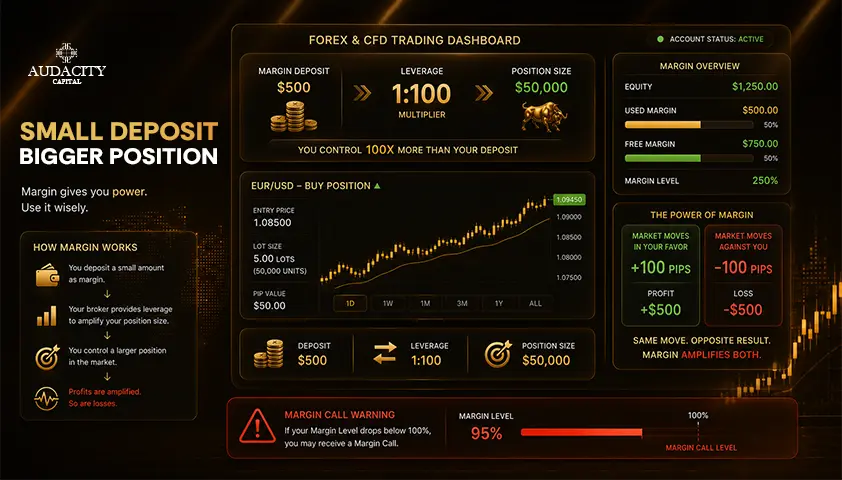
In the case of forex and CFD trading, margin is a concept that is distinct from US stocks.
In Forex and CFD trading, margin is the amount of money needed to enter into a leveraged trade. It is usually expressed either as a margin requirement percentage or as a leverage ratio.
A 30:1 ratio, for instance, implies a small amount of deposit manages a great deal of position.
Here are a couple of terms to help you follow along:
- Used margin is the amount that is currently used for open positions.
- Free margin is the margin left for new positions.
- The stop-out level also known as the margin-call level is the price at which your broker will automatically close your positions to stop further losses.
Regulators limit leverage in this market and the limits vary by jurisdiction. The FCA in the UK, ESMA in the EU, and ASIC in Australia limit major-pair retail forex leverage to around 30:1. Offshore brokers might offer much higher levels of leverage, but this can lead to a much greater risk and weaker regulatory protection.
Now, an important thing for US traders reading this is that forex, futures, and crypto were never covered by the US pattern-day-trader rule in the first place.
This means they are not affected by the 2026 change mentioned above. Each instrument comes with its own set of margin and leverage parameters, which differ by broker and regulator, so please check the conditions for your selected market and product.
The Risks of Trading on Margin
Margin can multiply your trading capacity, but it truly is high-risk. Let's take a look at the negative side.
1. Amplified losses.
The losses generated by leverage are as large as the gains.
You're holding a larger position than your capital can support, which means a small adverse move in the market can result in a significant loss, compared to your own capital.
2. Margin calls & forced liquidation.
When your equity falls short of the maintenance level, you need to put more money in or your broker can liquidate your positions to make up for the shortfall. This forced liquidation may occur rapidly and sometimes without any notice. The new intraday rules of 2026 allow such calls to be made at a faster pace or in real time, leaving less room than the previous end-of-day model.
3. Losing more than you deposited.
Since you are investing with borrowed capital, a move against you can cost you everything and make you owe your broker the rest. In a cash account your downside is limited to what you put in. In a margin account it is not.
4. Interest costs.
Interest is charged on the borrowed amount. Keep leveraged positions for long enough, and that the interest steadily erodes any returns that you achieve.
Margin account vs a funded account: where Audacity Capital fits
There is another method to meaningful trading capital and it operates on a totally different model. It's important to know the difference genuinely.
With a margin account, you are trading your own money with borrowed leverage. That means you could end up owing money, having to liquidate your assets, paying interest, and losing more than you put in.
There is an exception to this, though: a funded account.
Under a defined risk limit, you exchange a company's "simulated capital. You are not borrowing money, therefore, no interest is incurred. No margin call as such, and no $25,000-style minimum to clear. Your risk is already determined and set.
This is where Audacity Capital fits. Audacity is a proprietary trading company, not a broker.
It offers qualified traders access to "funded capital" through a fixed static drawdown, rather than lending you money on collateral.
The model is not risk-free, and it doesn't promise any income. What it does provide, however, is a rules-based method to trade up in size without risking your own money like you would with a margin account.
If that model fits how you want to trade, you can explore the Funded Trader Program or try the free monthly competition to test your process first.
Frequently Asked Question
No. The $25,000 pattern-day-trading rule was removed, and was replaced with an intraday margin model as of June 4, 2026. Smaller accounts can now day trade in a margin account but standard margin rules and any house rules set by your broker apply.
The long-standing minimum is $2,000 in equity. It is a different, older regulation that has been mixed up with the now-discontinued $25,000 day-trading rule. Depending on the broker, they may also have a house minimum that has to be met.
A cash account allows you to trade with money that you have already settled. A margin account also allows you to obtain money from your broker to increase your position size, thereby magnifying wins and losses and adding margin calls and interest charges.
Funds need to be added or positions need to be closed to restore the equity. Otherwise, your broker may close out your trades, sometimes without informing you. With the new rules in 2026, those calls can be more frequent and in real time.
Yes. Because you are trading with borrowed money, a sharp move against you can wipe out your deposit and leave you owing the broker. This is one of the main reasons margin trading is considered high-risk.
No, because FINRA introduced intraday margin requirements to replace the pattern-day-trader rule on June 4, 2026. Brokers are required to stop counting day trades and using the $25,000 minimum requirement. However, Firms have until October 2027 to fully implement the change, so the timing varies depending on the broker.
No, because both Regulation T and the pattern day trader rule apply only to US stocks, not forex, futures, or crypto. Each market has its own set of regulations when it comes to margin and leverage, which may be different from one another. So verify the rules for your specific instrument.
It can increase your buying power, but it also magnifies losses, adds interest costs, and risks forced liquidation. It suits disciplined traders with strong risk management rather than beginners chasing bigger positions.

Ready to apply disciplined risk to crypto? Explore Audacity Capital's new crypto instruments and bring your trading strategy.
Learn MoreNewsletter
Join our newsletter to stay up to date on features and releases.
Join Our Social & Community

Start Your Journey Today With Our Free Trial
Proudly showcase your skills and accomplishments through certificates and get recognition for your hard work and dedication from potential investors and peers.
Free TrialRelated Articles

What Is BOS in Trading? A Complete Guide to Break of Structure (2026)
Learn what BOS in trading means, how Break of Structure works, how to identify bullish and bearish BOS, and how traders use it in market analysis.


What Is a Breaker Block in Trading? A Complete Guide for 2026
Learn what a breaker block is in trading, how bullish and bearish breaker blocks form, how to identify them, and how traders use them in SMC and ICT.
Equity vs Balance in Trading: Which Number Matters
Equity vs balance explained: what each number includes, why margin calls and prop firm rules run on equity, and where your balance still decides things.

Averaging Down: Explained
What averaging down does to your breakeven and your exposure, the one question that settles whether to do it, and why leverage changes the answer entirely.