


CFD Trader Guide: How to Become a Profitable CFD Trader?



Most people who try to become a profitable CFD trader never get there. According to regulator statistics, most retail CFD traders make losses, with loss rates from major brokers commonly ranging from 62% to 82%.
That is what you are getting yourself into. However, there is another aspect to it.
Traders who achieve consistent profitability are not using secret strategies.; they maintain leverage rather than maximizing it, manage risks associated with their trades, account for costs that others neglect, and follow a tested process with discipline.
None of that is glamorous, but all of it is learnable.
This guide spells it out step-by-step: a brief foundation and then the skills which truly distinguish the profitable minority from the rest.
What is CFD trading, and how does it work?
A CFD, or contract for difference, is a derivative product. You don't purchase an asset, but instead you enter a contract that pays you the spread between the opening price and the closing price.
When the difference works in your favor, you make money. If it's going the other way, you lose.
Since you don't own the asset, you can trade both ways. If the price goes up, you gain from going long. If it falls, you benefit from going short. This flexibility makes CFDs so popular in the forex, indices, commodities and shares markets.
The other key characteristic is leverage and margin. You put up a small percentage of the total value of a trade, known as margin, to run a larger trade position.
This is what beginners mostly underestimate: Your profit or loss is based on the total position size, not the margin. Control a $10,000 trade with $1,000 margin, and a 5% price change in the underlying market translates to a $500 swing, half your margin, on a move that would barely register in an unleveraged account.
That cuts both ways, and it cuts hard. Remember this because it shapes everything that follows.
The honest reality: is CFD trading profitable?
Let's get to the not-so-pleasant question right up front: is CFD trading profitable for most people?
No.
Regulated jurisdictions require brokers to disclose the percentage of retail accounts that lose money, and the average range is between about 62% and 82%, with figures around 70% common at several major brokers.
The question is, why do so many people lose?
Three reasons dominate.
The first one is leverage misuse: traders place trades that are too big for their account and a small market swing kills them.
Second, trading costs: the spread and overnight financing subtly reduce returns, particularly for active traders.
Thirdly, the game is challenging and most players come without a tested plan. CFDs are NOT a scam. They are a sharp tool, but most people who pick them up use them carelessly.
The flip side is that a disciplined minority do profit, and they tend to do the same things. The remainder of this guide is focused on just that. A word of warning before we go further: CFD trading is a risky endeavor and you should never trade with money that you cannot afford to lose.
Respect leverage before anything else
Risk management is the bedrock of profitable trading and leverage discipline is the foundation on which it stands. Misused leverage is the single fastest way to destroy an account, which is why it's listed first.
The math is unforgiving. Suppose you open a position with 10:1 leverage, putting up 10% margin. A 2% move in the underlying market produces a 20% gain or loss on your margin. A 10% adverse move can wipe out your margin. There was nothing unusual in the market. You chose an ordinary position size and made an extraordinary, terrible move.
The profitable mindset flips the default. Most losing traders ask how much leverage they can get. Profitable traders ask what minimum leverage they need to have.
What your broker offers as maximum leverage is a ceiling, not a target. A sensibly sized position survives a bad day and lets your strategy play out over hundreds of trades. An over-leveraged account can close your account at a single piece of news.
Use leverage as a tool and not a shortcut to making money. It amplifies losses just as well as it amplifies profits and it does this on the total position size. There is no version of leverage that only works in your favor.
Know your costs: spread and overnight financing
Costs are the silent assassin of CFD profitability, and are often neglected compared to strategy. Two matter most.
Spread is the difference between the buy and sell prices. It's paid on each and every trade, win or lose. It's small per trade, which is precisely why traders disregard it, and precisely why it turns into a major drag for traders who trade regularly.
Overnight financing, often called swap, is a daily fee that is applied if you are holding a leveraged position past the broker's daily cut-off time. Since you have to borrow to control the entire position, you incur a financing charge for each night you own it.
In some markets, a commission is also included instead of or in addition to the spread, and forward CFDs often add the holding cost to the price, rather than nightly.
Why is this important to profitability? Because expenses change the math of your plan. The scalper paying the spread 50 times a day should have a real advantage to just break even. A swing trader who has open leveraged trades for 2 weeks observes the financing charges slowly devouring the move that was correctly predicted. A strategy that may appear to be profitable prior to costs can be a net loser after costs.
Successful traders always consider the cost of every trade before taking it; they take trades that are suitable for their time horizon and they don't over-trade. Each unneeded trade is a gift to your broker.

Build a CFD trading strategy (and pick one or two)
Now for the part most guides lead with. There is a standard set of CFD trading strategies, and you should be familiar with all of them, but here is the straight answer: you don't need them all. Successful traders focus on one or two methods of trading that are suited to their personality, schedule, and risk tolerance, and stick with them.
Short-term strategies
- Scalping: many small trades capturing tiny price moves. Demands speed, very low costs, and intense focus. Your worst enemy here is the spread.
- Day trading: trade in and out of a position on the same day without financing overnight. Usually driven by technical analysis on intraday charts.
- Range trading: When the market is in a sideways trend, buy at support levels and sell at resistance. Holds until the range breaks, meaning the exit is as important as the entry.
- News trading: deal with the volatility of scheduled economic releases. High risk, fast moves, and it requires an economic calendar and quick execution.
Longer-term strategies
- Trend or position trading: ride a larger trend over days to weeks, combining technical and fundamental analysis. The cost of overnight financing should factor into the calculations.
- Breakout trading: enter when price breaks through a key support or resistance level when momentum is strong, looking for the beginning of a new move.
- Pullback or retracement trading: wait for a temporary pullback into the prevailing trend, then buy at a better price in the trend direction.
- Hedging: taking an offsetting position to safeguard an open position or holding against short-term losses, but forfeiting some return.
Strategy | Typical timeframe | Best for |
Seconds to minutes | Full-time traders with low costs and fast execution | |
Minutes to hours | Traders who can watch the markets during the session | |
Range trading | Hours to days | Patient traders in sideways markets |
Minutes around events | Traders familiar with fluctuating markets. | |
Trend / position | Days to weeks | Part-time traders, bigger-picture analysis |
Hours to days | Traders who make quick decisions at crucial levels | |
Pullback | Hours to days | Trend followers looking for good entries |
Variable | Protecting existing positions |
They are typical strategies offered for education, not suggestions. Keep in mind that strategies with multi-day holds have financing costs overnight which shorter strategies do not.
Risk management: the real difference between winners and losers
If there is one step you take out of this guide, do this one. While strategy selection is what gets the focus, it is position sizing and risk management that will differentiate the winners from the losers. A mediocre strategy that has great risk management lives. A great plan but poor risk management ends up in a disaster.
The following practices are regularly found with traders who last:
1. Risk a small, fixed percentage per trade.
The majority of disciplined traders risk between 1% and 2% of their account per trade. The logic is survival math. Risking 2% per trade, a brutal streak of ten consecutive losses costs you around 18% of your account.
Painful, but recoverable. Risking 10% per trade, the same streak leaves you with about a third of your capital and a near-impossible climb back.
2. Always use a stop-loss.
A stop-loss is an order that automatically closes your position at a predefined price, capping your loss. Establish your exit before you enter the trade and not when it goes against you.
Some platforms have guaranteed stops which close when the price hits you, even when the market is moving quickly, and typically pay a fee.
Please note that standard stops do not guarantee an exact exit price, as in fast moving or gaping markets, slippage can result in a worse exit level than the stop level set.
3. Use a positive risk-reward ratio.
Your risk-reward ratio compares what you stand to lose if your stop is hit against what you stand to gain at your take-profit target. Aiming for 2:1, risking $100 to make $200, means you can be wrong more often than you are right and still come out ahead.
Win just 40% of your trades at 2:1 and you are net profitable before costs. This is how professionals stay profitable without needing to predict the market most of the time.
4. Size positions from your stop, not your confidence.
The correct position size is calculated: take your chosen risk amount, divide it by the distance to your stop-loss, and that is your size. Feeling certain about a trade is not a sizing input. Some of your most confident trades will lose.
5. Cap total exposure.
Five open positions on correlated markets is not five trades. It is one large trade wearing a disguise. Limit your total exposure and watch for hidden correlation, or one market event will hit your entire account at once.
None of this is exciting. All of it is the job.
Test before you risk real money
Profitable traders prove an edge exists before they fund it. An edge is simply a repeatable approach that wins more than it loses after costs, and you find out whether you have one through testing, not through hope.
Two tools do the work. Backtesting means applying your strategy rules to historical price data to see how the approach would have performed across different market conditions. It will not predict the future, but it will quickly expose a strategy that never worked in the first place.
A demo account lets you trade live market conditions with virtual money. This is where you practice execution, test your rules in real time, and rehearse your process without financial consequences. A strategy should show consistent results in backtesting and then on demo before a single unit of real money goes behind it.
One honest caveat: a demo cannot fully replicate the emotion of real-money risk. Watching virtual money fluctuate is not the same as watching your own. Treat demo success as necessary but not sufficient, which is exactly why the next section exists.
Master your trading psychology
Most traders do not fail at analysis. They fail at discipline. Trading psychology is where solid plans go to die, and the failure patterns are remarkably consistent:
- FOMO: chasing a move after it has already happened, entering late at the worst price because sitting out felt unbearable.
- Revenge trading: forcing trades after a loss to win the money back, usually with bigger size and worse setups.
- Overconfidence: a winning streak convinces you the rules no longer apply to you, so size creeps up and stops get looser.
- Hope management: moving or removing a stop-loss because you do not want the loss to become real. The small loss you refused to take becomes the large one you cannot afford.
The defense against all of these is the same: a written trading plan with predefined rules for what you trade, when you enter, where you exit, and how much you risk, plus the discipline to follow it during both drawdowns and winning runs.
The plan is your protection against the version of yourself that shows up under pressure.
The second habit is journaling. Profitable traders log every trade: the setup, the size, the outcome, and crucially the reasoning and emotional state behind it. Then they review.
Patterns emerge fast: maybe your losses cluster on Fridays, or your biggest leaks come from breaking your own entry rules. You cannot fix leaks you have not found.
This is the core mindset shift, treating trading as a process to refine rather than a series of bets.

A realistic path from beginner to consistent CFD trader
Here is the progression, stripped of shortcuts. It is the closest thing CFD trading for beginners has to a reliable roadmap:
- Learn the fundamentals. What CFDs are, how leverage and margin work, what the costs are, and the basics of the markets you intend to trade.
- Write a trading plan. Your market, your strategy, exact entry and exit rules, risk per trade, and realistic goals. If it is not written down, it is not a plan.
- Backtest, then demo trade. Prove the plan on historical data first, then trade it on demo until the results are consistent over a meaningful number of trades, not a lucky week.
- Go live small. Start with small size and minimal leverage. Your goal at this stage is flawless execution of the plan, not profit. Profit follows process.
- Journal, review, refine. Scale up slowly, and only once you have documented, proven consistency over time.
Set your expectations honestly. This progression typically takes months to years, not weeks, and many people never reach consistency at all. That is not meant to discourage you.
It is meant to recalibrate you, because traders who expect a long apprenticeship survive the early period that destroys everyone expecting fast money.
Steady process beats chasing returns, every time.
How much can you realistically make (and how much do you need)?
Two honest answers, no promises.
On returns: skilled traders typically target modest, compounding returns. A commonly cited ballpark for good traders is around 10% a year, not 10% a month, and even consistently profitable traders go through losing weeks and months.
If a figure you see online sounds dramatically better than that, treat it with suspicion. Realistic targets are not a limitation. They are what professional trading actually looks like.
On capital: percentage returns mean little without enough capital behind them. A 20% year on a $500 account is $100, which creates a dangerous temptation: undercapitalized traders try to force meaningful money out of small accounts by over-leveraging, and over-leverage is one of the top causes of failure.
There is no magic minimum, but you need enough capital to risk only 1% to 2% per trade, absorb a losing streak, and still be in the game.
This is general education, not financial advice, and no return is ever guaranteed. Plan for the downside first and let the upside take care of itself.
Important: where CFDs are restricted
A short but essential note before anything else. CFDs are banned for retail traders in the United States, so US residents cannot legally trade them through standard CFD brokers. In the UK, crypto CFDs are restricted for retail clients.
Rules differ meaningfully by country, and leverage caps, product availability, and protections vary across the UK, EU, UAE, Australia, and Asia.
Before you trade, check your local regulator's rules and confirm what you are legally allowed to access. Nothing in this guide changes what applies in your jurisdiction, and there are no legitimate workarounds to retail restrictions.
Where a tested edge meets capital
Pull the threads together and the picture is clear. Becoming a profitable CFD trader comes down to leverage discipline, risk management, cost awareness, a tested strategy, and the psychology to execute it consistently. Strategy turns out to be the easy part.
The real constraints are discipline and capital. Discipline is yours to build. Capital is where prop firms come in.
Once a trader has proven a genuine edge through testing and live consistency, the limiting factor is often account size, and that is the specific problem proprietary trading firms exist to solve for disciplined traders.
Audacity Capital, a prop firm founded in London in 2012, is one option worth knowing about. It offers funded trading programs, scaling opportunities for consistent performers, and free education through Trader University.
To be plain about it: a funded account provides capital and structure, not an edge or profitability. The discipline still has to be yours, and availability depends on your jurisdiction.
If you have done the work this guide describes, explore whether a funded path fits your next step at audacity.capital.
Frequently asked questions
Yes, it could be, for a disciplined minority. The regulator statistics suggest that about 62% to 82% of retail CFD accounts experience losses. The success here will depend on controlled leverage, proper risk management, low-cost trading, and executing a well-tested trading plan.
Yes, for a few people, but it needs proven edge, adequate funds, disciplined risk management, and years of experience. Consistent profitability does not mean no losing spells. Full-time CFD trading should be treated as an earning option rather than an assumption to plan around.
There is no fixed figure, although under-capitalization is the reason why most CFD traders fail since it forces them to use high leverage. The important thing is to have enough money to risk 1-2% per trade, withstand losing streaks, and keep implementing your trading system.
No. CFDs are banned for retail traders in the United States. They are legal in many other regions, including the UK, EU, UAE, and Australia, subject to local rules such as leverage caps and product restrictions. Always consult your local regulatory body before trading.
The primary reasons include leverage abuse, overlooking costs such as the spread, poor risk management, and trading based on emotions. CFD trading itself is not a scam. It is a high-risk, leveraged instrument that penalizes those who misuse it.
This depends on the individual trader's experience, skills, and patience, with months or even years being the norm. Some traders never manage to turn profits consistently. There is no guaranteed timeline. Traders who expect a long apprenticeship tend to survive the early stage that eliminates those chasing fast money.

Handa nang maglapat ng disiplinadong panganib sa crypto? Galugarin ang mga bagong instrumento ng crypto ng Audacity Capital at dalhin ang iyong diskarte sa pangangalakal.
Matuto PaNewsletter
Sumali sa aming newsletter.
Sumali sa Aming Social Community

Simulan ang Iyong Paglalakbay Ngayon Gamit ang Aming Libreng Pagsubok
Ipagmalaki ang iyong mga kasanayan at tagumpay sa pamamagitan ng mga sertipiko at makakuha ng pagkilala para sa iyong pagsusumikap at dedikasyon mula sa mga potensyal na mamumuhunan at kasamahan.
Libreng PagsubokMga Kaugnay na Artikulo
Prop Firms With No Minimum Trading Days
Prop firms with no minimum trading days compared, with evaluation rules, payout conditions and who each one suits.

Liquidity Sweeps Explained: How to Identify and Trade Them
Learn what a liquidity sweep is, how to identify bullish and bearish sweeps, spot sweeps vs breakouts, and use price action and market structure for confirmation.
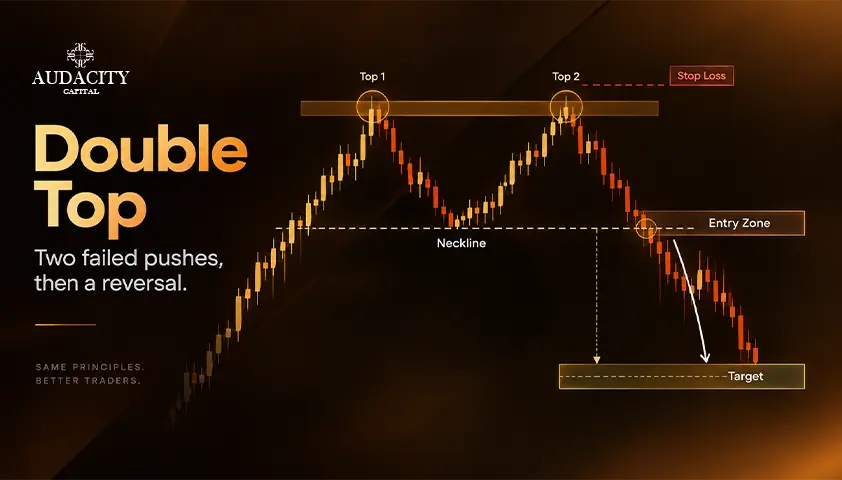
Double Top Pattern: How to Trade It
Learn how to identify, confirm, and trade a valid double top pattern with precise targets and stops.

Micro Futures Contracts Explained
What micro futures contracts are, why a smaller size does not mean lower risk, the margin trap that catches small accounts, and what they actually cost.