



10 Best Crude Oil Trading Strategies for Beginners & Professionals (2026)


Crude oil is one of the most traded and most volatile markets in the world, and 2026 has proven that in a big way. A year that started with talk of oversupply and soft demand quickly turned into one of the most turbulent oil markets in recent memory, driven by geopolitical shocks in the Middle East and shifting OPEC+ policy. For traders, volatility like this is both the opportunity and the danger.
If you trade oil on a funded account, the danger part matters even more. A single reckless position around a news event can wipe out a challenge or breach your daily loss limit before lunch. That is why strategy and risk control go hand in hand here.
This guide explores the best crude oil trading strategy ideas for 2026, covering 10 proven approaches that traders use in different market conditions. Whether you're looking for a beginner-friendly crude oil trading strategy or an advanced method for trading WTI and Brent crude, you'll learn how each strategy works, when to use it, and how to manage risk effectively.
Why Crude Oil in 2026
First, a quick note on what you are actually trading. Crude oil has two main global benchmarks. Brent crude is the international benchmark, priced off North Sea oil, and it is the reference most traders around the world watch. West Texas Intermediate (WTI) is the US benchmark. The two usually move together, with a price gap between them known as the Brent-WTI spread. Whichever one your platform quotes, the strategies below apply the same way.
Oil moves on a simple tug of war: supply against demand. The problem is that dozens of forces pull on both sides at once. OPEC+ production decisions, US shale output, inventory data, the strength of the dollar, global growth, and geopolitics all feed into the price at any given moment.
2026 has stacked several of these on top of each other. The year opened with a large projected supply surplus and a bearish tone, then flipped hard when tensions in the Middle East disrupted supply routes and sent prices spiking. The result has been fast, sharp swings in both directions. That kind of environment rewards traders who have a clear plan and punishes those who chase price without one.
What Is a Crude Oil Trading Strategy?
A crude oil trading strategy is a structured plan that helps traders decide when to buy or sell oil based on technical analysis, market fundamentals, or a combination of both. Because crude oil is one of the world's most volatile commodities, using a defined trading strategy can help traders manage risk, avoid emotional decisions, and identify high-probability opportunities. The best crude oil trading strategy depends on your trading style, timeframe, and current market conditions.
The strategies below work in different conditions. Part of trading oil well is knowing which one fits the market in front of you, rather than forcing the same approach into every session.
10 Best Crude Oil Trading Strategies
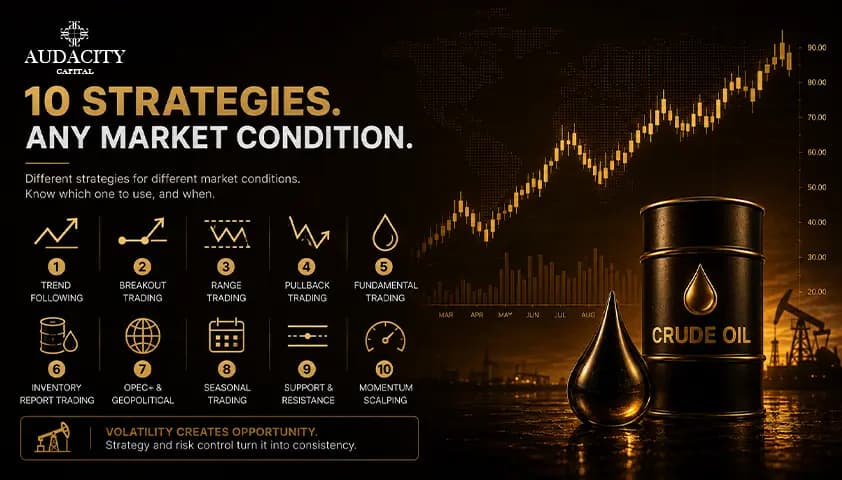
1. Trend Following Crude Oil Trading Strategy
Trend following is one of the most popular crude oil trading strategy approaches, helping traders follow the dominant market direction instead of trying to predict reversals.
Trend following is exactly what it sounds like. You identify the dominant direction and trade with it, rather than trying to pick tops and bottoms.
A common approach is to use two moving averages, for example a 50-period and a 200-period. When price is above both and they are sloping up, you only look for long setups. When price is below both and they slope down, you only look for shorts. This keeps you on the right side of the bigger move.
Trend following shines when oil is in a clean directional run, which happens often during sustained supply shocks or steady demand shifts. It struggles in choppy, sideways markets, so it pairs well with a filter that keeps you out when there is no clear trend.
2. Breakout Crude Oil Trading Strategy
Oil often coils into tight ranges before making a big move, especially ahead of scheduled events like OPEC+ meetings or inventory reports. Breakout trading aims to catch the move the moment price escapes that range.
The key is confirmation. Fakeouts are common in oil, where price pokes above resistance, traps buyers, then reverses. Waiting for a candle to close beyond the level, or for a retest that holds, filters out a lot of the noise. Volume expanding on the break is another good sign the move is real.
Breakouts can produce some of the cleanest trades in oil, but only if you respect the failed ones and cut them quickly.
3. Range Trading
Not every market trends. During quieter, oversupplied phases, oil can spend weeks bouncing between a floor and a ceiling. Range trading takes advantage of that by buying near support and selling near resistance, betting that price will revert back towards the middle.
This works best when you can clearly see a range holding, with price respecting the same levels several times. The moment price breaks out of the range with force, the strategy is done and you step aside. Range trading and breakout trading are two sides of the same coin, which is why many oil traders learn to read both.
4. Pullback and Retracement Trading
Chasing a move after it has already run is one of the fastest ways to get a bad entry. Pullback trading solves this by waiting for price to pause and retrace within a trend before joining.
In an uptrend, you wait for price to dip back towards a moving average or a Fibonacci retracement level (the 38.2% and 61.8% levels are popular), then look for signs of the trend resuming before entering long. In a downtrend, you do the reverse. The payoff is a much better entry price and a tighter stop, which improves your risk to reward.
This is a favourite among funded traders because the defined risk fits neatly inside tight drawdown limits.
5. Fundamental Trading (Supply and Demand)
While most of the strategies above read price action, fundamental trading reads the market itself. You build a directional bias from the underlying supply and demand picture, then hold positions to capture the bigger move as that picture plays out.
The inputs are the forces that actually set the price of oil: OPEC+ production policy, US and non-OPEC output, global inventory levels, demand from major economies, and the strength of the US dollar, since crude is priced in dollars and the two often move inversely. Broader risk sentiment matters too, as oil tends to firm when growth expectations are strong and soften when they weaken. Read together, these tell you whether the market is fundamentally tight or oversupplied.
Fundamental trading tends to suit swing and position traders on higher timeframes, because it can take days or weeks for the supply and demand reality to fully show up in price. The strongest setups appear when fundamentals and the chart agree, for example a bullish supply story lining up with an uptrend. The pandemic recovery, covered below, is one of the clearest examples of fundamental trading paying off.
6. Inventory Report Trading (EIA and API)
Twice a week, oil gets a jolt from inventory data. The American Petroleum Institute (API) releases its report on Tuesdays, and the US Energy Information Administration (EIA) follows on Wednesdays. These are US figures, but because the US is such a large producer and consumer, the numbers move the global oil price. Traders everywhere watch them. A surprise build or draw in crude stocks can move price sharply within minutes.
There are two ways to play this. Some traders take a position based on the reaction after the number drops, entering once direction is clear. Others avoid the release entirely and only trade the trend that develops afterward. What you should not do is hold a large, loosely managed position into the report and hope. The spread widens and price can gap right through a stop.
For funded traders, the safest approach is often to reduce size or stand aside through the release, then trade the cleaner move once the dust settles.
7. OPEC+ and Geopolitical Event Trading
OPEC+ decisions and geopolitical events are the biggest single drivers of oil, and 2026 has made that painfully obvious. Production cuts, output increases, supply route disruptions, and regional conflict can reprice the market in hours.
Event trading here is less about predicting the headline and more about reacting to the shift in the supply and demand picture once it is confirmed. When a genuine supply disruption hits, the trend can run for days or weeks, which suits trend and pullback strategies. The risk is the violent initial spike, where spreads blow out and stops become unreliable. Respect that first move rather than trying to catch it.
8. Seasonal Trading
Oil demand follows the calendar to some degree. Summer brings higher fuel demand from increased travel, with the US driving season a well known example. Winter brings heating demand across colder parts of the northern hemisphere. Spring and autumn often coincide with refinery maintenance, which affects how much crude refiners are pulling.
Seasonal traders lean on these tendencies to tilt their bias at certain times of year. The important word is tendencies. Seasonality is a probability edge, not a guarantee, and a strong geopolitical or macro force will override the seasonal pattern completely. Use it as one input among several, not a standalone signal.
9. Support and Resistance Trading
This is the foundation almost every other strategy is built on. Support and resistance are the price levels where oil has repeatedly reversed or stalled. Traders mark these zones and look to trade bounces off support, rejections at resistance, or breaks through either.
The strength of a level grows each time price respects it. A ceiling that has held four times is more meaningful than one tested once. As with breakouts, waiting for confirmation such as a rejection candle or a failed push through the level keeps you from front running a move that never comes. Simple, but reliable, and it works on every timeframe.
10. Momentum Scalping
Scalping is short timeframe trading that aims to capture quick, sharp moves and get out fast. Oil trades nearly around the clock on weekdays, but it suits scalping best during high-volume windows, such as the overlap of the London and New York sessions or the period right around inventory data, when momentum can build quickly.
This is the most demanding strategy on the list. It requires fast execution, tight stops, and iron discipline, because losses add up quickly if you overtrade or let a small loser run. Done properly, with strict risk per trade, scalping can fit inside a funded account's daily loss limit. Done carelessly, it is the fastest way to breach one. If you are newer, treat this as an advanced tool to grow into rather than a starting point.
What Happened to Oil During the Pandemic
If you want a lesson in how extreme oil volatility can get, look no further than the spring of 2020.
As COVID-19 lockdowns spread across the world, demand for oil collapsed almost overnight. Planes were grounded, cars stayed parked, and factories went quiet. At the trough, analysts estimated global demand dropped by roughly 30%. At the same time, producers kept pumping, and the world simply ran out of places to store all the excess crude. Storage hubs like Cushing, Oklahoma filled towards capacity.
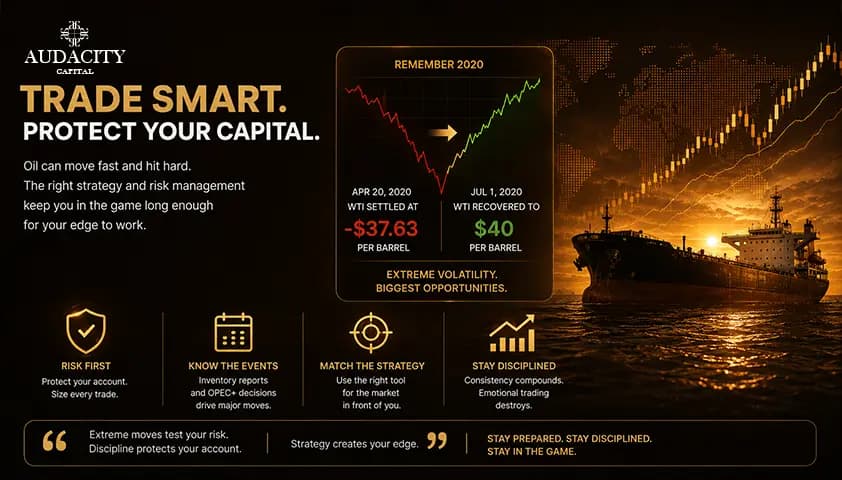
Then something happened that had never happened before. On April 20, 2020, the price of West Texas Intermediate (WTI) crude for May delivery settled at negative $37.63 per barrel. That was the first time oil had ever traded below zero since futures began trading in 1983. Traders holding the expiring May contract were effectively paying others to take the oil off their hands, because they had no way to store it and the contract was about to expire.
The pain was not limited to WTI. The next day, Brent crude, the global benchmark, fell to around $9.12 per barrel, its lowest level in decades.
The recovery, when it came, was steep. OPEC+ agreed to historic production cuts of nearly 9.7 million barrels per day, though those cuts came too late to save April. As lockdowns eased and demand slowly returned, WTI climbed back to around $40 per barrel by July 1, 2020, and held roughly around that level through much of the rest of the year.
Here is the part that often gets lost in the story. The crash was also one of the great opportunities of the decade for traders who read the fundamentals. The negative price itself was a futures expiry quirk tied to the May contract, not a sign that oil was truly worthless. Anyone looking at the bigger picture could see that the world still needed energy, that demand would return once lockdowns lifted, and that OPEC+ had just committed to record supply cuts. The fundamental case for a recovery was strong, even while the panic was at its loudest.
Traders who acted on that read, going long as oil sat in the low teens and twenties rather than trying to catch the negative print, positioned themselves for the move back toward $40 and the extended climb that followed through 2021. This is fundamental trading in its purest form: the crowd was pricing in fear and a temporary storage problem, while the supply and demand reality pointed the other way. The edge went to those with the patience to wait for the dislocation and the risk control to hold the position while it played out.
For traders, the 2020 crash is a permanent reminder of both sides of oil. Tail risk is real and can be brutal. Futures contract expiry and rollover carry their own dangers, since a thinly traded expiring contract can behave in ways the physical market never would. And oversized, poorly managed positions can turn a normal loss into a catastrophic one. But extreme dislocations also create the clearest opportunities, and reading the fundamentals is often what separates the traders who panic from the ones who profit. Both lessons are exactly why discipline and preparation matter more in oil than in almost any other market.
Which Crude Oil Trading Strategy Is Best?
There is no single best crude oil trading strategy because different market conditions require different approaches. A trend-following strategy may perform well during strong directional moves, while range trading is more effective in sideways markets. Likewise, traders who monitor economic data and geopolitical events may prefer a fundamental approach, whereas active day traders often favour breakout or momentum-based strategies.
The table below can help you choose the most suitable crude oil trading strategy based on your trading style and the current market environment.
Strategy | Best For |
|---|---|
Trend Following | Trending markets |
Breakout | News events |
Range Trading | Sideways markets |
Pullback | Swing traders |
Fundamental | Long-term traders |
Scalping | Experienced day traders |
How to Choose the Best Crude Oil Trading Strategy
There isn't a single best crude oil trading strategy for every trader. Trend-following strategies work well in strong directional markets, while range trading is more suitable during periods of consolidation. Traders who closely monitor OPEC decisions and inventory reports may prefer fundamental strategies, whereas active day traders often use breakout or momentum-based approaches. The right crude oil trading strategy depends on your experience, risk tolerance, and preferred trading timeframe.
Trading Oil on a Funded Account
Every strategy above lives or dies on risk management, and that is doubly true when you are trading someone else's capital. On a funded account, your job is not just to win, it is to stay within the rules long enough for your edge to play out.
That means knowing your daily loss limit and your maximum drawdown cold, and sizing every oil trade so that a normal losing streak cannot breach either one. Oil's volatility means position sizing that feels fine on a calmer market can be far too large here. Smaller size, defined stops, and avoiding oversized exposure around scheduled events go a long way.
One thing worth understanding is how your firm calculates drawdown, because it changes how you manage a position. Audacity Capital uses a static drawdown model on its Ability Challenge and Verification stages, where the daily limit is set at rollover based on your balance or equity and does not trail downward through the day. A static model is more predictable than a trailing one, which makes it easier to plan your risk around a volatile market like oil. Rules and figures can change, so always confirm the current limits for your specific program directly with Audacity Capital before you trade.
Key Takeaways
- Crude oil in 2026 has been highly volatile, driven by geopolitics and shifting OPEC+ policy, which creates opportunity but also real risk.
- No single strategy works in every condition. Match the approach to the market, using trend and breakout strategies in moving markets, range strategies in quiet ones, and fundamentals to set your bigger-picture bias.
- Fundamental trading reads the supply and demand picture (OPEC+ policy, output, inventories, demand, the dollar) and suits swing and position traders aiming to capture larger moves.
- Inventory reports (API on Tuesday, EIA on Wednesday) and OPEC+ or geopolitical events are major volatility triggers. Manage size around them or stand aside.
- Pullback and support and resistance strategies tend to fit funded accounts well because they allow tight, defined risk.
- The 2020 pandemic crash cut both ways. WTI settling at negative $37.63 is a lasting lesson in tail risk and contract expiry danger, but the recovery that followed rewarded traders who read the fundamentals and positioned for the move back up.
- On a funded account, staying within your daily loss limit and maximum drawdown matters as much as your entries. Understand your firm's drawdown model and size accordingly.
- Choosing the right crude oil trading strategy depends on your experience, market conditions, and risk management. No single strategy works in every situation, which is why successful oil traders adapt their approach based on trends, volatility, and fundamental events.
FAQ
Oil can be traded by beginners, but it is more volatile than many other markets, which makes risk management essential from day one. New traders are usually better off starting with simpler strategies like support and resistance or pullback trading, on small size, before attempting fast approaches like scalping.
Oil trades nearly around the clock on weekdays, but the most volume and movement usually comes during the overlap of the London and New York sessions, along with the periods around the API and EIA inventory reports. More movement means more opportunity, but also more risk, so match your strategy to the volatility you are willing to handle, and to the hours you can actually trade in your own time zone.
There is no single best strategy, but approaches with tight, defined risk tend to suit funded accounts well, such as pullback trading and support and resistance trading. What matters most is sizing every trade so a normal losing run cannot breach your daily loss limit or maximum drawdown.
A collapse in demand during the COVID-19 pandemic, combined with producers still pumping and storage running out, left traders holding an expiring futures contract they could not offload. On April 20, 2020, WTI for May delivery settled at negative $37.63 per barrel, the first negative price in the history of oil futures.
The EIA and API reports show changes in US crude oil stocks. A larger than expected build (more supply) tends to push prices down, while a larger than expected draw (tighter supply) tends to push prices up. The reaction can be sharp and fast, which is why many traders reduce size or wait until after the release.
OPEC+ remains one of the most important forces in the oil market through its production decisions, but it is not the only one. In 2026, geopolitical events and supply disruptions have played an outsized role alongside OPEC+ policy, which is why traders watch both closely.
Most consistent oil traders use both. Fundamentals (supply, demand, OPEC+ policy, inventories, the dollar) tell you which direction the market is likely to lean over time, while technical analysis helps you time entries and exits and manage risk. The 2020 recovery is a good example of fundamentals pointing the way, with the chart used to enter and control the trade.

Kriptoya disiplinli risk uygulamaya hazır mısınız? Audacity Capital'in yeni kripto enstrümanlarını keşfedin ve ticaret stratejinizi getirin.
Daha Fazla BilgiBülten
Yeniliklerden haberdar olmak için bültenimize katılın.
Sosyal Topluluğumuza Katılın

Bugün Yolculuğunuza Başlayın Ücretsiz Denememizle
Becerilerinizi ve başarılarınızı sertifikalar aracılığıyla gururla sergileyin ve potansiyel yatırımcılardan ve akranlarınızdan sıkı çalışmanız ve özveriniz için takdir alın.
Ücretsiz Denemeİlgili Makaleler

10 Most Profitable Trading Strategies in 2026
Learn the most profitable trading strategies for 2026 and discover how consistent traders use them to qualify for funded trading accounts and grow their capital.


10 Gold Trading Strategies That Actually Work in 2026
Discover 10 proven gold trading strategies for 2026. Learn trend, breakout, range, and scalping techniques to trade gold more confidently and manage risk effectively.

10 Price Action Trading Strategies: Complete Guide 2026
Learn price action trading strategies using support, resistance, and candlestick patterns. Discover real examples, risk management, and proven setups used by professional traders.

Carry Trading Strategy Explained (2026): How It Works + Examples
Learn how the carry trading strategy works in forex with step-by-step guidance, real examples, best currency pairs, and risk management tips to trade more effectively.