



Day Trading Crypto vs Stocks: Which Is Better?



Crypto and stocks can both support a day-trading routine, but they suit different schedules, account sizes and risk tolerances.
Stocks generally offer a more structured session, clearer scheduled catalysts and stronger market safeguards. Crypto offers continuous access and more frequent price movement, but that comes with higher volatility, variable liquidity across venues, and platform or custody risk.
The right answer is rarely universal. It depends on when you can actually sit at the screen, what product you are trading, how much capital you have available, and how strict your risk process is.
Day Trading Crypto vs Stocks: Quick Answer
Stocks are usually the better starting market for traders who want a fixed session, deep liquidity in major names, scheduled catalysts and stronger investor protections.
Crypto on the other hand, may fit traders who need evening or weekend access, want smaller nominal position sizes, and can absorb faster price moves plus exchange-specific risks.
Before the table, one caution. A thin penny stock can be less liquid and more erratic than a major crypto asset, and a mid-cap altcoin can behave more chaotically than either. Always compare the exact instrument, venue and strategy, not the label on the market.
Factor | Crypto day trading | Stock day trading | Practical edge |
Trading hours | 24/7, including weekends and holidays | Defined core session, with limited extended hours | Crypto for access, stocks for routine |
Frequently higher, especially outside majors | Structured by session, calmer in large caps | Depends on tolerance | |
Deep in top assets, thin in smaller tokens | Deep in large caps, thin in small caps | Comparable if matched like for like | |
Spreads and fees | Spread, maker and taker fees, funding, network costs | Commission or zero-commission, spread, data, regulatory fees | Depends on venue and volume |
Price catalysts | Continuous, macro, regulatory, on-chain, social | Earnings, filings, guidance, economic data | Stocks for structure |
Short selling | Available via derivatives on many venues | Available via broker margin, with borrow rules | Stocks for regulated access |
Leverage | High leverage on perpetuals, liquidation risk | Regulated intraday margin, broker-controlled | Stocks for guardrails |
Account rules | Fewer day-count rules on spot, product limits vary | US intraday margin rules apply, in transition | Depends on country |
Safeguards | Vary by venue and jurisdiction | Mature disclosure and surveillance regimes | Stocks |
Trader workload | Continuous monitoring risk | Concentrated session, forced downtime | Depends on lifestyle |
Verdict in two lines: stocks usually win for structure and market protections, while crypto wins for schedule flexibility and continuous access. The better market is the one that fits your tested setup and your risk limit.
First Decide What You Are Actually Trading

Most crypto vs stock day trading comparisons fail because they compare two labels, not two products.
"Crypto day trading" can mean spot assets you actually own, perpetual futures with leverage and funding rates, or crypto CFDs offered by a broker.
"Stock day trading" can mean cash equities, margin shares, stock CFDs or single-stock options.
These products carry different leverage, fees, ownership rights, liquidation mechanics and protections.
For the rest of this article, the default comparison is spot crypto versus cash equities, because that is the cleanest retail baseline.
A spot crypto trader pays a spread and a transaction fee, holds the asset outright, and faces no forced liquidation from borrowed money.
A perpetual-futures trader on the same coin may also pay funding rates and can be liquidated.
A cash-equity trader owns shares and receives statutory protections. A CFD trader holds a contract with the broker instead of the underlying share.
Getting this distinction right prevents sweeping claims such as "crypto has no day-trading rules" or "stocks require twenty-five thousand dollars."
Both statements depend on the product, the account, and the country.
Trading Hours and Daily Routine
Crypto markets run continuously, including nights, weekends and holidays. Equity markets have defined stock market hours, with extended-hours access available through some brokers.
The practical question is not which market offers more opportunities. It is whether you can maintain a repeatable routine inside those hours.
Crypto trade-off.
Continuous crypto market hours suit traders with day jobs or time-zone constraints. There is no natural closing bell, though, which can encourage overtrading, poor sleep and constant chart-checking unless you set a strict session yourself.
Weekend trading is possible, but weekend liquidity can be thinner and news can hit when you are least prepared.
Stock trade-off.
A fixed session concentrates liquidity and scheduled catalysts. It also forces downtime, which many traders eventually recognize as an asset. Extended-hours trading offers flexibility, but spreads and depth can differ from the core session.
Note: Stock exchange hours differ by country. Not every reader trades US equities, so treat the US session as one example, not the default.
Practical action: write down the exact two-hour block you can trade consistently, every day, without disrupting work or sleep. A market that is open when you are tired is not a real advantage.
Volatility, Liquidity and Trade Quality
More movement does not automatically mean a better day-trading market. A useful move must remain tradable after the spread, slippage, stop distance and position size are considered.
Volatility and liquidity work together. Major crypto assets often offer strong liquidity, while smaller tokens can have thin order books, wider spreads and abrupt moves.
Higher volatility can create setups, but it also demands smaller size and wider risk limits. Blanket claims that every crypto asset moves more than every stock that does not survive contact with a large-cap earnings day or a small-cap news gap.
Large, active stocks generally have deep liquidity during the core session. Small-cap, penny and news-driven stocks can be extremely volatile and can face trading halts and circuit breakers or difficult fills at the top of a move.
Compare like with like: liquid majors against liquid majors, and speculative tokens against speculative small caps.
Practical metric. For every instrument you plan to trade, record the average bid-ask spread and slippage, typical one-minute range, session volume and the stop distance your strategy actually needs. The instrument with the larger headline move may still offer the worse net setup.
One language correction worth internalizing. Stock sessions and catalysts are more structured. Price direction, in any market, is never predictable.
Trading Costs: Stocks Can Be Commission-Free, Not Cost-Free
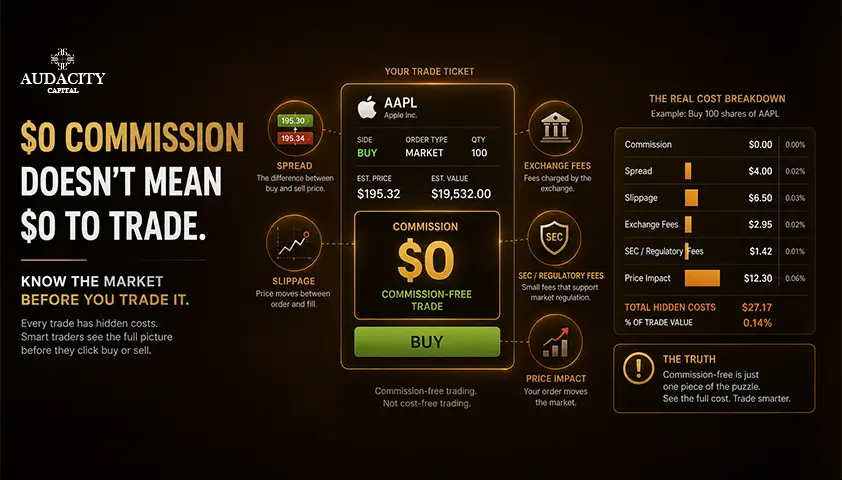
Compare the entire cost stack, not the label on the commission line.
Zero-commission stock trading does not remove spreads, price-improvement differences, margin interest, short-borrow costs, market-data charges or regulatory fees.
Crypto trading can include maker and taker fees, spreads, funding rates on perpetuals, withdrawal charges and blockchain network fees.
Neither market is universally cheaper. Costs vary by venue, account tier, product, order type, monthly volume and whether you add or remove liquidity.
For example: imagine a hypothetical round trip on a two thousand dollar position. A ten basis-point total cost, including spread and fees, is two dollars per trade, or eighty dollars across forty round trips in a month.
On a scalping strategy that targets small edges, that friction can quietly consume the entire expectancy.
Practical action: export thirty days of fills from your broker or exchange, sum every fee, spread and slippage estimate, and divide the total by gross profit.
That single number tells you whether the strategy has an edge after friction, regardless of how attractive the raw price action looks.
Account Size, Margin Rules and Access in 2026
Crypto is often easier to access with a small nominal balance and fractional position sizes. Stock day trading can also support fractional shares, but margin, settlement, short-selling access and broker-level controls can restrict frequent trading.
US update on the PDT rule in 2026. FINRA has adopted new intraday margin requirements effective June 4, 2026, with a permitted broker transition period through October 20, 2027.
During that transition, some firms may still apply the previous pattern-day-trader framework, while others may move earlier to the updated standard.
The PDT rule in 2026 is best understood as a moving target at the broker level, so check your brokerage's current treatment before assuming any specific dollar threshold applies to your account.
The older shorthand that every US stock day trader must hold twenty-five thousand dollars does not accurately describe the transition period. Treat any specific number as broker-confirmed, not universal.
Outside the US, pattern-day-trader rules are a US securities-margin issue. Other jurisdictions and other products follow different rules. Crypto derivatives can carry their own eligibility, leverage caps and geographic restrictions.
Access checklist: account minimum, cash or margin, intraday buying power, settlement rules, short availability, leverage, liquidation terms, country eligibility.
What Moves Prices During the Trading Day?
Stock and crypto trading vs stock trading routines reward different research habits.
Stock traders can build a schedule around earnings releases, guidance updates, filings, analyst actions, economic data prints and scheduled market events. Company disclosures are standardized, which makes preparation easier to routine.
Crypto traders track macro news, regulatory decisions, token-specific events, exchange flows, funding, liquidation cascades and on-chain activity. Prices react continuously, including outside your planned session.
That is a feature for some traders and a source of stress for others.
One note on data. On-chain metrics and social sentiment are context, not signals. Use them to understand positioning, not to predict the next candle.
Trader-fit question: do you prefer a scheduled morning preparation process, or can you monitor a continuous market and still enforce a hard stop time?
Risk, Safeguards and What Can Go Wrong
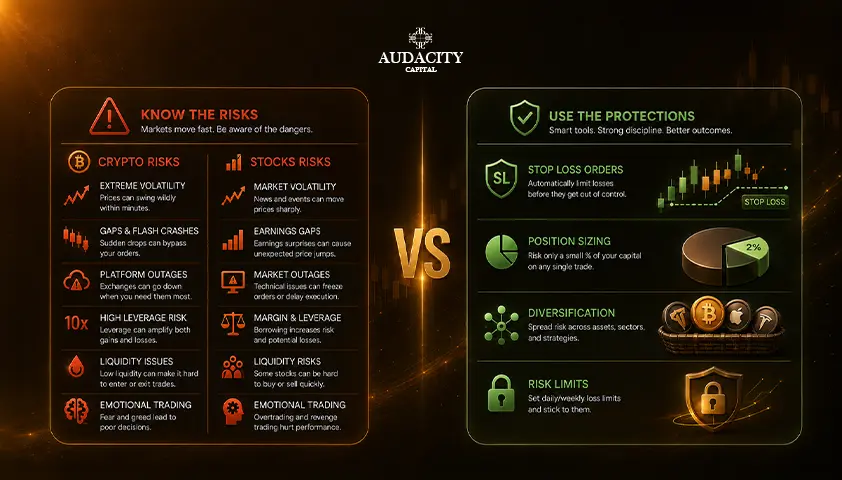
Both markets can produce rapid losses. The risk types differ.
Stock traders face gap risk over holds, margin risk when leveraged, short selling and leverage risks such as squeezes, corporate actions, halts and company-specific events. Regulated stock markets generally provide mature disclosure, surveillance and intermediary frameworks. That is a meaningful structural advantage, but it is not a guarantee that any single trade or account cannot lose money.
Crypto traders add exchange and custody risk, hacks, token concentration, thin liquidity in smaller assets, forced liquidations on leveraged products and fragmented regulation across jurisdictions. Protections vary widely by product and country.
Circuit breakers versus continuous trading is a genuine structural difference, not a ranking. Stock halts can interrupt execution during extreme moves, which sometimes protects and sometimes traps a trader.
Crypto markets tend to keep trading through sharp moves, although individual venues can pause, freeze withdrawals or fail. Neither mechanism is automatically better.
A more volatile market should not be paired with larger leverage simply because the account allows it. Liquidation math amplifies losses quickly, and adverse moves in continuous markets can occur while you sleep.
Day trading risk management checklist: maximum loss per trade, daily stop, position-size rule, venue risk assessment, withdrawal plan, two-factor security setup, and a written plan for what you will do during an outage.
Which Market Fits Your Trading Style?
Instead of declaring one market the winner, use a trader-fit matrix.
Stocks may fit better when you can attend a fixed session, prefer scheduled catalysts, want deeper liquidity in major names, value a natural end to the day, and can meet the account and data requirements of the market you choose.
Crypto may fit better when you need evening or weekend access, are comfortable with continuous markets, understand venue and custody risk, can handle wider moves with smaller position sizes, and have calculated all recurring fees including funding.
Neither may fit when you cannot follow a daily loss limit, need trading income immediately, are using borrowed or essential living money, cannot stop after a losing streak, or have not tested a strategy after costs.
Both may fit when an experienced trader runs separate playbooks, separate risk limits and separate sessions for each market. Switching markets simply because one is quiet often turns selective trading into overtrading. That is not diversification, it is boredom management.
Decision matrix rows to score yourself against: schedule, capital, volatility tolerance, preferred catalysts, fee sensitivity, research style and need for investor protections.
A Practical Test Before Choosing Crypto or Stocks
Before committing real capital, run a seven-day paper-trading comparison. The goal is to measure process quality, not simulated profit.
Step 1: Choose one liquid crypto instrument and one liquid stock instrument. Apply the same setup rules and the same maximum dollar risk to each.
Step 2: Trade only during a fixed two-hour window that matches your real schedule. Ignore the 24/7 crypto market outside that window.
Step 3: Record spread, fees, slippage, stop distance, number of valid setups and time spent monitoring.
Step 4: Log process mistakes: late entry, revenge trade, missed stop, fatigue, rule change or forced exit.
Step 5: Compare net expectancy after costs, average risk per setup, and how easily you were able to stop for the day.
Step 6: Check account and product rules for your country, including margin, shorting, leverage and tax reporting.
Step 7: Choose one market for a longer testing block. Do not fund both accounts simply because both produced a winning week.
Paper-trading results do not guarantee live performance. Execution quality, psychology and real costs behave differently with actual money on the line.
Conclusion
Stocks generally suit traders who want structured sessions, clearer scheduled information and mature safeguards. Crypto suits traders who need flexible hours and can manage continuous volatility, variable liquidity and venue risk. Neither market is better without a tested strategy, a full understanding of costs and a strict risk plan.
Run one liquid instrument from each market through a fixed paper-trading window. Choose the market in which you followed your rules more consistently after costs. That is a more useful answer than any generic comparison. If you want a disciplined path to trading larger size after you have proven consistency, structured evaluation programs such as the Ability Challenge, Ability One and the Instant Funding at Audacity Capital exist for that purpose.
Related Article
Frequently Asked Questions
Stocks often provide more structure for beginners, with scheduled sessions, standardized company disclosures and mature safeguards. That said, the right choice depends on your country, your available capital and the specific product you plan to trade. A liquid large-cap stock and a liquid major crypto asset are both more forgiving than illiquid alternatives in either market.
You can usually access crypto with a smaller nominal balance and use fractional position sizes on most venues. Stock brokers also support fractional shares, but intraday margin rules can restrict frequent trading in some jurisdictions. Small capital is a starting point, not a strategy edge, so focus first on risk per trade rather than account size.
The pattern day trader rule is a US securities-margin rule and does not apply to spot crypto. For US stock accounts, FINRA has adopted new intraday margin requirements effective June 4, 2026, with a broker transition period through October 20, 2027. Confirm the exact treatment with your broker, because firms may apply the old or new framework during that window.
Neither market guarantees better results. Profitability depends on strategy, execution, costs and discipline, not the market label. Higher volatility can create larger moves and larger losses in the same session.
There is no universal winner. Compare the full cost stack, including spread, commissions or maker and taker fees, funding rates on perpetuals, market-data charges, borrow costs and network or withdrawal fees. Your venue, product, volume tier and order type usually matter more than the market you choose.
Some brokers offer extended-hours trading before and after the core session, but spreads and depth can differ from regular hours. Weekend equity trading is very limited in most markets. If your schedule only allows evening or weekend trading, crypto's continuous hours will fit more naturally, provided you accept the trade-offs.
Experienced traders can trade both if they use separate tested playbooks, separate risk limits and separate sessions for each market. What usually backfires is switching between markets whenever one feels quiet, which tends to increase overtrading. Prove consistency in one market first, then add the second only when your process is stable.
Bülten
Yeniliklerden haberdar olmak için bültenimize katılın.
Sosyal Topluluğumuza Katılın

Bugün Yolculuğunuza Başlayın Ücretsiz Denememizle
Becerilerinizi ve başarılarınızı sertifikalar aracılığıyla gururla sergileyin ve potansiyel yatırımcılardan ve akranlarınızdan sıkı çalışmanız ve özveriniz için takdir alın.
Ücretsiz Denemeİlgili Makaleler

Why Is Pattern Day Trading Illegal? (It Is Not, and the Rule Is Gone)
Why is pattern day trading illegal? It never was. Learn what the old PDT rule required, what changed in 2026, and what traders need to know now.

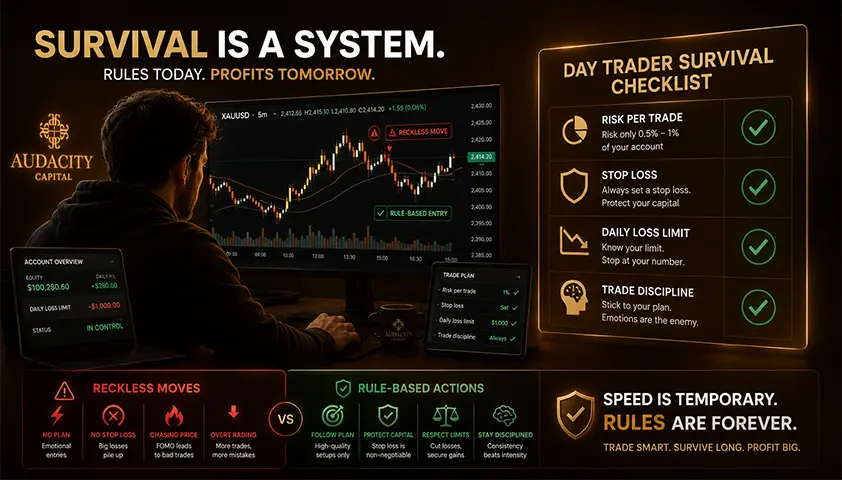
Day Trading Tips: The Rules That Actually Decide Whether You Survive
Practical day trading tips ordered by what actually matters. Risk rules, discipline, execution, and the 2026 pattern day trader change explained honestly.
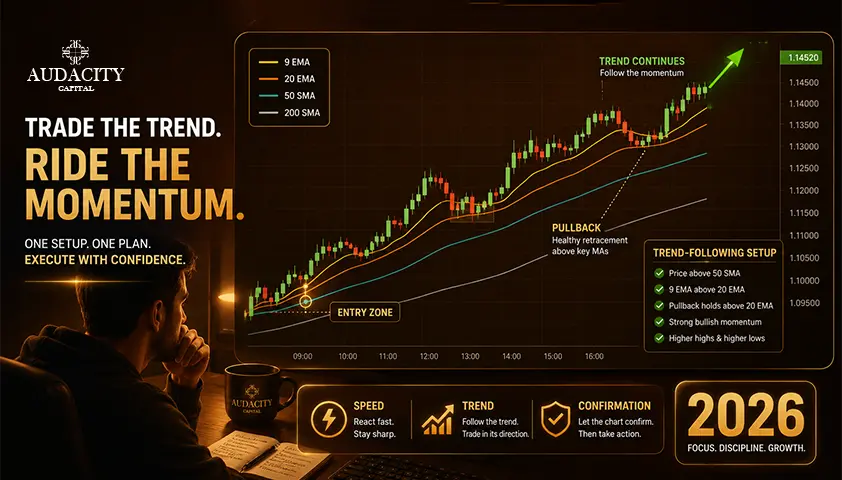
Best Moving Average for Day Trading in 2026
Compare the 9, 20, 50 and 200 moving averages for day trading, when each works best, and how to avoid lag, noise and false signals.

How to Create a Day Trading Risk Management Plan?
Build day trading risk management strategies with daily loss limits, position sizing rules, drawdown controls, and a practical trading checklist.