


Prop Trading Business Model: How It Works (2026)



In short - The prop trading business model is simple at its core: a firm gives skilled traders access to its capital, usually through a paid evaluation, sets strict risk rules, and shares the profits. Modern retail prop firms make money mainly from evaluation fees and a cut of the profits their funded traders generate. Understanding how prop firms make money tells you why the rules are strict and what to look for before you join one. |
What Is the Prop Trading Business Model?
A proprietary trading firm trades with its own money rather than managing money for clients. The prop firm business model extends that idea to independent traders: instead of hiring you, the firm lets you prove your skill on a simulated account, and if you pass, it backs you with its capital and pays you a share of what you make.
Your personal risk is limited to a one-time evaluation fee. You never deposit a large trading balance, and you are not liable for trading losses beyond that fee. In return, the firm keeps a slice of the profits and the structure that surrounds you, the platform, the rules, the risk monitoring, is the product you are really paying to access.
“Prop trading” covers two related but different models. The first is the traditional institutional desk, where banks and specialist firms hired experienced traders and handed them the firm's capital and infrastructure. The second, and the one most people mean today, is the retail prop trading business model: a remote, challenge-based firm that any trader can apply to, pay an evaluation fee, pass a simulated test, and receive a funded account.
The retail model took the structure of the old desks, professional capital and strict risk control, and opened it to traders worldwide. The funded account is the product, and the evaluation is the filter that decides who gets one.
How Prop Firms Make Money (Revenue Sources)
This is the part most guides skip. A prop firm is a business with several income streams, not just trading profits. Here is where the money actually comes from:
- Evaluation and challenge fees. For most retail firms this is the primary revenue source. Traders pay an upfront fee to attempt the challenge, and because only a minority pass, these fees add up across thousands of attempts.
- Reset and retry fees. Traders who breach a rule often pay to restart, which adds a recurring layer of revenue on top of the first attempt.
- The firm's share of trading profits. When a funded trader earns, the firm keeps its portion of the profit split (the trader typically keeps 70% to 90%). This is real but secondary for most firms, because relatively few accounts reach large, sustained payouts.
- Copying consistent traders to live markets. Many firms mirror the positions of their most reliable funded traders into real markets, earning on those trades alongside the trader. A genuinely profitable trader becomes an asset, not a cost.
- Ancillary income. Some firms also earn from platform or data add-ons, spreads or commissions, and scaling-related fees.

Put together, this diversified mix is what lets prop firms offer large account sizes at scale without betting the business on any single trader.
Check a detailed guide about How Do Prop Firms Make Money?
Do Prop Firms Only Make Money When Traders Lose?
It is the loudest myth about the prop firm business model, and the honest answer is: not if the firm is built well. It is true that evaluation fees are a major revenue source and that most candidates do not pass, so failed attempts do fund the business. But a firm that depended purely on people failing would be fragile and short-lived.
Reputable firms want consistent, profitable traders, because those traders can be scaled, copied into live markets, and kept for the long term. The strongest firms are built on trader longevity and clear rules, not churn. A useful way to judge any firm is to ask whether its incentives are aligned with yours: does it reward consistency and pay reliably, or does it rely on aggressive marketing and high failure rates?
Profit-Split and Scaling Models
The profit split is the headline number traders compare, and it usually runs from 70% up to 90% in the trader's favour, sometimes rising with performance. On top of the split, most firms add a scaling plan: hit defined profit milestones while respecting the rules, and your account size, and your earning potential, grows in steps. These profit share models are how firms reward the traders who prove they can perform without breaching risk limits.
A Short History: When Did Prop Trading Firms Start?

Proprietary trading is far older than the challenge model. For decades it lived inside banks and specialist firms, where traders worked on physical desks, used the firm's capital, and were watched closely by risk managers. After the 2008 financial crisis, the Volcker Rule restricted banks from much of this speculative trading, which pushed proprietary trading out of the banks and into independent, technology-driven firms.
The electronic era replaced trading pits with screens, fast execution, and data-driven methods. Then, through the 2010s, the remote retail challenge model emerged and grew quickly, giving traders anywhere the chance to access firm capital through an online evaluation. Audacity Capital has operated in this space since 2012, through the shift from in-person desks to remote, rules-based funding.
Crypto Prop Firms: The Same Model, a New Market
The crypto prop trading business model works the same way as forex or futures: pass an evaluation, trade the firm's capital under set rules, and keep a profit split. The main difference is the market itself. Crypto trades around the clock and moves faster, so drawdown and risk rules tend to matter even more, and firms may adjust limits to account for higher volatility. As demand has grown, more firms, Audacity among them with its newer crypto instruments, now offer crypto-focused funded accounts.


Audacity Capital Empowering Traders Since 2012
Join the Prop FirmIs the Prop Firm Business Model Legit and Sustainable?
Yes, it is a real and established model, but quality varies, so a little due diligence goes a long
way. Before you pay for any challenge, check a few things: does the firm have a verifiable payout track record, are its rules and drawdown limits clearly published, are the profit targets realistic rather than designed to make almost everyone fail, and does it operate through proper legal entities? A firm built on transparent rules and long-term traders is far more sustainable than one that relies on a constant churn of failed attempts.
Where Audacity Capital Fits
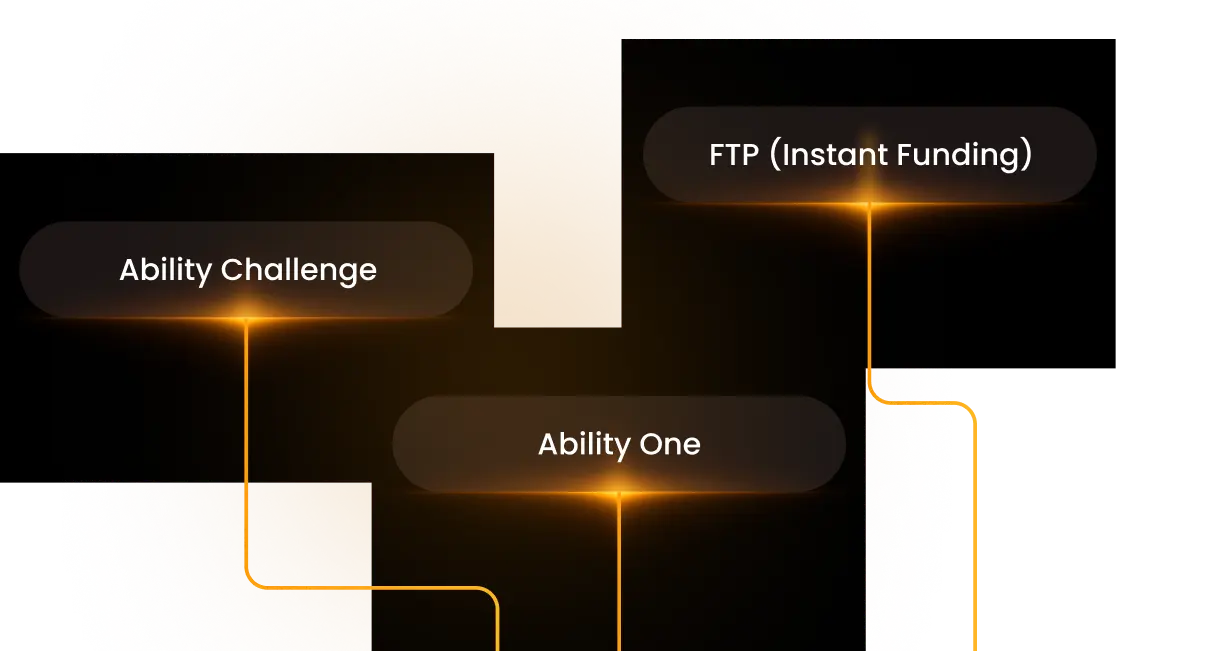
Audacity Capital runs the retail funded model with a focus on transparency. You choose an evaluation route, Instant Funding, One Step, or Two Step, prove your skill on a simulated account, and keep up to 90% of the profit you generate, with a scaling plan that grows your account as you stay consistent. There are no interviews or qualifications; the rules are the same for everyone.
Worth being clear about how it works: the capital is simulated and payouts are real, and the model rewards discipline rather than offering a shortcut. Trading carries significant risk, most retail traders lose money, and the evaluation is a skills test, not a guaranteed path to profit, so it is best attempted once your strategy is proven. If that fits where you are, explore the Funded Trader Program or test your skills first in the free trading competition.
Audacity's Funded Trader Program
Start Trading ProgramRelated Articles
Check About Audacity's Free Pop Firm Challenge
Read more about What Is Prop Trading?
Read more about prop trading platforms
Learn mor about How Prop Trading Firms Work
Read more about Prop Trading Challenges and Rules
Click here to learn more about How Traders Get Funded?

Prop Trading Challenges
Free Prop Firm ChallengeFrequently Asked Questions
Most of their revenue comes from evaluation and reset fees rather than the profit split, since only a minority of traders pass and reach payouts. Firms also earn their share of funded-trader profits and may copy consistent traders into live markets.
Many retail firms run the evaluation, and often the funded stage, on simulated capital under live market conditions, while paying out real profits. This lets them offer large account sizes with risk capped at the fee you pay.
The remote, challenge-based model grew through the 2010s, after the Volcker Rule pushed proprietary trading out of banks and technology made online evaluations practical for traders anywhere.
Well-run firms are, because they earn from several streams, evaluation fees, the profit split, copied trades and add-ons, rather than relying on any single one. The most durable firms are built around long-term, consistent traders.
A broker executes your trades using your own deposited money and earns from spreads or commissions. A prop firm funds you with its capital after an evaluation and earns a share of the profits you generate.
The origin of the prop firms can be traced back to the ‘golden era’ of family-run organizations when the U.S. began deregulating the financial markets.
It started with in-house funding and local edges before shifting to the electronic era, characterized by multiple screens and faster speeds, to today’s challenge-based systems.
Look for a verifiable payout history, clearly published rules and drawdown limits, realistic profit targets, and proper legal entities. Transparency about how the firm operates is the strongest signal.
The rules protect the firm's capital and filter for disciplined traders. Daily loss limits, drawdown caps and profit targets are designed to identify traders who can manage risk consistently.
Because it provides immediate access to a larger capital allocation while minimizing the risk to the trader’s own funds.
The best strategy to pass a challenge and become a funded trader is to follow the rules strictly and to have clear support/resistance levels.
Some of the key features of a trader-funded challenge include evaluation phases, profit targets, risk management rules, and a virtual trading environment.

Kriptoya disiplinli risk uygulamaya hazır mısınız? Audacity Capital'in yeni kripto enstrümanlarını keşfedin ve ticaret stratejinizi getirin.
Daha Fazla BilgiBülten
Yeniliklerden haberdar olmak için bültenimize katılın.
Sosyal Topluluğumuza Katılın

Bugün Yolculuğunuza Başlayın Ücretsiz Denememizle
Becerilerinizi ve başarılarınızı sertifikalar aracılığıyla gururla sergileyin ve potansiyel yatırımcılardan ve akranlarınızdan sıkı çalışmanız ve özveriniz için takdir alın.
Ücretsiz Denemeİlgili Makaleler

Best Local Payment Methods for Forex Prop Trading
Compare the best local payment methods for forex prop trading by region and learn faster, cheaper prop firm withdrawals with fewer delays.

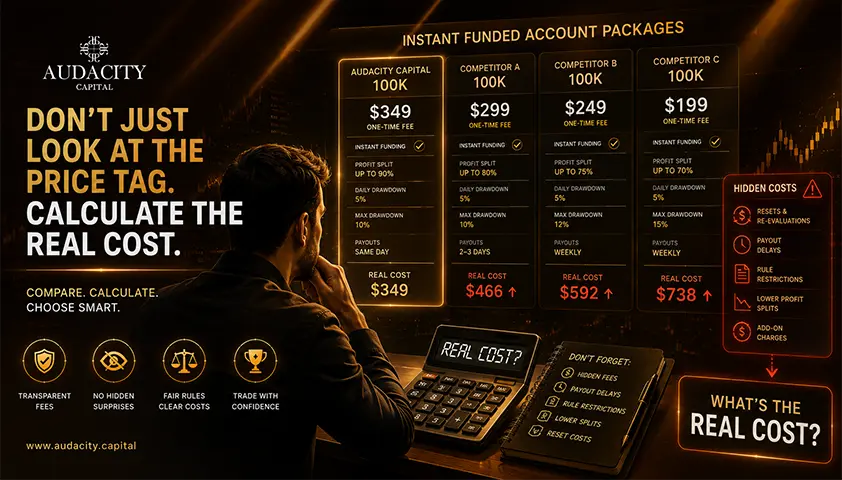
How Much Does an Instant Funded Account Cost?(2026 updated)
Sticker price tells only half the story. See what an instant funded account cost really covers, why it runs 2 to 3x a challenge, and if it's worth it.

Are Funded Accounts Legit? An Honest, Balanced Answer
Some funded account firms are real, some are scams. Find out if funded accounts are legit, how to spot a payout-denying firm, and what to check before you pay.
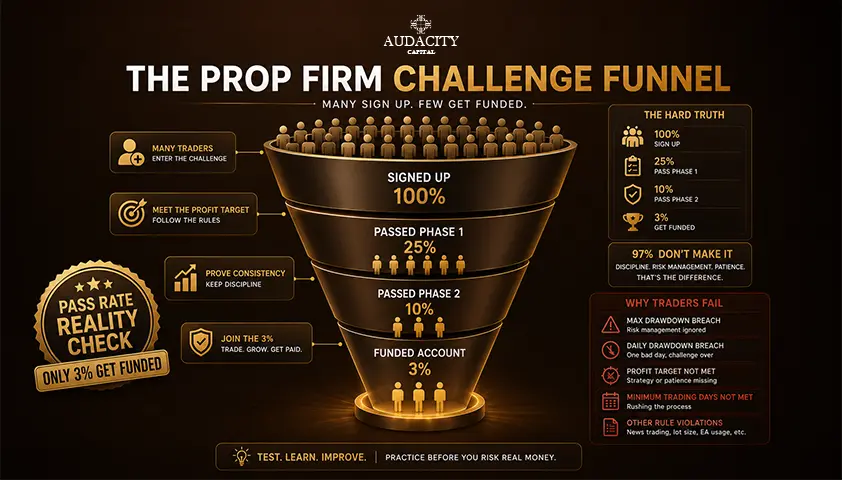
Prop Firm Pass Rate: What Percentage Actually Get Funded?
Learn the real prop firm pass rate, why estimates vary, how many traders get funded, and what the data says about payouts and repeat attempts.