


What Is Risk to Reward Ratio in Prop Trading?


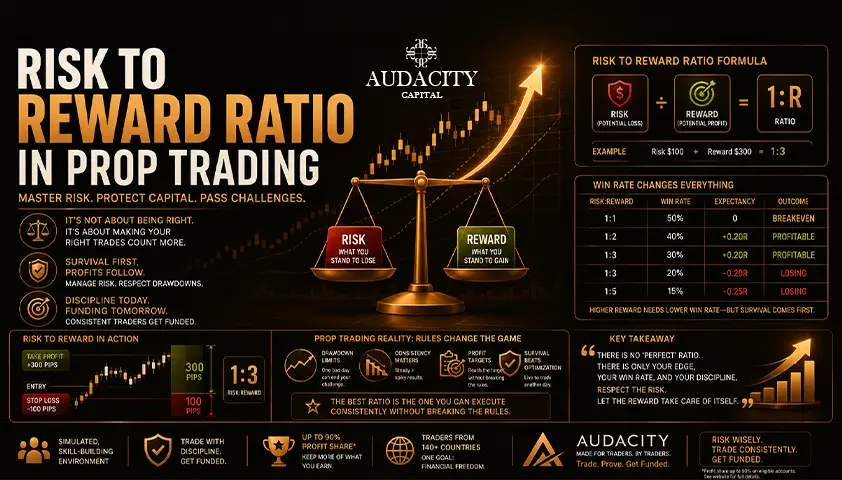
Risk to Reward ratio is a measure of how much you lose on a trade to how much you want to gain.
When you risk 1 unit to make 2, your ratio is 1:2. That is the whole idea.
The issue here is that this one figure is the most cited and least understood stat there is in trading, and the chase for the "perfect" ratio without any comprehension of underlying math is how many traders lose their accounts.
Here is the cold hard truth: a “good” ratio, by itself, has little meaning. It is relevant solely as a tool used together with win rate, which represents the percentage of profitable trades.
In prop trading it's not a profit switch. It's a survival tool that is directly tied to your firm's drawdown limits. Optimize it without taking drawdown parameters into consideration, and you'll be dead in the water before getting even close to turning a profit.
In this guide we'll cover
- what the Risk to Reward Ratio is,
- the Risk to Reward Ratio formula,
- how to calculate Risk to Reward Ratio,
- what is considered a "good" ratio,
- Why win rate is the final line of success,
- and how the Math changes within a Funded challenge.
There are two important things you should know before we start; most retail traders lose money, and most challenge attempts fail.
No ratio changes that and nothing here is a profit promise. All examples below are to be considered as learning and not financial advice or a recommendation of a strategy.
What is the risk to reward ratio?
The ratio is a comparison of two distances on your chart.
Risk is the distance between entry and stop loss – this is where you believe the trade is wrong and you exit. That’s the distance you lose if the trade moves against you.
Reward is the distance between the entry and the take profit level where you close in profit. That's the distance you'll make if the trade is a success.
The risk to reward ratio simply sets one against the other. When you bet 1 unit for 2, you're getting a 1:2 trade.
Now the largest source of confusion. You will notice the same trade written in 2 different ways::
- Risk to reward, written 1:2, means "risk 1 to gain 2."
- Reward to risk is written 2:1, which is interpreted as "gain 2 for every 1 at risk.
They talk about the same trade. The numbers simply look upside down because the order is reversed.
Hence, two articles can cite seemingly conflicting figures and both be correct. For consistency, this guide expresses the trade in terms of risk to reward (for instance, 1:2 or 1:3), and uses the reward to risk number (the single multiple, like 2 or 3) when performing the survival and expectancy math, since that is the figure those formulas need.
Another tip: The ratio can be expressed in dollars, pips, points or% terms. The unit is not important as long as risk and reward both use the same unit.
The risk to reward ratio formula (and how to calculate Risk to Reward Ratio)
The formula for risk reward ratio is very simple:
Risk = Entry price − Stop loss price
Reward = Take profit price − Entry price
Reward-to-risk = Reward ÷ Risk
Express as risk to reward = 1 : (Reward ÷ Risk)
The vertical bars indicate "absolute value" which means disregard the minus sign and take the actual distance. This maintains the same math for long and short trades.
Here's how to calculate risk to reward ratio step by step:
Step 1: Make note the entry price.
Step 2: Set your stop loss and take profit based on your setup and NOT the ratio that you want.
Step 3: Estimate the risk (distance from entry to stop).
Step 4: Measure the reward (distance from entry to target).
Step 5: Divide reward by risk to get the reward-to-risk multiple.
Step 6: Write it as a risk to reward ratio (1 to that multiple).
An example, long trade
You go long at 100.00. Your stop sits at 98.00 and your target at 106.00.
- Risk = 100.00 − 98.00= 2.00
- Reward = 106.00 − 100.00 = 6.00
- Reward ÷ Risk = 6.00 ÷ 2.00 = 3
- Risk to reward = 1:3 (reward to risk = 3:1)
Worked example, short trade
You go short at 100.00. Your stop sits at 101.50 and your target at 95.50.
- Risk = 100.00 − 101.50 = 1.50
- Reward = 95.50 − 100.00 = 4.50
- Reward ÷ Risk = 4.50 ÷ 1.50 = 3
- Risk to reward = 1:3 (reward to risk = 3:1)
Same ratio, mirrored direction. The absolute-value approach is the reason why it does not matter the direction of the trade.
Trade | Entry | Stop | Target | Risk | Reward | Ratio |
Long | 100.00 | 98.00 | 106.00 | 2.00 | 6.00 | 1:3 |
Short | 100.00 | 101.50 | 95.50 | 1.50 | 4.50 | 1:3 |
Most charting platforms will do this for you. As you drag the stop and target levels, the ratio is automatically calculated by the long and short position tools from the MetaTrader 5, DXTrade and TradingView platforms.
Two practical notes. Each distance is divided by the entry price to get %ages. Always consider the cost of trading in the risk: spread, commission, and slippage, these will enhance the real risk and lower the real reward.
If you're trading intraday, you could be leaving out the costs that accumulate and start to make your 1:2 become 1:1.5 without you even realizing.

What is a good risk to reward ratio?
The straight answer is: it depends on how good your win rate and strategy are.
You will see 1:2 or 1:3 quoted as a "minimum." Those baselines are there to allow you to be wrong fairly often and still be profitable. They are said to be good starting points. They are not laws.
So what is a good risk to reward ratio in trading?
A ratio is only 'good' when it is within your actual Win Frequency. There is also a negative correlation that you cannot escape from: the higher the rewards, the farther away your targets will be from your entry, and the less frequently the price will reach there, making your chances of winning less.
The lower reward targets are closer, hit more frequently but pay less per hit. You're always playing against the frequency of wins versus the size of the wins.
For a rough and ready comparison, many funded traders operate at about 1:2 ratios and have 40-50% success rates.
It's a good place to start testing, but not a suggestion or a promise of anything. The next thing we're looking at will be what makes you succeed or fail in making money.
Why risk to reward means nothing without your win rate
This is the part that most internet “guru rules” don't talk about.
The ratio alone doesn't tell you anything about whether you are successful in making money. You will need to pair it with your "win rate" in order to get your expectancy, which is your average expected outcome per trade.
The actual standard is expectancy. The ratio is just one of its two inputs.
So here's the myth buster. The rule of "You must use 1:2" on its own is incorrect.
A 1:2 ratio with 20% win is still a money loser! Out of 10 trades: 8 losers at 1 unit each is minus 8, and 2 winners at 2 units each is plus 4.
Net result: minus 4 units. The "good" ratio costs you money because the win rate is not high enough to cover it.
To find out how often you need to win at a given ratio, use the break even win rate formula:
Break even win rate = 1 ÷ (1 + reward-to-risk)
Reward-to-risk | Risk to reward | Breakeven win rate |
1 | 1:1 | 50% |
1.5 | 1:1.5 | ~40% |
2 | 1:2 | 33.3% |
3 | 1:3 | 25% |
4 | 1:4 | 20% |
In general, the more the reward-to-risk ratio, the lower the win percentage needed to break even.
But remember, it's an inverse relationship. When you push for 1:4, your required win rate drops to 20%, but your real win rate drops, as well, because the further away the targets are the less likely they are to be hit.
They move against each other. And now comes the expectancy equation:
Expectancy = (reward-to-risk × win rate) − (1 × loss rate)
With a 2:1 reward-to-risk ratio and a 60% win rate:
(2 × 0.60) − (1 × 0.40) = 1.20 − 0.40 = 0.80
This amounts to an average profit of 0.80 units per trade risked, before any cost deductions. Let us then apply the same 60% win rate to 1:1:
(1 × 0.60) − (1 × 0.40) = 0.60 − 0.40 = 0.20
Still positive, but considerably reduced and when spread, commission and slippage are deducted, what was small could just about break even.
The whole idea is to optimize the ratio and max win rate simultaneously to have positive expectancy. One without the other tells you nothing.
And a positive expectancy on paper does not guarantee a profit in reality when variance, costs and actual execution become a factor.

Risk to reward ratio in prop trading: why survival beats optimization
This is where prop trading comes into play.
In the case of a regular trading account, all that you need is a positive expectancy on sufficient trades.
However, in case of funded accounts or prop firm challenges, there is a second and even tougher constraint. You should outlast the drawdown restrictions of the prop until you develop your edge.
Most companies have a daily drawdown (maximum loss per day) and a maximum drawdown (a maximum loss floor for the account sometimes trailing).
The second constraint is opposite of the first one. The low-win-rate, high-ratio method is designed such that it generates long consecutive losses.
But eventually there are some big wins; the problem here is that the variance could take out the drawdown floor first and destroy the account before anything.
The expectancy value of the second approach might be higher than the first, however a 1:1 ratio at 60% probability returns you much more than a 1:3 ratio at 35%.
Strategy A | Strategy B | |
Risk to reward | 1:1 | 1:3 |
Win rate | 60% | 35% |
Equity curve | Smooth, frequent wins | Choppy, long losing runs |
Theoretical expectancy | Lower | Slightly higher |
Drawdown survival | Strong | Fragile |
Likely outcome in a capped account | Survives | Can breach before a winner lands |
In a "drawdown-capped" account, A would be more likely to survive than B. The market doesn’t have a duty to provide you with your winners as promised. And the drawdown limit isn’t waiting either.
Another concept worth understanding: Trailing versus end-of-day drawdown.
Usually, an end-of-day limit is established when you come to a closing balance. Some trailing drawdown models follow your highest equity level, while others use different calculations. Always review your firm's specific rules.
When you win you give a little back, and you might have the floor moved under you. Always know what type of account you have.
The simple practical rule is to estimate the worst realistic losing streak that you can have, and then set your per-trade risk to ensure that your losing streak never exceeds that level.
Survival first. Optimization second.
Each firm will have a different drawdown, always check the actual drawdown of your account before sizing.
Using risk to reward to stay funded and pass a challenge
Now the practical challenge math.
Many prop firm evaluations use profit targets in the range of 5% to 10%, although requirements vary between firms and programs.
The method used to connect the ratio and those limits is called position sizing: risking a small, fixed percentage per trade keeps a normal losing streak within the floor.
For this reason, many traders opt for a 0.5% to 1% per trade. This is illustrative and not a recommendation.
Here is a clearly hypothetical, simulated walkthrough:
- Profit target: 8% to 10%
- Daily drawdown: 5%
- Maximum drawdown: 10%
- Risk per trade: 1%
- Reward-to-risk: 1:2
- Win rate: roughly 45% to 50%
If the risk is 1%, and the reward is 1:2, then the winnings are around 2% and the losses are around 1%.
Your net gain is positive with a win rate around 50%, so you can achieve a target of 8 to 10% by stacking small net gain trades over a series of sessions instead of swinging for it in a single session.
Survival-wise, five consecutive 1% losses would result in a 5% drawdown, which remains within the example maximum drawdown limit.
That's the whole point of small and fixed sizing.
Profit target | Daily drawdown | Max drawdown | Risk/trade | Reward-to-risk | Win rate |
8–10% | 5% | 10% | 1% | 1:2 | 45–50% |
This example is provided for educational purposes only. It does not guarantee challenge success, profitability, or future performance. All figures are hypothetical and should not be interpreted as trading advice
The discipline is up to you.
Common risk to reward mistakes in prop trading
Most account failures trace back to a short list of avoidable errors. Watch for these:
1. Chasing an unrealistically high ratio. Targets set so far away that the win rate collapses and the streaks become unsurvivable.
2. Ignoring win rate entirely. The meaningless-ratio trap. A great ratio at a weak win rate still loses.
3. Moving or widening the stop to avoid a loss. This quietly turns a 1:2 into a 1:1 or worse and eats straight into your drawdown.
4. Over-risking per trade. One ordinary losing streak then breaches the limit.
5. Revenge trading after a loss. One of the most common causes of account breaches. It has nothing to do with the ratio and everything to do with you.
6. Forgetting costs. Spread, commission, and slippage shrink your real reward and widen your real risk.
7. Recalculating after entry. Cherry-picking a better-looking ratio once you are in, instead of fixing it before you click.
8. Forcing a fixed ratio onto a setup that cannot support it. Take what the chart actually offers, not what your rule demands.
Risk management is a behavior problem, not a math problem
By now you have noticed something: the math is the easy part. The formula fits in one line. The breakeven table fits in a few rows.
Anyone can learn it in an afternoon.
But doing it consistently when fear, greed, or frustration take over is the hard part.
That is why most challenge attempts fail. Not because the ratio was wrong, but because the trader stopped following their own plan: they widened a stop, doubled their size to "win it back," or held past their target out of greed.
The edge is not the ratio. The edge is disciplined execution: pre-defined risk, stops you actually honor, small consistent sizing, and the patience to not chase.
That discipline is precisely what a prop firm's evaluation is built to test, and it is what keeps a funded trader funded.
FAQ
It is a useful guideline, not a rule. The ratio only matters alongside your win rate, and some consistent traders use 1:1 with a high win rate. What matters is positive expectancy, not hitting a specific number.
It is possible if your reward is large enough that your winners outweigh frequent small losers, but only if variance does not breach your drawdown first. In a capped funded account, a high-ratio, low-win-rate approach is harder to survive than the raw math suggests. There are no guarantees either way.
Many work around 1:2 with a 40 to 50% win rate as a balanced starting point. It varies widely by strategy, instrument, and timeframe, and it should be tested rather than copied.
Tighter drawdown generally favors a more conservative ratio paired with smaller per-trade risk, so a normal losing streak stays inside the limit. The goal is to survive variance long enough for your edge to show.
Not necessarily. Forcing a target onto a setup that cannot support it is usually worse than taking what the chart offers. Consistency of process matters more than a fixed number.
Many traders use 0.5 to 1% so a normal losing streak stays well inside the daily and maximum drawdown. This is illustrative, not advice, and the right figure depends on your strategy and your account's rules.
Yes. Costs widen your effective risk and shrink your reward, which matters most on tight intraday trades where the spread is large relative to your stop distance. Leaving them out flatters your ratio.
The ratio measures the size of your wins versus your losses. The win rate measures how often you win. You need both together to know your expectancy, which is what actually determines results over time.

Kriptoya disiplinli risk uygulamaya hazır mısınız? Audacity Capital'in yeni kripto enstrümanlarını keşfedin ve ticaret stratejinizi getirin.
Daha Fazla BilgiBülten
Yeniliklerden haberdar olmak için bültenimize katılın.
Sosyal Topluluğumuza Katılın

Bugün Yolculuğunuza Başlayın Ücretsiz Denememizle
Becerilerinizi ve başarılarınızı sertifikalar aracılığıyla gururla sergileyin ve potansiyel yatırımcılardan ve akranlarınızdan sıkı çalışmanız ve özveriniz için takdir alın.
Ücretsiz Denemeİlgili Makaleler

Micro Futures Contracts Explained
What micro futures contracts are, why a smaller size does not mean lower risk, the margin trap that catches small accounts, and what they actually cost.


Prop Firms With No Minimum Trading Days
Prop firms with no minimum trading days compared, with evaluation rules, payout conditions and who each one suits.

Prop Firms That Allow Weekend Holding in 2026 (Compare Firms)
Compare prop firms that allow weekend holding. Explore weekend and overnight rules, news trading, drawdown, markets, profit splits and key restrictions.
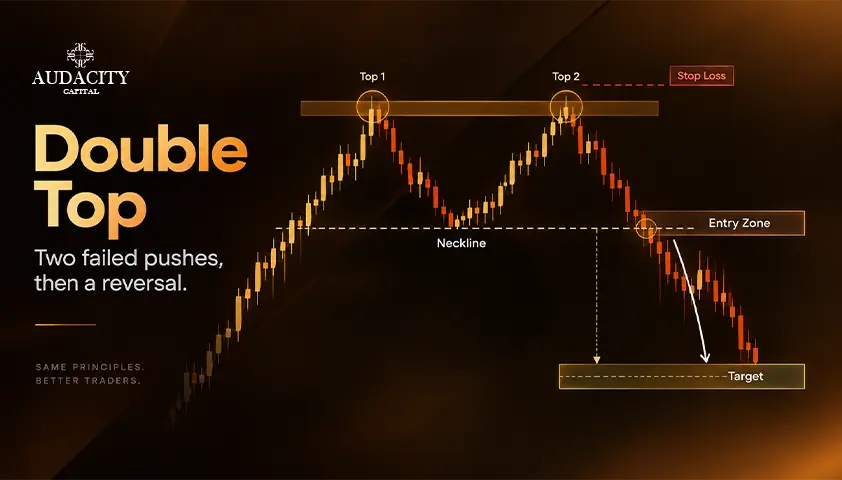
Double Top Pattern: How to Trade It
Learn how to identify, confirm, and trade a valid double top pattern with precise targets and stops.