


What Size Instant Funded Account Should You Start With?


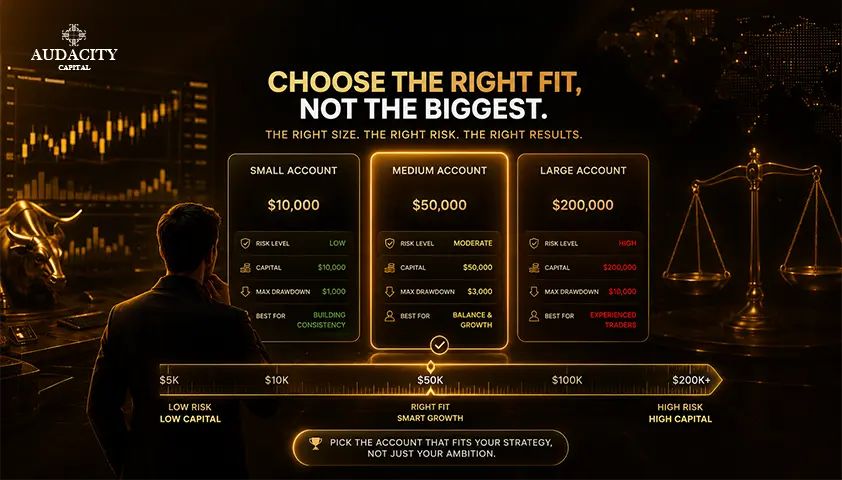
You are on the checkout page, looking at account sizes from small tiers up to six figures, and the bigger numbers are pulling at you because the payouts look life-changing.
Here is the truth: start with the smallest size that is meaningful to you, not the biggest you can afford.
The real decision is not how much capital you want.
It is two simpler questions: what fee can you comfortably afford to lose, and what size can you actually trade well within the rules?
Those answers point most newer traders toward a small account. Below, we cover why bigger is not easier, how to choose your size, and how scaling lets you start small without capping your growth.
What size instant funded account should you start with?
For most traders, the answer is to start small. Pick the smallest size that still feels meaningful enough to take seriously, then prove yourself there before committing more money.
Here is the reframe that matters. People usually pick a size by asking how much capital they want, but what size prop firm account to start with is really a risk-and-budget question.
A better pair of questions is this: what fee can I afford to lose, and what size can I trade well within the rules? The fee—not the account size—is your real financial commitment when you join a funded trading program.
A quick note on terms for newer traders. The fee is what you pay up front to access the account. The capital you trade is simulated, meaning it represents the firm's funds rather than your own cash on the line.
The rules are the limits you must respect:
- the drawdown (the maximum your account can fall before it breaches),
- the daily loss limit (the most you can lose in a single day),
- and the profit target (the gain you need to reach to qualify for the next step or a payout).
The spectrum is honest, not absolute. A proven trader with a real edge and the budget to match can reasonably start bigger. A newer trader almost always should start small.
The deciding factor in which account size should I start with is your evidence, not your ambition. With that framing set, here is the insight that explains why bigger does not mean better.
Why a bigger account isn't easier or safer
The most common assumption on the checkout page is that more capital is automatically better. It is not, and the reason is simple once you see it.
Many prop firms scale the drawdown limits and profit targets proportionally with account size, although the exact rules vary between firms. The drawdown, the daily loss limit, and the profit target are all set as percentages of the account, not fixed dollar amounts.
A bigger account does not give you proportionally more breathing room. It gives you a bigger dollar version of the exact same percentage rules.
An illustrative example
Imagine two accounts under identical rules: a 10% maximum drawdown and an 8% profit target.
Note: The numbers below are examples to illustrate the math, so treat them as such.
- On a $25,000 account, the drawdown buffer is $2,500 and the target is $2,000.
- On a $100,000 account, the drawdown buffer is $10,000 and the target is $8,000.
Four times the capital, four times the dollar figures, and zero change in the percentage difficulty. The rules are identical in proportion. What changed is the size of every swing in your account balance.
The bigger-account fallacy and the psychology
This is where the trouble starts. A trader who is calm watching a $250 drawdown can come apart watching a $1,000 one, even though both represent the same 1% move. The larger absolute dollar swings create real psychological pressure, and pressure leads to worse decisions: moving stops, oversizing to recover, abandoning the plan.
Your position sizing in percentage terms should be the same at any account size. Risking 1% on a small account and 1% on a large one is the same trade in proportional terms.
The bigger account does not change how you should trade. It only raises the dollars at stake and the emotional weight that comes with them.
That is why bigger is not easier and never automatically safer.
Why starting small is the smart move

Starting small is the disciplined choice, not the timid one. Here is why it works.
1. You are paying to learn the firm, so do it cheaply.
Your first account is really a test of two things: how the firm's specific rules behave in live conditions, and whether the firm actually pays when you qualify. Run that test as inexpensively as you can before committing more capital.
2. A bigger fee hurts more when you breach.
Instant funding programs generally have a higher entry fee than evaluation challenges. Before purchasing any program, review the firm's refund and payment policies. Most traders breach early as they adjust to the rules and the pressure. A small account keeps the cost of those likely early stumbles low.
3. Lower dollar pressure makes the rules easier to follow.
When the swings are small, it is far easier to stick to your plan and build the consistency that actually leads to payouts. Discipline is hard enough without large numbers amplifying every emotion.
4. A smaller account you keep beats a bigger one you breach.
This is the simple truth behind the best instant funded account size for beginners. The account you survive on is worth more than the account you blow up.
Because instant fees are bigger and non-refundable, oversizing on an instant account costs more than oversizing on a cheap challenge. That makes starting small matter even more here.
How to choose your account size
Use this four-factor framework to land on a sensible size.
1. Affordability first.
The fee should be money you can comfortably afford to lose. Treat it as tuition or a business cost, not an investment with a guaranteed return. If losing the fee would genuinely hurt your finances, size down. Your risk tolerance for the fee itself comes before anything else.
2. Your proven track record.
Match the size to what you have actually traded successfully in percentage terms, whether on demo or a smaller live account. A useful rule of thumb is to start near your current trading volume.
A trader managing a five-figure personal account might reasonably start with a small five-figure prop account. Do not jump to a size you have never handled in practice.
3. Your strategy.
Scalpers and tight-stop traders often suit smaller account sizes well. Swing traders may prefer a little more room to let positions breathe. Either way, choose an account size that fits both your trading strategy and your budget.
When comparing account sizes, it's also important to understand how the firm's drawdown model works. Some prop firms use trailing drawdown, while others use static drawdown. These models can influence how comfortably you manage risk and may affect which account size is the best fit for your trading style.
4. The payout math.
Honestly, a bigger account does pay more per percent of gain, but only if you survive. Weigh the bigger potential payout against the bigger fee and the heavier pressure. The larger payout is meaningless if a breach takes the account first.
The honest case for a bigger account
To be fair, there is a genuine counter-point, and it deserves a clear hearing.
Per dollar of funded capital, bigger accounts are usually more fee-efficient. A single larger account tends to cost proportionally less than buying several small ones, so the cost per dollar of capital does favor size.
So when does starting bigger make sense? Three conditions need to be true at once:
Condition #1: You have a proven, consistent edge with a real track record behind it.
Condition #2: You can trade the larger size sensibly within the same percentage rules, without the bigger swings affecting your decisions.
Condition #3: You can comfortably afford the larger non-refundable fee if the account breaches.
If all three hold, starting bigger can be a reasonable, informed choice. The point here is not to warn you off size. It is to make sure the decision is informed.
Note: For a starting trader, this is the exception, not the rule. If you meet only one or two of those conditions, that is a strong signal to start smaller and build up.

Want immediate access to funded capital?
Explore Instant FundingStart small, then scale up

Here is the part that resolves the whole tension. Most firms offer a scaling plan that grows your account as you prove consistency.
At Audacity Capital, traders can start with a smaller funded account and become eligible for the firm's scaling plan through consistent performance. This allows you to increase your trading capital over time without needing to begin with the largest account size. Starting with a smaller account doesn't limit your long-term potential—it gives you the opportunity to build confidence, develop consistency, and grow into larger capital allocations.
Your starting size is not a ceiling. You can earn your way up to a bigger account over time without paying a large fee up front.
This is exactly why starting small costs you almost nothing in upside. You keep the full path to bigger capital while limiting what you risk right now. You get the survivability of a small account and the growth potential of a large one, in the right order.
One discipline point holds at every stage. Whatever size you scale to, keep the same percentage risk per trade. If you risk 1% on a small account, you risk 1% on a bigger one.
A bigger account is never a reason to risk more per trade, only a reason to keep doing what already worked.
So the path is simple. Start small. Prove your edge. Let the scaling plan, not a large upfront fee, carry you to size.
Ready to skip the evaluation phase? Explore Audacity Capital's Instant Funding program and get access to instant funded account with flexible trading rules, competitive profit splits, and the opportunity to scale your trading capital as you prove consistent performance.
Are You Looking For A Funded Trader Program?
Choose Funded Trader ProgramFAQ
Not because of the rules, since the drawdown and profit target percentages are usually identical across sizes. A bigger account is often harder to manage well, though, because the larger dollar swings create more emotional pressure and can lead to worse decisions. The difficulty is psychological, not structural.
Many newer traders start with the smaller tiers because the fee is affordable to lose if the account breaches. The risk discipline you learn on a small account scales directly to a bigger one later, so there is very little downside to starting small. It is a low-cost way to learn the firm and test whether you can trade within the rules.
Usually only in dollar terms. The drawdown, daily loss limit, and profit target are typically set as the same percentages at every size, so a bigger account mainly changes the dollar amounts and the fee. The proportional difficulty stays the same.
Usually no. The biggest account you can afford also means the biggest fee to lose and the most pressure to manage. Since most traders breach early, a smaller account you can comfortably afford and trade well is the safer way to start.
Yes. Most firms offer a scaling plan that grows your account as you prove consistency over time. Starting small does not cap your earnings, because you can scale up to a bigger account as your track record builds. Check the specific scaling structure with your firm before you commit.
Your percentage risk per trade should stay the same no matter the size. If you risk 1% on a small account, risk 1% on a bigger one. A bigger account is not a reason to risk more per trade, only a reason to keep applying the discipline that already worked.
For a newer trader, one small account you can manage well is usually best. Multiple accounts only make sense once your edge is genuinely consistent, because they amplify mistakes as much as they amplify wins. Master one before you spread across several.
Per dollar of capital, bigger accounts usually cost less in fees, so the value math can favor size. That value only matters if you can actually trade the larger size within the rules and afford to lose the bigger fee. For most starting traders, a smaller, survivable account is the better value because survivability comes first.

Kriptoya disiplinli risk uygulamaya hazır mısınız? Audacity Capital'in yeni kripto enstrümanlarını keşfedin ve ticaret stratejinizi getirin.
Daha Fazla BilgiBülten
Yeniliklerden haberdar olmak için bültenimize katılın.
Sosyal Topluluğumuza Katılın

Bugün Yolculuğunuza Başlayın Ücretsiz Denememizle
Becerilerinizi ve başarılarınızı sertifikalar aracılığıyla gururla sergileyin ve potansiyel yatırımcılardan ve akranlarınızdan sıkı çalışmanız ve özveriniz için takdir alın.
Ücretsiz Denemeİlgili Makaleler

Instant Funding Prop Firm Rules Explained
Instant funding prop firm rules start at the first trade. Learn how daily drawdown, payout milestones, prohibited practices, and scaling really work on an instant funded account.


What 'Instant' Really Means: How Fast You Actually Get a Funded Account
The word "instant" is widely misunderstood in prop trading. Learn how fast you get a funded account in practice, same day or within 24 to 48 hours.

Should Beginners Use Instant Funded Accounts?
Is an instant funded account for beginners a smart first step? Get the honest answer, the one test that decides it, how to start safely, and a better path.

How to Know if a No Deposit Instant Funded Account Real or Myth?
Are the prop firms' claims to give instant funded free accounts without any deposit real? Here's the truth, the red flags to avoid, and actual ways to get paid.