


Is Options Trading Profitable? Risks, Returns, and Reality


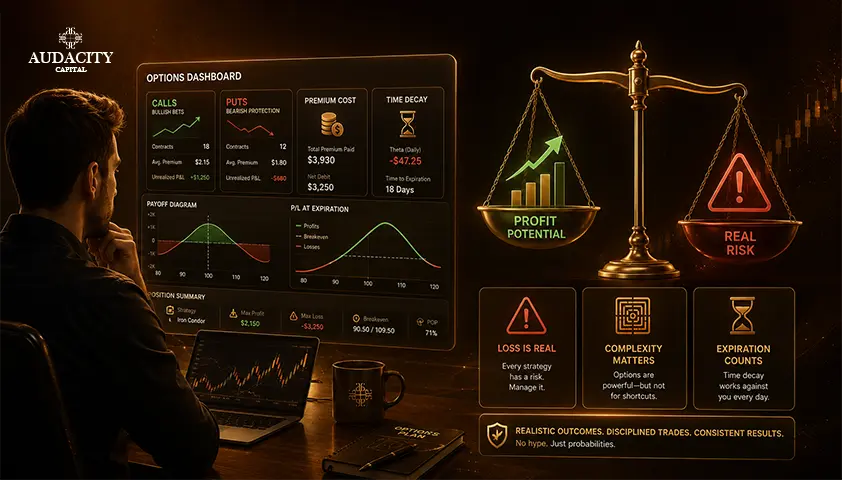
Is options trading profitable? The short answer is yes, some traders make money with options, but consistent profitability is uncommon among retail traders and cannot be judged from a handful of wins.
Whether you end up in the profitable minority depends on having a tested edge, controlling position size, respecting time and volatility, and measuring returns after every cost.
Options can produce large percentage gains on small capital. That same leverage, combined with expiration, can turn small mistakes into complete premium losses for buyers or much larger obligations for sellers.
What Does "Profitable" Mean in Options Trading?
Before you can answer whether options trading is profitable for you, you need a working definition.
A profitable trade is not the same as a profitable strategy, and a profitable month is not proof of a durable business. What matters is whether the approach produces positive net expectancy over a meaningful sample of trades without unacceptable drawdown.
Five measures actually decide the question:
- Net profit after all costs including spreads, commissions, slippage, assignment costs, and taxes where applicable.
- Average win across the winners in the sample.
- Average loss across the losers.
- Maximum drawdown from peak to trough on the equity curve.
- Return on capital actually at risk, not just return on premium.
Win rate is a supporting measure, not the headline. This is where win rate versus profitability gets confused.
Probability of profit tells you how often a trade closes green. It does not tell you how much you make when you win versus how much you lose when you are wrong.
For example: you take ten trades. Seven winners each earn $100. Three losers each lose $350. Your win rate is 70 percent, which sounds excellent. Your net result is $700 in wins minus $1,050 in losses, a $350 loss before costs. High win rate, negative expectancy.
The equation that ties it together:
Expectancy = (win rate × average win) − (loss rate × average loss) − average trading costs
Profitability Scorecard
Trades | Win rate | Average win | Average loss | Costs | Net expectancy |
10 | 70% | $100 | $350 | $30 | −$38 per trade |
40 | 55% | $180 | $150 | $12 | +$19 per trade |
60 | 40% | $420 | $160 | $18 | +$66 per trade |
The first row shows options expectancy going negative despite a strong win rate. The others show positive expectancy at lower win rates, because the average win is larger than the average loss.
What Does the Data Say About Retail Options Traders?
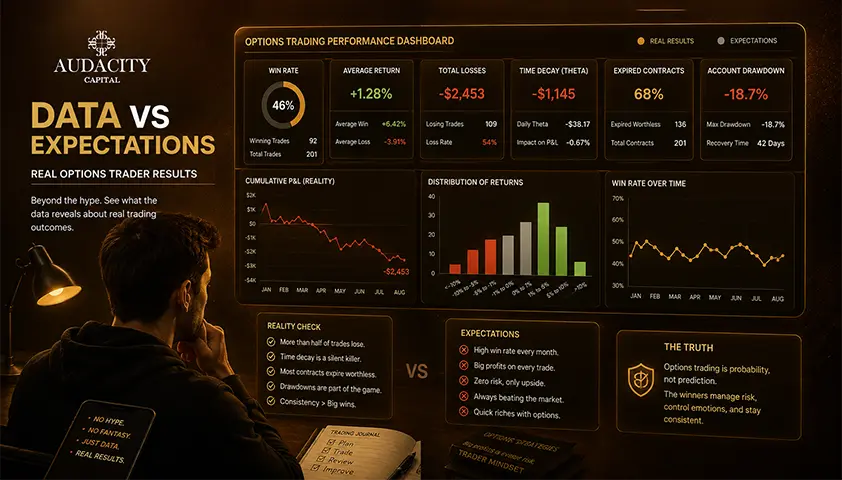
The evidence does not support the idea that most retail traders make consistent money from options.
SEBI, India's markets regulator, reported that roughly 93% of individual equity F&O traders lost money across FY22 to FY24.
A follow-up study covering FY25 reported that around nine in ten individual traders remained loss-making.
The important caveat: these figures combine equity futures and options for individual traders in India. They are not a global options-only statistic.
Peer-reviewed research adds a second layer.
A 2024 Management Science study, "Who Profits from Trading Options?", found that retail investors concentrated more heavily in simple one-sided option positions and, in that sample, lost to the rest of the market.
More complex or volatility-selling styles performed better within the study.
Put together, the honest read is this.
There is no reliable universal options trading success rate because markets, trader definitions, account survival, product mix, costs, and study periods differ.
What we can say is that regional regulator data and academic research both point to poor average outcomes for retail participants using simple directional options.
That is the reality any trader asking whether option trading profitability is realistic should sit with before scaling up capital.
Why Being Right About Direction Is Not Enough?
You can predict direction correctly and still lose. An option's price must move far enough, soon enough, and in a way that respects what the market had already priced into implied volatility.
Four variables drive a long option outcome:
- Direction: was your bias right?
- Magnitude: did the underlying move far enough to overcome the premium paid?
- Timing: did it happen before enough time value bled away?
- Implied volatility: did IV hold up, or did it collapse after the catalyst?
Imagine you buy a short-dated call on a stock ahead of a scheduled earnings release.
The market has priced in a wide expected move, so implied volatility is elevated and premiums are rich. Earnings come out modestly positive. The stock rises, but by less than the options market had already priced in.
Implied volatility collapses after the event, an effect commonly called IV crush. Time has passed. Your call is worth less than you paid, even though your directional call was correct.
Long options have a defined maximum loss equal to the premium paid. That does not make repeated premium losses small.
Cheap out-of-the-money contracts expire worthless frequently, and a string of full-premium losses is one of the fastest ways an account bleeds.
Option Buying vs Option Selling: Which Is More Profitable?
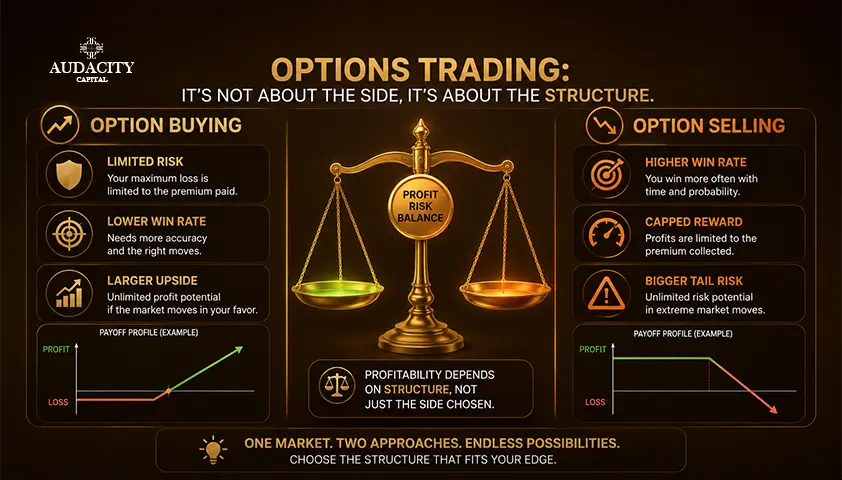
Neither side is automatically more profitable. Buyers and sellers face different payoff profiles, and each has its own failure mode.
Buying profile.
Premium paid is the maximum loss on a simple long option. Time decay and theta work against you, and a fall in implied volatility can hurt even when the underlying moves in your favor.
Win rates on outright directional buys tend to be lower, with occasional large wins that need to cover many small losses.
Selling profile.
Premium received is the maximum profit on a simple short option. Time decay may work in your favor, and win rates can look high. The risk sits in the tail.
Assignment and exercise risk, gap moves, and uncovered positions can produce losses well beyond the premium collected. An uncovered short call has theoretically unlimited loss potential.
A frequent competitor claim is that option sellers are profitable because most contracts expire worthless. That is a misreading.
Expiring worthless is not the same as seller profitability, and a long string of small premium wins can be erased by one poorly managed loss during a volatility shock or gap move.
Defined-risk options strategies such as vertical spreads cap the maximum loss and the maximum profit. They add legs, execution complexity, and management decisions. They are useful risk tools, not a shortcut to profitability, and no specific spread is the "best" strategy.
Buyer vs Seller: Quick Comparison
Option buying | Option selling | |
Max profit | Large, theoretically uncapped on long calls | Premium received |
Max loss | Premium paid | Large, uncapped on uncovered short calls |
Time decay | Works against you | Can work for you |
IV exposure | Hurt by IV crush | Helped by IV falling after entry |
Typical win rate | Lower | Higher |
Main failure risk | Repeated full-premium losses | Tail loss, assignment, margin expansion |
What Returns Are Realistic From Options Trading?
There is no reliable universal monthly return for options traders. Any number quoted without capital base, drawdown, leverage, strategy, sample size, and costs is close to meaningless.
Competitors often publish ranges like 2 to 5 percent per month or 10 percent per month without a source or a risk denominator. Skip past those.
Ask these questions instead:
- What capital was actually at risk to produce the return?
- What was the maximum drawdown along the way?
- How many trades produced the result?
- Did the result survive different volatility regimes?
Return denominator matters. A 50% gain on a $200 premium is $100. If that trade required $2,000 of buying power or margin support, the return on the capital that was genuinely tied up is 5 percent, not 50.
Return on premium can flatter a track record. Return on capital at risk is closer to reality.
Judge realistic options trading returns by net expectancy, stable position sizing, and drawdown over a reasonable sample of comparable trades.
A few dozen trades in similar conditions is usually the earliest point at which patterns are worth discussing. One great month tells you almost nothing.
Return-quality checklist:
- Net return after costs
- Capital at risk, not just premium
- Maximum drawdown observed
- Sample size across similar setups
- Performance across different market regimes
- Cost ratio as a percentage of gross returns
The Risks That Decide Long-Term Profitability
Seven risks quietly determine whether options trading can be profitable for you turns from a question into a track record.
1. Leverage and total premium loss.
A small move in the underlying can produce a large percentage move in the option. Long contracts can lose the entire premium quickly, and back-to-back full-premium losses damage the account faster than most traders expect.
2. Time decay and theta.
Option value erodes as expiration approaches, even when the underlying barely moves. Short-dated contracts amplify the cost of every timing error.
3. Implied volatility and IV crush.
Options can be expensive before earnings, macro releases, or product events. A drop in implied volatility after the event can reduce option value even when the underlying moves in the expected direction.
4. Tail risk for sellers.
Premium income can look steady for months, then a single sharp move can produce a loss larger than several previous wins combined. Defined-risk options strategies limit this, but they do not eliminate loss risk.
5. Assignment and expiration.
Short options can be assigned, and some styles allow early exercise. Multi-leg positions can become unbalanced when one leg is assigned and another is not, creating exposure the trader did not intend to hold overnight.
6. Bid-ask spread and slippage.
Liquidity and trading costs matter more than most retail traders assume. Wide bid-ask spreads, slippage on market orders, and per-contract fees can turn a small theoretical edge into a losing strategy, especially for active traders and thinly traded strikes.
7. Strategy and regime mismatch.
A premium-selling approach built for calm markets can break in a volatility spike. A long-volatility approach can bleed through quiet periods. Profitability has to be tested across the conditions the strategy will actually meet. Ignoring this is one of the main reasons why options traders lose money after a hot start.
How to Test Whether Your Options Strategy Is Actually Profitable?
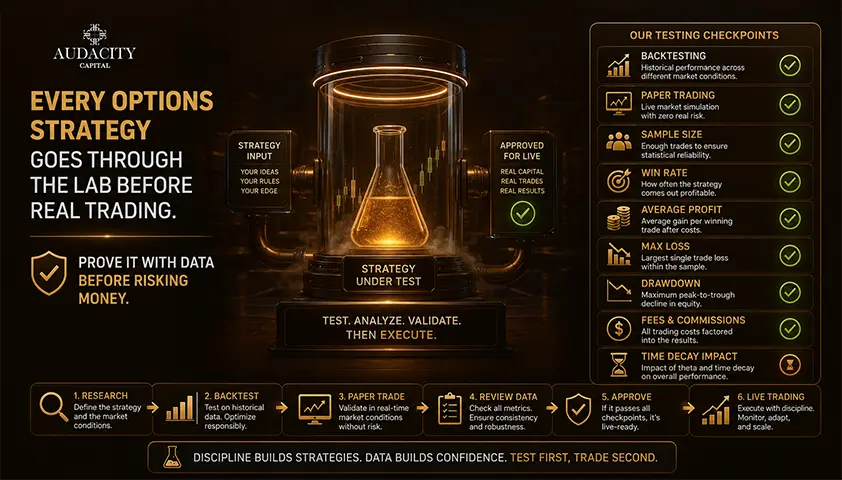
This is the practical audit. Apply it to a spreadsheet or a proper options trading journal before you conclude your strategy has an edge.
Step 1. Group comparable trades.
Same strategy, similar expiration window, similar market condition. Do not mix long calls, credit spreads, and event trades into one average.
Step 2. Record everything.
Opening and closing prices, commissions, slippage estimates, assignment costs, and the maximum capital at risk on each trade. Costs hidden here are the single biggest source of overstated results.
Step 3. Calculate the core metrics.
Win rate, average win and average loss, net expectancy, maximum drawdown, and return on capital at risk. This is where win rate versus profitability becomes visible.
Step 4. Separate backtested, paper, and live results.
Live execution and decision-making under pressure often differ from a clean backtest.
Step 5. Slice by regime and catalyst.
How did the strategy perform in high IV versus low IV? Around earnings versus quiet weeks? A strategy that only worked in one narrow window is not yet an edge.
Step 6. Run a stress test.
Model a worse loss streak than you have already experienced. Ask whether your position sizing and account survive it without changing the rules in the middle of a losing sequence. This is essentially a risk of ruin check.
Step 7. Set a review point and a stop condition.
Decide in advance what evidence would invalidate the strategy, not only what would confirm it. Traders who only look for confirmation quietly finance losing systems for years.
Backtesting and journaling improve measurement. They do not guarantee future profitability.
Blank Profitability Audit Table
Field | Your value |
Strategy name | |
Number of comparable trades | |
Win rate | |
Average win ($) | |
Average loss ($) | |
Total costs ($) | |
Net expectancy per trade | |
Maximum drawdown | |
Capital at risk per trade | |
Return on capital at risk | |
Result across regimes |
Copy the structure into a spreadsheet and update it after every closed trade.
Who Is Options Trading Suitable For?
Options can suit a trader who understands the underlying market, can calculate maximum loss before entry, has enough capital for the chosen strategy, accepts irregular returns, and can follow a written process through losing periods.
Options are a poor fit when a trader needs immediate income, uses money required for living expenses, cannot explain assignment and exercise risk in their own words, chooses contracts only because they look cheap, or increases size after losses.
Not every options trade is speculative. Options can also hedge or reshape existing portfolio exposure. A protective put may lose money on the option itself while doing exactly what it was bought to do. Judging that trade by its P&L alone misses the point.
A one-sentence decision test. Before entering a trade, describe it in a single sentence: market view, maximum loss, required move, time limit, and what would prove the idea wrong. If any part is fuzzy, the trade is not ready.
Complexity is not skill. Matching the product to your knowledge, capital, and risk tolerance is.
Conclusion
Is options trading profitable? Yes, it can be, but consistent profitability is a minority outcome and cannot be judged from a handful of winning trades. The measures that count are net expectancy, costs, return on capital at risk, maximum drawdown, and whether the strategy survives changing market conditions.
Before adding capital, audit a set of comparable trades using the framework above. If the numbers do not show a positive edge after realistic costs and risk, the strategy is not profitable yet. Fix the process first, then decide what to fund.
Frequently Asked Questions
No universal global figure exists. Indian regulator data shows a large majority of individual equity F&O traders lose money, and academic research on retail options participants points in a similar direction. These findings are scoped to specific markets, samples, and periods, so they are best treated as strong warnings rather than a single worldwide statistic.
Returns from options are uneven and should not be treated as a salary. Even strategies with high win rates can produce losing months during volatility shocks or regime changes. Traders who commit household expenses to expected option income usually run into trouble when the sequence of returns turns against them.
Not automatically. Sellers often show higher win rates because time decay can work in their favor, but they carry tail risk, assignment and exercise risk, and potential margin expansion. Buyers show lower win rates with defined maximum loss and occasional large wins. The right comparison is payoff profile and risk tolerance, not a blanket winner.
On simple long calls or long puts, the maximum loss is the premium paid. On uncovered short options, losses can be much larger than the premium collected, and on uncovered short calls the loss is theoretically unlimited. Defined-risk structures cap the loss to the width of the spread minus the credit received.
Direction is only one variable. Time decay, implied volatility and IV crush after a catalyst, and insufficient magnitude of the move can all reduce an option's value even when your directional view is correct. This is the most common surprise for new options buyers.
There is no fixed timeline. Some traders never reach consistent net profitability. Those who do typically spend a long period building a measured process, sizing conservatively, and running a real options trading journal before their expectancy stabilizes.
Options are risk-transfer tools used by hedgers, market makers, and speculators. Untested, oversized directional speculation on short-dated contracts can resemble gambling in its outcome distribution. The instrument is not the problem, the process around it is.
It depends on the trader, the strategy, and the market. Options offer leverage, defined-risk structures, and flexibility that stocks do not, but they also introduce time decay, volatility exposure, and assignment risk. For many retail traders, simple stock exposure produces steadier long-term outcomes than active options trading.

Ready to apply disciplined risk to crypto? Explore Audacity Capital's new crypto instruments and bring your trading strategy.
Learn MoreNewsletter
Join our newsletter to stay up to date on features and releases.
Join Our Social & Community

Start Your Journey Today With Our Free Trial
Proudly showcase your skills and accomplishments through certificates and get recognition for your hard work and dedication from potential investors and peers.
Free Trial