


Prop Firms That Allow EA: The Rules That Actually Matter


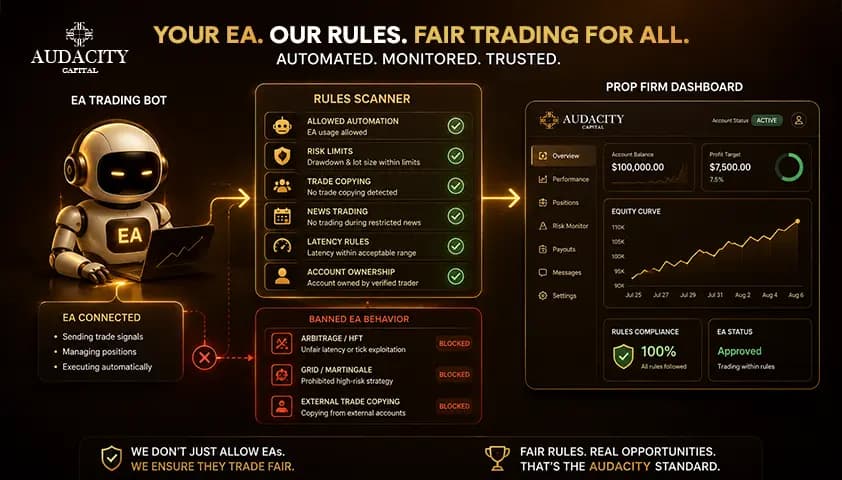
Most major prop firms allow ea, often across both the evaluation and the funded phases. But the useful answer is not which firms allow Expert Advisors. It is what they allow and what they ban.
Allowed does not mean unrestricted. Firms impose strategy bans, leverage caps, and drawdown limits specifically to protect their capital, and a bot that performs well on a retail account can breach a prop account in its first week.
This guide covers the banned strategy types, the firms and their rules, the restrictions that catch EA traders out, and how to choose.
What EA Trading means on a Prop Account?
An Expert Advisor (EA) is a program that executes a trading strategy automatically on your behalf.
Most run on MetaTrader, meaning MT4 / MT5, with cTrader's cAlgo environment as the main alternative. The broader terms you will see are algorithmic trading, automated trading, and trading bots, and they all describe the same core idea: software placing and managing trades according to coded rules.
Traders automate for practical reasons. An EA removes emotion from execution, applies its rules consistently trade after trade, and can operate outside the hours a person can realistically watch a chart. For a systematic trader, that consistency is the whole point.
On a funded account, the context shifts.
Your EA is not just trading a strategy, it is trading inside a firm's rulebook. The firm's constraints become part of the strategy whether the EA is coded to know that or not.
If the bot does not respect the drawdown limit or the leverage cap, the account fails, regardless of how the underlying idea performs.
Automation is mainstream, not niche. According to third-party estimates, the automated algorithmic trading market was valued at roughly $27 billion in 2026, with substantial projected growth by 2029. Plenty of retail traders are now looking to fund the bots they already run.
The Automated Strategies almost Every Firm Bans
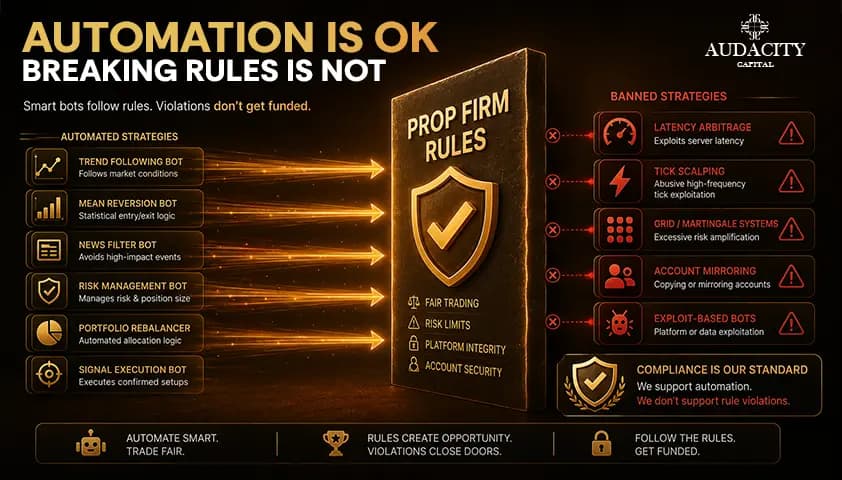
This is the section that saves a breached account. Some strategy types are prohibited at virtually every firm, and no amount of profit on a personal account changes that.
Banned almost everywhere:
- Arbitrage bots
- Latency arbitrage
- Tick scalping on delayed or slow price feeds
- High-frequency strategies
- Any approach that exploits platform or price-feed weaknesses
Firms treat all of these as gaming the system rather than trading, because they profit from a technical flaw rather than a genuine market view.
Then there are the categories that are firm-dependent and need checking:
1. Grid and martingale systems.
A grid strategy layers positions at intervals, and a martingale strategy increases size after losses. Some firms ban both outright because of their drawdown profile.
These systems can produce impressive returns on a personal account while regularly breaching prop rules, which is exactly why they are restricted.
2. Copy trading from external signals.
Many firms require that you are the originating account, not mirroring someone else's calls. If your EA simply executes a third-party signal, check the policy carefully, and see our guide on prop firms that allow copy trading for the detail.
Strategy type | Status at most firms |
Arbitrage, latency arbitrage | Banned |
Tick scalping on delayed feeds | Banned |
High-frequency / feed-exploiting | Banned |
Grid and martingale | Check the terms, often restricted |
External signal copying | Check the terms, often restricted |
Standard trend, breakout, mean-reversion EAs | Commonly permitted |
The Best Prop Firms that Allow EAs
Below are firms commonly cited among the best prop firms for EA trading.
Every entry follows the same structure so you can compare fairly: what automation is permitted and in which phases, the notable restrictions, drawdown and leverage rules, platforms, and one honest note.
Every rule below changes frequently and varies by plan, platform, and region. Verify each one in the firm's own Terms and Conditions before paying for anything. Treat all figures here as current-as-of-checking, not fixed facts.
And ignore any source claiming a firm allows EAs with no restrictions at all, that is an unverifiable absolute and not credible.
1. Audacity Capital: compliant EAs permitted, no third-party signals
Audacity Capital: Compliant EAs Permitted, No Third-Party Signals
Audacity Capital allows the use of Expert Advisors (EAs), provided they comply with the firm's trading rules and are not driven by third-party signals.
Supported platforms are MT5 and DXtrade. The firm uses a fixed static drawdown model, which is beneficial for algorithmic traders because, unlike a trailing drawdown, the drawdown limit does not tighten as the account grows, providing more predictable risk limits.
2. FTMO: the largest firm with explicit EA permission
FTMO is among the largest prop firms by trader count and explicitly permits Expert Advisors across its account sizes, commonly cited from $5,000 to $200,000.
It prohibits arbitrage and any strategy that exploits platform weaknesses. Rules commonly cited include roughly a 5% daily and 10% maximum drawdown with no time limit, a two-phase evaluation, and a profit split typically in the 70 to 90% range.
3. FundedNext: EAs across challenge and funded phases
FundedNext permits automated trading systems including EAs and algo bots across both the challenge phase and funded accounts. It offers cTrader support, which suits developers working in cAlgo, roughly a 6 to 10% maximum loss depending on the model, and news trading is allowed. Honest note: it explicitly provides no setup or technical assistance for your automation. Verify the model-specific limits.
4. The5ers: among the most EA-friendly, with VPS support
The5ers is one of the most algo-friendly firms, with explicit support for algorithmic strategies and VPS hosting available, plus a scaling program that is popular with systematic traders.
It is considered as the primary choice for serious algorithmic traders.
5. E8 Markets: EAs with relatively generous drawdown caps
E8 Markets permits EAs with relatively generous daily caps, roughly 5 to 10% cited across sources, which matters for strategies with a wider intraday swing. Honest note: verify the current caps for the specific account model you intend to trade.
6. FundingPips: EAs permitted, but check the oversight rule
FundingPips permits risk-management EAs and standard algorithmic strategies, with one important caveat: fully automated bots requiring no human oversight may be restricted. This is the clearest example of why an algo trader must read the automation clause rather than a summary.
A firm can permit EAs in general and still restrict the fully hands-off setup you actually plan to run.
7. Topstep: automation allowed on futures and forex, with strict conduct rules
Topstep allows automated trading bots and EAs in both its Trading Combine and funded accounts, with roughly a 7% daily drawdown and a 3% per-trade loss maximum on forex, alongside prohibited-conduct rules including restrictions such as single-user hedging.
It states plainly that it will not help set up or troubleshoot your bot.
The Restrictions that Catch EA Traders Out
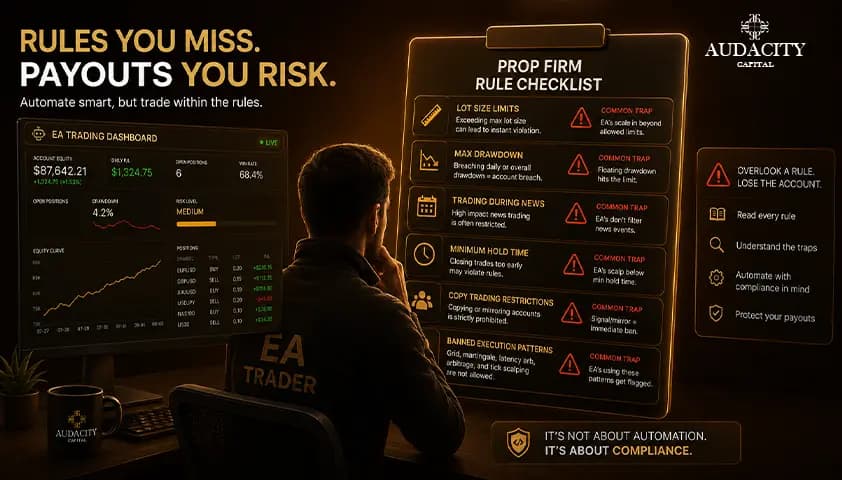
Even when EAs are allowed, these are the rules that break them.
1. Leverage caps.
Prop accounts commonly cap leverage far below retail, roughly 1:50 to 1:100 versus up to 1:500 on a retail account. If your EA was tuned for retail conditions, its position sizing is immediately wrong.
A strategy that performs brilliantly at a high retail leverage cap can blow up in its first week on a prop account with a 10% daily drawdown limit, because the cap, not the strategy's long-run edge, is the binding constraint.
2. Drawdown caps.
Both daily and maximum, and whether the model is static or trailing. Compare them against your EA's own historical drawdown before you start, not against how it feels in a good month.
3. Minimum trading days.
A low-frequency EA can simply fail to place enough trades to satisfy an activity requirement. Check that your EA will trade enough across the required minimum trading days.
4. Lot size and consistency rules.
Some firms cap position size or flag uneven trade distribution. An EA that spikes size occasionally can trip these.
5. News-trading restrictions.
Buffer windows around high-impact releases, which an EA will ignore unless you code or schedule around them.
6. No technical support.
Setup and troubleshooting are entirely your responsibility. Budget time for this.
7. VPS and uptime.
A dropped connection leaves positions unmanaged, which is why VPS hosting matters for unattended automation.
8. Running one EA across multiple accounts.
This can trigger capital-cap aggregation breaches even where both EAs and own-account copying are permitted. See our copy-trading guide for how aggregation works.
Why EA Traders Fail Prop Firm Challenges
A tight diagnostic to tie it together. The recurring causes of failure are consistent:
- Grid and martingale drawdown breaches, the strategy type most likely to breach a daily cap.
- Position sizing carried straight over from a high-leverage retail account.
- An EA that trades too infrequently to satisfy minimum trading days.
- Ignoring news-window restrictions during high-impact releases.
- Running an off-the-shelf EA the trader does not actually understand, so they cannot tell when it is malfunctioning versus simply losing.
- Aggregation breaches from running the same EA across several accounts.
- The root cause behind most of these: treating EAs allowed as the only rule that mattered.
Related Articles
10 Best EAs to Pass Prop Firm Challenges in 2026
Conclusion
Keep the essentials in mind when using EA. Arbitrage, latency arbitrage, tick scalping, and high-frequency strategies are prohibited almost everywhere.
Grid and martingale systems and external signal copying are restricted at many firms. And the constraints that actually break EAs are leverage caps, drawdown limits, minimum trading days, and news windows.
The method is just as simple. Profile your EA first.
Read the automation clause, not the summary. Backtest against the firm's rules rather than retail conditions. Verify anything ambiguous in writing before you pay for a challenge.
An EA automates whatever edge you already have, it does not create one. The work is in the fit between strategy and rulebook.
Frequently Asked Questions
At most major firms, yes. Automation is commonly permitted in both the evaluation and funded phases. But the EA still has to respect the firm's drawdown caps, leverage limits, and minimum trading days, and banned strategy types will void the account no matter how it performs.
Arbitrage, latency arbitrage, tick scalping on delayed feeds, and high-frequency or platform-exploiting strategies are prohibited almost everywhere. Grid and martingale systems and external signal copying are restricted at many firms and should be checked in the terms before you start.
Usually leverage and drawdown. Prop accounts often cap leverage far below retail and enforce daily loss limits, so position sizing tuned for a retail account can breach the cap long before the strategy's edge has time to play out.
No. Firms that allow automation are typically explicit that they will not assist with installation, configuration, or troubleshooting. The technical side is entirely the trader's responsibility, so plan for that before buying a challenge.
It is not always required, but it is strongly advisable for unattended strategies. A dropped local connection leaves open positions unmanaged, and some firms offer VPS hosting as part of their programs.
Yes. Firms with minimum trading day requirements can fail an account that has not placed trades on enough days, which catches low-frequency EAs. Check the activity requirement against your EA's trade frequency before you begin.
Sometimes, but this is where traders get caught. Even where automation and own-account copying are permitted, identical trades across accounts can breach a firm's capital caps through aggregation, so check the multi-account rules specifically.
Some firms permit them and others ban them outright because of their drawdown profile. They are among the most likely strategy types to breach a daily loss limit, so confirm the firm's position before you start.

هل أنت مستعد لتطبيق مخاطر منضبطة على العملات المشفرة؟ استكشف أدوات التشفير الجديدة من Audacity Capital واجلب استراتيجية التداول الخاصة بك.
اعرف المزيدالنشرة الإخبارية
انضم إلى نشرتنا الإخبارية.
انضم إلى مجتمعنا الاجتماعي

ابدأ رحلتك اليوم مع تجربتنا المجانية
اعرض مهاراتك وإنجازاتك بفخر من خلال الشهادات واحصل على تقدير لعملك الجاد وتفانيك من المستثمرين المحتملين والأقران.
تجربة مجانيةمقالات ذات صلة
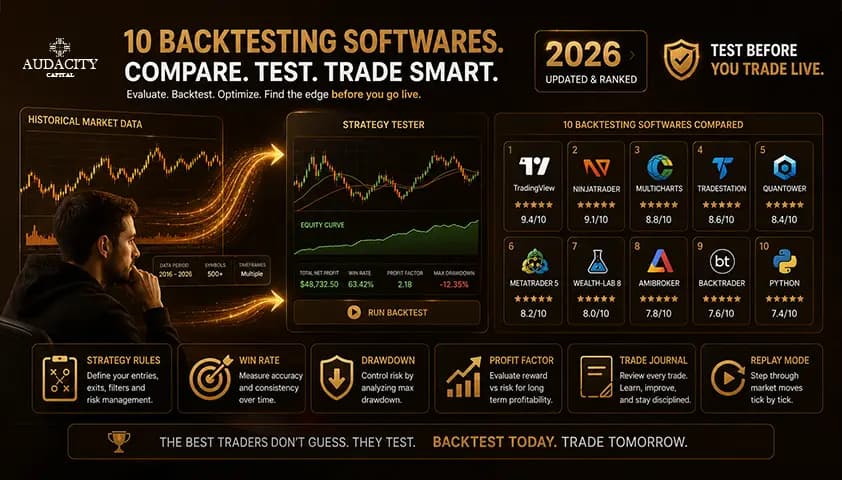
10 Best Software for Backtesting Trading Strategies in 2026
Compare 10 backtesting tools by market coverage, data quality, coding needs, execution modelling and price to find the right testing workflow.


Minor Forex Pairs (Cross Currency Pairs): The Complete Trader's Guide
Learn what minor forex pairs are, explore the full list of cross currency pairs, and understand spreads, volatility, risks, and how to trade them.
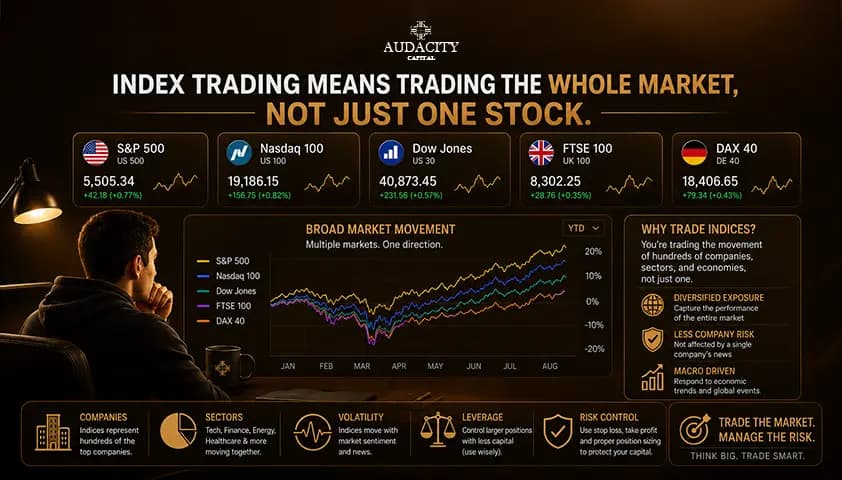
How to Trade Indices: A Beginner's Guide
Learn how to trade indices, choose the right instrument, calculate position size, plan entries and exits, and manage leverage and event risk.
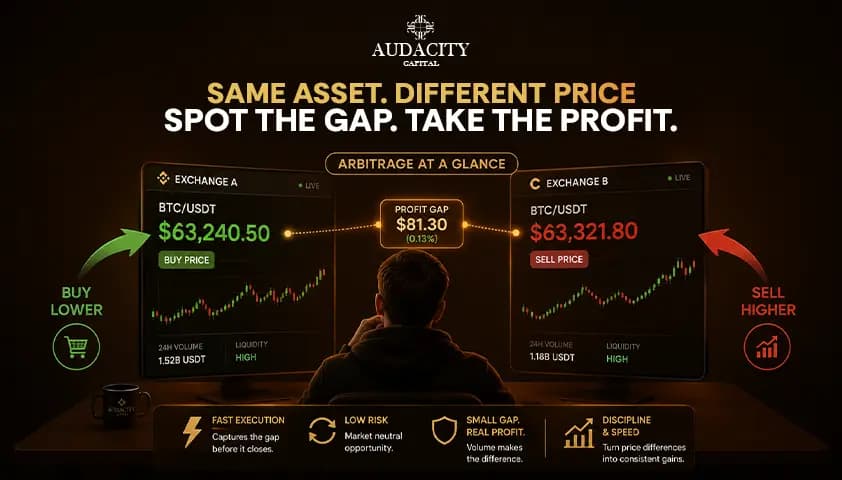
What Is Arbitrage Trading?
What is arbitrage trading, and is it really risk-free? Learn how it works, the main types, and why arbitrage and latency exploitation are prohibited on funded accounts.