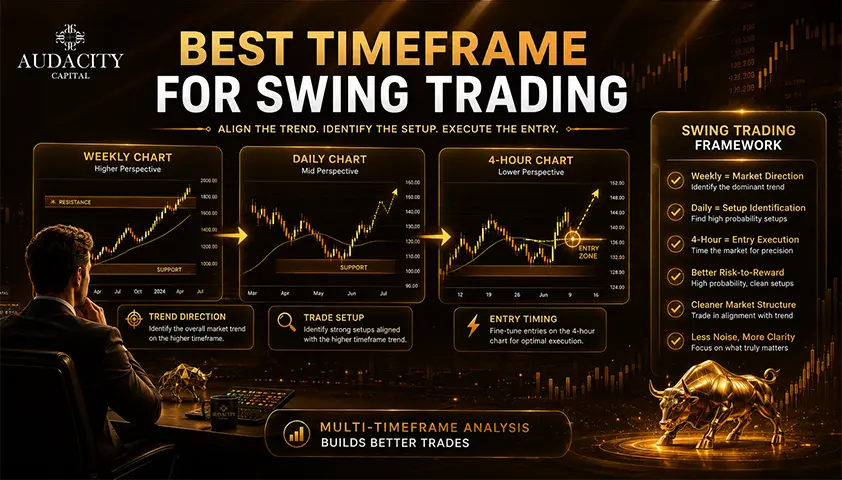


Is Swing Trading Profitable?


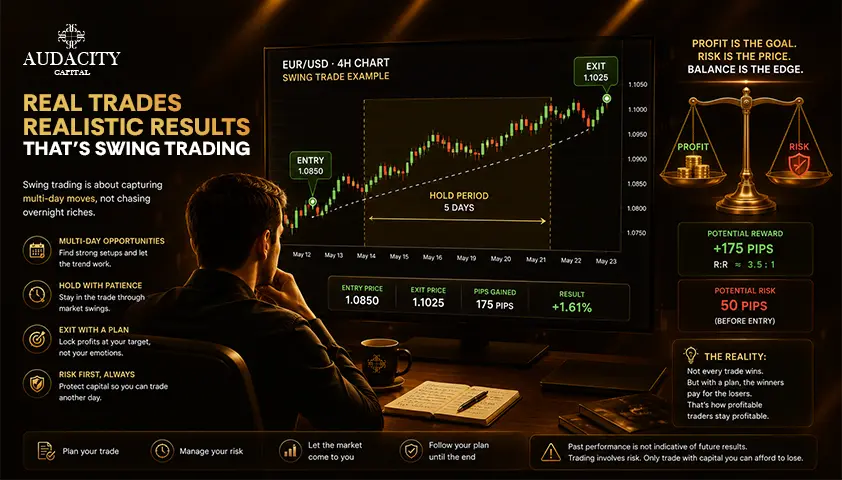
Swing trading can bring profits to some traders but it is a skill that develops over time, not a quick get rich scheme.
You've likely encountered it being marketed as a casual method to make money in a couple of hours a day. That pitch is misleading.
Swing trading can be successful when there is a tested strategy, discipline, and strict risk management, but when it does not it can empty an account quickly.
So the real question is not if the approach is going to work in theory. It does for a few dedicated traders.
The question is what differentiates those traders who make profits from those who do not, and whether you are ready to invest efforts that profitability actually demands.
That's what this article is all about. We'll give you a straight answer, then discuss realistic return expectations, the factors that determine profitable trading, why most swing traders fail, how swing trading differs from day trading and long-term investing, and the practical steps that enhance your chances of profitability.
Is swing trading profitable?
Yes, swing trading can be profitable for the traders who take it seriously as a skill. Many people do make money out of it.
The key is to know how that profit is generated.
Swing trading means holding positions for several days to a few weeks to capture a "swing" in price, the move between a shorter-term low and high. That's somewhere between day trading (trading in and out within minutes to hours) and long-term investing (investing over years).
One of the selling points is the longer holding period, as it requires less screen time and requires less decision making than day trading.
An important point to note here. Swing trading profits have to be made and tested. It cannot be assumed. It's not from a lucky week or a "secret" set up, but from a good strategy, risk control, and consistency on numerous trades.
There are no guarantees and losses are common, depending on the trader. As you read the remainder of this article, do so through that lens: the end goal is to gain insight into what's really behind these actual, repeatable results, not just what seems easy.
What returns can you realistically expect?
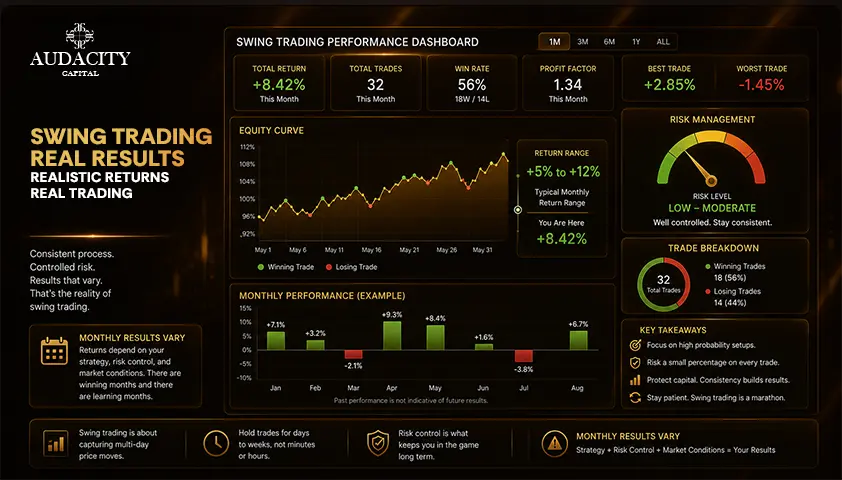
This is where honesty comes into play the most as unrealistic expectations sink more traders than bad strategies.
A typical range for a "good" swing is about 10-30% per year. According to some research and industry sources, the average annual return for a disciplined swing trade is about 15%, and individual swing trades are seeking price moves of 5% to 20% which can add up over time.
These figures should be seen as indicative and not commitments. They're often published from sites or companies that are promoting a product, so be skeptical while reading them.
Now the temper.
Online you'll be able to see a lot louder numbers, 5-10% a month or 75-84% win rate. Don't expect those to be the norm, but rather consider them optimistic outliers.
They are often marketing and they get new traders in trouble and over-risking. Consistency and capital protection is more important than chasing high numbers.
The sobering side, attributed and presented as a range rather than as a fact: As much as 90% of all active traders lose money (reputable industry estimates), and some sources estimate that only 10% of swing traders can be consistently profitable over a whole year.
The numbers are difficult to verify independently, and they're from parties that may have conflict of interest, so hold them loosely. But, they're all in the same direction, and that's something to respect: Most people who attempt it fail.
One more caveat that bears upon each of the above numbers. A sample of 30 to 50 trades is too small to determine profitability.
In the short run, luck prevails. It takes hundreds of trades before results reflect skill and not chance.
Thus, when you ask what is profitable in swing trading for you, you should consider all the market conditions and a large sample, never just a good week.
What determines whether swing trading is profitable?
The difference between profitable swing traders and everyone else comes down to a handful of factors. All of them do not guarantee a return. However, when combined, they can help you tip the scales.
1. A tested strategy with a real edge
An "edge" (also called positive expectancy) means that, across many trades, your strategy makes more than it loses on average. Momentum, mean reversion, and breakout can all work, but only if they have been tested on a large enough sample and you have found that they really have a positive expectancy for you.
A "feel good" strategy isn't an edge. A strategy that has been successful in hundreds of trades is.
2. Risk management above everything
The most important factor is risk management. Most consistent traders stake 1 to 2 % of their capital on a single trade and they are looking for a minimum of 2:1 reward-to-risk ratio, which means they want to make at least double what they risk.
This is important because handling the risk is more important than forecasting prices. Even the best strategy suffers setbacks and a tight risk control is the key that helps prevent one loss or a string of losses from wiping out the account.
3. Discipline and psychology
Plans are only effective if they are implemented. Trading psychology refers to the discipline that can keep you from breaking your rules when fear and greed try to get the better of you.
Emotional decisions, revenge trading after losing a trade, or even abandoning your trading plan mid-trade are what make a viable trading strategy a losing one.
4. Patience
Profitability is earned over a number of trades, not a particular one. You need to stick around long enough for your edge to work out on a statistical level. A trader who gives up or changes their strategy after a normal drawdown will not be able to give the real edge a chance to show up.
5. Realistic expectations and capital protection
Traders looking to preserve capital and slowly build up over time generally last longer than those who seek the big win. Protection of your downside is what's going to get you stay in the game long enough to compound.
6. Adapting to market conditions
Markets go through phases of trending, ranging and volatility. The strategy which works well in one environment can fail in another. Being alert to shifting circumstances and adapting, or sitting out, is a key element to long-term profitability.
Why most swing traders lose money
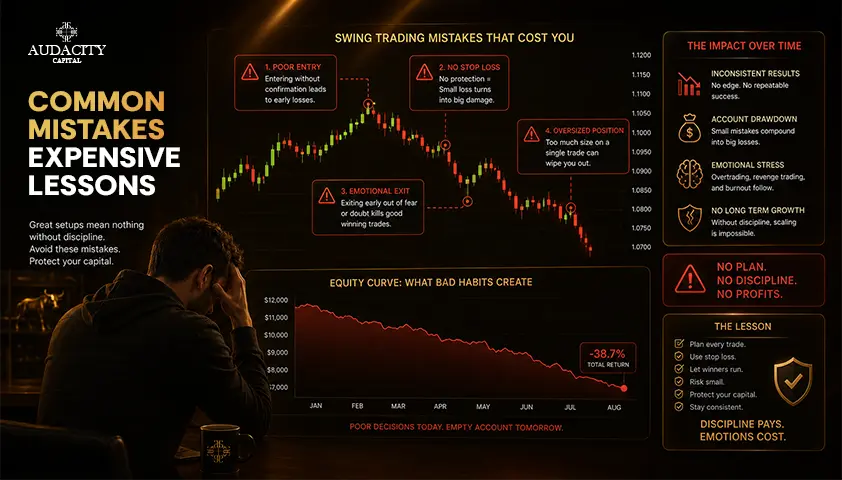
If the majority of retail traders lose, it is important to know exactly why, as the reasons are usually fixable.
The ugly reality is that most losses are due to execution and not strategy. The most frequently made errors in execution are:
1. Not following the trading plan: Trading what is not on the trading plan or missing the opportunities that are on the setups.
2. Holding losers hoping they recover: Turning a small, planned loss into a large, unplanned one.
3. Cutting winners prematurely: fear takes profit before the move does, and in secret kills your reward-to-risk ratio.
4. Overtrading: This is when you make too many trades and reduce your capital, costing you a lot of money and typically driven by boredom or emotion, not good trades.
5. Poor risk control: Not using stop losses, risking too much on a single trade, or choosing poor risk-to-reward trades that don't pay off over time.
The mindset failures that underlie these are unrealistic expectations (expecting to learn in days and getting rich quickly), lack of structure, and emotional decision-making in pressure.
The theme of takeaway is simple. Discipline and risk management is typically the difference between the profitable trader and the unprofitable trader, not some secret strategy.
Most of the losing traders don't need a better system. They must execute a good one on a regular basis. You genuinely get out what you put in.
To get a detailed analysis of the execution pitfalls that slowly drain funds from accounts, check out our common mistakes in funded trading accounts article and to learn about the psychological patterns that lead to these mistakes, read our trading psychology for funded traders guide.
Swing trading vs day trading vs long-term investing
The easiest way to determine if swing trading is for you is to view it objectively with the other possibilities.
None is automatically the most profitable. Each appeals to different people and different time, money and effort.
Factor | Swing trading | Day trading | Long-term investing |
Screen time | Moderate, checks per day | High and steady during sessions | Low, occasional review |
Trade frequency | Several per week | Many per day | Rare, buy and hold |
Capital needed | Moderate | Higher | Flexible, can start small |
Main pressure | Overnight and weekend risk | Costs, speed, psychology | Patience over years |
Relative reliability | Skill-dependent | Hard, many struggle | Often the more reliable path |
Swing trading requires less screen time and far less trades than day trading, reducing the stress and allowing it to fit around a job.
It gives more opportunities than long-term investing and it requires less capital than day trading.
Day trading has short time frames and high frequency, and industry statistics reveal that far too many day traders suffer from transaction costs, professional competition, and constant psychological pressure.
This is indeed a challenging journey.
Long term investing is more passive in terms of market growth over an extended period. It is the superior option in terms of building wealth for many, and without all the trouble and hassle.
So be honest with yourself.
For those who desire more action than investing but less than day trading, and who are willing to develop a real skill, swing trading falls somewhere between. It is not necessarily more profitable than the alternatives.
How to improve your chances of profitability
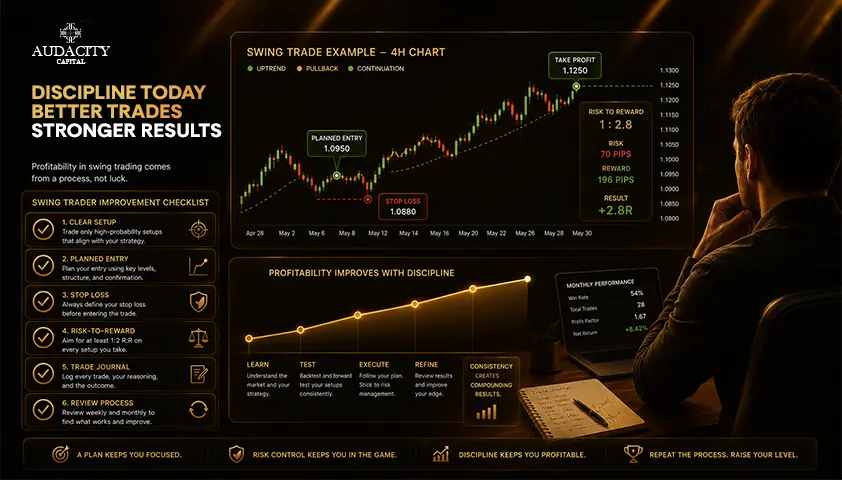
There's no certainty of making a profit. You can stack the odds in your favor and deal with the losses that will occur. Here is an organized, practical method to do so.
1. Develop and test a strategy with a genuine edge.
Test any approach over a large sample of the market over a variety of market conditions before putting your trust in it. If it does not have a positive expectancy in hundreds of trades, it's not ready.
2. Practice strict risk management.
Maintain small risk per trade, typically 1-2% of capital. Always have stop losses and stick to a sensible reward-to-risk ratio. Sound position sizing is what is going to prevent the losing streak from being a death sentence.
3. Maintain a written plan and journal.
Record your rules and keep track of all trades. The best way to discover and correct the common errors you're making without realizing it is to read through your journal.
4. Make realistic, consistency-based goals.
First protect your capital and then generate positive returns. Look for consistency, not a big win. Realistic returns compounded over time, swinging for big numbers and blowing up.
5. Practice on a demo or simulated account first.
Test your process without having to risk real money. Only scale up when there are consistent results over a meaningful sample.
6. Keep learning.
Improve your technical analysis, knowledge of market structure and your understanding of psychology and risk. Skill compounds just like returns do.
To improve two of the greatest leverage skills mentioned above, check out our guides on the risk-to-reward ratio and what market structure is in forex trading, both fundamental to reading swings effectively.
Trade with that understanding that losses are inevitable. These are the steps that increase your chances of success. But they don't eliminate the risk.
Conclusion
So, is swing trading profitable? Yes, for some traders. But the truth is that profit is a learned craft, developed over time with a proven advantage, one that requires a proven edge, thoughtful risk management and discipline.
It is not a shortcut, it is not passive income, and it is never guaranteed. Most individuals who attempt to do so are unsuccessful.
Maintain the realistic setting. A good outcome is moderate and consistent returns, in the range of 10 to 30% per year by common third-party estimates, not the 5 to 10% per month that marketing loves to promise.
If you want to build these skills in a fair, structured environment, Audacity Capital is a prop trading firm with a static drawdown model, meaning your maximum loss level is set from the start rather than shifting as your balance moves, which many swing traders find easier to plan around.
You can test your process in our free competition and, once you are consistent, apply your skills through a simulated funded account on MT5 or DXTrade.
Related Articles
10 Best Prop Firms For Swing Trading
Frequently Asked Questions
There is no fixed minimum, but you need enough that risking 1 to 2% per trade is still meaningful after costs. Many traders start with a few thousand in capital. A funded or prop route can provide larger capital to trade once you have shown you are consistently profitable over a meaningful sample.
It can be for a small minority of highly disciplined, consistent traders, but it is unreliable as a sole income early on. Most people treat it as a skill to build alongside other income until they are consistently profitable across a large sample of trades, and even then results vary and losses remain part of trading.
There is no set timeline. Building a tested edge and the discipline to follow it typically takes many months to years, and profitability only shows up reliably over hundreds of trades rather than a few weeks. Anyone promising fast, guaranteed results is selling a story, not a realistic path.
They are different tools. Investing compounds market growth fairly passively over years, while swing trading aims for more frequent gains but demands skill, time, and active risk management. For many people, long-term investing is the more reliable wealth-builder with far less effort.
Estimates vary and are genuinely hard to verify, since many come from sources with something to sell. Industry figures suggest only a minority, often cited around 10%, are consistently profitable over a year, while as many as 90% of active traders are said to lose money. Treat both numbers as rough indicators, not precise fact.
Most losses come from execution rather than strategy: ignoring your plan, holding losers hoping they recover, cutting winners too early, overtrading, or risking too much per trade. In most cases, tightening your discipline and risk control helps far more than switching to a new strategy.
No. Win rate alone does not determine profitability, because your reward-to-risk ratio matters just as much. A 40% win rate with a 3:1 reward-to-risk ratio can outperform a 70% win rate paired with tiny wins and large losses, which is why traders track expectancy, not just how often they are right.
It can, since swing traders can trade both long and short and aim to profit from moves in either direction. That said, bear markets are often more volatile and unforgiving, so disciplined risk management and careful position sizing matter even more, and the risk of loss remains real.

هل أنت مستعد لتطبيق مخاطر منضبطة على العملات المشفرة؟ استكشف أدوات التشفير الجديدة من Audacity Capital واجلب استراتيجية التداول الخاصة بك.
اعرف المزيدالنشرة الإخبارية
انضم إلى نشرتنا الإخبارية.
انضم إلى مجتمعنا الاجتماعي

ابدأ رحلتك اليوم مع تجربتنا المجانية
اعرض مهاراتك وإنجازاتك بفخر من خلال الشهادات واحصل على تقدير لعملك الجاد وتفانيك من المستثمرين المحتملين والأقران.
تجربة مجانية