


Should Beginners Use Instant Funded Accounts?



When you're new to trading and considering an instant funded account for beginners, this is the truth upfront:
For most beginners, instant funding is typically not the best initial move. But it's not off-limits either.
A prepared, disciplined beginner can use one and do fine. It is a question of whether it is the "right starting move" for you right now, not whether you can take it.
The appeal is easy to understand. Passing an evaluation is perceived as slow and difficult while instant funding promises to jump straight to a funded account.
The concern is just as genuine: you don't want to invest money that you can't afford to lose. Both emotions are legitimate, and neither should be the deciding factor for you.
So this guide provides you with one straightforward test to answer the question "is instant funding good for beginners" then explains why it's usually not the best choice for new traders, when it's a good choice, how to do it safely if you proceed, and the smarter path most new traders should take instead.
Is instant funding good for beginners?
Most often, an instant funded account for beginners is not the best starting point.
Here is why, simply put: instant funding is meant for traders who already have an effective and profitable method and simply want to jump past the evaluation and begin trading the firm's capital more quickly.
This is a different person than the one still learning what works.
Here are some quick definitions, so we're all on the same page.
An instant funded account is an account that you cover a fee for and can start trading immediately without undergoing an evaluation process. An evaluation or challenge is a test round in which you demonstrate that you can achieve the profit target and remain within the risk parameters prior to being funded.
Simulated capital refers to an account that typically trades in a simulated environment, but the rules, the payouts and the pressure are real.
The crucial detail though: “Should beginners use instant funding?” doesn’t have a universal answer. "Beginner" is a spectrum.
A complete novice, with no demo time, and no tested strategy is in a much different situation than a near-beginner who has been practicing for months and is likely to be able to pass an evaluation at this point.
One of such people should most certainly begin elsewhere. The other can make their own reasonable judgment.
The one test that settles it
The one most important question you can ask yourself is:
Could I pass a standard evaluation right now?
- If yes, instant funding mainly saves you time and the hassle of the evaluation. You already know the skill, you just want the quicker option.
- If not, then instant funding does not fix that. It simply increases the cost of your losses as you are likely to breach the account and incur a larger and non-refundable penalty.
Here's the entire matter in one question. Instant funding never supplies a trading edge. It provides finances and structure. If you don't have a strategy that's working, then no account type will develop one.
Why instant funded accounts are usually not ideal for beginners
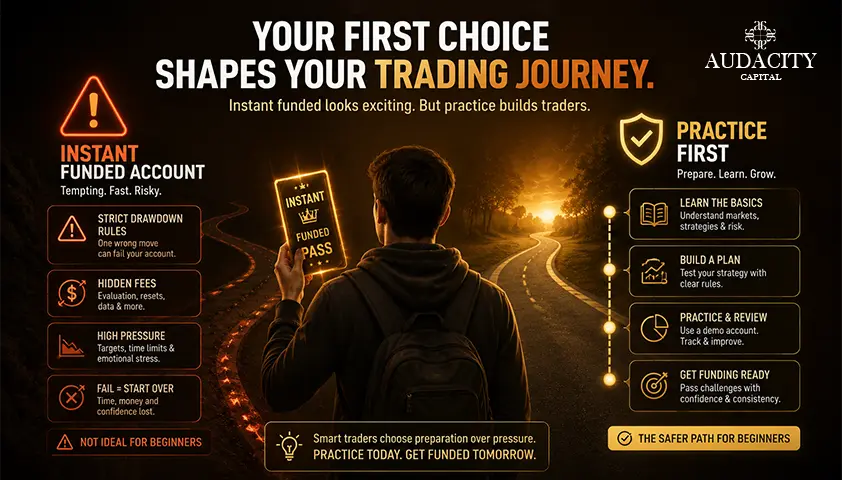
None of these reasons are meant to discourage you from trading. They are meant to protect your money and your confidence while you are still learning.
All of these are not intended to dissuade you from trading. They should help you to safeguard your finances and your trust while you're still getting the hang of it.
Here are the five honest answers as to why, “is instant funding good for beginners” is frequently “not yet.”
1. The evaluation is a training ground, not just a hurdle
A challenge is easy to perceive as a nuisance barrier separating you from the capital. It's even more helpful than that.
An evaluation not only requires you to develop a trading plan, but also involves practicing risk management and demonstrating your ability to be consistent over time. That's the kind of skill that always keeps funded traders funded! Skip the evaluation and you do not skip the lessons. It's just that you end up learning them on a more costly account.
2. Instant accounts often have tighter, less forgiving drawdown rules
Since the firm has not seen you execute trades, it takes care of its capital from your first trade. It means more strict drawdown regulations, and sometimes even a trailing or tightening drawdown which will follow your gains and provide less room to make errors.
The problem is that these strict rules punish the very errors that beginner traders do all the time: overtrading, revenge trading after a failure, and over-sizing the position. It is just easier to breach the rules for a novice. A novice is just more prone to breach.
3. A bigger, non-refundable fee is more to lose
Instant accounts are generally more expensive than a similar challenge as you are paying for instant access. So, when a beginner violates, and many do, they end up paying a larger non-refundable fee than the smaller evaluation would have cost. The numbers are just not in favor of a new trader here.
4. There is no proving phase and more pressure
Switching from a demo to a funded account affects your decision making process, even with a simulated capital. The weight of trades taken in practice are suddenly heavier.
This is trading psychology doing what it does, real consequences change the behaviour. An evaluation helps you get used to that pressure. Instant funding puts you straight into the deep end with no warm up.
5. It makes no one profitable
This is the one to keep in mind. An instant funded account provides you with the capital and structure. It doesn't help you have an advantage. The beginner who doesn’t have the tested system will definitely lose their fee regardless of whether it’s an instant funded account or not. The only difference is that instant funding makes things happen faster, while following more stringent conditions.
From an impartial viewpoint: a challenge is not easy or safe either. Many newbies experience failures in challenges as well. The point here is that the challenge is a cheaper way to create discipline in the process, so it's not a guarantee.
When an instant funded account can work for a beginner
Now the other side of the coin because it's not a blanket ban. An instant funded account may be worth considering for a novice trader under the following circumstances:
1. You have some real demo experience: You have actually spent some meaningful time on a demo account and you have a tested, rule-based approach, although you have not gone live.
2. You know the exact account rules prior to buying: Drawdown type, daily loss limit, payout schedule, everything.
3. You have realistic expectations: You are aware that it is not a quick path to profit and most traders, on instant accounts or challenges, don't get profitable all the time. Realistic expectations are not being negative. They are protection.
4. You can comfortably afford to lose the fee. You're not investing it for a sure profit, but rather paying tuition fees.
5. You truly appreciate instant access and are ready to honor strict rules to get it.
6. You are beginning with a small account size, and not the largest one available.
In simple terms, this is a near-beginner who would probably pass an evaluation however just chooses to skip it, knowing precisely what the expense would be.
That is an exception and not the rule. If most but not all of these are present, then it's a sign to wait a little longer rather than a green light.
What a beginner should look for in an instant funded account
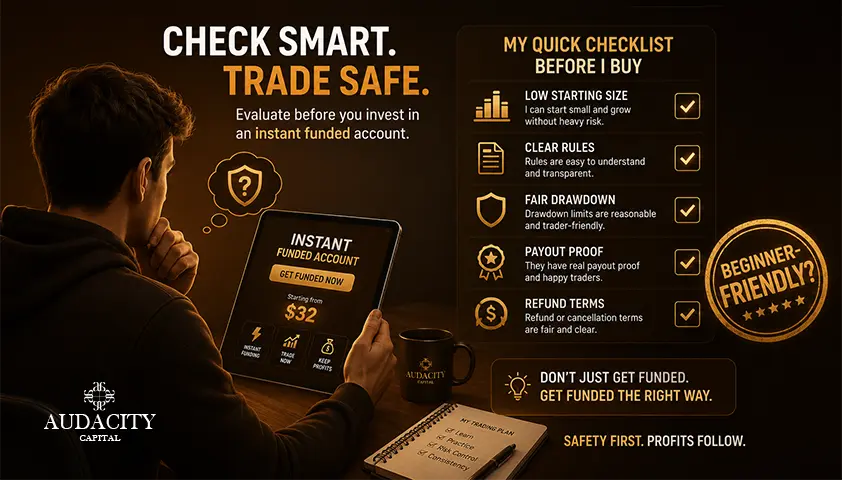
If you're thinking of opting for instant funding, these are some tips on how to do it correctly. This is the quick answer to what's the best instant funding for beginners; not the cheapest or biggest, but the most forgiving and transparent.
What to prioritize | Why it matters for a beginner |
Static drawdown, not tight trailing | A fixed floor is much more tolerant of a new trader's pullbacks and errors. A static drawdown stays put instead of chasing your gains. See static vs trailing drawdown. |
Legitimate firm with proven payouts | Research their reputation and verify that real traders are paid. Read our guide on whether instant funding prop firms are legit. |
Smallest sensible account size | Find out the firm's rules before paying a larger fee. Start small. |
Transparent, published rules | No hidden or “catch-all” provisions. If the rules are not clear, walk. |
An affordable, non-refundable fee | It's money that you can afford to lose without pain. |
A special note on a pattern: an instant account that charges a much lower than standard evaluation fee is a warning sign to read all the rules, and not a bargain to grab.
Low cost is usually accompanied by more limitations in the fine print. The above is a general trend in the industry, not an opinion on any specific firm.
How a beginner should approach instant funding safely
If you want to do this, do it following this guide. Consider it to be a mentor's advice, not a warning label.
Step 1: Practice first with a demo account. Establish a consistent, rules-based approach before you spend any money. Your strategy should be in practice and working!
Step 2: Start with the smallest account size. Know the firm's guidelines firsthand before paying higher fees.
Step 3: Read and understand all rules prior to purchase. Type of drawdown (as measured), daily loss limit, consistency rule, minimum days to trade and the payout schedule. Here surprises cost money.
Step 4: Choose a firm that has a fixed static drawdown and has a solid payout record. This will provide you with more room and more assurance that you will get paid.
Step 5: Risk small per trade and protect against the tight drawdown. No overtrading. No revenge trading after a losing position. Your risk management is what keeps the account alive.
Step 6: View the fee as tuition. It's the cost of learning and access, it's not an investment with a fixed return.
Step 7: Have a plan for a breach. It is probable to happen early on. If it does, don't try to recover the loss by making an impulsive purchase. Take a step back, observe what went wrong and make a measured decision.
This calm, structured approach is the difference between a controlled learning experience and an expensive lesson in trading psychology.
The better first step for most beginners
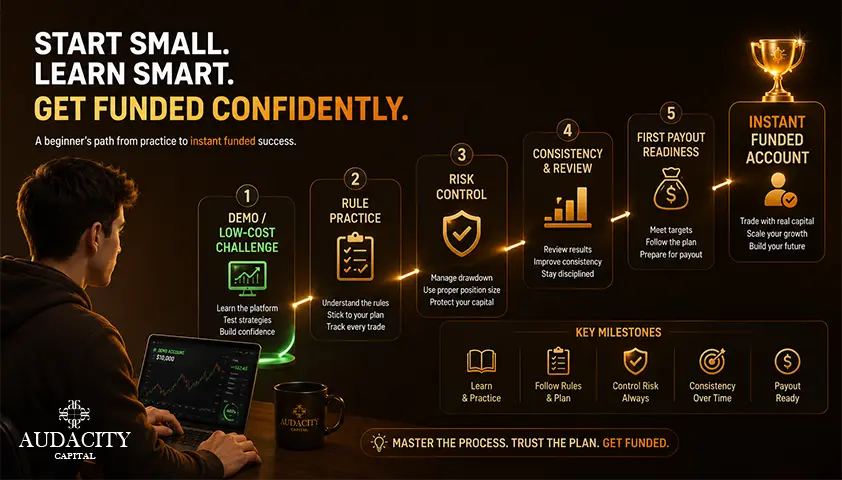
Well, here's the straight talk, given as a guideline and not a rule.
If you're a true beginner, the better route to go is to practice your trade on a demo account before attempting a low-cost evaluation or challenge.
Why this works better:
- It is also more affordable, and your mistake is not as costly.
- The assessment develops a new trader's real skills and abilities.
- It's a less expensive method to determine if you have a good edge before you spend more money on an instant fee.
There is also a lower-risk option to be aware of: a free competition that offers a funded account. That allows the beginner to try their hand without any cost and no risk. You put in effort, not money.
For the record, the challenge route is not a magical route. Most novices fail the first time and it is perfectly natural. But, if the challenge fails, it will teach you something at a much cheaper price than it will if it is broken in an instant account.
And none of this is permanent. You can always move to instant funding later, once you are consistent and value the speed. Starting the slower way is not a consolation prize. It is the path that gives a new trader the best chance.
Where Audacity Capital fits
Audacity Capital supports a beginner at every stage of this journey, which is exactly why the instant funded account for beginners question does not have to be all-or-nothing here.
1. A free monthly competition. It costs nothing to enter, and the prize is a funded account. For a new trader, this is a genuinely no-risk way to test your skills before spending a penny.
2. Evaluation routes that build discipline. The Ability Challenge and Ability One let you prove your approach at a lower cost than jumping straight into instant funding.
3. An instant Funded Trader Program for when you are ready. Our FTP uses a forgiving fixed static drawdown of 5% daily and 10% maximum, rather than the tight trailing limits that catch beginners out elsewhere.
That static drawdown point matters more than it sounds. A fixed, predictable floor is more forgiving of the mistakes new traders make than a limit that tightens as you trade. It gives you room to learn.
When you are ready to test yourself, start with the free competition or explore the Funded Trader Program.
FAQ
Yes, anyone can buy one. But "can" is not the same as "should." A complete novice with no demo practice and no tested strategy will likely breach the account quickly and lose the fee. Practicing on demo and starting with a challenge is usually the wiser move.
For most beginners, a low-cost challenge is the better first step, because it is cheaper and the evaluation builds the discipline you need. Instant funding tends to suit a beginner only once they have practiced enough that they could pass an evaluation anyway.
No. It gives you capital and structure, not a trading edge. Instant funding does not make anyone profitable, and a beginner without a tested, rule-based strategy will lose the fee either way, just faster under tighter rules.
There is no fixed number. The honest test is whether you could pass a standard evaluation right now. If yes, you are prepared enough to consider instant funding. If no, you are likely not ready for the bigger fee and tighter rules yet.
Practice on demo first, start with the smallest account size, and read every rule before buying. Choose a firm with a fixed static drawdown and proven payouts, risk small per trade, and treat the fee as tuition you can afford to lose.
Often, yes. Instant accounts tend to have tighter, sometimes trailing, drawdowns because the firm carries risk from day one. Those rules punish the impulsive mistakes new traders make, so a beginner can breach an instant account more easily.
A genuinely free route is rare, but some firms run free competitions where the prize is a funded account. That is a no-cost, no-risk way for a beginner to test their skills. Instant funding itself always carries a fee.
The smallest you reasonably can, so you learn the firm's rules cheaply before risking a bigger fee. Buying a large instant account as your very first account mostly means paying a premium to make beginner mistakes.

Bereit, diszipliniertes Risiko auf Krypto anzuwenden? Entdecken Sie die neuen Krypto-Instrumente von Audacity Capital und bringen Sie Ihre Trading-Strategie mit.
Mehr erfahrenNewsletter
Treten Sie unserem Newsletter bei, um auf dem Laufenden zu bleiben.
Treten Sie unserer sozialen Gemeinschaft bei

Beginnen Sie Ihre Reise heute Mit unserer kostenlosen Testversion
Präsentieren Sie stolz Ihre Fähigkeiten und Leistungen durch Zertifikate und erhalten Sie Anerkennung für Ihre harte Arbeit und Ihr Engagement von potenziellen Investoren und Kollegen.
Kostenlose TestversionVerwandte Artikel

How to Know if a No Deposit Instant Funded Account Real or Myth?
Are the prop firms' claims to give instant funded free accounts without any deposit real? Here's the truth, the red flags to avoid, and actual ways to get paid.

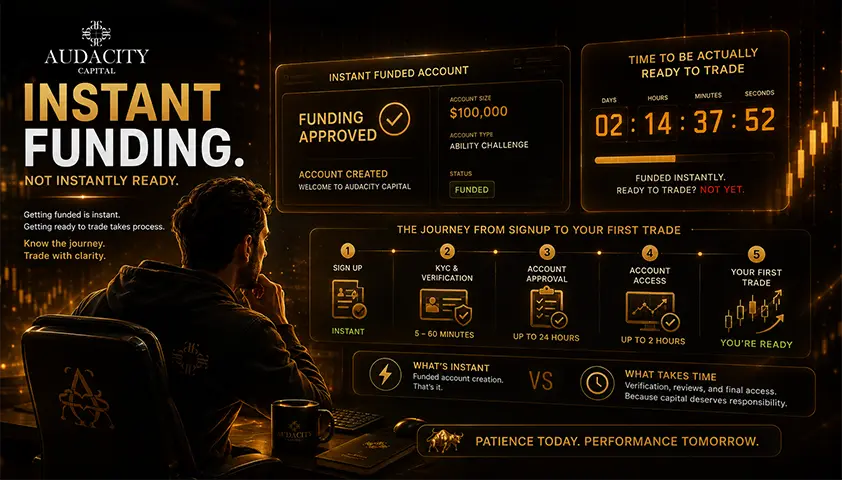
What 'Instant' Really Means: How Fast You Actually Get a Funded Account
The word "instant" is widely misunderstood in prop trading. Learn how fast you get a funded account in practice, same day or within 24 to 48 hours.

What Size Instant Funded Account Should You Start With?
That bigger account size on the checkout page looks tempting, but what size funded account to start with comes down to fee risk and discipline. Here is how to choose well.
Instant Funding Prop Firm Rules Explained
Instant funding prop firm rules start at the first trade. Learn how daily drawdown, payout milestones, prohibited practices, and scaling really work on an instant funded account.