


What Are Prop Firms in Trading? How They Work



If you have spent any time around trading lately, you have seen the term everywhere. Prop firms have changed how people get into serious trading, and for good reason. But a lot of what gets written about them is either vague or trying to sell you something. This is the plain version: what a prop firm actually is, how the model works step by step, how these firms make their money, and how to tell a solid one from a shaky one.
THE SHORT ANSWER A prop firm (short for proprietary trading firm) gives you access to its capital to trade, in exchange for a share of your profits. You prove your skill in a paid evaluation, and once you pass, you trade a funded account under set risk rules and keep most of what you make. The one thing you risk personally is the evaluation fee. You are not putting your savings on the line, but that fee is usually non-refundable, and most people who start a challenge do not pass it. |
What is a prop firm?
A prop firm is a company that trades with its own money and brings in skilled traders to help generate returns. The name is short for proprietary trading, which simply means trading the firm's capital rather than money that belongs to outside clients.
That last part is what sets a prop trading firm apart from a regular broker or a hedge fund. A broker earns commissions by executing your trades with your money. A hedge fund invests money pooled from outside investors. A prop firm risks its own capital and shares the upside with the traders who produce it. In the modern, online version that most people mean today, you get access to that capital by passing an evaluation, and you can usually do the whole thing from your laptop.
How do prop firms work?
Almost every retail prop firm runs on the same four-step model. Once you see it, the whole industry makes sense.
- 1. Pass a paid evaluation. You pay a fee and trade a simulated account, aiming to hit a profit target (often around 8 to 10 percent) while staying inside two limits: a daily loss cap and a maximum drawdown. Some firms use one phase, others use two. This fee is the main thing you risk.
- 2. Get your funded account. Clear the evaluation and the firm gives you a funded account to trade under live market conditions. At most firms, including Audacity, this account is simulated, so you are trading real prices with the firm's capital rather than your own.
- 3. Trade within the rules. You keep the same guardrails: a daily loss limit and a maximum drawdown. Break either one and the account can be closed, even if you were up overall. Follow them, and you can often scale to a larger account over time.
- 4. Get paid. When you make a profit, you withdraw your share on a set schedule, usually every two weeks or once a month. Profit splits across the industry commonly run from 50 to 90 percent in the trader's favor.
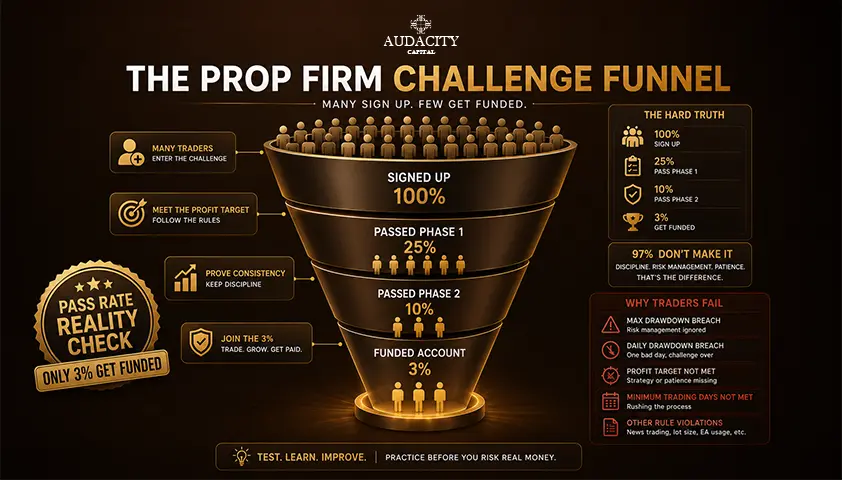
That is the entire model. The appeal is real: you can trade meaningful size without risking your own savings. But be clear-eyed about it. A funded account is capital and structure, not an edge. It does not make you a profitable trader, and industry data shows most people breach a limit before they ever reach a large payout. Treat it as a way to build and prove skill, not a shortcut to income.
How do prop firms make money?
A prop firm earns in two main ways, and understanding them tells you a lot about whether a firm is on your side.
The first is evaluation fees. Every trader pays to attempt a challenge, and that fee is collected whether they pass or fail. For many retail firms, this is the biggest source of revenue. The second is the firm's share of trader profits, which only shows up when its traders actually succeed. The honest tension sits right there: a firm that makes most of its money from failed challenges has very different incentives than one that makes its money from traders who win. That is why the business model is worth a look before you pay anyone. For a deeper breakdown, see our guide to the prop trading business model.
Types of prop firms

Not every prop trading firm works the same way. They fall into two broad worlds.
Institutional prop desks are the traditional kind: banks and large trading firms that trade their own money through in-house employee traders, often with sophisticated strategies and hundreds of millions in capital. You do not "join" these by paying for a challenge, you get hired, usually with strong credentials.


Audacity Capital Empowering Traders Since 2012
Join the Prop FirmRetail prop firms are the online model that has taken off since 2020, and the one this guide is really about. You earn access to capital by passing an evaluation, and most of these firms are fully remote, so traders from around the world can take part. A few still run a physical office where traders work from a desk, but the large majority operate entirely online to keep overhead low and reach a global audience.
Read more about our detailed guide Types of Prop Trading Firms
How prop trading differs from other trading
The quickest way to understand a prop firm is to line it up against the other ways people trade. The difference comes down to one thing: whose money is at stake.
Model | Whose capital | Your personal risk | How you earn | How you get in |
|---|---|---|---|---|
Retail trading | Your own | All of it | Keep all the profit, absorb all the loss | Open a broker account |
Prop trading (retail) | The firm's | The evaluation fee | A profit split, often 50 to 90% | Pass a paid evaluation |
Hedge fund | Outside investors' | None, you are an employee | Salary and bonus | Get hired, credentials needed |
Institutional desk | The bank or firm's | None, you are an employee | Salary and bonus | Get hired, credentials needed |

Retail trading gives you full control and full risk. Prop trading trades some of that autonomy for the firm's capital and a rulebook. Hedge funds and institutional desks are jobs you apply for, not programs you buy into. If you want the full comparison with managed funds, read prop trading vs hedge funds.
The pros and cons of prop firms
A prop firm is a genuinely useful tool for the right trader, and the wrong fit for others. Here is the honest picture of both sides.
The upside
- You trade real size without risking your own savings, since the capital is the firm's.
- The daily loss and drawdown limits force the kind of discipline that keeps traders in the game.
- You get access to platforms and tools that would cost a lot to run on your own.
- You keep the large majority of the profit you generate, and you can often scale to a bigger account.
The trade-offs
- You pay a fee that you lose if you do not pass, and it is usually non-refundable.
- Most people fail the evaluation, and most funded traders breach a limit before a large payout.
- The rules are strict, and a single bad day that breaks a limit can end the account.
- The capital is a resource, not a guarantee. It does not make you profitable on its own.
How to choose a legitimate prop firm
Not all prop trading firms are built the same, so before you pay any evaluation fee, do a little homework. Three things matter more than the headline numbers.
Proven payouts. A high profit split means nothing if the firm is slow to pay or disputes withdrawals. Look for a track record of real payouts and clear withdrawal terms, not just a big percentage on the homepage.
Clear, documented rules. You want plain definitions of maximum drawdown and daily loss, worked examples of exactly when an account fails, and rules that cannot be changed on you after the fact. If the termination conditions are vague or read differently on different pages, treat that as a warning sign.
Operational transparency. A trustworthy firm tells you whether accounts are live or simulated, how disputes are handled, and how often the rules change. If the answers are buried in fine print or you cannot get a straight one, assume more risk. Watch for the biggest red flag of all: a firm whose income clearly depends on traders failing rather than succeeding.

Audacity Prop Trading Challenges
Free Prop Firm ChallengeWhere Audacity Capital fits
Audacity Capital is a forex and CFD prop firm that has run on this model since 2012, using MetaTrader 5 and DXTrade in a simulated, skill-building environment. There are three ways in: a two-step Ability Challenge, a one-step Ability One, and an instant Funded Trader Program for traders who would rather skip the evaluation. Drawdown is static and the daily loss limits are published up front, so you always know where the lines are, and the profit share runs up to 90 percent on the challenge route.
If you want to see how the model feels before paying for anything, there is also a free monthly trading competition you can enter. Either way, we will be straight with you: the capital and the structure are what we provide, but the trading is still on you. Most challenges are failed, so the smart move is to treat a funded account as a way to prove real skill, not a fast track to a paycheck. If that is the kind of firm you are looking for, start with our funded program.
The bottom line
A prop firm gives skilled traders access to real capital in exchange for a share of the profits, and it does it without asking you to risk your savings. You pass a paid evaluation, trade a funded account inside clear risk rules, and withdraw your split. The model is a genuine opportunity, as long as you go in understanding that the fee is real money, most people do not pass, and the capital is a tool rather than an edge. Learn how the model works, pick a firm that pays and plays fair, and it can be one of the best ways to build a trading career.
Frequently asked questions
Not in the way you would trading your own account. You are not putting your savings at risk on the trades, because the capital belongs to the firm. What you do risk is the evaluation fee, which is usually non-refundable, so you lose it if you do not pass. Think of that fee as the real cost of entry.
At most retail prop firms, including Audacity, the funded account is simulated. That means you trade real market prices with the firm's capital under live conditions, but the account itself is a simulated one. The payouts you earn, however, are real money.
For the online retail firms, no. You do not need a professional license or formal qualifications to take a challenge and get funded. You just have to pass the evaluation and follow the rules. Institutional desks at banks are the opposite, since those are jobs with strict hiring requirements.
A prop trading company is a firm that enables carefully selected traders to trade with its capital, thereby eliminating all personal risk to the trader in exchange for profit splits.
It depends on the route. Instant funding programs can activate an account within minutes to a day or two. Challenge routes take as long as you need to hit the profit target while meeting the minimum number of trading days, so the timeline is largely in your hands.
Breaking a core rule, usually the daily loss limit or the maximum drawdown, normally closes the account, even if you were in profit at the time. Some firms let you reset a failed challenge for another fee and try again, which is worth checking before you sign up.
No. You’ll not be risking your own funds when trading. Once you become funded, you’ll start to use the prop firm’s money. But remember, you must pay the evaluation fee and pass this phase to get funded.
They can, but a funded account is not a substitute for learning to trade. Beginners often do better practicing on a demo account or a free competition first, then paying for a challenge once they have a consistent approach, rather than burning through evaluation fees while they are still finding their feet.
A legit prop trading firm like Audacity Capital ensures that all its rules, payout terms, and drawdown calculations are clearly documented. If you’re unable to understand the rules provided by a firm, walk away, as this is the first red flag to look for in a firm.
It is almost always a rule breach rather than a lack of profit. Traders blow the daily loss limit or the drawdown by taking oversized positions or chasing the profit target too quickly. Passing is less about big wins and more about staying inside the limits while you grind toward the target.
No. The payouts from a prop firm are usually conditional and based on your ability to observe its rules. This means that your account may also get terminated, no matter how profitable it is, if you show that you can’t follow the rules in place.
No. Many remote prop trading firms do not require their traders to possess professional qualifications or even a license.
Related Articles
Check more about How to Find the Top Prop Firm for a Beginner Trader?
Read about our latest guide about What Is Prop Trading?
As you contemplate these various types, please check out our guide on Comparing Prop Trading Firms.
To get you started, we have prepared a detailed guide on how prop trading firms work.
Read learn more about Prop Firm For Stocks
Learn more about our latest guide What to Look for in a Prop Trading Firm
choosing the right prop trading firm is to understand that not all prop trading firms operate the same.
Are you interested in learning more about Prop Firm Trading No Eval
Read here learn more about Understanding Prop Trading Challenges & Rules
Check here about Red Flags in Prop Trading Firms
Learn more about Prop Trading Vs Retail Trading

Bereit, diszipliniertes Risiko auf Krypto anzuwenden? Entdecken Sie die neuen Krypto-Instrumente von Audacity Capital und bringen Sie Ihre Trading-Strategie mit.
Mehr erfahrenNewsletter
Treten Sie unserem Newsletter bei, um auf dem Laufenden zu bleiben.
Treten Sie unserer sozialen Gemeinschaft bei

Beginnen Sie Ihre Reise heute Mit unserer kostenlosen Testversion
Präsentieren Sie stolz Ihre Fähigkeiten und Leistungen durch Zertifikate und erhalten Sie Anerkennung für Ihre harte Arbeit und Ihr Engagement von potenziellen Investoren und Kollegen.
Kostenlose TestversionVerwandte Artikel

Do You Pay Taxes on Prop Firm Payouts? A Funded Trader's Guide
In almost every country, prop firm payouts are taxable income, not capital gains. Learn how they are taxed, what you can deduct, and why records matter.


10 Best Prop Trading Firms in Malaysia in 2026
Compare the 10 best prop trading firms in Malaysia for 2026, ranked on swap-free accounts, payout speed, fees, and payments that work from Malaysia.
Prop Firm Pass Rate: What Percentage Actually Get Funded?
Learn the real prop firm pass rate, why estimates vary, how many traders get funded, and what the data says about payouts and repeat attempts.

Best Local Payment Methods for Forex Prop Trading
Compare the best local payment methods for forex prop trading by region and learn faster, cheaper prop firm withdrawals with fewer delays.