



What Is Leverage in Forex Trading?



Leverage in forex trading means using a relatively small amount of your own capital to control a larger market position. For example, with 1:100 leverage, $1,000 could provide up to $100,000 in market exposure, subject to the broker’s margin requirements. How leverage works in forex trading is therefore based on the relationship between your capital, required margin, and total position exposure.
What Is Leverage in Forex Trading?
Leverage in forex trading is a financial mechanism. With leverage, traders control a larger market position with a smaller amount of their own capital. A broker provides access to greater market exposure based on the amount of margin a trader is required to maintain. This allows traders to participate in currency markets without committing the full value of each position from their own account.
The amount of leverage available is expressed as a ratio like 1:10, 1:50, or 1:100. These ratios show how much market exposure can be controlled for each unit of the trader's capital, subject to the broker's margin requirements and applicable rules.
For example, with 1:100 leverage, a capital of $1,000 could support a position with a nominal value of up to $100,000 under the relevant margin requirement.
To understand leverage meaning in forex trading, knowing the difference between account capital and market exposure is important. Account capital represents the funds held by the trader, while market exposure refers to the total nominal value of the position being controlled.
For example, a standard lot of EUR/USD represents 100,000 units of the base currency. With a 1:100 leverage ratio, a trader could potentially control a $100,000 position while providing $1,000 as the required margin in a simplified example. The broker's margin requirement determines how much capital must be committed to support that position.
Leverage is widely used in forex because currency prices often move in relatively small increments. A modest price movement can produce a limited dollar gain on a small unleveraged position. By increasing market exposure, leverage gives those price movements a greater financial impact on the trader's account.
This also means that leverage affects losses in the same way it affects gains. A larger position creates greater exposure to each price movement, so the effect on account equity becomes more significant as position size increases.
What Does Leverage Mean in Forex Trading?
Leverage in forex trading is the ability to gain greater market exposure relative to the capital in your account. A higher leverage ratio reduces the proportion of the position's value that must be provided as margin, which can increase the amount of exposure available to the trader.
It is useful to distinguish between available leverage and realized leverage. Available leverage is the maximum leverage offered by the broker under its rules and account conditions. Realized leverage represents the actual value of a trader's open positions compared with their account capital.
How Does Leverage Work in Forex Trading?
The mechanics of leverage in forex trading can be understood through four connected elements: account capital, margin, leverage, and position exposure.
Your account capital provides the funds available in your trading account. When you open a leveraged position, the broker determines the margin required to support that trade. Margin is the amount of capital committed as collateral for the position. The leverage ratio then determines how much market exposure can be supported relative to that capital.
For example, consider a trader with $1,000 in account capital:
Leverage | Capital | Position Exposure |
1:10 | $1,000 | $10,000 |
1:50 | $1,000 | $50,000 |
1:100 | $1,000 | $100,000 |
The margin required for a position is linked to the leverage available. A 1:10 ratio corresponds to a 10% margin requirement, while 1:50 corresponds to 2% and 1:100 corresponds to 1%. This inverse relationship means that a higher leverage ratio requires a smaller percentage of the position's value to be provided as margin.
The exact amount of margin required can vary depending on the broker, instrument, account structure, and applicable regulatory rules. Currency pairs may also have different requirements, particularly where an instrument carries greater volatility or falls under specific broker risk controls.
It is also important to distinguish the amount of leverage available from the amount actually used. A trader may have access to 1:100 leverage while opening a position that represents only 2:1 or 5:1 exposure relative to their account capital. The leverage setting determines the available capacity, while the size of the position determines the trader's actual market exposure.
Once this relationship is clear, the next step is to see how different position sizes change the effect of the same forex price movement.
Forex Leverage Example
A practical example can make the relationship between leverage, position size, and account capital easier to understand. Suppose a trader has $1,000 in their account and has access to 1:100 leverage.
Under a simplified 1% margin requirement, the trader could theoretically control a position worth up to $100,000:
$1,000 × 100 = $100,000
For this example, assume the trader opens a 1.0 standard lot GBP/USD position at an exchange rate of 1.3000. A standard lot represents 100,000 units of the base currency, and a 1-pip movement in GBP/USD is worth approximately $10 for a position of this size.
If GBP/USD moves 40 pips in the trader's favour, from 1.3000 to 1.3040, the resulting profit would be:
40 pips × $10 per pip = $400
The trader's $1,000 account would therefore increase to $1,400 before trading costs, representing a 40% return on the initial account capital.
The same position produces an equal loss if the market moves 40 pips in the opposite direction. If GBP/USD falls from 1.3000 to 1.2960:
40 pips × $10 per pip = $400 loss
The account would fall from $1,000 to $600, equivalent to a 40% reduction in the original capital.
This example also shows why you should not confuse maximum theoretical exposure with an appropriate position size. A $100,000 position on a $1,000 account uses the full theoretical exposure available at 1:100 leverage, leaving no additional capital buffer in this simplified example. The actual margin and account requirements depend on the broker, instrument, and applicable trading rules.
How to Calculate Leverage in Forex Trading?
Calculating leverage in forex trading involves comparing the total value of a position with the trader's available capital. The basic formula is:
Leverage = Total Position Value ÷ Trader's Capital
For example, suppose a trader has $5,000 in account equity and opens a EUR/USD position of 20,000 units when EUR/USD is trading at 1.1000.
First, calculate the position's nominal value:
20,000 × 1.1000 = $22,000
The trader's realized leverage is therefore:
$22,000 ÷ $5,000 = 4.4:1
This means the trader is controlling $4.40 of market exposure for every $1 of account capital.
The calculation describes the leverage the trader is actually using on the position. It can be much lower than the maximum leverage offered by the broker. A broker might make 1:100 leverage available, for example, while the trader uses only 4.4:1 based on their position size and account capital.
How to Calculate Margin from Leverage?
Leverage and margin have an inverse mathematical relationship. The basic formula is:
Margin Requirement = 1 ÷ Leverage Ratio × 100
Using common leverage ratios:
- 1:10: (1 ÷ 10) × 100 = 10%
- 1:50: (1 ÷ 50) × 100 = 2%
- 1:100: (1 ÷ 100) × 100 = 1%
A higher leverage ratio therefore corresponds to a lower margin requirement, although the actual margin required for a trade depends on the broker, instrument, account type, and applicable rules.
Leverage vs Margin in Forex Trading
Leverage and margin are closely connected, but they describe different parts of a leveraged trade. Leverage shows how much market exposure can be controlled relative to the trader’s capital, while margin is the amount of capital the broker requires to support that position.
For example, with 1:100 leverage, a trader may be able to control $100,000 of market exposure with $1,000 of required margin, subject to the broker’s conditions and applicable rules.
Feature | Leverage | Margin |
What it describes | Position exposure relative to capital | Capital required to support a position |
How it is shown | Ratio, such as 1:100 | Percentage or monetary amount |
Example | 1:100 | 1% margin |
Basic calculation | Position value ÷ capital | 1 ÷ leverage ratio |
The two move in opposite directions mathematically. A higher leverage ratio corresponds to a lower margin requirement, while lower leverage requires a larger proportion of the position value to be provided as margin.
Our Leverage vs Margin in Forex Trading has a more detailed explanation.
Is High Leverage Good in Forex Trading?
The usefulness of high leverage in Forex Trading depends on how it is used and how much market exposure a trader takes.
High leverage allows a trader to control a larger position while committing a smaller amount of capital as margin. This can make capital allocation more flexible, especially when a trader does not want to commit the full value of a position to one trade.
The same feature can increase the impact of a losing trade. A larger position means that each movement in the currency pair has a greater effect on account equity. As a result, high leverage can magnify both gains and losses, particularly when the trader increases position size to use more of the available exposure.
This means a high leverage ratio does not, by itself, make a trading strategy more profitable. When deciding how much exposure to take, traders also need to consider their risk per trade, stop-loss distance, account drawdown limits, position size, and the volatility of the currency pair.
One useful distinction is between high leverage being available and high leverage being used.
High Available Leverage vs High Leverage Actually Used
A broker may offer 1:100 leverage, but that does not mean every position is traded at 100:1. Suppose a trader has $10,000 in account capital and opens a position worth $20,000. Their actual exposure is 2:1, even though 1:100 leverage is available on the account.
In this case, the higher leverage mainly reduces the amount of margin required to open the position. The trader's actual market exposure remains linked to the $20,000 position.
How Does Leverage Affect Forex Trading Risk?
Leverage affects forex trading risk by determining how much market exposure a trader can take relative to the capital in their account. But separate the leverage available on an account from the risk created by a particular trade. The actual profit or loss comes from the size of the position and the movement in the currency pair.
For example, a trader with $10,000 in account capital could hold a $100,000 position and therefore have 10:1 real leverage. If the same trader opened a $10,000 position, the real leverage would be 1:1. The broker could offer 1:100 available leverage in both cases, but the trader's actual exposure would be very different.
Leverage and Position Size
Position size is the point where leverage becomes a monetary risk. A larger position has a greater value for every pip the market moves. With a $100,000 position in a major currency pair, a one-pip movement may have an approximate value of $10. A $10,000 position would have an approximate pip value of $1, all else being equal.
This is why two traders with the same account balance can face very different outcomes. The amount of leverage their broker offers does not tell you how much they are risking on an individual trade. The position they actually open does.
Leverage and Stop-Losses
A stop-loss gives the trader a predefined exit level when the market moves against the position. The distance between the entry and stop-loss, combined with the position size, determines the potential loss before trading costs and any execution differences.
A larger position increases the value of each pip, so the trader may need to reduce the lot size when using a wider stop-loss. This allows the potential loss to remain within the trader's chosen risk level without relying on the maximum leverage available.
What Is Overleveraging?
Overleveraging occurs when the size of open positions becomes too large for the account to absorb normal market movements. It can leave a trader with limited free margin and very little room for a losing trade to recover.
One practical warning sign is when routine price movements regularly bring the account close to a margin call or when a single trade could remove a significant share of the account's capital. Keeping position size aligned with account equity, stop-loss distance, and risk per trade helps prevent leverage from becoming the main source of account drawdown.
What Is a Good Leverage for Forex Trading?
There is no single leverage ratio that suits every forex trader. An amount makes sense depending upon the exposure being taken, available capital, and how the trade is managed.
- Factors like account and position size, risk per trade, and stop-loss distance directly bear on the level a trader can reasonably carry.
- Trading style also matters. A short-term trader may open and close positions within a single session, while a swing trader may keep a position open for several days and face a different level of market exposure.
- Volatility can also change the amount of room a position needs before reaching its stop-loss or affecting the trader's margin.
- Broker requirements and regulatory restrictions are another part of the equation. A trader may have access to a certain leverage ratio on one account or with one broker and a different limit elsewhere.
For that reason, choosing leverage should begin with the amount of risk the trader is prepared to take and the position size required by the strategy. Only then can you view the maximum ratio available from the broker as a trading facility.
How Much Leverage Should a Beginner Use?
Again, there’s no universal beginner ratio as well. Beginners can easily manage their trades when actual exposure remains modest while they learn how position sizing, stop-losses, margin, and price movements interact. A lower level of real leverage leaves more account equity available to absorb normal market fluctuations.

Audacity's Trading Dashboard
Start Trading NowWhat Determines the Maximum Forex Leverage You Can Use?
The maximum forex leverage available to a trader depends on:
- The broker.
- Regulatory jurisdiction.
- Instrument.
- Account type.
- The margin requirements attached to the trade.
In short, no single leverage limit applies to every forex account.
Regulators can place limits on the leverage brokers may offer to retail clients, while brokers can also apply their own risk controls within those limits. The currency pair or other instrument can affect the requirement as well. Some instruments may require more margin because of their volatility or the broker's assessment of the underlying risk.
Account classification can also make a difference. Retail and professional clients may have different access to leverage under some regulatory frameworks, subject to the relevant eligibility requirements. The conditions attached to a specific account therefore matter as much as the headline leverage figure advertised by a broker.
Why Forex Leverage Limits Differ by Broker and Country?
Leverage rules differ between jurisdictions because financial regulators set their own requirements for how much exposure retail traders can take. A broker operating under one regulatory framework may therefore offer a different maximum ratio from a broker operating under another.
The instrument matters too. Major forex pairs, minor pairs and other leveraged products can be subject to different margin requirements. Brokers can also reduce available leverage or increase margin requirements when market conditions or position sizes warrant it.
For this reason, traders should check the current terms that apply to their specific account and instrument before opening a leveraged position. The leverage shown on a broker's website is not necessarily the ratio available to every client or every trade.
Check our guide about Best Leverage For Forex
Costs of Using Leverage in Forex Trading
Leverage can reduce the amount of capital needed to open a position, but leveraged trading still involves costs. The most familiar are the spread and, where applicable, trading commissions. Because these costs are linked to the trade itself, the size of the position remains important even when only a portion of its value is provided as margin.
For example, a trader may need only a fraction of a position's nominal value as margin, while the spread is still applied to the full trade size. This is one reason position size matters when assessing the overall cost of a leveraged trade.
Holding a position for longer can introduce another cost that is particularly relevant to leveraged forex trading.
Overnight Financing and Rollover
A forex position that remains open after the broker's daily rollover time may incur a financing charge or receive a financing credit. These amounts are commonly referred to as swap or rollover.
The amount depends on factors such as the currency pair, interest-rate differentials, the direction of the trade, and the broker's financing terms. Because the charge or credit is associated with the position exposure, a large position can create a more noticeable financing effect than a smaller one.
For traders who hold positions overnight for several days or longer, these costs can become part of the trade's overall return. Checking the broker's current swap or financing schedule can therefore be important when assessing the cost of maintaining a leveraged forex position.
Become a Funded Trader Today
Funded Trader ProgramLeverage in Forex Trading for Prop Firm Traders
Forex leverage can work differently for traders using a proprietary trading firm than it does for someone trading through a conventional retail forex broker. A prop firm sets the trading conditions for its own programmes, which can include the maximum leverage available, margin requirements, position-size rules and account-level drawdown limits.
At Audacity Capital, the current leverage settings differ between its funding routes. The Ability Challenge, offers 1:100 leverage on forex with the same forex leverage applying through its Verification and Live stages. The Funded Trader Program currently offers 1:30 leverageacross its assets.
The leverage figure sets the maximum exposure supported under the programme's trading conditions. It does not mean a trader has to use the full amount available. A trader with access to 1:100 leverage can still maintain much lower actual exposure by choosing smaller position sizes.
Prop-firm traders also need to consider the firm's other trading conditions. Drawdown limits, margin requirements, position-size restrictions, and rules governing how trades can be managed can affect how much exposure is practical within an account.
Important: Do not assume that a prop-firm leverage will work like the leverage offered by every retail forex broker. Conditions can differ between firms and between programmes within the same firm, so check the latest rules.
Guides About Trading Strategies
FAQ
Leverage in forex trading allows you to control a larger position with less of your own capital. For example, 1:100 leverage can provide up to $100,000 of exposure for $1,000 of capital.
Leverage describes the relationship between your account capital and the market exposure of a position. A 1:100 ratio means $1 of capital can support up to $100 of position exposure, subject to the applicable requirements.
Leverage allows a trader to open a position by providing a portion of its value as margin. The position size then determines how strongly price movements affect the account's profit or loss.
To calculate leverage in forex trading, use the formula below:
Leverage = Position Value ÷ Account Capital
For example, a $50,000 position on a $5,000 account represents 10:1 realized leverage.
High leverage provides access to greater market exposure with less required margin. Its effect on trading risk depends on the position size actually taken, so higher available leverage does not automatically mean higher or lower risk.
Leverage describes the relationship between capital and position exposure. Margin is the amount of capital required to open and maintain the position under the broker's or firm's trading conditions.
No. Higher available leverage can allow a trader to take a larger position, but profit depends on the position size and the market's price movement.
Yes. A larger leveraged position can make adverse price movements have a greater effect on account equity. The size of the position determines the actual monetary loss.
If account equity falls to a broker's or firm's required stop-out level, open positions may be closed automatically. The exact threshold and liquidation process depend on the account's trading conditions.
No. 1:100 describes the maximum available leverage in that example. Actual leverage depends on the size of the trader's open positions relative to their account capital.
Available leverage is the maximum leverage offered under the account's conditions. Actual leverage is the exposure of the trader's open positions relative to their account capital.

¿Listo para aplicar un riesgo disciplinado a las criptomonedas? Explore los nuevos instrumentos de cripto de Audacity Capital y traiga su estrategia de trading.
Aprender másBoletín
Únase a nuestro boletín para mantenerse al día.
Únete a Nuestra Comunidad Social

Comienza Tu Viaje Hoy Con Nuestra Prueba Gratuita
Muestra con orgullo tus habilidades y logros a través de certificados y obtén reconocimiento por tu arduo trabajo y dedicación de posibles inversores y compañeros.
Prueba GratuitaArtículos Relacionados
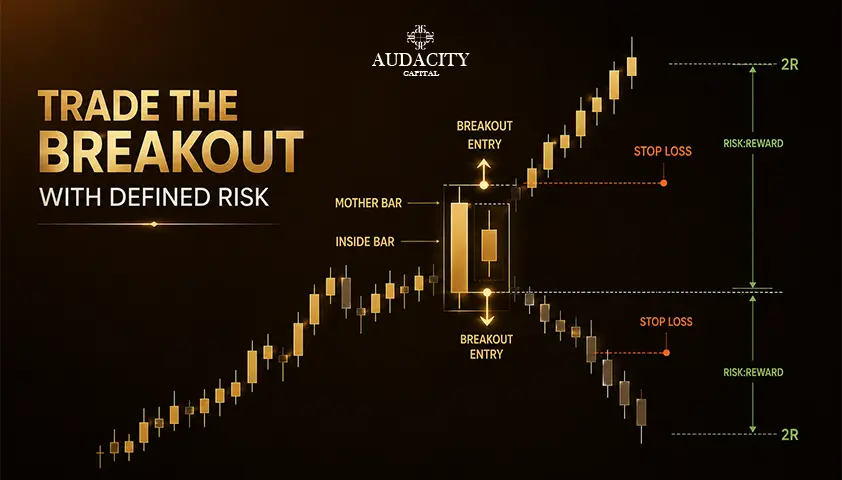
Inside Bar Trading Strategy: Rules, Entries and Risk Guide
Master the inside bar trading strategy with practical rules for pattern identification, entry triggers, stop placement, risk management, and testing.

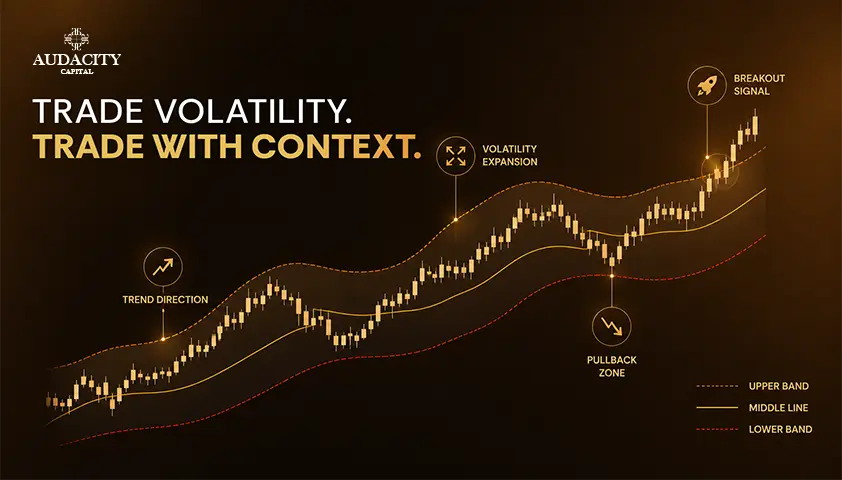
Keltner Channel Trading Strategy: How to Read Volatility With Context
Discover how Keltner Channels measure market volatility, spot trend pullbacks, and confirm breakouts. Includes setup rules, settings, and testing methods.
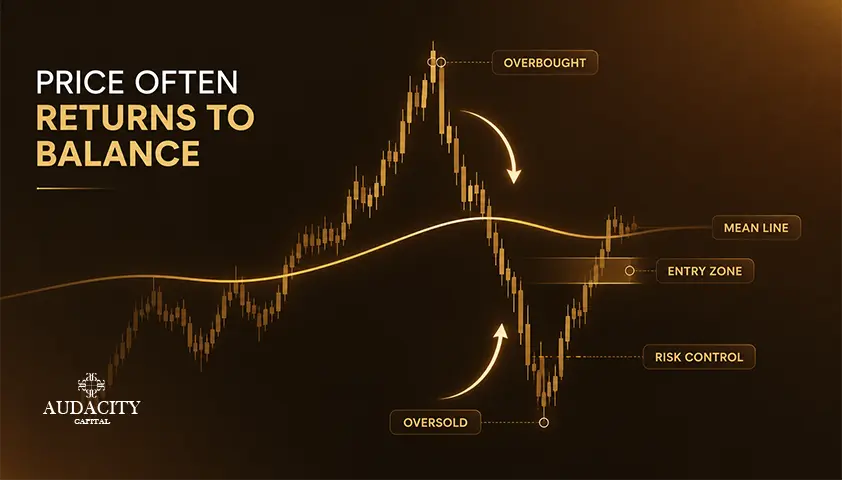
Mean Reversion Trading Strategy Explained (2026)
Prices that stretch too far tend to snap back to an average, but only in the right market. Learn the tools, the setup, and the trend risk.
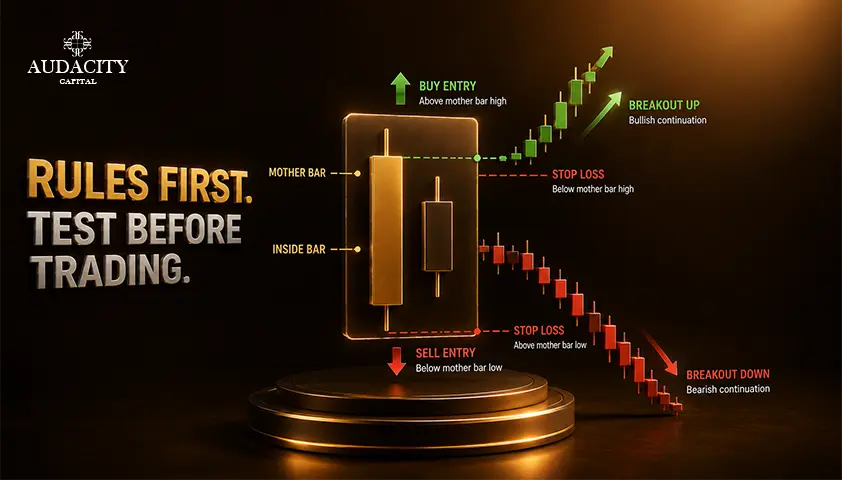
Inside Bar Trading Strategy: Rules, Entries and Backtest Guide
Learn a rule-based inside bar trading strategy. Get the pattern definition, three entry models, stop and target logic, and a backtest framework for your market.