


Expert Advisors in Trading: Rules, Restrictions and Risk Management


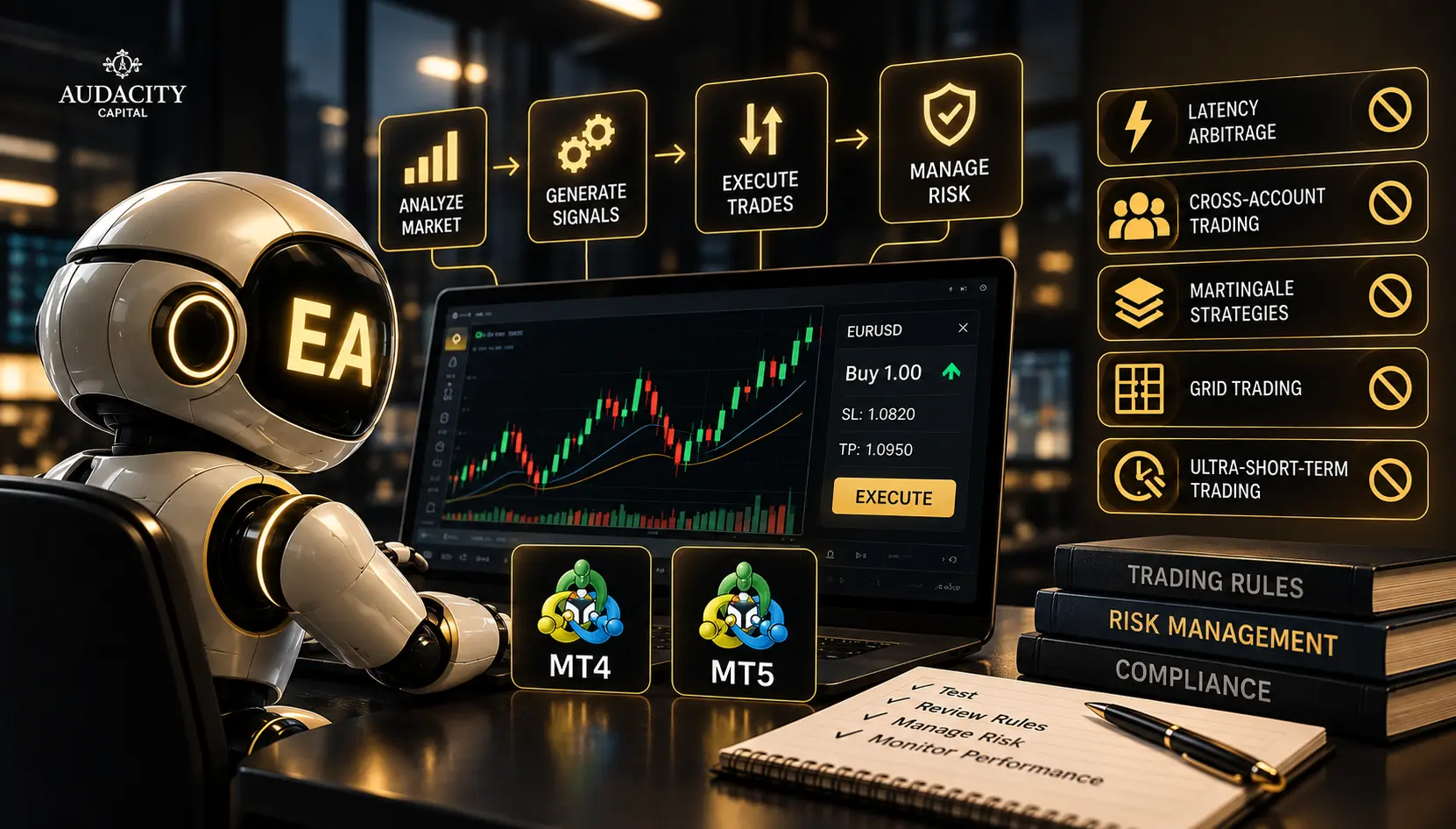
Introduction: Understanding Automated Trading
Automated trading has made it easier for traders to apply predefined rules, manage positions and execute trades without manually handling every step. One of the most widely used tools for this purpose is the Expert Advisor (EA), a programme that can automate trading activities on platforms such as MetaTrader 4 (MT4) and MetaTrader 5 (MT5).
However, using an automated system does not automatically make a trading strategy suitable for every trading environment. An EA's acceptability depends on how it operates, the risks it creates and the rules of the trading programme in which it is used.
At Audacity Capital, traders should understand the firm's current requirements before deploying automated systems. Certain approaches, including strategies that exploit price-feed delays or execution discrepancies, may be prohibited. Other methods may be subject to specific restrictions under the firm's trading rules.
This guide explains how Expert Advisors work, examines automated trading strategies that may raise compliance concerns, and outlines how traders can assess an EA before using it in a proprietary trading programme.
What Is an Expert Advisor (EA) in Trading?

An Expert Advisor is a software programme that automates trading tasks according to predefined instructions. Commonly used with MetaTrader platforms, EAs can monitor market conditions, identify trading signals, place orders and manage open positions.
Depending on its design, an EA may automate a single task, such as adjusting a stop-loss, or follow a complete trading strategy with specified entry and exit conditions.
How Do Expert Advisors Work?
An EA generally follows a set of programmed rules to process market information and manage trades.
The process typically involves:
- Monitoring market conditions: The EA reads available price data and other supported indicators.
- Identifying trading signals: It checks whether market conditions meet its programmed entry criteria.
- Executing orders: If the required conditions are met, the EA can submit a buy or sell order, subject to platform permissions and execution conditions.
- Managing positions: The programme applies its instructions for stop-losses, take-profits, position management or trade closure.
- Repeating the process: The EA continues monitoring the market while it is running and the relevant conditions are satisfied.
The quality of the outcome depends on the strategy, the accuracy of its programming, market conditions and execution costs. Automation can improve consistency, but it cannot guarantee profitable trades or eliminate risk.
EAs are one part of the wider development of algorithmic trading in forex markets, where software is used to analyse market data and execute predefined trading rules. However, algorithmic trading covers a broader range of systems than Expert Advisors alone.
Common Uses of Expert Advisors
Traders use EAs for a range of purposes, including:
- Automated trade execution: Opening and closing positions when predefined conditions are met.
- Trade management: Applying stop-losses, take-profits and other position-management rules.
- Technical analysis: Monitoring indicators or price patterns to identify potential trading opportunities.
- Risk controls: Applying programmed limits to position sizes or other aspects of trade management.
- Routine automation: Reducing repetitive tasks and monitoring multiple instruments.
An EA can support a systematic trading approach, but it still requires appropriate testing, monitoring and risk management.
Some traders also investigate using an EA to pass a prop firm challenge. Before doing so, they should understand the challenge requirements, the firm's rules on automation and the risks associated with relying on a programmed strategy. An EA cannot guarantee that a trader will meet a profit target or avoid a drawdown limit.
Are Expert Advisors and High-Frequency Trading the Same?
No. Expert Advisors and high-frequency trading (HFT) are related, but they describe different things.
An EA is a tool for automating trading tasks. HFT is a specialised trading approach that relies on very high-speed systems and often seeks to exploit short-lived market opportunities.
An EA can execute a conventional technical strategy, manage existing positions or apply a set of risk-management rules without operating as an HFT system. Similarly, a trade that opens and closes within seconds is not automatically high-frequency trading.
The distinction depends on how the strategy works, including its decision-making process, execution behaviour and reliance on speed or timing advantages.
For a detailed explanation of HFT, its technology, common strategies and market impact, read our guide to high-frequency trading (HFT).
Traders researching automated trading rules may also want to compare prop firms that allow HFT. Firm policies can differ, so review each provider's current terms rather than assuming that a strategy permitted by one firm will be accepted by another.
Automated Trading Strategies That May Be Restricted
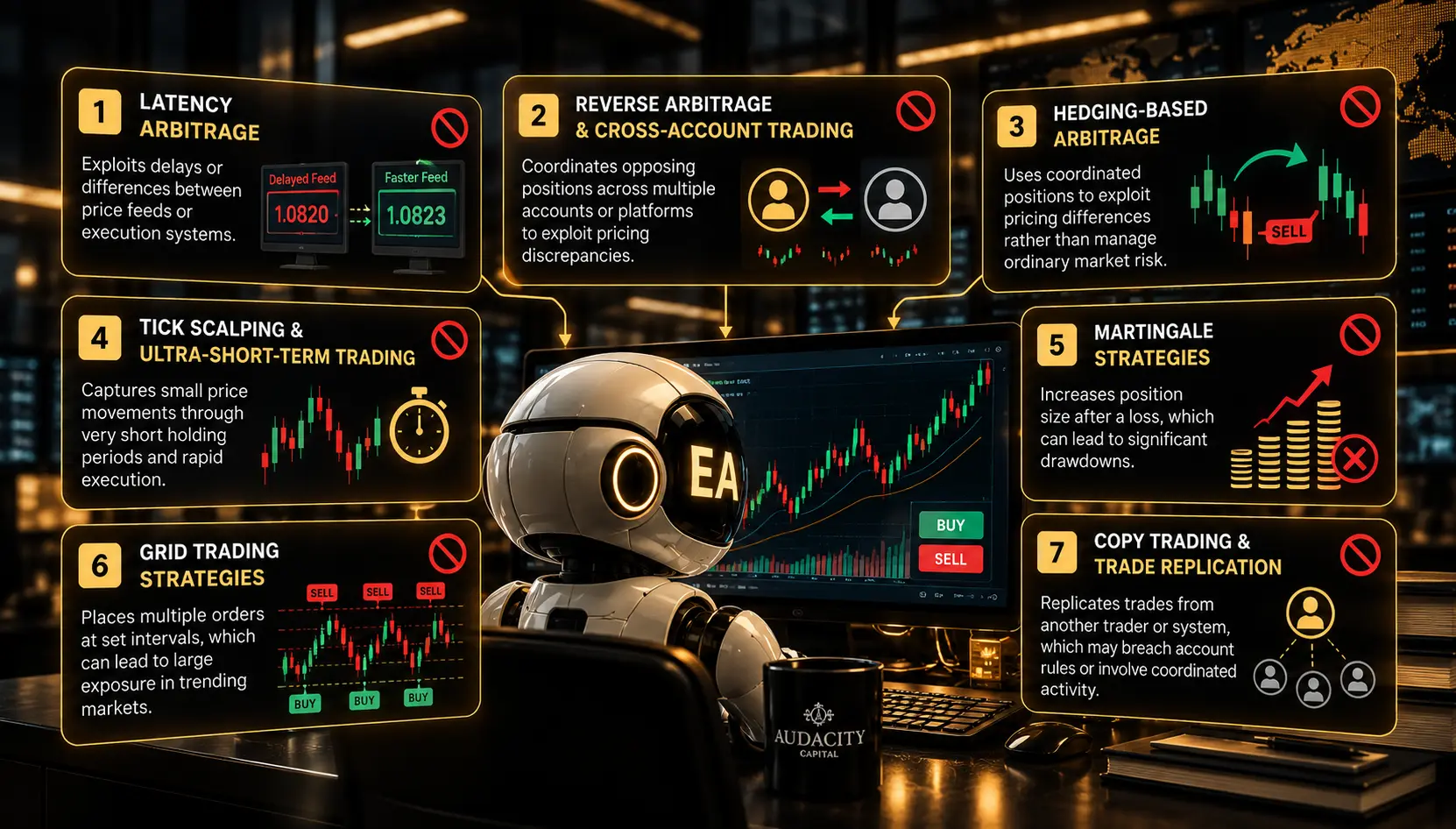
Automated trading covers many different methods. Some focus on technical indicators and systematic trade management, while others rely on position-sizing techniques, coordinated positions or pricing discrepancies.
The following strategies can raise compliance or risk-management concerns. Whether a particular method is prohibited depends on the firm's current trading rules and the way the strategy is implemented.
For a broader overview of conduct that may breach programme rules, review Audacity Capital's guidance on prohibited trading practices. Always refer to the current official policy when determining whether a specific EA or trading method is permitted.
1. Latency Arbitrage
Latency arbitrage attempts to exploit delays or differences between price feeds or execution systems.
For example, an automated system may compare the price displayed on a trading platform with a faster external feed. If the platform's quote has not yet updated, the system may attempt to trade against that delayed price before the discrepancy disappears.
This approach relies on a timing advantage rather than solely on a conventional market signal. It can raise concerns about fair execution and the use of technical delays to gain an advantage.
Traders should review the firm's policy on latency arbitrage before using any system that relies on external price comparisons or feed-timing differences.
2. Reverse Arbitrage and Cross-Account Trading
The term reverse arbitrage can have different meanings in different trading contexts. When reviewing a firm's prohibited-strategy rules, traders should focus on the specific behaviour described in the policy.
One area of concern is coordinating opposing positions across multiple accounts or platforms to exploit pricing discrepancies, execution differences or programme rules.
Such arrangements may be restricted even when the individual trades appear straightforward. Traders should check the applicable policy for the firm's precise definition of prohibited arbitrage and cross-account activity.
3. Hedging-Based Arbitrage
Hedging involves opening positions that offset some or all of the exposure of another position. It can be used as a legitimate risk-management technique.
However, coordinated positions across accounts or platforms may raise concerns if they are designed to exploit pricing differences or structural advantages rather than manage ordinary market risk.
Hedging should not automatically be treated as prohibited. Traders need to distinguish between legitimate position management and arrangements that breach the relevant trading rules.
4. Tick Scalping and Ultra-Short-Term Trading
Tick scalping seeks to capture small price changes, sometimes by entering and exiting positions rapidly. Some systems use automated execution to respond to individual price updates or short-lived market movements.
A short holding period alone does not prove that a strategy is HFT or violates a firm's rules. The relevant factors may include the strategy's design, how it generates trading signals and whether it exploits execution delays or other prohibited technical advantages.
Traders should consult the actual policy rather than judge compliance solely by the number of seconds a position remains open.
5. Martingale Strategies
A martingale strategy increases position size after a loss in an attempt to recover previous losses through a subsequent winning trade.
For example, an EA may increase the size of its next position after each losing trade. If losses continue, the required position size can grow quickly.
This approach can expose an account to substantial drawdowns and may run into margin or position limits before a recovery occurs. A larger position does not guarantee that the next trade will be profitable.
Whether martingale strategies are permitted depends on the specific rules of the trading programme. Traders should confirm the current policy before deploying an EA that uses this method.
6. Grid Trading Strategies
Grid trading places multiple orders at predetermined price intervals. Depending on its design, a grid system may attempt to benefit from repeated price movements within a range.
The main risk is that positions can accumulate as the market moves against the strategy. During a sustained trend, the resulting exposure and drawdown may become significant, particularly when position limits and exit rules are inadequate.
Grid trading is not automatically HFT. It is a separate strategy that may be restricted under a firm's rules for reasons related to risk or prohibited trading behaviour.
7. Copy Trading and Trade Replication
Copy trading involves replicating trades from another trader, account or trading system. The method may be offered through third-party platforms or account-linking services.
In a proprietary trading programme, restrictions may apply to coordinated activity across accounts, unauthorised trade replication or other arrangements that breach account-use requirements.
Copy trading rules vary between firms. Before using a trade-copying tool, traders should check whether it is permitted and whether any conditions apply.
Audacity Capital's Rules on Expert Advisors and Automated Trading
Before using an EA in an Audacity Capital programme, traders should review the firm's current official trading rules and prohibited-strategies guidance.
The firm's guidance identifies high-frequency trading approaches that rely on ultra-fast execution and technical timing advantages, including latency arbitrage and attempts to exploit delays in price feeds.
For traders using automated systems, the important question is not simply whether a programme places trades automatically. It is how the programme makes decisions, executes orders and manages positions.
Traders comparing providers can also read our guide to prop firms that allow Expert Advisors. However, a firm's general approach to EAs does not automatically establish whether every EA or strategy is permitted. Always check the specific terms that apply to the programme you intend to use.
What Should Traders Check Before Using an EA?
Before deploying an automated strategy, consider the following questions:
- Does the EA attempt to exploit delayed price feeds or differences between execution systems?
- Does it coordinate positions across accounts or platforms in a way that may breach the firm's rules?
- Does it use a martingale, grid or other strategy specifically restricted by the current policy?
- Does it copy trades or engage in account activity subject to restrictions?
- Does its execution method depend on technical delays or other prohibited advantages?
- Can the trader explain how the system opens, manages and closes positions?
These questions can help identify potential issues, but they do not replace the official rules or constitute approval of a strategy.
An EA should not be assumed to be permitted simply because it is available commercially or compatible with MetaTrader. Equally, traders should not assume that all automation is prohibited.
If the rules do not clearly address a particular EA or trading method, contact Audacity Capital for clarification before using it.
Why Automated Trading Strategies Need Risk Management
Even when an EA complies with a firm's rules, it can still produce losses. Automated execution does not remove the risks associated with market movements, poor strategy design or technical failures.
Market Risk
Prices can move unexpectedly in response to economic announcements, changes in liquidity or other market events. An EA may continue following its programmed rules even when conditions no longer suit the strategy.
Programming and Technical Errors
A coding error, incorrect setting or platform disconnection can affect order placement and position management. Traders should understand how their system responds to failed orders, unexpected prices and interruptions.
Over-Optimisation
A strategy may perform well on historical data but fail in live markets. This can happen when its settings have been tailored too closely to past price movements or when transaction costs have not been adequately considered.
Position Sizing and Drawdown
Systems that increase position size after losses or add multiple positions can expose an account to substantial drawdowns. Traders should understand the maximum potential exposure and how the EA responds to extended losing periods.
Execution Costs
Spreads, commissions, slippage and other costs can reduce a strategy's net performance. This is particularly important for systems that aim to capture small price movements or trade frequently.
Risk management should therefore be considered before an EA is deployed, not only after it begins producing unexpected results.
How to Assess an EA Before Using It
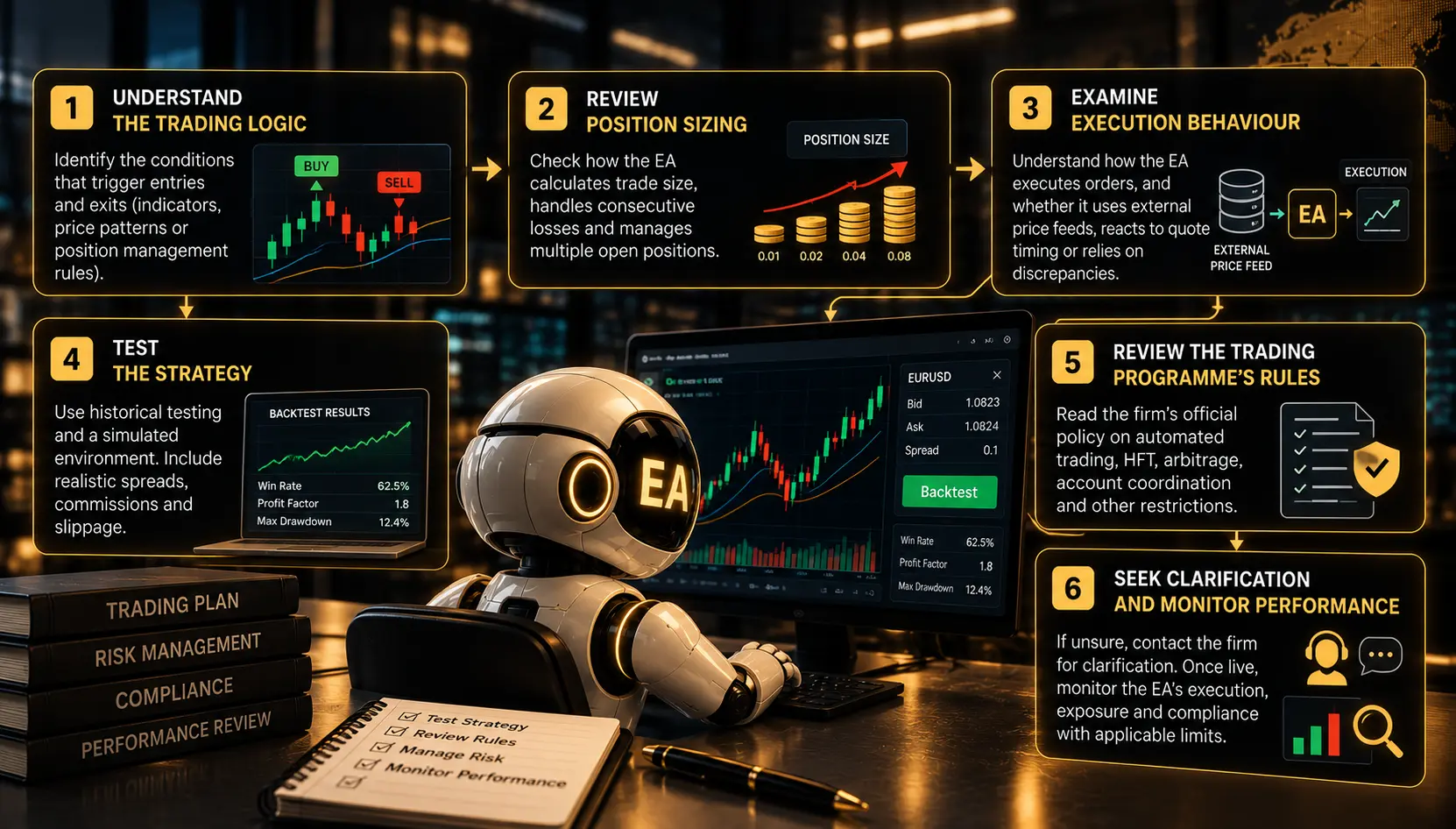
A structured review can help traders understand how an EA operates and whether it is appropriate for their trading programme.
Step 1: Understand the Trading Logic
Identify the conditions that trigger entries and exits. Determine whether the EA follows technical indicators, price patterns, position-management rules or another method.
Step 2: Review Position Sizing
Check how the EA calculates trade size, handles consecutive losses and manages multiple open positions. Pay particular attention to any process that increases exposure after a losing trade.
Step 3: Examine Execution Behaviour
Understand whether the EA uses external price feeds, reacts to quote timing or relies on discrepancies between trading systems. These features may require additional compliance checks.
Step 4: Test the Strategy
Where appropriate, use historical testing and a simulated environment to assess how the EA behaves under different market conditions. Include realistic assumptions for spreads, commissions and slippage.
Past results do not guarantee future performance, and successful testing does not establish that a strategy complies with a firm's rules.
Step 5: Review the Trading Programme's Rules
Read the current official policy on automated trading, HFT, arbitrage, account coordination and any other relevant strategy. Do not rely solely on the EA provider's description of the software.
Step 6: Seek Clarification and Monitor Performance
If the strategy's status is uncertain, ask the firm before deploying it. Continue monitoring the EA after it is activated, including its execution, exposure and compliance with applicable limits.
Conclusion: Choose Automated Trading Tools Carefully
Expert Advisors can help traders automate repetitive tasks, apply predefined rules and manage positions systematically. However, automation does not guarantee profitable results or ensure that a strategy complies with every trading programme.
The key considerations are how an EA operates, how it manages risk and whether its methods are permitted by the relevant firm's rules. Strategies involving latency arbitrage, cross-account activity or other restricted practices require particular care, while approaches such as martingale and grid trading should be assessed separately according to the applicable policy.
Before using an EA with Audacity Capital, review the current trading rules and seek clarification if any aspect of the strategy is uncertain. A clear understanding of both the system and the programme's requirements can help traders make more informed decisions about automated trading.
Frequently Asked Questions
An Expert Advisor is a software programme that automates trading tasks according to predefined rules. It can monitor market conditions, generate signals, place orders and manage positions on supported platforms.
The terms are often used similarly, but their meanings can vary. An Expert Advisor usually refers to an automated programme associated with platforms such as MT4 or MT5, while a trading bot is a broader term for software that automates trading activities.
Do not assume that every EA is prohibited or permitted. Check Audacity Capital's current official rules to determine whether the system's strategy and execution methods comply with the applicable requirements.
Not necessarily. A short holding period alone does not establish that a strategy is HFT. Its decision-making process, execution behaviour and reliance on speed or timing advantages are also relevant.
Latency arbitrage attempts to exploit delays or discrepancies between price feeds or execution systems. An automated system may compare prices from different sources and attempt to trade before the discrepancy disappears.
Not inherently. Martingale describes a position-sizing approach that increases exposure after losses, while grid trading places orders at predetermined price intervals. Either may be subject to separate restrictions under a firm's rules.
Both platforms support automated trading, but technical compatibility does not determine whether an EA is allowed in a particular programme. Check the relevant trading rules before using it.
Review the firm's current official policy and contact its support team for clarification before deploying the system. Avoid relying solely on claims made by the EA's developer or seller.

¿Listo para aplicar un riesgo disciplinado a las criptomonedas? Explore los nuevos instrumentos de cripto de Audacity Capital y traiga su estrategia de trading.
Aprender másBoletín
Únase a nuestro boletín para mantenerse al día.
Únete a Nuestra Comunidad Social

Comienza Tu Viaje Hoy Con Nuestra Prueba Gratuita
Muestra con orgullo tus habilidades y logros a través de certificados y obtén reconocimiento por tu arduo trabajo y dedicación de posibles inversores y compañeros.
Prueba GratuitaArtículos Relacionados
Momentum Trading Strategy: A Comprehensive Guide
Master the core principles of a momentum trading strategy. Learn how to use key indicators, manage sharp-reversal risks, and master exit timing.

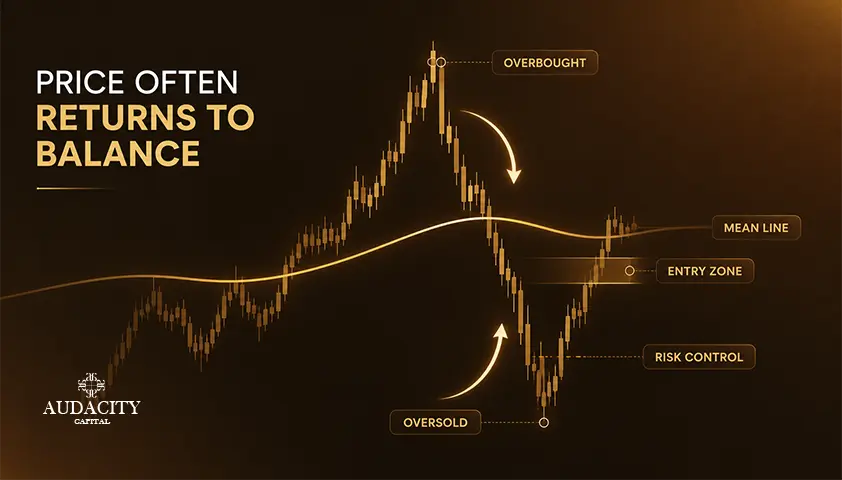
Mean Reversion Trading Strategy Explained (2026)
Prices that stretch too far tend to snap back to an average, but only in the right market. Learn the tools, the setup, and the trend risk.

Martingale Strategy in Trading
How the martingale trading strategy works, what the doubling arithmetic actually costs, why position sizing cannot create an edge, and where it is banned.
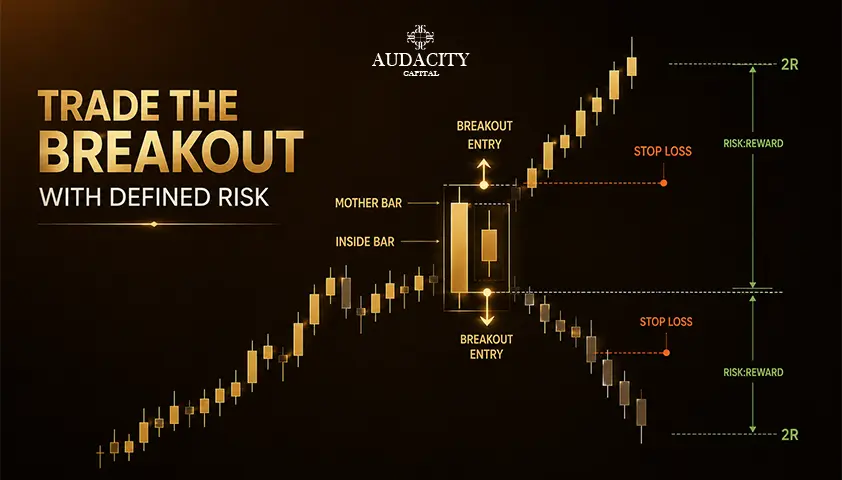
Inside Bar Trading Strategy: Rules, Entries and Risk Guide
Master the inside bar trading strategy with practical rules for pattern identification, entry triggers, stop placement, risk management, and testing.