



Forex Algorithmic Trading: Strategies, Benefits, Risks and How It Works


Forex Algorithmic Trading has changed the way currency markets operate. Earlier, a large part of Forex dealing depended on telephone communication between banks and other financial institutions. Traders had to rely on available market information and communicate with dealers to arrange transactions. The market has since moved towards electronic trading, where prices can be accessed through trading platforms and orders can be handled by computer systems.
One important development has been the use of algorithms to manage trading activity. These systems follow programmed instructions and can respond to market conditions without waiting for a trader to place every order manually. This has changed how both institutional and retail participants approach the market.
However, using a computer to trade does not automatically improve the outcome. The rules behind the system still matter, and an algorithm can produce losses when market conditions move against its strategy. In this guide, we look at how it works and what traders need to understand before using it.
What Is Forex Algorithmic Trading?
Forex algorithmic trading is a method where computer programs are designed to follow written trading instructions to analyse the currency market and place or manage orders.
Forex algorithm trading is written around price movements, time, technical indicators or other available market information- basically, the conditions that a trader wants a system to follow. If a trader wants to buy EUR/USD when its price moves above a particular moving average, they will program the algorithm to spot that condition and send the order through the connected platform.
How Does a Forex Trading Algorithm Work?
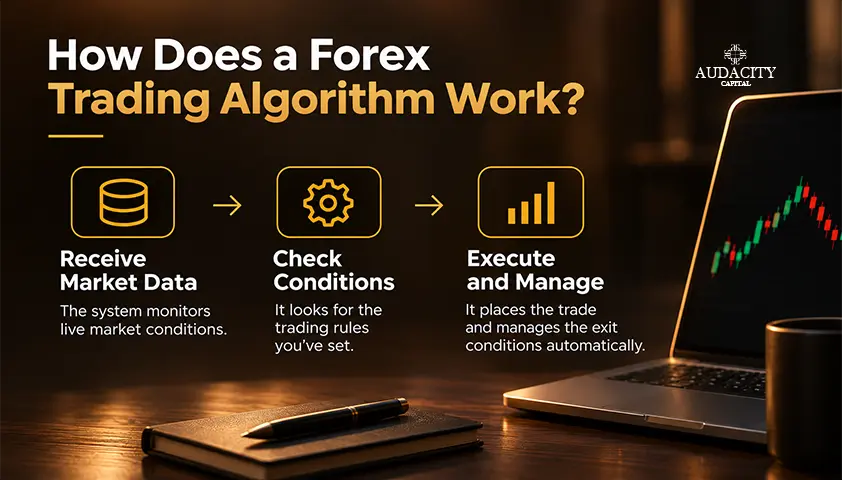
A forex trading algorithm follows the instructions written into its program. It starts when the system receives market data and checks whether the conditions for entering or managing a trade have been met. It then does two things.
- It sends an order through the platform when the entry conditions match.
- It manages the open position with the exit conditions the trader specified.
The trader sets the rules before the system starts, which is an important part of algorithm forex trading. The computer follows the instructions and doesn’t judge whether a trade is worth taking, so it only needs conditions that can be tested against actual market data. Poorly designed conditions or a changed market leave it placing trades that no longer fit.
How Is Algorithmic Trading Used in Forex Markets?
The use of algorithms is not limited to retail traders looking for trading opportunities. There are automated systems in place in banks, hedge funds, and other financial institutions, but their requirements are often quite different.
In a bank, automation comes in handy in executing a large currency order without putting added pressure on the exchange rate. A retail trader, on the other hand, may use a programme to identify a particular price movement and enter a position.
Algorithmic trading in forex markets is used for several purposes in the institutional market:
- Order execution: With automation in place, large orders are easily divided into smaller transactions. They are executed over a period of time to reduce market impact.
- Market making: As market conditions change, algorithms can update buy and sell quotes. This helps liquidity providers to manage their positions.
- Statistical trading: Quantitative models can examine relationships between currency prices and look for opportunities when those relationships change.
- Automated hedging: With this, many financial institutions adjust currency positions and manage their existing market exposure.
Having these systems doesn’t always mean that you can predict which currency will rise or fall. Some are designed to handle an order more efficiently, while others are built to identify trading opportunities. The Bank for International Settlements explains this distinction in its research on FX execution algorithms.
What Are the Most Common Forex Trading Algorithms and Strategies?
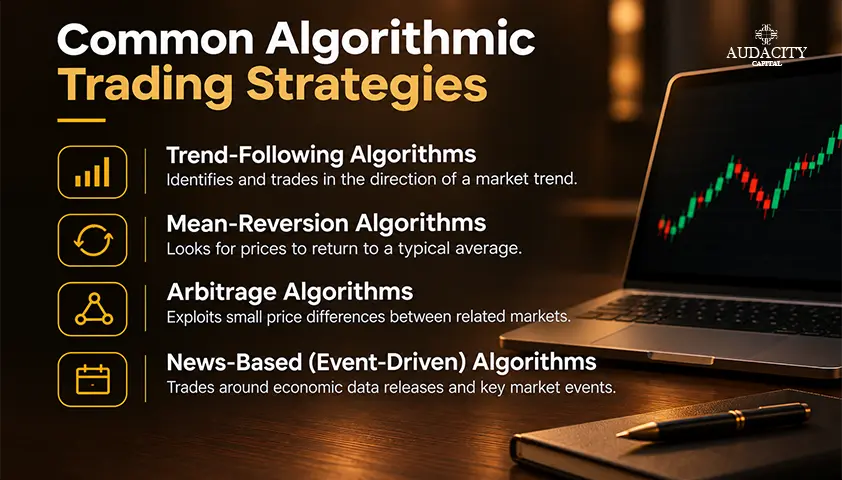
There is more than one way to approach algorithmic forex trading. The instructions depend on what the trader wants the programme to identify. A system designed to follow a market trend will not behave in the same way as one looking for a temporary difference between currency prices. This is why it is important to understand the trading idea before looking at the software used to execute it.
Trend-Following Algorithms
This system looks for directional movement in a currency pair. It uses moving averages to confirm the trend direction and enters the market when its entry setup appears. The problem is that the signal may appear after a considerable part of the movement has already occurred. If the market changes direction, the system may also give back some of its earlier gains.
Mean-Reversion Algorithms
These programmes look for prices that have moved away from a selected average. The expectation is that the price will eventually move closer to that level. However, a currency pair can remain outside its usual range when a strong market trend develops, leaving the algorithm on the wrong side of the movement.
Arbitrage Algorithms
An arbitrage system looks for a difference between related prices. A triangular arbitrage programme sees three currency pairs to find a possible exchange rate inconsistency. The execution speed and transaction costs matter more because these differences are generally short-lived.
News-Based and Event-Driven Algorithms
A news-based algo keeps watching economic data releases and other market info. It may act on an unexpected inflation number or central bank news. But the immediate move after the announcement is tough. Spreads get wide and execution price can be different.
Automated Execution and Hedging
Institutional traders also use algorithms to manage orders rather than predict price movements. A large currency order can be divided into smaller transactions, while a hedging system can adjust existing exposure as market conditions change. The BIS has examined how these execution systems affect the functioning of the FX market.
Common Forex Algorithmic Trading Strategies
Strategy | What the algorithm looks for | Main limitation |
Trend following | An established price direction | Signals can arrive late |
Mean reversion | Price moving away from an average | Strong trends can invalidate the assumption |
Arbitrage | Temporary differences between related prices | Costs can remove the opportunity |
News-based | Price reactions to economic events | Volatility can affect execution |
Automated execution | Efficient placement of larger orders | Execution quality depends on market liquidity |
Auto-hedging | Changes in existing currency exposure | Does not remove all market risk |
What Are the Benefits of Forex Algorithmic Trading?
A trader who monitors several currency pairs manually may find it difficult to respond whenever a particular trading condition appears. This is one area where Forex Algorithmic Trading can be useful. The automated program will check the market as per the set instructions and will act when those instructions are matched. In all of this, the trader doesn’t have to personally place an order.
Faster Order Execution
With algorithmic Forex trading, order execution happens faster. Once the conditions for trading are met, the programme will send an order automatically. This is very useful for strategies that rely on specific price levels. However, a faster instruction is not a guarantee that execution will happen at the requested price.
Reduced Emotional Interference
A computer programme does not become nervous after a losing trade or chase the market after missing an entry. Whatever happens, it simply follows the trader’s instructions for execution consistency. However, this cannot prevent losses caused by poor trading rules.
Consistent Application of Trading Rules
Consistent application helps maintain the same conditions whenever the algorithm finds a suitable opportunity. With this, the results are easier to review, along with finding out if the system is following the approach that was originally intended.
Continuous Market Monitoring
Having an algorithm means the selected currency pairs are being continuously monitored while the trader is engaged in something else. It can handle an open position as well without constant manual attention in place. This depends on the programme remaining connected and operational.
The BIS points out that execution algorithms can improve the efficiency of matching orders in the fragmented FX market. It also shows there are extra execution risks users have to manage.
This is something to keep in mind. Automation can make the process easier, but it does not make the trading decision more dependable.
What Are the Risks and Limitations of Algorithmic Trading in Forex?
A forex trading algorithm can follow its rules perfectly and still produce a poor result. A system that works in a trending period may struggle once prices move sideways. Anyone asking what is forex algorithmic trading needs to learn these limits before real money is involved.
Technical Failures and Connectivity Problems
This happens more than people think. Internet drops, server is down, broker never gets the order. Then a bug keeps your position open and unmanaged. Better to decide beforehand what the system does in that case.
Over-Optimisation and Curve Fitting
In algorithm forex trading, a strategy adjusted again and again against historical data will eventually look great. That’s curve fitting, and the results may only reflect the period you tested. Treat a strong backtest as a first sign, then run the system on data it was not built with.
Slippage and Changing Market Conditions
You request a price but execution is at another price. That gap is slippage. It grows around major economic announcements or thin liquidity, and strategies that live on small moves feel it most.
Unexpected Market Events
Rules built on past price behaviour may not cope with a surprise central bank decision or a geopolitical shock. The conditions behind the earlier results may have gone.
Overdependence on Automation
A running algorithm still needs supervision, so check why it enters positions and whether its original conditions still hold. The CFTC also warns about automated Forex programs sold with unrealistic performance claims. A program can follow instructions, but it can’t consistently predict where prices go, so be wary of any forex trading algorithms promising otherwise.
A good backtest is only the first stage of Forex Algorithmic Trading, because it shows how an algorithm fitted past prices and tells you little else. So run the same rules but on another data period. One that the system has never tested on. Check if it still works. Then check the impact of spread widening and slippage, since small moves are easily gone with that.
After that, forward test on a demo account to watch how orders are handled in live conditions. That’s why it is better to find the weak spots at this stage than with real money. If forex trading algorithms only perform well under the conditions they were built around, the rules need more work before algorithm forex trading goes live.
How to Build, Backtest and Optimise a Forex Trading Algorithm?
A computer can’t act on a hunch, so a trading idea has to become clear instructions first. That’s the starting point for any Forex Algorithmic Trading system. Settle what conditions lead to an entry, then decide when the position closes and how much risk the system is allowed. After that, the rules go into a program and get tested against historical market data.
Define the Trading Rules
When we look at a moving average crossover, we are looking at an entry signal and nothing more. A forex trading algorithm also needs an exit condition, a stop-loss rule and a cap on position size. Leave any of those out and the program opens trades it has no plan for managing.
Choose the Right Development Platform
This choice requires considering the kind of strategy and how technical you are. MetaTrader 4 and 5 run Expert Advisors (EAs), and MT5 has a Strategy Tester for historical testing and optimisation. Python fits customised quantitative models and links to supported trading APIs. cTrader runs cBots written in C# or Python. TradingView uses Pine Script to build and test strategies and send alerts, though an alert only becomes a broker order through a supported integration or an additional execution arrangement.
Backtest the Algorithm Using Historical Data
Run the rules over historical data and read the numbers closely. Profit factor, maximum drawdown, win rate and the average win against the average loss all matter. Subtract trading expenses first, because gross returns can mislead.
Forward-Test Before Going Live
Test on fresh data first, then trade the system on a demo account to watch how it behaves live. Store the original backtest results separately. If performance shifts considerably, investigate the reason and avoid tweaking the rules over and over until the numbers look attractive.
Forex Algorithm Development and Testing Process
Stage | What happens |
Strategy development | Define entry, exit and risk conditions |
Coding | Convert the rules into executable instructions |
Examine performance using historical data | |
Optimisation | Adjust parameters while avoiding curve fitting |
Forward testing | Evaluate the system using unseen data or a demo account |
Live deployment | Introduce controlled exposure and monitor execution |
Why Does Execution Speed and Low Latency Matter in Forex Algorithmic Trading?
Spotting an opportunity is only half the job. The order still has to travel through the connected system before it reaches the broker, and the time that trip takes is called latency. In Forex Algorithmic Trading even a short delay can change the execution price, most of all for strategies that depend on small price movements.
That’s why latency matters more for short-term systems that try to capture brief pricing differences. A longer-term trend-following system feels it less, because its trades are built to stay open for longer.
Several things influence delays.
- Server location. The physical distance between your system and the broker’s server affects communication time.
- Internet connectivity. An unstable connection can delay the order.
- VPS hosting. A Virtual Private Server keeps the program running without your personal computer having to stay on.
- Broker infrastructure. How the broker handles orders also affects how quickly an instruction is processed.
Sending an order quickly is one thing, and getting a favourable price is another. Low latency helps forex trading algorithms, but it doesn’t remove slippage and it won’t make a weak strategy profitable.
What Software and Platforms Support Forex Algorithmic Trading?
You don’t have to build every part of an automated system yourself. There are many platforms with tools that can develop strategies, test rules, and automate part of trading. Choosing the right one comes down to two things: what you want the program to do and the amount of control you need over its instructions.
Platform | Automation and development features |
MetaTrader 4 | Expert Advisors and MQL4 |
MetaTrader 5 | Expert Advisors, MQL5 and Strategy Tester |
cTrader | cBots with C# and Python support |
TradingView | Pine Script strategies and alerts |
Python | Custom quantitative models and supported API connections |
Traders who want to develop or use Expert Advisors, the best option for them is MetaTrader. But if you want to test and optimise a system on historical data, the MT5 Strategy Tester is one for you. Similarly, cTrader takes another route with cBots. It analyses the market conditions and then manages orders as per the programmed instructions.
TradingView is also an option and a rather strong one for chart-based strategy development. However, it is not an execution broker and a trader will require a suitable execution connection to turn the alert into a real transaction.
Having these tools doesn’t mean every forex trading algorithm will make money, since the trading rules still need testing.
Can You Use Forex Algorithmic Trading in a Prop Trading Firm?
Traders who use automated systems may also want to apply their strategies through a proprietary trading programme. However, permission to use an algorithm depends on the firm's rules. A system can work on a personal trading account and yet not fulfil the conditions meant for a funded trading programme.
Traders should check if the firm allows automated execution and if there are any restrictions on how the programme operates before they use an Expert Advisor. Drawdown limits also need attention. An algorithm that increases position sizes after losses or opens several positions without considering overall exposure can breach the firm's risk requirements.
At Audacity Capital, Expert Advisors are permitted under the published programme rules, subject to restrictions on prohibited trading practices. The firm also specifies that third-party EAs and externally sourced trading signals are not permitted under its current guidelines.
Are Expert Advisors Allowed at Audacity Capital?
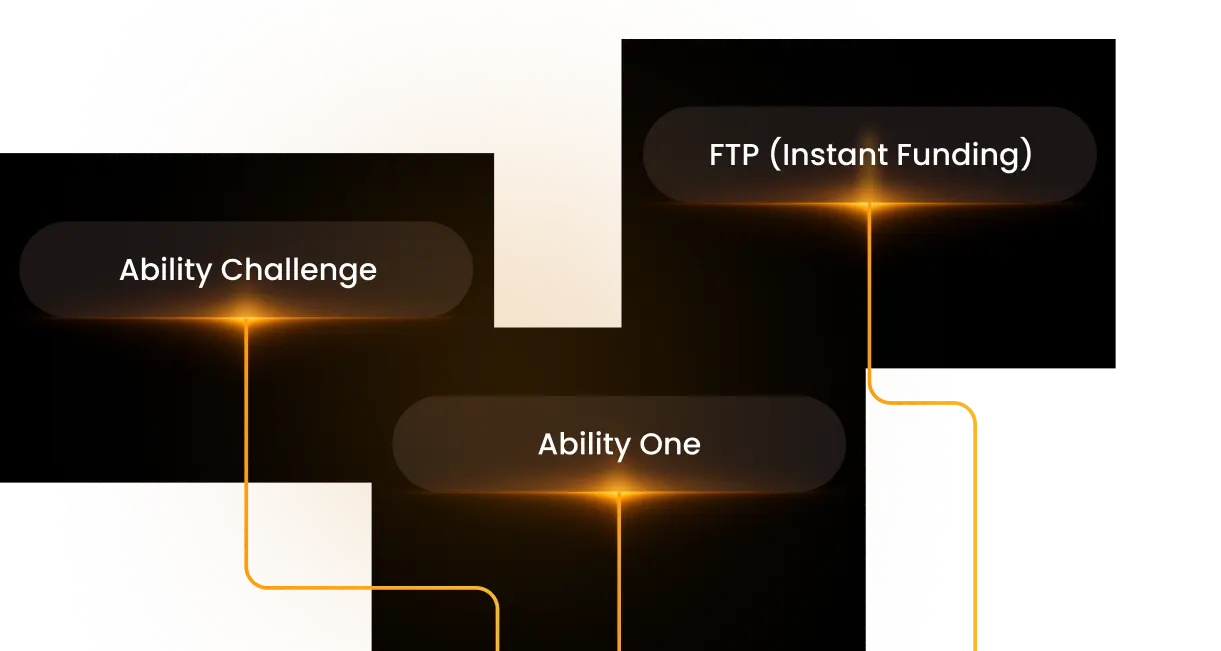
The Ability Challenge permits EAs, provided traders comply with the applicable trading rules. High-frequency trading, latency arbitrage, martingale approaches and other prohibited practices are not allowed.
Traders should review the latest Audacity Capital trading guidelines before deploying an EA.
Is Forex Algorithmic Trading Suitable for Beginners?
A beginner can learn forex algorithmic trading without writing a complicated program on day one.
What comes first is understanding how currency pairs move and what affects trading decisions, because without that you can’t tell why a system opens or closes a position.
Some platforms offer ready-made Expert Advisors, so programming knowledge isn’t always needed. Before you use one, do check their rules, as many advertised performance figures may not necessarily reflect the real trading conditions. It is wise to begin learning how an algorithm works, test the instructions on historical data, and observe it on a demo account. Even for code written by someone else, you need to understand the decisions your system is going to make.

Are You Looking For A Funded Trader Program?
Join the Funded Trader ProgramFinal Thoughts
The growth of Forex Algorithmic Trading has changed how traders approach the currency market. Computer programmes can now handle trading instructions that once required constant manual attention. However, the outcome still depends on the strategy behind the system and how well it handles changing market conditions.
At Audacity Capital, traders can incorporate Expert Advisors into the Ability Challenge, provided their systems follow the firm's trading rules. HFT, martingale and other prohibited practices are not permitted. Traders interested in using automated strategies can explore the Ability Challenge and review its conditions before getting started.
FAQs
Forex algorithmic trading is a systematic approach or a technique consisting of rules, logic, code, and data. This method of trading is executed by computer programs to trade currencies based on your already set rules.
Forex trading algorithms work with a few simple steps:
- A trader defines the rules/ builds a program (basically tells the algorithm what to do).
- That program watches the market 24/5 to check if your conditions/ rules are met.
- If the conditions match, the program/ algo. automatically places the order, without you manually doing anything.
- Upon entering, it manages the trade following the rules you set initially. Basically, the algorithm does what a trader would do manually, but faster and without adding emotions.
Yes, algorithmic Forex trading can be profitable, but not automatically and not always. The algorithm doesn't make your trade profitable, but the strategy inside it does. The risks remain, and the outcome is just like manual trading.
Yes, you can. In fact, there are many no-code algorithm Forex trading platforms that work without a single line of code. They offer ready-made Expert Advisors or tools for configuring automated strategies.
Platforms like MetaTrader 4& 5, cTrader, TradingView, NinjaTrader, Audacity Capital etc., support Forex trading algorithms. Traders who know Python can also build their own algorithm and connect to the broker directly.
Yes, it is legal in most countries as law does not ban how "manual or algorithm" you trade. The law only regulates what and where you trade. Algorithmic trading in Forex is just a tool and is completely legal.
Those who are unfamiliar use automated trading and algorithmic trading interchangeably. An algorithm is the brain (the logic/rules), whereas automated trading is the hand (where it actually clicks the buy/ sell button for you).

Ready to apply disciplined risk to crypto? Explore Audacity Capital's new crypto instruments and bring your trading strategy.
Learn MoreNewsletter
Join our newsletter to stay up to date on features and releases.
Join Our Social & Community

Start Your Journey Today With Our Free Trial
Proudly showcase your skills and accomplishments through certificates and get recognition for your hard work and dedication from potential investors and peers.
Free TrialRelated Articles
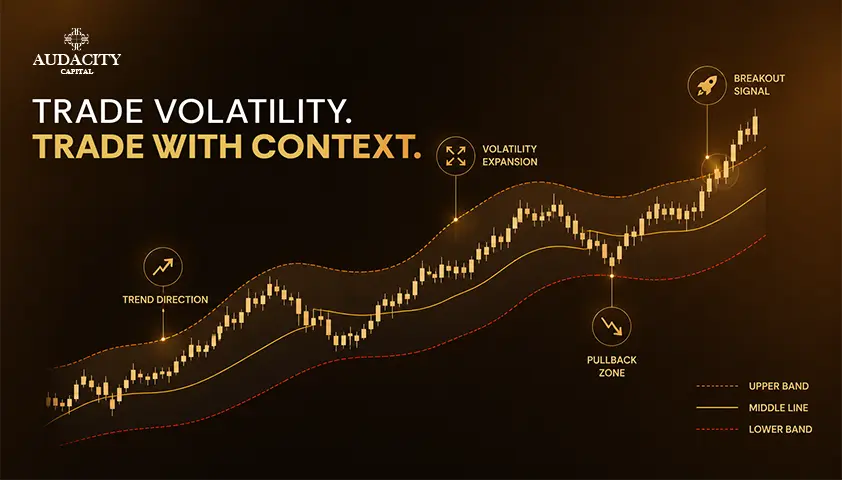
Keltner Channel Trading Strategy: How to Read Volatility With Context
Discover how Keltner Channels measure market volatility, spot trend pullbacks, and confirm breakouts. Includes setup rules, settings, and testing methods.

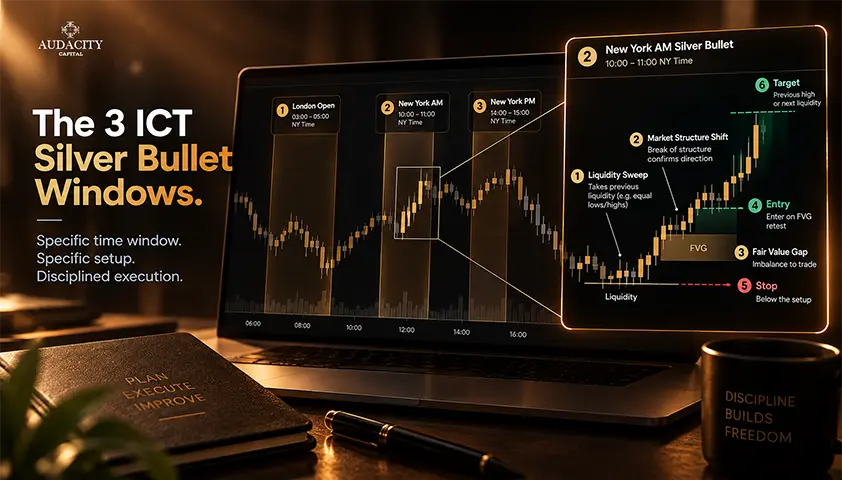
ICT Silver Bullet Strategy: Windows, Setup and Execution Rules
The ICT Silver Bullet windows, the setup step most guides skip, entry and stop rules, and what the published win rates rest on.

Break and Retest Trading Strategy for Beginners
Learn the break and retest trading strategy, how to identify valid breakouts, confirm retests, set stop-losses and manage trading risk.
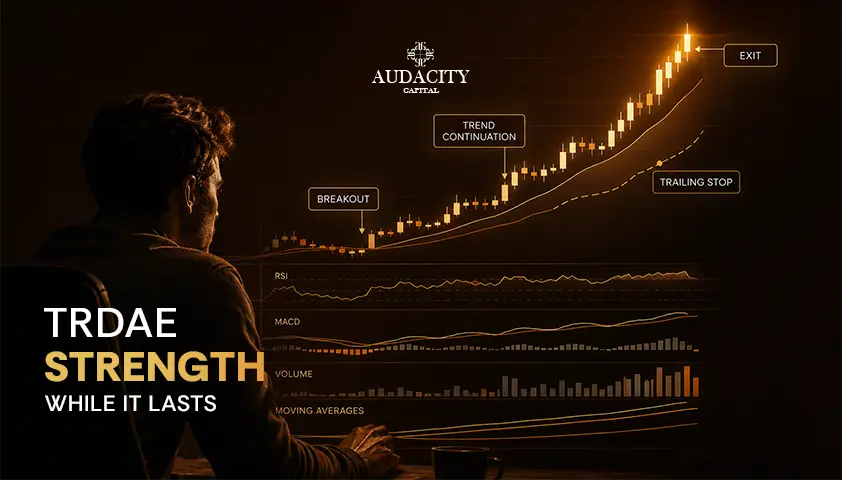
Momentum Trading Strategy: A Comprehensive Guide
Master the core principles of a momentum trading strategy. Learn how to use key indicators, manage sharp-reversal risks, and master exit timing.