


10 Best Forex Demo Accounts for 2026 : Compared & Reviewed


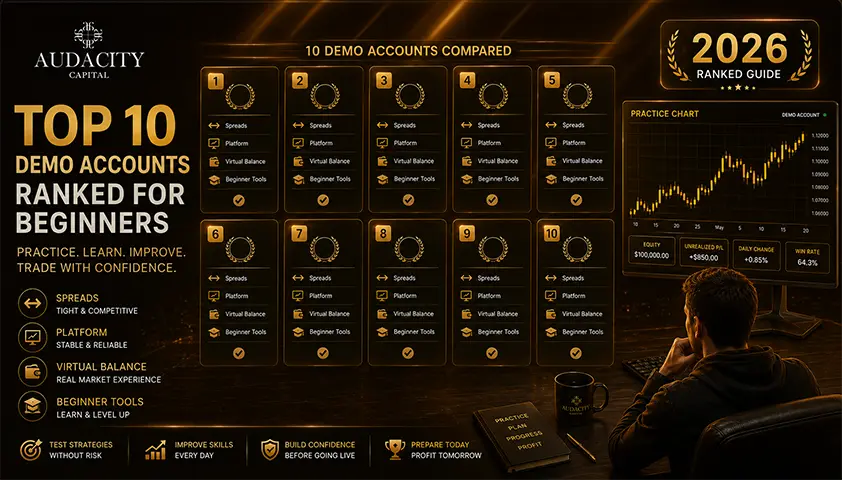
A forex demo account is the safest, smartest way to learn how markets move and test your strategies before a single dollar of real money is on the line.
As the title promises, this guide covers the 10 best forex demo accounts for 2026, how to choose the right one, how to actually use it well, and how to know when you have outgrown it.
One note to make before we start: a demo is essential, but it has limits. It teaches you the platform and the mechanics, not the emotions.
Forex and CFD trading is high risk, and most retail traders lose money. This article is educational, not financial advice. Used the right way, though, a demo is where good habits begin.
What is a forex demo account?
A forex demo account, also called a forex practice account or paper trading account, lets you trade in real market conditions using virtual funds instead of your own money. You place trades, watch positions move, and learn the platform with zero financial risk.
A typical demo includes a virtual balance, real-time market prices, and the broker's actual trading platform and tools.
The one thing it does not include is real money, which means no real profit and no real loss. Any gains you see are simulated.
That difference matters more than beginners expect, and we will come back to it. For now, the key distinction to understand is between a demo and a live account.
A live account uses your real capital, carries real consequences, and triggers real emotion. A demo does not.
Demo accounts come in two main types by duration. Some are unlimited with no expiry, and some are time-limited, commonly 30, 60, or 90 days. An unlimited demo account is far more useful for serious practice, so duration is one of the first things to check.
What makes a great forex demo account?
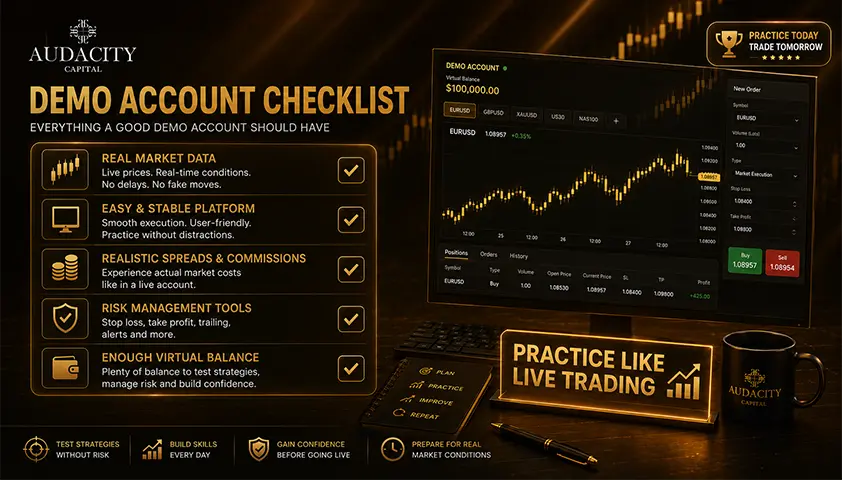
Not all demos are equal. These are the criteria we used to shortlist the picks below, and they double as a checklist for what you should look for yourself.
1. Demo duration (most important).
An unlimited or long-running demo beats a short time-limited one. Real progress takes months, not weeks, so a 30-day window rarely gives you enough runway to test properly.
2. Platform variety.
Access to MT4 / MT5, TradingView, cTrader, or a strong proprietary platform matters because you want to practice on the exact software you will trade on later.
3. Realistic, customizable virtual funds.
A demo that lets you set the virtual balance near your planned live capital teaches realistic position sizing. A default $100,000 balance does not.
4. Tier-1 regulation and trust.
A regulated broker overseen by the FCA, ASIC, CySEC, or CFTC (for the US) signals accountability. Regulation is a trust signal, not a guarantee of results.
5. Execution fidelity and real-time data.
The closer the demo mirrors live pricing, spreads, and behavior, the more your practice transfers.
6. Quality education.
Built-in lessons, webinars, and guides accelerate the learning curve.
7. Full mobile access.
You should be able to practice and monitor trades wherever you are.
Duration first, everything else second. Keep that order in mind as you read the list.
The 10 Best Forex Demo Accounts for 2026
The picks below are strong starting points for 2026. Each entry covers what the demo offers, one genuine standout, and one honest limitation, so you can weigh the trade-offs fairly.
Important: demo durations, virtual-fund amounts, supported platforms, and regulation vary by region and change often. Treat every figure below as current as of checking, and confirm the latest terms on each broker's own site before you sign up.
Broker | Platforms | Virtual funds | Demo duration | Regulation | Best for |
IG / tastyfx | Web, mobile, MT4, TradingView, ProRealTime, L2 Dealer | Customizable | Verify current | FCA, ASIC, CFTC (US) | Best overall |
Interactive Brokers | TWS, pro suite, API | ~$1,000,000 | Extended | Multiple tier-1, CFTC | Advanced traders |
Saxo | SaxoTrader | Customizable | Time-limited (verify) | Multiple tier-1 | Platform and research |
FOREX.com | MT4/MT5, proprietary, TradingView | Customizable | ~90 days | CFTC, FCA, ASIC | Active traders |
CMC Markets | Next Generation | Customizable | Verify by region | FCA, ASIC | Widest FX range |
XTB | xStation | Customizable | Verify current | FCA, CySEC, KNF | Beginners |
Pepperstone | MT4, MT5, TradingView, cTrader | Adjustable | Expires on inactivity | FCA, ASIC, CySEC | Platform choice |
IC Markets | MT4, MT5, cTrader | Customizable | Extended | ASIC, CySEC | Scalping and algos |
Plus500 | Proprietary | Virtual | Unlimited | FCA, ASIC, CySEC | Simple unlimited demo |
AvaTrade | MT4/MT5, own apps | Large balance | Verify (reactivatable) | Multiple jurisdictions | Learning while practicing |
1. IG (tastyfx in the US) - Best overall
IG is the most widely praised all-round demo, and it is easy to see why. Its practice account spans a proprietary web and mobile platform, MT4, TradingView, ProRealTime, and the advanced L2 Dealer, giving you room to test almost any trading style.
The FX range is huge, and IG Academy offers one of the strongest structured learning paths in the industry. IG is long-established and tier-1 regulated, with tastyfx serving as its US arm.
The standout is breadth: the sheer number of platforms and the guided learning journey mean you can grow into more advanced tools without switching brokers.
The honest limitation is that same breadth. For a complete beginner, the range of platforms and instruments can feel like a lot at once. Confirm the current demo duration and virtual-fund amount before you open the account, as these vary by region.
2. Interactive Brokers - Best for advanced and professional traders
Interactive Brokers offers a professional-grade paper-trading account built for serious traders. The virtual balance is reported to be around $1,000,000, which lets you test larger positions realistically, and you get access to the powerful Trader Workstation (TWS) and related pro platforms.
It covers 100+ FX pairs across global markets, carries a very high trust score, and supports API and algorithmic trading.
The standout is institutional-grade tooling. Few demos let you rehearse large-position management and automated strategies with this level of depth.
The limitation is the learning curve. The interface and feature set can intimidate newcomers, and beginners may feel overwhelmed before they feel capable. Regulation is strong, spanning multiple tier-1 authorities including the CFTC for US clients.
3. Saxo - Best platform and research
Saxo runs its demo on the very same SaxoTrader platform its live clients use, so what you practice on is exactly what you will trade on. Add award-winning research, a very large instrument range, and a well-capitalized, tier-1 regulated business, and you have a premium experience.
The standout is platform quality paired with genuinely deep research, which helps you understand the why behind price moves, not just the how.
There are two limitations. First, Saxo's live-account minimums tend to be higher than budget-friendly rivals, so the step up costs more. Second, the demo is reported to be time-limited, so verify the current window before you rely on it for long-term testing.
4. FOREX.com - Best for active traders and education
FOREX.com suits active traders who want tight pricing and plenty of markets. You get 80+ FX pairs, competitive spreads, and a choice of MT4, MT5, a proprietary platform, and TradingView, backed by a strong education library of webinars and videos.
The standout is that pairing of pricing and education, which makes it a productive place to sharpen both skill and strategy.
The limitations: the demo is reported to run around 90 days, which is short for testing longer-term strategies, and US clients trade without negative balance protection. FOREX.com is regulated in the US by the CFTC and holds tier-1 licenses in other regions too.
5. CMC Markets - Best for the widest forex range
CMC Markets offers one of the broadest FX menus around, reported at roughly 282 pairs, on its feature-rich Next Generation platform. Charting and research are genuine strengths, and the broker holds tier-1 regulation.
The standout is range and charting. If you want to explore exotic pairs or run detailed technical analysis, few demos give you more to work with.
The limitation is that the platform's depth can overwhelm a beginner who just wants to place a simple trade and learn the basics. Demo availability may also vary by region, so verify what is offered where you are before signing up.
6. XTB - Best for beginners
XTB is built around xStation, a fast and intuitive platform that new traders tend to pick up quickly. Behind it sits a Knowledge Base with 200+ lessons, all from a tier-1 regulated broker. Together, that makes XTB one of the most beginner-friendly demos on this list.
The standout is the blend of ease of use and structured education, so you are learning the concepts as you practice the mechanics.
The limitation is a smaller instrument range than the multi-asset giants like IG or Saxo. If you plan to trade well beyond forex, you may eventually want more. Verify the current demo duration, as this can change.
7. Pepperstone - Best for platform choice
Pepperstone gives you the widest platform choice for testing, spanning MT4, MT5, TradingView, and cTrader, with ECN-style pricing and a customizable demo that lets you adjust balance and leverage to match your plans. It is a tier-1 regulated broker.
The standout is exactly that flexibility. You can practice on whichever platform you intend to trade on live, which keeps your habits consistent when you make the switch.
The limitation is that Pepperstone has no in-house proprietary platform, so you rely on third-party software. Also, MetaTrader demos can expire after a period of inactivity, so keep the account active and verify the current policy.
8. IC Markets - Best for scalping and algorithmic trading
IC Markets is a favorite among scalpers and systematic traders thanks to raw ECN-style spreads and a demo that runs on MT4, MT5, and cTrader. This setup is well suited to testing automated systems and fast, short-term strategies.
The standout is execution conditions. If your edge depends on tight pricing and quick fills, this is a strong environment to test it, and it is a tier-1 regulated broker.
The limitation is less hand-holding for absolute beginners. IC Markets assumes a degree of familiarity, so a complete newcomer may prefer a more education-led broker first, then move here once the fundamentals are solid.
9. Plus500 - Best simple, unlimited demo
Plus500 offers a free and genuinely unlimited demo account on a clean, user-friendly proprietary platform. It is a publicly listed, tier-1 regulated broker, which adds a layer of transparency and trust.
The standout is the no-expiry demo. You can practice at your own pace without racing a countdown clock, which is ideal for beginners who want time to build risk management habits.
The limitations are worth knowing. Plus500 offers CFDs only, runs a proprietary platform with no MT4 or MT5 support, and provides fewer advanced tools for in-depth strategy testing. It is excellent for getting comfortable, less so for complex systematic work.
10. AvaTrade - Best for learning while practicing
AvaTrade pairs a solid demo with a strong education ecosystem, making it a good fit for new traders who want to learn as they go. You get MT4, MT5, and AvaTrade's own apps, a large virtual balance, and regulation across multiple jurisdictions.
The standout is that learn-while-you-practice balance. The tutorials and guides sit close to the platform, so knowledge and hands-on practice reinforce each other.
The limitation is the demo duration. It is reported to expire, though it can often be reactivated, so confirm the current terms before you count on long-term access.
How to choose the right forex demo account for you
The best pick depends on who you are and what you plan to trade.
Here is a quick way to self-select.
- Complete beginners: for ease of use and education. Look at XTB, AvaTrade, Plus500, or IG.
- Scalpers and algo traders: favor execution and platform range. Look at IC Markets or Pepperstone.
- Advanced or professional traders: for pro tools and breadth. Look at Interactive Brokers, Saxo, or CMC Markets.
- Traders who want an unlimited demo: Plus500, IC Markets, or OANDA are worth checking.
- US-based traders: you need a CFTC-regulated broker, so consider tastyfx, Interactive Brokers, or FOREX.com.
One universal tip cuts through all of it: choose a well-regulated broker whose demo supports the platform you actually plan to use, and set your virtual balance close to your planned live capital.
How to get the most out of a forex demo account
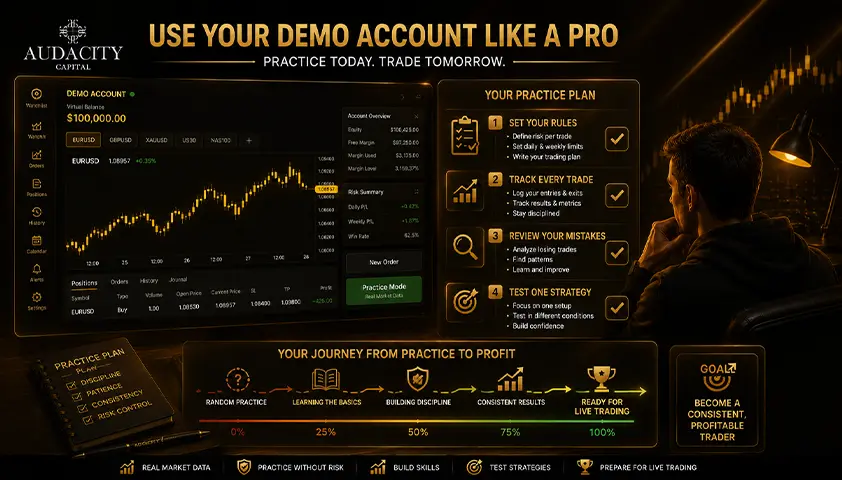
A demo only works if you use it seriously. These habits separate traders who progress from those who spin their wheels for months.
Habit #1: Treat the demo like real money.
This is the single most important habit. Every trade should feel like it matters.
Habit #2: Set a realistic virtual balance.
Match it to what you actually plan to fund a live account with, so your position sizing transfers instead of teaching you the wrong instincts.
Habit #3: Always use stop losses.
Practice proper risk management from day one, because it is far harder to learn under real pressure.
Habit #4: Keep a trading journal.
Record your entries, exits, reasoning, and results so you can spot patterns and fix mistakes.
Habit #5: Test one strategy at a time.
Mixing approaches makes it impossible to know what actually works.
Habit #6; Trade realistic position sizes.
Oversized virtual lots feel exciting but teach reckless habits.
The Limits of Demo Trading
Now the honest part. Demo prices and spreads are usually real, but slippage, liquidity gaps, and requotes can behave differently once you go live. The bigger gap is psychological.
Trading with virtual funds removes real fear and greed, the two forces that drive most trading decisions and mistakes. That absence can breed overconfidence and sloppy risk habits that only surface, painfully, once your own money is at stake.
The takeaway is simple: the closer you treat your demo to real trading, the smaller that gap becomes when you make the jump.
When to Move On from a Demo Account
A demo is essential for learning, but it has a ceiling. There are no real stakes, no discipline forged under real pressure, and no way to actually get paid. Staying on demo forever can even work against you by feeding overconfidence that has never been tested.
So how do you know you are ready to progress? Look for a few honest signs:
When those boxes are ticked, you face a choice. Moving to a live account means risking your own capital, with all the emotion that brings.
Alternatively, a funded or prop route lets you trade with real structure and a path to a share of profits without funding a large account yourself.
Neither path is risk-free, but both are real steps forward, and only you can decide which fits your situation.
Conclusion
A forex demo account is the safest way to learn the market and test strategies before real money is involved, and the 10 picks above are strong starting points for 2026.
The right choice comes down to your experience level, the platform you plan to trade on, and whether you want an unlimited demo or can work within a time-limited one.
Two habits matter most.
First, choose a well-regulated broker whose demo genuinely fits your needs.
Second, treat that demo like real money, because that is what closes the gap between practice and reality.
Remember the honest limit too: a demo cannot replicate real emotion, and it cannot pay you. The sensible path is to practice on demo, prove your consistency, and then step up.
When a demo is no longer enough, that is where a prop route can fit. At Audacity Capital, our free trading competition and Funded Trader Program give disciplined traders a structured way to trade toward a share of profits, with a real path to capital rather than a large deposit of your own.
If you have outgrown practice mode, explore Audacity's free trading competition and funded routes as your next step.
FAQ
There is no fixed rule, but a common guideline is at least a few months, and ideally until you are consistently profitable over a meaningful number of trades across different market conditions. One short lucky run is not enough. The goal is repeatable, rule-based results, not a single good week.
Mostly. Prices, spreads, and platform behavior are usually real, which makes the mechanics genuinely useful to practice. What does not show up is slippage, liquidity gaps in fast markets, and above all the emotional pressure of trading real money. That emotional gap is a demo's biggest limitation.
No. A demo uses virtual funds, so any profits are simulated and cannot be withdrawn. Its value is entirely in learning and testing. Earning real money requires a live account or a funded route, both of which carry real risk.
No. Reputable brokers offer demo accounts for free with no deposit, and often without full identity verification. Funding a live account later does require a deposit and identity checks, so the free demo stage is a genuinely no-cost way to learn.
Yes. Most brokers let you open multiple demos, which is useful for testing different strategies, platforms, or account types side by side. It is a smart way to compare how the same strategy performs under different conditions before committing.
Some do. Durations range from about 30 to 90 days at some brokers, while others offer unlimited demos with no expiry. Many time-limited demos can also be reset or reopened. Always check each broker's current policy, since terms change and vary by region.
Because there is no real money at stake, a demo removes the fear and greed that drive real decisions. That can create a false sense of confidence and encourage poor risk habits, such as oversized positions or ignoring stop losses. Those habits often surface painfully once you switch to live trading.
Ideally an amount close to what you plan to fund a live account with, so your position sizing and risk habits transfer realistically. Trading a $100,000 demo when you intend to fund $1,000 teaches the wrong instincts and inflates your sense of what a normal trade looks like.

Prêt à appliquer un risque discipliné aux cryptos ? Explorez les nouveaux instruments crypto d'Audacity Capital et apportez votre stratégie de trading.
En savoir plusNewsletter
Rejoignez notre newsletter pour rester informé.
Rejoignez Notre Communauté Sociale

Commencez Votre Voyage Aujourd'hui Avec Notre Essai Gratuit
Affichez fièrement vos compétences et réalisations grâce à des certificats et obtenez la reconnaissance de votre travail acharné et de votre dévouement auprès d'investisseurs potentiels et de pairs.
Essai GratuitArticles Connexes
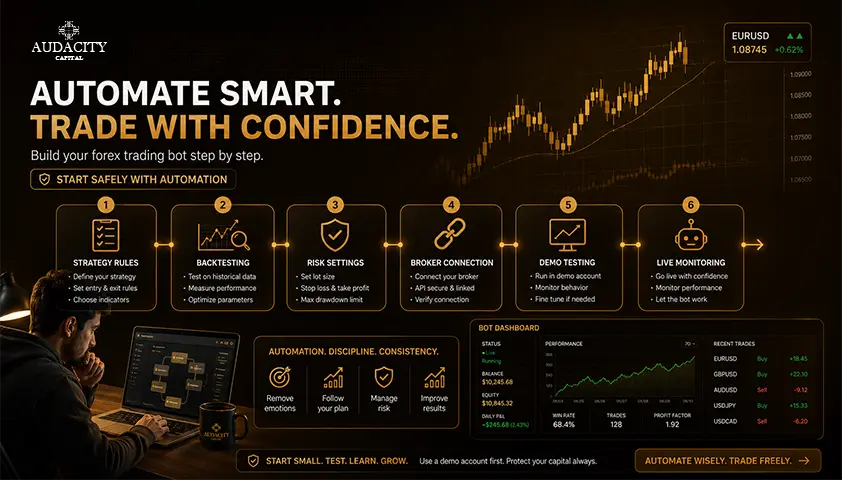
How to Get Started With Automated Forex Trading
Learn how automated forex trading works, choose or build an EA, backtest it, use a demo account, and launch with practical risk controls.

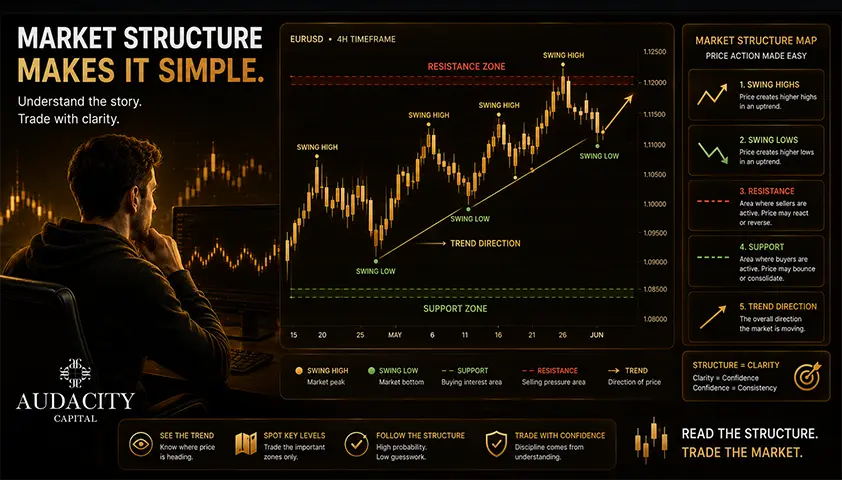
What Is Market Structure in Forex Trading?
Market structure in forex explained simply: swing highs and lows, BOS and ChoCh, support and resistance, plus how to read and trade it with discipline.

Best Pairs to Trade in Forex: A Beginner's Guide to Choosing the Right Currency Pairs.
Discover the best pairs to trade in forex, including major, minor, and exotic currency pairs. Learn how to choose the right forex pairs based on your trading style and experience.
Best Forex Trading Sessions and Times for Funded Traders
Plan your Forex trading around the best time to trade forex globally. Get market data analysis for the time of the day with highest or most volatile trades