


Instant Funding Prop Firm Rules Explained



Instant funding eliminates the evaluation process, not the regulations.
From the very first transaction, the account will be subject to all of the drawdown, payout, strategy, and scaling regulations that apply to its firm.
Skipping the evaluation means there is no qualification target to pass, but it doesn’t mean that there are no restrictions as to whether the account will survive, make money, or become eligible for a payout.
No evaluation means no test before access, not no test of discipline after access.
All the rules that are normally enforced on a passed challenge account are in effect here, and sometimes with more stringent limits.
In this guide we will cover four questions:
- what can close the account,
- what makes a trader eligible for a payout,
- Which trading strategies truly are limited after you read past the pricing card,
- and how to scale after the initial profit target.
Note: Trading and simulated trading is risk prone. Funding, payouts and scaling will depend on rule compliance and is not guaranteed.
What Instant Funding Prop Firm Rules Actually Control?
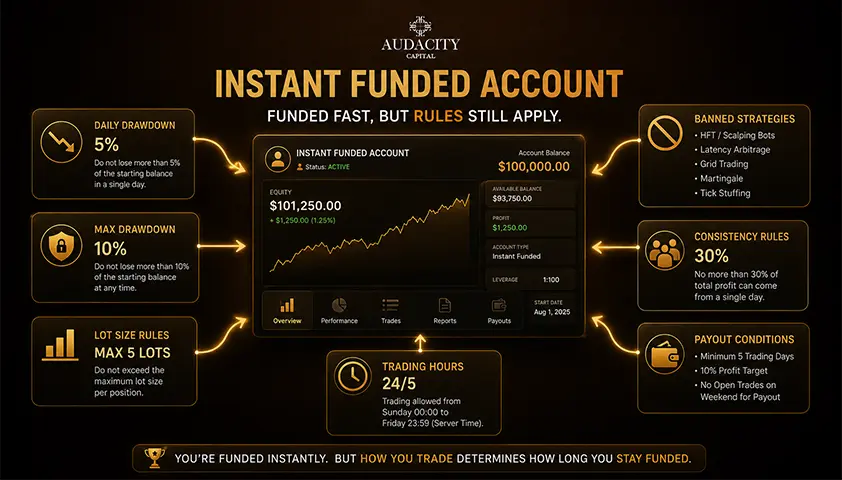
With the instant funding model, there is no evaluation and a funded-stage account is issued immediately.
It may be a simulated account or be linked to a live account, depending on the company and program.
Never assume that the word ‘funded’ means the account is backed by live capital. Check the program terms.
Once the account is issued, the rulebook is split up into 6 sections. The majority of the breaches are found where two of the categories overlap, so the category-based view may be more useful than the flat list.
Rule category | What it controls | Common variations | What to verify |
Loss limits | Daily and lifetime drawdown limits | Static or trailing, balance or equity, reset time, account or position level | Formula, reset clock, whether open PnL counts |
Payout eligibility | When you can withdraw | Profit milestone, minimum trading days, review period and split tiers | Exact milestone, days and review window |
Trading activity | Days, hours, sessions | Minimum active days, blackout periods and holding rules | Whether weekend and news are inside or outside allowed windows |
Prohibited strategies | What execution styles are prohibited | HFT, arbitrage, hedging, martingale, grid and third-party EAs | The prohibited-practices page, not the marketing page |
Scaling and allocation | How the account grows | Milestone-based doubling, combined allocation caps and scaling ceiling | Starting size, combined cap and final ceiling |
Account administration | Fees, refunds, resets and closures | The refund rules, the penalty for a breach and the criteria for a review | The terms and conditions, NOT sales copy. |
The instant funding rules you agree are specific to the particular company.
The daily loss can be static or trailing, based on balance or equity, and can be reset at various server times. Profit rules can feature a stage-based profit split, a review period, minimum trading days, and a profit milestone.
Two companies offering the same "10% max loss," could have vastly different accounts behind the scenes.
The Audacity FTP Rules At a Glance
Throughout this article, a worked example of the Audacity Capital's Funded Trader Program (FTP) is provided. The numbers quoted below are based upon Audacity Capital's published FTP information and should be verified before purchase against the present terms of their program.
Some of the major FTP rules are:
- There is no evaluation needed to access the instant-funded account.
- 5% daily trailing drawdown.
- 10% maximum drawdown.
- At least 5 trading days prior to making a request for payout.
- Payouts eligibility and progression are based on reaching a 10% profit mark.
- There is no consistency rule for the FTP.
- Profit split depends on account size, stage and how quickly one reaches the 10% mark, and the published structure is between 50% and 80%.
- News trading and weekend trading are allowed, as long as trading restrictions and prohibited trading practices in the program are obeyed.
The 10% figure should not be confused with an evaluation target. The FTP does not require an evaluation and the 10% milestone applies to payout eligibility and progression once the account is issued.
The drawdown structure is also more complex than shown in the summary. The 5% daily loss limit is trailing from the peak intraday equity and is reset at the beginning of a new server day. By contrast, the 10% maximum loss is fixed and is calculated off the account's original balance.
Daily Drawdown and Maximum Drawdown Explained
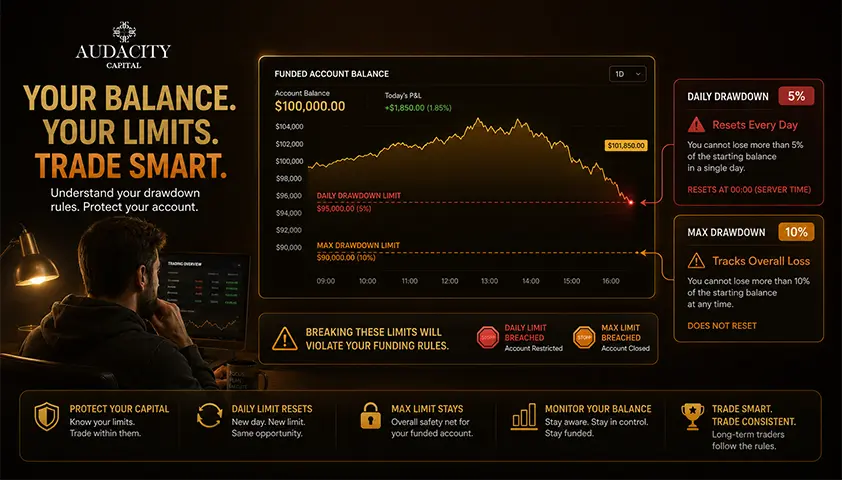
This is the place where most of the instant funded accounts are lost. Use a calculator to read this section.
1. Daily drawdown, trailing from intraday equity high
Under the FTP's equity-based daily drawdown rule, the daily floor is 95% of the highest value in the equity for that trading day. The floor can move up when equity increases but it cannot move back down until the server reset has occurred.
For example: On a $10,000 account:
- Day open: balance $10,000, equity $10,000, daily floor $9,500
- Once trades are in, open profits bring equity to $10,400
- The highest intraday equity is now $10,400
- New daily floor: 95% of $10,400 = $9,880
- Market Reverses; Open profit disappears; Equity falls to $9,850
- Although there is a starting balance of $10,000, no trade has been closed on loss; account is breached.
It's for this reason that open profit is risky in an equity-based trailing daily rule. When equity breaks past a new high, the floor will lift, and once it returns to those levels, the account can be closed.
2. Maximum drawdown, static from the initial balance
The 10% static maximum loss will lead to a lifetime minimum loss of $9,000 on the same $10,000 account.
This remains the same with growing account size. The floor is unchanged after a profitable week, unless otherwise stated by the terms of the program.
3. Balance versus equity
As per the equity based rule, open profit and open loss is part of the floor calculation.
A trader may make a breach before closing a losing trade. The core idea behind FTP is equity-based drawdown, which is a consideration to tight stops surrounding news, thin liquidity and weekend gaps.
4. Reset time
The daily limit in the FTP is reset at the applicable MT5 server rollover time. Traders should consider the platform clock instead of local midnight because server-time offsets might change depending on daylight-saving times.
A trade opened at 23:45 server time can remain open across the daily reset, meaning the applicable daily drawdown reference may change while the position is still active.
Full walkthrough
Time (server) | Balance | Equity | Highest equity today | Daily floor | Max floor | Status |
00:00 | $10,000 | $10,000 | $10,000 | $9,500 | $9,000 | Active |
10:30 | $10,000 | $10,400 | $10,400 | $9,880 | $9,000 | Active |
13:15 | $10,000 | $9,900 | $10,400 | $9,880 | $9,000 | Breach on daily |
00:00 next day | Reset reference, new intraday high starts from new open equity |
Note: The above drawdown rules for instant funding are Audacity-specific. Different companies have different formulas, resets and balance-to-equity ratios. Don't take these numbers to another firm's account.
Payout Rules, Profit Milestones and Minimum Trading Days
Immediate funding does not necessarily mean immediate withdrawal.
The instant funding payout rules at most programs are hidden behind a milestone, minimum-days requirement, risk review and scheduled payout process.
For Audacity FTP:
- The Profit Milestone is 10% of the account balance.
- Minimum trade days: 5 days and a minimum of 1 trade per day.
- Time limit to reach the milestone: unlimited
- After milestone risk review: currently stated as 1-3 working days.
- Trading during review: Paused.
- Once approved: Profit added to the dashboard wallet, new scaled account issued.
The sequence matters.
A 10% profit is not enough to trigger a payout. The account should also fulfill the minimum trading day requirements (5 days) and risk review.
Once accepted, it will be credited to the trader's dashboard wallet, and the external payout will be made as per platform schedule and payout method.
Profit split
The FTP profit split is not one fixed percentage, it changes. The published structure of Audacity capital is between 50% and 80% depending on the account size, account stage and the speed of reaching the 10% profit mark.
Traders need to check the payout ratios for the account size and stage of their trading before assuming any certain percentage, as payouts can vary.
Same-day language
In some instances, prop firms label their payout as same-day. The Knowledge Center defines a review period prior to wallet credit. All these are not conflicting when they are broken down into the payout request, the review, wallet credit and external withdrawal to the trader's payment method. Read the entire text and not the headline.
A payout is based on the rules followed. No one can guarantee you a payout on any prop firm program, including instant funded ones.
Trading Styles, EAs, Copy Trading and News Rules
The term "allowed" in a marketing label is very general and doesn't tell you the full story. Generally, the instant funded account rules as to strategies stem from the prohibited practices document, which limits what "allowed" means.
1. News trading and weekend holding
As of this writing, Audacity has news trading and weekend holding listed as permitted on FTP, with their usual restrictions on trading and prohibited practices in place. It explicitly bans orders that are placed near large economic announcements when the market is volatile, with the intention of taking advantage of the news. It is important for traders to review the latest trading instructions before implementing a news-based trading strategy.
2. Expert advisors
EAs are permitted, but currently only self-developed EAs. Commercial and publicly available bots, and bots made by third parties are not allowed. There is also a ban on HFT-style systems and bulk automatic executions. Running a purchased EA is not equivalent to the "EAs allowed" permission.
Copy trading
Copy trading is allowed as stated in Audacity's published FTP information, but traders are advised to check the latest restrictions on copying between accounts or from external providers before using a particular setup.
Scalping
Scalping is permitted but each trade must be held for 2 minutes or longer. Short trades under 2 minutes might be reviewed if they have a similar trade pattern as latency arbitrage or feeds exploitation.
Named prohibited practices
Currently, the prohibited-practices page lists the following, among others:
- HFT exploitation
- Hedging in the same account or across accounts
- Martingale and averaging-down cycles
- Grid trading
- Coordinated trading between traders
- Third-party account management
- Latency or feed exploitation
- Automated bulk execution
- The size of the lot is not proportional to the size of the account.
Activity | Published status | Important condition |
Expert advisors | Permitted | Only self-developed, no HFT, no bulk execution |
Permitted with restrictions | Confirm if the particular setup includes permitted account-to-account copying or prohibited external signals or providers. | |
Permitted | A minimum trade duration of 2 minutes | |
Permitted | No one-sided pending-order pre-positioning to exploit releases | |
Weekend holding | Permitted | Equity-based drawdown still applies through the gap |
Not permitted | Within or across accounts | |
Grid | Not permitted | |
Martingale | Not permitted | |
Not permitted |
Wording in this section can be changed by Audacity at any time. Make sure to verify the live terms and prohibited-practices page before you trade a strategy that uses any of the above fringe behaviours.
Scaling and Maximum Account Allocation Rules

The rules of payout and drawdown are not tied to the rules of scaling. Most of the instant funding programs are not offering the maximum account on the first day. Each successful milestone will take the account one step up the scaling plan.
The scaling potential for FTP is currently advertised as up to $2 million with Audacity. The page also lists a scaling graphic with more figures, which are also applicable; traders should make sure to check the current FTP terms to find the ceiling and stage structure applicable for the graphic, and not assume a maximum.
Three numbers must be kept separate:
- Starting account size, chosen at purchase.
- Combined purchased allocation, currently capped at $240,000 for combined FTP accounts when purchasing an additional account. This is the maximum amount of capital that you will be able to manage through the purchase of additional accounts.
- The long-term ceiling of an account, which was reached through profit milestones, is currently known as scaled account ceiling, set at $2 million.
The scaling ceiling can be scaled over time with performance, and the purchased-allocation ceiling can be reached early with buying.
The landing page currently displays account-size options and a scaling graphic. Be sure to check the exact sizes available and the existing ceiling on the live product page before ordering.
Rule Interactions That Cause Unexpected Breaches
The majority of rule-breach stories aren't about a single rule. They are roughly two rules mixed together in a manner that the trader did not anticipate.
This is where the no evaluation prop firm rules framework comes into play the most, as the entire rulebook runs from the first trade.
- Trailing daily floor plus giveback. Open profit lifts the floor. Giving back that profit can breach even with a positive closed balance.
- Minimum days plus milestones. Five completed trading days do not create payout eligibility on their own. The 10% profit milestone and the risk review must also be clear.
- News allowed plus one-sided pending orders banned. Trading through news is fine. Stacking one-sided pending orders around a release to catch a spike is a separate prohibited practice.
- EAs allowed plus third-party bots banned. Running your own EA is fine. Running a commercial EA is not.
- No consistency rule plus disproportionate lot sizing banned. Position sizing is not free. Oversized single trades can trigger review even without a consistency rule.
- Weekend holding allowed plus equity-based drawdown. A gap on Monday can breach the floor before any exit is possible.
Situation | Rule interaction | Likely mistake | Pre-trade check |
Big open profit at midday | Trailing daily floor rises | Letting winners round-trip | Recalculate daily floor after new equity high |
Five days done, 10% hit | Payout still needs review | Requesting payout too early | Confirm review status and window |
Trading NFP | News allowed, pre-positioning restricted | Stacking pending orders | Enter after release, not before |
Running a paid EA | Only self-developed EAs allowed | Assuming "EAs allowed" is unrestricted | Confirm EA origin in terms |
Holding into Monday | Equity-based drawdown continues | Ignoring gap risk | Size for a gap that touches the max floor |
How to Compare Instant Funding Rules Before Paying
Use this as an audit checklist. Every point should be verifiable in writing before purchase.
Account model
- Is the account simulated or live?
- Which entity provides the program?
Loss limits
- Daily loss percentage and lifetime maximum
- Static or trailing on each
- Balance-based or equity-based
- Reset time on the platform clock
Targets and access
- Any target required to access funding, if the program is not truly instant
- Any milestone required to withdraw
- Any separate milestone to scale
Payout mechanics
- Minimum trading days
- Payout frequency
- Review time
- Profit split, including stage and speed tiers
- Withdrawal minimum
- Whether trading pauses during review
Prohibited practices
- Read the prohibited-practices page in full, not the pricing card
- EAs, copy trading, scalping, news, weekend holding, hedging, grid, martingale, lot-size rules
Platform and instruments
- Platform, leverage, instruments, swap, commission
- Available account sizes
- Combined allocation cap
- Scaling ceiling
Documentation
- Save a dated copy of the terms
- Ask support in writing to clarify any conflict between marketing and rules
- A screenshot of a sales card is not a substitute for the binding rulebook
The instant funded account rules you sign up to should be documented, dated, and consistent across the marketing page, the terms, and the prohibited-practices page. Any conflict should be resolved with support before payment, not after a breach.
Are Instant Funding Rules Stricter Than Challenge Rules?
Sometimes, but not in one universal direction. Instant funding removes the entry evaluation, while funded-stage loss limits and payout conditions apply from day one.
Some firms offset the missing challenge with higher fees, lower early profit splits, tighter drawdown mechanics, or more detailed strategy restrictions.
Compare the pressure, not just the percentages. In a two-step challenge, a breach usually costs the evaluation fee and the chance to qualify.
On an instant funded account, the same mistake can close an account that was already positioned to generate a payout in the current cycle.
Fit depends on the strategy.
Instant funding is easier to reason about when the trader already knows their normal drawdown, average holding period, lot-size range, and news exposure. It is a poor place to test an unproven system, because there is no evaluation buffer between testing and consequence.
Neither route is inherently easier, safer, or more profitable. The correct route depends on the strategy and the exact instant funding prop firm rules attached to the program.
Conclusion
Instant funding removes the evaluation, not the rulebook. From the first trade, the account operates under drawdown, payout, strategy, and scaling rules that decide whether it survives long enough to generate a withdrawal.
Three checks prevent most surprises:
- Calculate the equity floor, both daily and lifetime, using the correct formula and reset time.
- Understand the payout gate, including the profit milestone, minimum days, review, and split tiers.
- Read every prohibited-practice condition sitting behind an "allowed" label on the marketing page.
Rules, fees, splits, and platform terms can change. Verify the current terms, Knowledge Center, and prohibited-practices page before any account purchase or trade. Trading carries risk. Nothing above is financial advice, and rule compliance does not guarantee profitability or payouts.
Frequently Asked Questions
There is no profit target to access the account, because funding is granted at purchase. Most programs still require a profit milestone before you can withdraw or scale. On FTP, that milestone is currently 10% of the account balance and applies to payout eligibility, not account access.
It depends on the firm, and the difference matters. Equity-based drawdown counts open profit and loss, so an account can breach before any trade is closed. Audacity's FTP daily rule is currently described as trailing from the highest recorded intraday equity, which is equity-based.
Many programs treat touching the drawdown floor as a breach rather than a warning. Servers measure equity continuously, so a wick, a spread widening event, or a swap posting can cross the line without a manual trade. Assume touch equals breach unless the terms explicitly state otherwise.
Not usually. Payout eligibility typically requires a profit milestone, a minimum number of trading days, and a passed risk review. On FTP, the current conditions are 10% profit, five minimum trading days, and a risk review currently described as taking one to three working days.
EAs are permitted on FTP, but currently only self-developed EAs. Commercial, publicly available, or third-party bots, HFT systems, and automated bulk execution are not permitted. Confirm your specific EA against the current prohibited-practices page before running it live.
Copy trading is permitted under Audacity's published FTP information, but restrictions may apply depending on the source of the copied trades or signals. Traders should confirm their specific setup with Audacity before using it.
Both are currently permitted on FTP. News trading is allowed as ordinary trading through releases, but one-sided pending-order pre-positioning to exploit a release is separately prohibited. Weekend holding is permitted, but equity-based drawdown continues to apply through Monday's open, so gap risk still counts.
A breach typically closes the funded account and removes access to it. Depending on the terms, the trader may be able to purchase a new account, but the breached account itself is not usually restored. Read the specific breach and refund conditions in the current terms before purchase.

Prêt à appliquer un risque discipliné aux cryptos ? Explorez les nouveaux instruments crypto d'Audacity Capital et apportez votre stratégie de trading.
En savoir plusNewsletter
Rejoignez notre newsletter pour rester informé.
Rejoignez Notre Communauté Sociale

Commencez Votre Voyage Aujourd'hui Avec Notre Essai Gratuit
Affichez fièrement vos compétences et réalisations grâce à des certificats et obtenez la reconnaissance de votre travail acharné et de votre dévouement auprès d'investisseurs potentiels et de pairs.
Essai GratuitArticles Connexes

How to Know if a No Deposit Instant Funded Account Real or Myth?
Are the prop firms' claims to give instant funded free accounts without any deposit real? Here's the truth, the red flags to avoid, and actual ways to get paid.


Should Beginners Use Instant Funded Accounts?
Is an instant funded account for beginners a smart first step? Get the honest answer, the one test that decides it, how to start safely, and a better path.

What 'Instant' Really Means: How Fast You Actually Get a Funded Account
The word "instant" is widely misunderstood in prop trading. Learn how fast you get a funded account in practice, same day or within 24 to 48 hours.

What Size Instant Funded Account Should You Start With?
That bigger account size on the checkout page looks tempting, but what size funded account to start with comes down to fee risk and discipline. Here is how to choose well.