


Common Mistakes in Funded Trading Accounts (And How to Avoid Them)


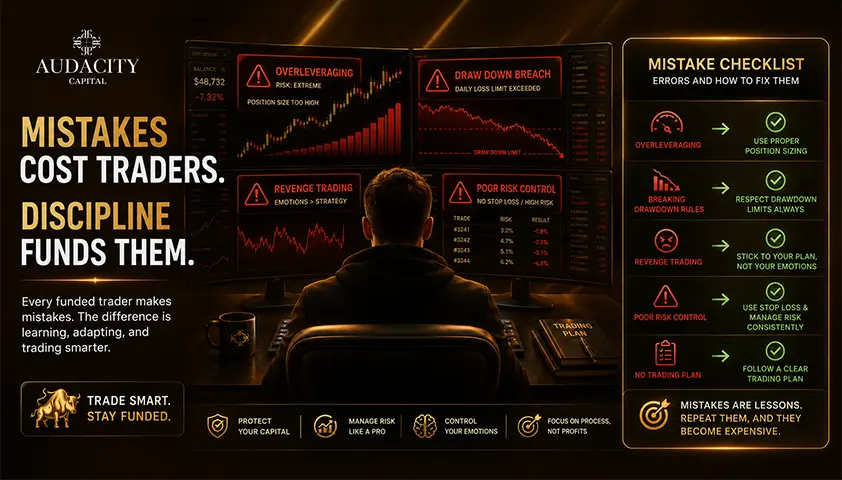
If you keep failing funded trading accounts, the issue is rarely the market or the strategy you employ.
It's a collection of recurring, common mistakes in the funded trading account and most of them are entirely avoidable.
Industry estimates have challenge failure rates somewhere between 80% and 90% and those failure points are concentrated around the same handful of errors.
But the great thing is these are behavioral mistakes and therefore they can be corrected.
In this guide, we classify the errors into four categories: rules, risk management, psychology and process, label each of these errors clearly, and provide you with a tangible solution. Making the changes will be a matter of discipline rather than looking for a different strategy.
That being said, no good habit equals a pass and a profit, and most traders still lose.
Why funded accounts are really lost
Before getting to the list, it will be helpful to understand what the funded program is testing.
Funded and prop-firm evaluations are meant to gauge discipline and not brilliance in strategy. They serve to filter out impulsive and aggressive behaviour, and most failures boil down to that.
The process of evaluating and the funded account that follows is very similar to a job interview or a driving test. The firm isn't seeking to hit a home run. It wishes to see you consistently handle risk and adhere to rules session after session.
Once you view it that way, the whys of traders not succeeding at prop firm challenges become clear.
The errors made that end an account are behavioral and procedural and not of choosing the wrong trade. A funded account is capital and structure for developing skill. It's not an edge and it doesn't make anybody profitable. That re-frame is important because it removes the pressure from your strategy, and shifts the emphasis to what you can do: work on your habits.
Rule mistakes (the ones that end accounts instantly)
These faux pas can make an account sink in one fell swoop, hence they're first. They are all easy to prevent if you know what to look out for.
1. Not knowing the firm's rules
The most prevalent mistake made by traders is not reading and understanding the rulebook.
Each firm has its own rules, including: type of drawdown, daily loss limits, minimum trading days, lot size limits, correlated-exposure limits, inactivity windows, and, in some firms, a consistency rule where your profits must be distributed across a number of days rather than earned in one or two big days.
If you break any of them, you may be disqualified even if your account is profitable.
The fix is simple, but effective.
Go through all the rules prior to the first trade. Make a quick list of the basics limits and review them before every session.
If you have any questions, reach out to support and request it to be confirmed in writing. Note that the consistency rule is a firm point. Many companies still have one in place and Audacity Capital has taken it down, so that particular trip wire is not available on their programs.
2. Breaching the daily loss limit
This is the one most common rule that should be at the top of any list of funded account mistakes to avoid. Your daily drawdown limit is the maximum you are allowed to lose in one trading day.
Once crossed, the day or the entire evaluation will be over. This is broken when traders trade near the limit without any margin for slippage, spread widening or normal market noise.
According to some companies, the overwhelming majority of their failures are due to daily-drawdown breaches, and while that is an illustrative figure, not an industry-wide fact, a figure commonly circulated is around 78.7%.
The fix is to give yourself a buffer.
Set a personal soft limit that is considerably lower than what the company requires, say half of it. Trade according to your account balance and not the floating equity. Stop trading the minute you reach your limit and ensure that you never get anywhere near the limit set by the company.
3. Trading by news and poor conditions
Not paying attention to the market is a quick method to ruin an account. Prices can quickly shift and exceed your limits during high impact news releases, rollover times, and periods of low liquidity. Some companies don't allow news trading at all, so be aware of what your company's policy is before you make an assumption. News trading is permitted on Audacity Capital, but be sure to check the current rule for your particular program.
The fix is to respect the calendar.
Understand when big releases are coming, avoid them or wait until the initial volatility has passed, scale down your trading if you want to trade the release, and only get in when market structure is right for your strategy.
One of the surest ways to secure your account is to have patience with the news.
Risk-management mistakes
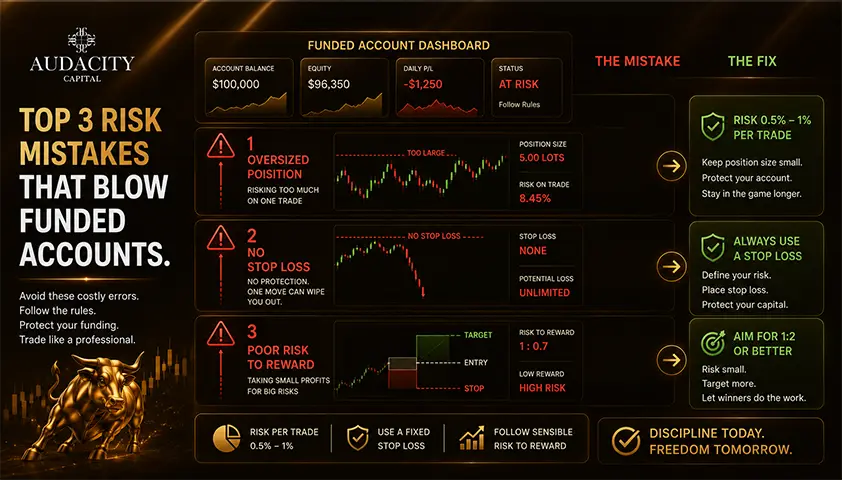
If the rule mistakes end accounts instantly, the risk-management mistakes bleed them out. This is where the one most important account-killer resides, and oversizing carries most weight here.
4. Oversizing and overleveraging (number one killer!)
Oversizing is often given as the leading reason for account failures, and it's in the middle of nearly all lists of prop firm trading mistakes.
The trap is simple: The trader places trades that are too large for the account to meet the target quickly. "I need 10% profit, if I risk 5% per trade then 2 winners is all I need." Then it's one bad trade, one unexpected move and the daily or maximum drawdown is hit and the account is gone.
The fix is to risk small.
Limits that will help you survive a normal losing streak. The rule of thumb is to stick to about 0.5 to 1% per trade.
It's a guideline, not a rule and not a guarantee, but the principle still works: funded accounts are rewarded for consistency, not aggression. Oversizing sounds like a quick way to the desired target. In reality, it's the quickest route out the door.
5. Trading without a stop, or moving your stop
These are two examples of the same error. Not having a set stop loss means you're at risk for one catastrophic trade that can wipe your account out before you know it.
Moving or widening a stop to avoid taking a loss, hoping price comes back, turns a small planned loss into a large one that can breach a limit.
They're both a refusal to accept an outcome that you're already willing to take.
The fix is discipline at the point of entry.
Always set your stop before you enter, according to the set-up and your risk per trade, and never increase your stop once you are in trade. A stop is a decision, not a suggestion. The first step to solid risk management is to keep to the stop you established when you were calm.
6. Sizing off floating equity and chasing poor risk-to-reward
These are the less obvious risk errors. Position sizing on floating (or unrealized) equity instead of fixed starting balance can gradually lead you to overspend as your equity fluctuates.
Chasing trades with a poor risk-to-reward, where you risk a lot to make a little, makes losing inevitable over enough trades no matter how often you win.
The fix is to size off your initial balance
Respect any per-trade position-sizing cap, and only take trades with a sensible risk-to-reward. A trade that loses 1% of its value and only gains 0.3% is on a losing streak over the long haul. For a detailed breakdown, check out our risk-to-reward ratio guide.
Psychological mistakes
The majority of errors made by funded traders are not technical related. They are emotional.
The idea here is to not condemn your feelings, but to label the negative pattern and to give you a healthy alternative.
Everything else depends on good trading psychology.
7. Overtrading
Overtrading refers to making trades that aren't according to the criteria, typically driven by boredom, fear of missing out (FOMO), or the desire to be active in the market. It does not contribute to your profits.
It exposes you to bad layouts and the chances of breaching the daily loss limit. More trades is not more edge, it is more risk.
The fix is to define a maximum number of trades per day before the session starts, for example one to three.
Only trade your best setups and know that not trading is a legitimate professional decision. No trades can be the best of the trading days for some.
8. Revenge trading
Revenge trading is easy to explain and hard to execute: when you lose, you make an impulsive, often large trade to make up for the loss. It's often referred to as the fastest way to lose an account as it gives up on your plan at the most inopportune moment when you're least able to think clearly.
The fix is to treat a closed loss as finished business.
Take a break from the screen for 15 minutes or more to relieve the emotion. Journal how you feel while you are away.
Re-enter only when a good set-up is provided, and not to recoup the previous loss. That's not the money you're entitled to, and you'll likely end up paying more for it than it's worth.
9. Chasing the target and get-rich-quick expectations
Many of the accounts drop under a dream: "I'll pass this challenge in two weeks and quit my job." That expectation can result in forcing trades to make progress today and scaling up near the profit target to get out early, and that's where many breaches occur.
The typical 10% target is achieved with a rate of about 0.5% per day, which translates to 20 trading days, without ever forcing a trade. Don't think about the balance, let the target crawl up to you. The slow and gradual finish has much more evaluations than the fast and aggressive finish.
Fear after losses and overconfidence after wins
Emotional ups and downs are two-sided. Fear, following a drawdown, causes traders to not make good entry into a setup or exit a winning trade prematurely. After a winning streak, they grow overconfident and take a bigger risk or smaller quality trades. Both break consistency and consistency is the whole game.
The fix is to tie your size and your rules to the setup and the account, never to the outcome of your last trade or the mood you happen to be in.
Do not make the decision with emotion, let the plan take over. If you want to learn more about managing tilt, fear, and confidence, check out our trading psychology for funded traders guide.
Process mistakes
The last group is related to your trading systems. These errors do not necessarily terminate an account within a day, but they do make the other errors much more likely.
10. Trading without a tested plan
Jumping into a funded account without a defined, tested, rule-based strategy means you are gambling, not trading.
With little or no backtesting and forward-testing, you have no way to know whether your approach has an edge, and no way to stay consistent when it matters.
The fix is to prove your trading plan before you risk an evaluation on it.
Backtest across a large sample of trades and different market conditions. Forward-test on a demo or a low-cost account. Document your entry, stop, and exit rules so your approach becomes a repeatable system rather than a set of gut calls.
11. Skipping the journal and never reviewing
Most repeated failures happen because the trader never analyzes what went wrong. They focus on the next trade and miss the lessons sitting in the last ten. Without review, you repeat the same mistake indefinitely.
The fix is to keep a trading journal.
Record each trade, the reasoning behind it, and how you felt at the time. Review it every session or week to spot the patterns, which mistakes keep recurring, and fix them at the source.
12. Treating the account casually, freezing, or not adapting
There are three mindset failures here. Some traders treat the account casually, like a game, taking risks they would never take with their own money.
Others freeze under the pressure of trading someone else's capital and barely trade at all. And many assume a demo-optimized strategy will perform identically in live conditions.
The fix is to treat the account like a business: objective, consistent, and never tied to your self-worth on any single trade.
Start with slightly smaller risk in your first week to adjust to real-money pressure, and adapt your strategy to live conditions rather than assuming demo results carry over unchanged. For a broader plan, see how to pass a prop firm challenge.
The common thread: discipline over aggression
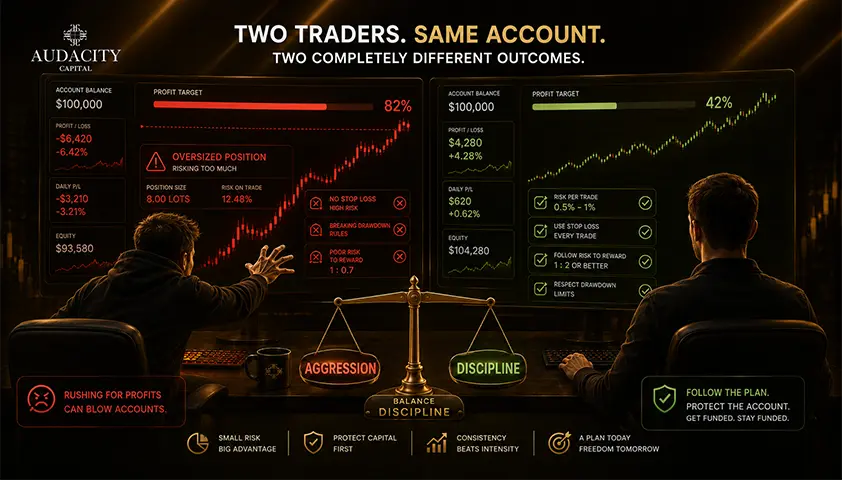
Look back across every mistake in this guide and you will notice they are all versions of the same thing: choosing aggression over discipline.
- The traders who keep their accounts do the boring, disciplined work.
- They treat the account like a job interview or a business.
- They risk small, controlled amounts.
- They follow their own written rules, use a personal soft stop below the firm's limit, take fewer high-quality trades, and step away after a loss.
The sources across this industry keep landing on the same line, and it holds up: aggression fails challenges, discipline passes them.
A funded account does not need spectacular performance. It needs patience and consistency. None of this guarantees a pass or a profit, most traders still fail, but discipline is what moves the odds in your favor.
Here is a short checklist to carry into your next session:
- Risk small, around 0.5 to 1 percent per trade, off your fixed balance.
- Follow your own written rules, every session.
- Set a personal soft stop well below the firm's limit.
- Cap your trades at a few high-quality setups a day.
- Step away for at least 15 minutes after a loss.
- Journal every trade and review it weekly.
How Audacity Capital supports the discipline
You have the fixes. The right structure makes them easier to hold session after session, and that is where Audacity Capital fits.
Three honest points. The most common account-killer is a surprise drawdown breach, and Audacity Capital's fixed static drawdown, 5% daily and 10% maximum, keeps that line visible and unmoving, so you always know exactly where it sits.
Sizing too close to it is still a mistake, but you are never guessing where the floor is. Audacity also publishes a clear rulebook with no consistency rule, so that particular trip wire is simply off the table.
And the free monthly competition, along with both evaluation routes, the Ability Challenge and Ability One, are lower-pressure places to build the disciplined habits every fix above depends on.
Learn the fixes first, then put them to work on a structure built to support them. Explore the Funded Trader Program or join the free competition when you are ready.
FAQ
Oversizing positions and then breaching the daily loss limit. Risking too much per trade to reach the target fast is the single biggest account-killer, because one bad trade can blow the drawdown in a single move. Small, controlled risk is what keeps you in the game long enough to succeed.
Yes. Breaking a rule, exceeding a lot-size cap, violating a consistency rule where one applies, or trading inside a restricted news window can cost you the account even during a winning week. That is exactly why reading and understanding every rule before your first trade matters so much.
A common guideline is around 0.5 to 1 percent per trade. Small, controlled risk lets you survive normal losing streaks and stay well clear of the daily and maximum drawdown limits. It is a guideline that improves your odds, not a rule and not a guarantee.
Real money and an evaluation on the line add emotional pressure that a demo simply does not have. Some traders freeze and hesitate on valid setups, while others force trades or size up. A strategy that worked calmly on demo can fall apart under that pressure.
Step away for at least 15 minutes to let the emotion fade, then review whether the loss actually followed your plan. Only re-enter on a valid setup. Never take the next trade purely to win the loss back, that is revenge trading, and it is how accounts vanish.
Set a personal soft stop well below the firm's limit, for example half of it. Size your positions off your fixed balance rather than floating equity, and stop trading for the day the moment you hit your own ceiling. The firm's limit should be a line you never approach.
Yes. More trades mean more exposure to poor setups and a higher chance of hitting the daily loss limit, not more profit. Capping yourself at a few high-quality trades a day is usually far safer and more consistent than staying constantly in the market.
Yes. The goal shifts from chasing big gains to protecting the account and producing steady, consistent results. Treating it like a business rather than a lottery ticket is what keeps most funded traders in the game long enough to grow.
The common mistakes in funded trading accounts that lose evaluations, and the honest, practical fixes. Rules, risk, psychology, and process, explained trader to trader.

क्या आप क्रिप्टो पर अनुशासित जोखिम लागू करने के लिए तैयार हैं? Audacity Capital के नए क्रिप्टो उपकरणों का पता लगाएं और अपनी ट्रेडिंग रणनीति लाएं।
और जानेंन्यूज़लेटर
हमारे न्यूज़लेटर से जुड़ें।
हमारे सामाजिक समुदाय में शामिल हों

आज ही अपनी यात्रा शुरू करें हमारे नि:शुल्क परीक्षण के साथ
प्रमाणपत्रों के माध्यम से अपने कौशल और उपलब्धियों को गर्व से प्रदर्शित करें और संभावित निवेशकों और साथियों से अपनी कड़ी मेहनत और समर्पण के लिए पहचान प्राप्त करें।
नि:शुल्क परीक्षण