


Is Copy Trading Profitable? Benefits, Risks and What Traders Should Know


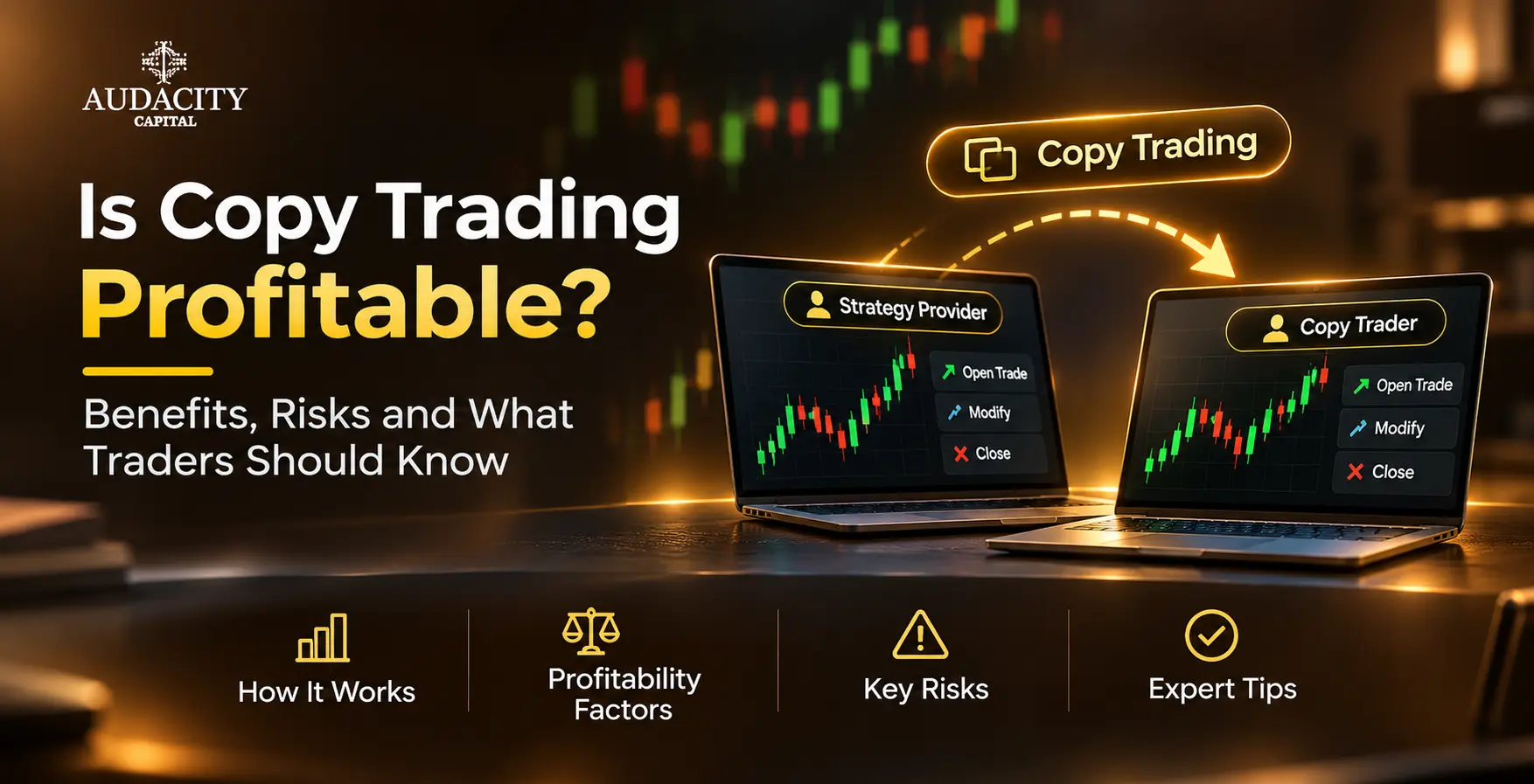
Copy trading can be profitable, but it is not a guaranteed way to make money in the financial markets. Your results depend on the trader you follow, their strategy, the risks they take, market conditions and the costs associated with each trade.
For beginners, copy trading can provide a way to follow another trader's decisions without manually analysing every market movement. However, copying an experienced trader does not automatically mean you will achieve the same results.
Before getting started, it is important to understand how copy trading works, what affects profitability and how to evaluate a trading strategy beyond its advertised returns.
What Is Copy Trading?
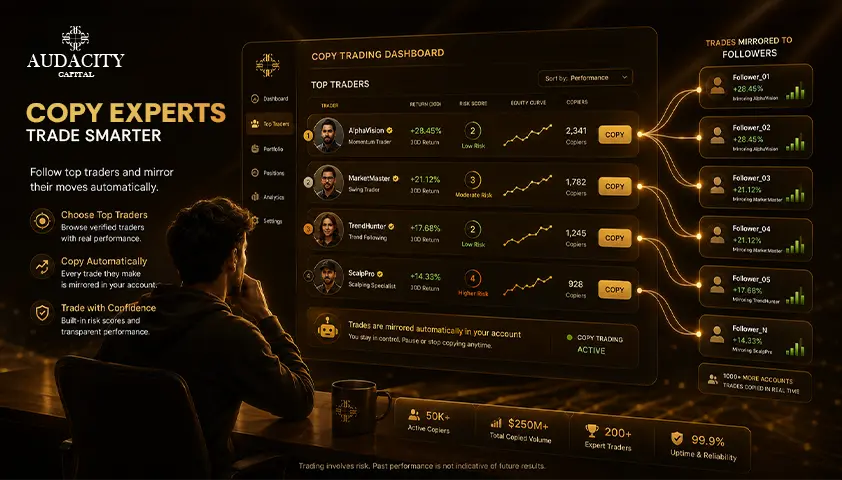
Copy trading is a trading method that allows you to automatically replicate another trader's positions in your own trading account. When the trader you follow opens, modifies or closes a position, the same action is replicated in your account according to the platform's settings.
For example, if a trader opens a position on EUR/USD, your account may automatically open a corresponding position. The size of that position depends on the copying method, your allocated capital and the platform's risk settings.
Copy trading is available across different financial markets, including forex, stocks, indices, commodities and cryptocurrencies, depending on the platform.
There are generally two roles involved:
- Strategy provider: The trader whose positions and trading decisions are being copied.
- Copy trader or follower: The person who connects their account to replicate the provider's trades.
Although the execution process can be automated, choosing a strategy, managing risk and monitoring performance still require attention.
Is Copy Trading Profitable?
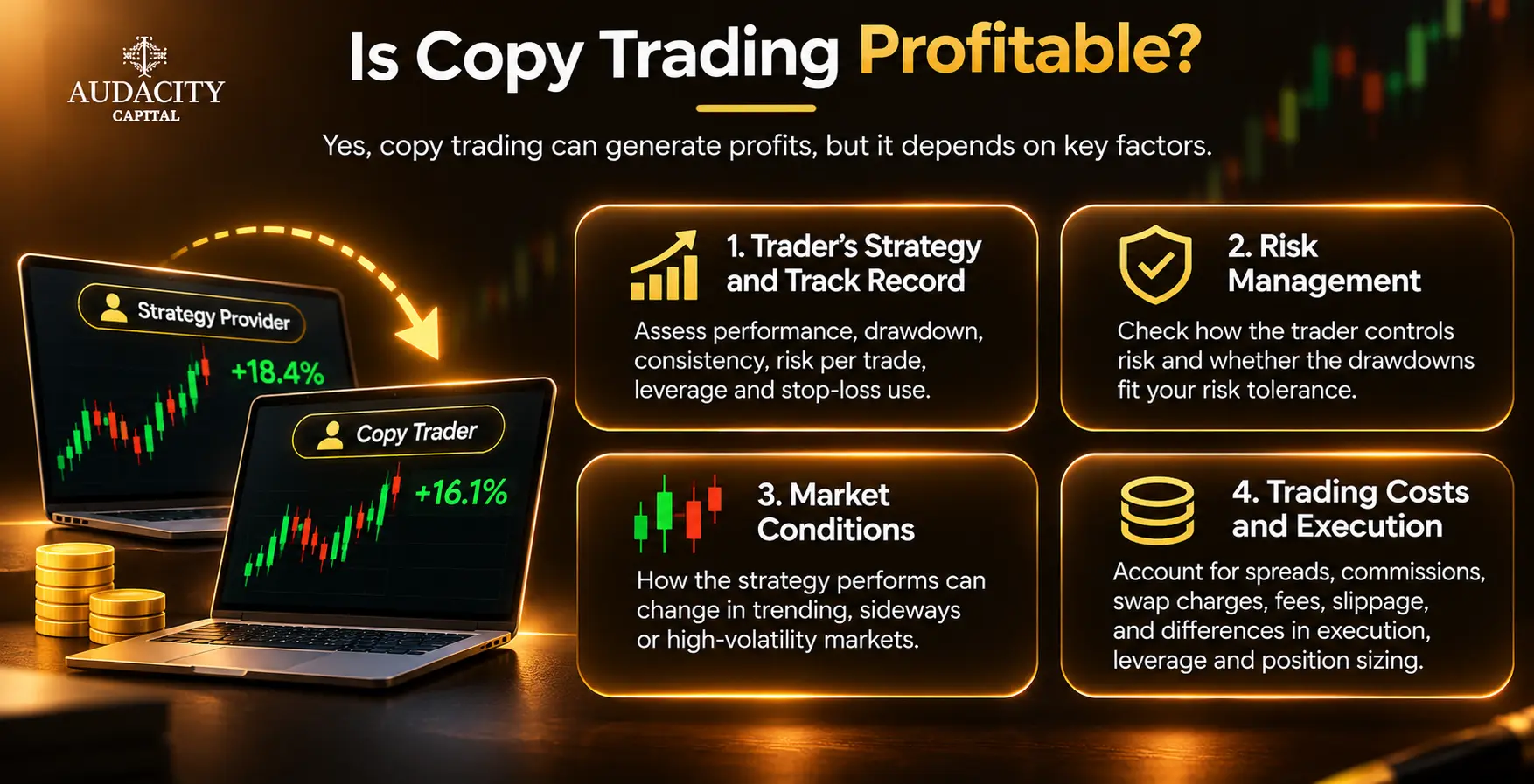
Yes, copy trading can generate profits, but profitability depends on several factors. There is no reliable percentage return that every copy trader can expect.
A trader may have a profitable strategy over one period and experience losses during another. Even when a strategy performs well, the person copying it may achieve different results because of execution prices, position sizing, trading costs and the timing of their entry.
Consider the following factors before deciding whether copy trading is suitable for you.
1. The Trader's Strategy and Track Record
The performance of the trader you follow is one of the most important factors affecting your results.
A trader with a strong historical return may appear attractive, but past performance alone does not establish whether their strategy is sustainable. A short period of high returns could reflect favourable market conditions or excessive risk-taking.
Instead of looking only at total profit, evaluate:
- How long the trader has been active.
- Their historical maximum drawdown.
- The consistency of returns across different market conditions.
- Their average risk per trade.
- Their use of leverage and stop-loss orders.
- Whether their trading approach is understandable and repeatable.
A longer track record can provide more information about a strategy, although it cannot guarantee future performance.
2. Risk Management
Risk management can make a significant difference to copy trading outcomes.
A trader may generate impressive returns by taking large positions or accepting substantial drawdowns. However, copying that strategy could expose your account to losses that exceed your risk tolerance.
For example, a strategy that produces a 20% return during a favourable period may also experience a significant decline when market conditions change. The headline return does not show the full amount of risk involved.
Before copying a trader, understand how much of your allocated capital could be lost and whether you can tolerate that possibility.
3. Market Conditions
No trading strategy performs equally well in every market environment.
A trend-following strategy may perform well during sustained price movements but struggle when prices move sideways. A strategy that works during low volatility may also behave differently during major economic announcements.
When market conditions change, a previously profitable strategy may experience losses or extended drawdowns.
This is why it is important to evaluate a trader's performance across different market conditions rather than assuming that recent success will continue indefinitely.
4. Trading Costs and Execution
Copy trading results can differ from the strategy provider's results because of trading costs and execution differences.
These may include:
- Spreads and commissions.
- Overnight financing or swap charges.
- Performance or subscription fees, where applicable.
- Slippage during volatile market conditions.
- Delays or differences in trade execution.
- Differences in leverage and position sizing.
Even small differences can affect overall profitability, particularly for strategies that execute trades frequently.
A trader's reported return should therefore not be treated as the return you will necessarily receive in your own account.
How to Calculate Profitability in Copy Trading
To assess whether copy trading is profitable, look at the net result after accounting for trading costs and any applicable fees.
A simple calculation is:
Net profit = Gross trading profit − Trading losses − Trading costs − Applicable fees
For example, suppose a copied strategy generates $500 in gross profit over a particular period.
Item | Amount |
|---|---|
Gross trading profit | $500 |
Spreads, commissions and financing | −$50 |
Applicable copying or performance fees | −$50 |
Net profit | $400 |
In this hypothetical example, the net profit is $400 before any applicable taxes. Actual results will vary, and trading losses could cause the account to lose money instead.
You should also consider the return relative to the capital allocated and the maximum drawdown experienced during the same period. A high return may not be attractive if it requires taking risks you cannot comfortably tolerate.
What Are the Benefits of Copy Trading?
Copy trading offers several potential advantages, particularly for people who have limited time to monitor financial markets.
Less Manual Trade Execution
Once the connection is configured, trades can be replicated automatically. You do not have to place every copied order manually.
However, automation does not remove the need to monitor the account or understand the strategy.
Exposure to Different Trading Strategies
Copy trading can help you observe how other traders approach market analysis, position sizing and trade management.
Depending on the platform, you may be able to compare strategies that use different instruments, timeframes or risk-management methods.
Reduced Time Spent Analysing Every Trade
Followers may spend less time analysing individual trade entries because the strategy provider makes those decisions.
However, researching the provider, reviewing performance and monitoring risk remain important responsibilities.
An Opportunity to Learn About Trading
Reviewing another trader's decisions can help you understand how a strategy operates in different market conditions.
This benefit depends on whether you take the time to understand the reasoning behind the trades rather than simply relying on automated execution.
What Are the Risks of Copy Trading?
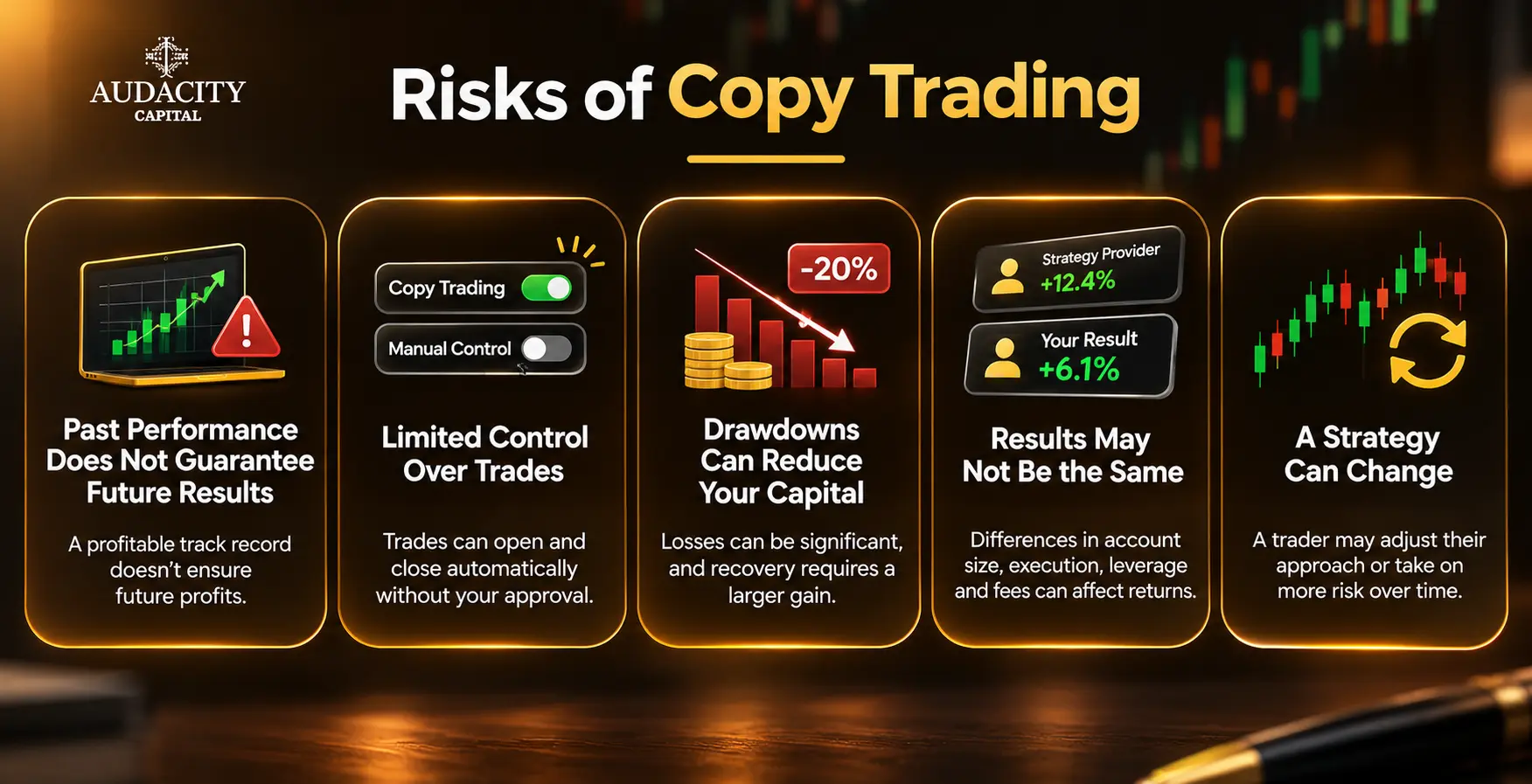
Copy trading does not eliminate market risk. When you copy another trader, you also take on exposure to the decisions and risk-management practices behind their strategy.
1. Past Performance Does Not Guarantee Future Results
A trader who has generated consistent profits in the past may experience losses in the future.
Market conditions change, strategies can stop working as expected, and even experienced traders can make mistakes.
Avoid choosing a trader solely because they have the highest historical return or the largest number of followers.
2. You Have Limited Control Over Individual Trades
Depending on the platform and settings, copied positions may open and close automatically without requiring your approval.
You may not have enough time to assess every trade before it is executed. If the strategy provider takes a position that does not fit your risk preferences, your account may still replicate it.
You should understand how to pause copying, disconnect the strategy or close positions before activating the service.
3. Drawdowns Can Reduce Your Capital
A drawdown occurs when an account declines from a previous peak in value.
For example, if your allocated capital is $5,000 and the account experiences a 20% drawdown, the balance would fall by $1,000 to $4,000, assuming no deposits or withdrawals.
Recovering from a loss requires a larger percentage gain than the percentage lost. A 20% loss, for example, requires a 25% gain on the remaining capital to return to the original balance.
This is why understanding maximum drawdown is often more useful than focusing only on historical returns.
4. You May Not Receive the Same Results as the Provider
Differences in account size, execution prices, leverage, fees and timing can affect the outcome of copied trades.
Even if the provider finishes a period in profit, your account could generate a smaller return or a loss.
5. A Strategy Can Change
A trader may change their approach, increase position sizes or begin taking risks that were not part of their previous trading history.
Regularly review the strategy's performance and risk profile rather than assuming it will continue operating in the same way.
How to Choose a Trader for Copy Trading
Choosing a trader to copy requires more than comparing profit percentages. You should evaluate how the trader manages risk, how long the strategy has operated and whether its approach matches your objectives.
Use this checklist before allocating capital.
- Review the track record: Look for sufficient historical data to assess performance across different market conditions.
- Check maximum drawdown: Understand the largest historical decline and how much risk the strategy may expose you to.
- Understand the trading style: Determine whether the trader scalps, day trades, swing trades or holds positions for longer periods.
- Examine position sizing: Look for signs of excessive leverage, unusually large positions or aggressive risk increases after losses.
- Review trading costs: Include spreads, commissions, financing and any provider fees when assessing returns.
- Understand the instruments traded: Make sure you understand the risks associated with the currencies, commodities or other assets involved.
- Monitor performance regularly: Reassess the strategy if its risk profile or performance changes significantly.
No checklist can identify a consistently profitable trader with certainty. The purpose is to make an informed decision and avoid relying on headline returns alone.
Copy Trading vs Manual Trading: Which Is Better?
Neither copy trading nor manual trading is inherently more profitable. The better approach depends on your experience, objectives, available time and ability to manage risk.
Factor | Copy Trading | Manual Trading |
|---|---|---|
Trade decisions | Made by the selected strategy provider | Made by you |
Execution | Often automated | Usually controlled by you |
Time commitment | Less time spent placing and analysing individual trades, but monitoring is still required | More time may be needed for analysis and execution |
Control | Depends on platform settings and copying arrangement | Greater direct control over entries and exits |
Learning | Can help you observe other strategies | Requires you to develop and test your own approach |
Main risk | Dependence on another trader's decisions | Errors in your own analysis and risk management |
Copy trading may suit someone who prefers automated execution, while manual trading may suit someone who wants to develop and control their own strategy.
Neither approach guarantees profits, and both can result in financial losses.
Does Audacity Capital Allow Copy Trading?
Audacity Capital permits copy trading between accounts owned by the same trader, subject to its applicable rules.
This allows traders to copy positions between their own eligible accounts or from their own external trading account, where permitted by the firm's terms.
However, copying trades from third-party traders, signal providers, account managers or external copy trading platforms is not permitted under Audacity Capital's stated policy.
The distinction is important: managing execution across your own accounts is different from relying on another person or service to make your trading decisions.
Before using any copying method, review the current rules for your specific programme and confirm that the proposed setup is permitted.
You can learn more about Audacity Capital's trading programmes here:
Each programme has its own requirements. Review the relevant rules before trading.
Is Copy Trading Suitable for Beginners?
Copy trading may appear attractive to beginners because it reduces the need to make every trading decision manually. However, it should not be treated as a shortcut to guaranteed income.
Before starting, beginners should understand the following:
- How the copied strategy generates trades.
- How much capital is at risk.
- What happens during a drawdown.
- Which fees and trading costs apply.
- How to stop copying or manage open positions.
- Whether the platform and strategy are available and permitted in their jurisdiction.
It is also worth learning the basics of trading and risk management independently. Understanding the risks makes it easier to evaluate a strategy and recognise when its performance or behaviour changes.
Only allocate money you can afford to lose, and avoid borrowing money to participate in a high-risk trading activity.
Final Thoughts: Is Copy Trading Worth It?
Copy trading can be profitable, but it should not be treated as a guaranteed source of income or a replacement for understanding trading risk.
Before choosing a strategy, evaluate its track record, maximum drawdown, position sizing, trading costs and behaviour across different market conditions. Remember that the provider's reported performance may differ from the results achieved in your own account.
For traders considering a prop firm, it is equally important to understand the firm's rules on copying trades and account ownership before getting started.
The key takeaway: Copy trading can simplify trade execution, but it cannot remove market risk. Informed decisions, realistic expectations and disciplined risk management remain essential.
Related Articles
Copy Trading in India: How It Works, Best Platforms & Risks
The Best Prop Firms That Allow Copy Trading
Frequently Asked Questions
Yes, copy trading can generate profits when the copied strategy performs well enough to cover trading costs and fees. However, profitability is not guaranteed, and losses are possible. Results depend on the strategy, market conditions, risk management and execution.
It can be profitable for beginners, but experience alone does not determine the outcome. Beginners still need to evaluate the strategy, understand the risks and monitor performance. Copy trading does not remove the possibility of losing capital.
There is no fixed amount you can expect to earn. Returns depend on the strategy's performance, the capital allocated, trading costs and the level of risk taken. Be cautious of anyone promising guaranteed or unusually consistent returns.
Yes. If the copied strategy loses money, your account may also experience losses. Depending on the instruments and leverage involved, losses can be substantial. Understand the platform's terms and the risks before allocating capital.
Not necessarily. Copy trading automates the replication of another trader's decisions, while manual trading gives you more direct control over your own decisions. Neither method is automatically more profitable; the outcome depends on strategy quality, risk management, market conditions and costs.
No. No legitimate copy trading platform can guarantee that a strategy will remain profitable. Historical performance is not a reliable guarantee of future results.
No. Under Audacity Capital's stated policy, traders may copy between accounts they own, subject to the applicable rules, but copying trades from third-party traders, signal providers, account managers or external copy trading platforms is not permitted. Always check the current rules for your programme.

क्या आप क्रिप्टो पर अनुशासित जोखिम लागू करने के लिए तैयार हैं? Audacity Capital के नए क्रिप्टो उपकरणों का पता लगाएं और अपनी ट्रेडिंग रणनीति लाएं।
और जानेंन्यूज़लेटर
हमारे न्यूज़लेटर से जुड़ें।
हमारे सामाजिक समुदाय में शामिल हों

आज ही अपनी यात्रा शुरू करें हमारे नि:शुल्क परीक्षण के साथ
प्रमाणपत्रों के माध्यम से अपने कौशल और उपलब्धियों को गर्व से प्रदर्शित करें और संभावित निवेशकों और साथियों से अपनी कड़ी मेहनत और समर्पण के लिए पहचान प्राप्त करें।
नि:शुल्क परीक्षणसंबंधित लेख
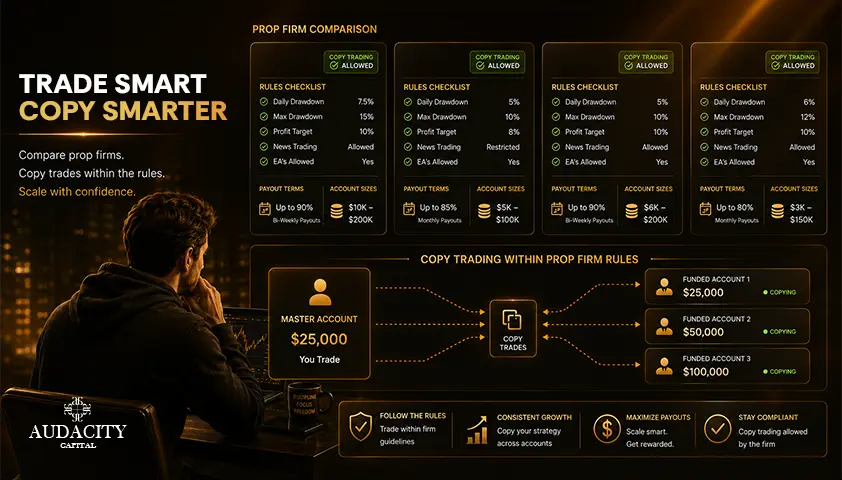
The Best Prop Firms That Allow Copy Trading in 2026
A guide to prop firms that allow copy trading in 2026. Learn internal vs external copying, the firms that permit trade copiers, and how to stay compliant.

Best Copy Trading Platforms for 2026
A 2026 roundup of the best copy trading platforms, how copy trading works, real risks and costs, and why building your own trading skill often wins.

Copy Trading in India: How It Works, Best Platforms & Risks (2027 Guide)
Want to know how copy trading works in India? Explore copy trading India platforms, legal aspects, risks, benefits, and expert tips for beginners.