


Best $50K Funded Accounts in 2026



One firm charges $50K funded accounts $60/month, another charges several hundred dollars as a one-time payment. The difference may seem like a bargain vs. an extra fee, but it is impossible for the reader to know where the bargain ends and the premium starts.
In most cases, it is far from being a good deal. It is simply a different product being marketed with a different payment system.
This article sorts the $50K field on the parameters that make them different, thus making the price comparison possible in the first place.
Note: This comparison is published by Audacity Capital, which offers one of the accounts presented in this list.
Why the $50K Tier Is the One Most Traders Pick
The $50K account is the most popular size within the prop trading community, and it is not an ambition-related but a practical choice.
This is the size of the account where the numbers become relevant without the commission itself becoming the major financial decision.
Think of it from the risk management point of view and not the headline size of the capital. The $50K account will provide the trader with a well-defined loss limit, measured in the low thousands, rather than in the low hundreds.
It provides enough room to cover an ordinary string of losses without two poor trades being the death of the account. Small tiers usually do not offer such a safety margin, and the competition hardly ever mentions it.
One objection must be voiced right now.
More money will not help a trader to be more successful. There is no correlation between the size of the account and the probability of success. It is important to consider the size that a strategy can take comfortably, rather than just the largest size that the budget will cover.
How This Comparison Was Put Together
The method precedes the list, since a comparison published by a participant is only readable for the reader when they can see the ruler the participant uses.
The criteria used in the evaluation are universal for all firms presented here.
- Total cost to get to a funded account, whether that includes the activation fee or reset cost and not only the headline fee.
- Drawdown structure, since it governs how the account has to be traded.
- Profit split and terms associated with the headline percentage.
- Payout cycle and duration of the first payout window.
- Any trading restrictions that significantly affect strategy, including news trading, weekend holding, and minimum trading days requirement.
- Platform availability.
- And operating history, the closest measure for the consistency of the payouts.
It is not a measure of the quality of the execution, not based on the number of trades of any account and all numbers are as published by each firm on the date listed further down.
Two Pricing Models, and Why the Prices Are Not Comparable
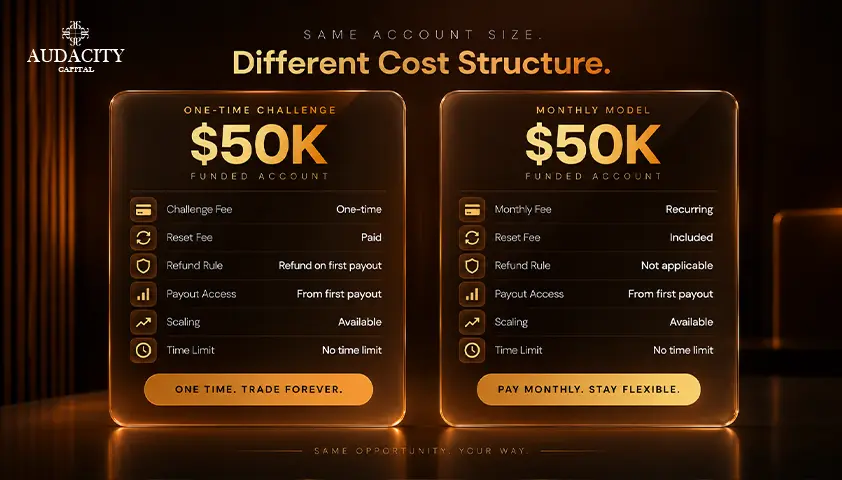
Where there is only one column of prices sorted in ascending order, people click more often, although this approach is misleading.
The $50K package is available in two pricing models. Futures-focused companies tend to provide it as a subscription on a monthly basis, usually adding the activation fee after passing the evaluation period.
Forex and CFD companies tend to offer it as a one-time fee with no extra recurring charges. A monthly fee headline stands next to a one-time figure, which appears to be much cheaper.
Often, it isn't, since the subscription will run for as long as the evaluation takes, while an activation fee is to follow after.
So make the calculation, don't believe the headline.
In the case of the subscription model, total cost would equal the monthly fee multiplied by a realistic number of months (plus any activation or reset fees). Compare that to a one-time fee that includes all of these.
The input no one can provide for you is the number of months your evaluation will take, and this is precisely why the two models appeal to different traders, rather than one being more affordable.
This is the second important difference in addition to pricing.
These are two different products. Futures accounts deal with exchange-traded instruments, while forex and CFD accounts have a completely different set of instruments and pricing.
The reader making a choice based on price alone may choose the market they don’t actually trade. This is where futures and forex CFD models part ways completely.
Monthly subscription model | One-time fee model | |
Typical market | Futures contracts | Forex, indices, metals and CFDs |
How you pay | Each month until you pass | Once, upfront |
Hidden cost to check | Activation fee after passing | Reset cost if you breach |
Cheapest when | You pass quickly | The evaluation takes you a while |
What the headline price hides | How many months you will need | Nothing, if resets are avoided |
The Best $50K Funded Accounts Compared
This section is not a ranking but rather an unordered comparison.
Each company listed below has a multi-year operating history, a real $50K tier and in total represents both business models.
It is the criteria that counts the most in an industry where companies come and go often.
1. Audacity Capital.
Founded in London in 2012, it offers a 50K prop firm account through its evaluation and instant funding routes.
A trader can get a $50K account through the one-step and two-step evaluation process or by the instant funding program with static drawdown during the challenge process and unlimited time to complete the phases.
Trading platforms are MT5 and DXTrade.
The trade-off, expressed simply: the entry cost is higher than the lowest in this list, so the trader focusing solely on the lowest initial cost will find lower numbers elsewhere.
2. FTMO.
It's been in operation since 2015 and has the longest and largest independently verified payout history in the forex category.
Available as a one-time fee through the two-step evaluation that offers static drawdown and platform compatibility with MT5, DXTrade and cTrader.
The downside is that the two-step format requires two profit levels to be reached, which is a longer period than the one-step format for some traders.
3. The5ers.
Operating since 2016, offering both one-step and two-step routes for a one-time fee. No time limit on evaluations, no minimum trading day requirement, and a scaling plan with a high ceiling for traders who plan on growing their account over time.
The disadvantage is that the account sizes and their rules differ significantly, so the terms should be read carefully prior to buying.
4. FundedNext.
Two evaluation tracks including a single-phase option, sold as a one-time fee. It offers a profit share paid on challenge-phase performance, which is unusual in the category.
The disadvantage is that the tracks have different rule sets, and it may be very easy to choose the wrong track for your trading system without thorough analysis.
5. FundingPips.
One of the lowest entry costs in forex, charged as a one-time fee, and offering a flexible payout schedule. This is the better option for a trader who is focused on price if they want to move to a funded account.
The downside of the low entry point is that the rules and drawdown terms are based on disciplined and patient trading strategies, not on aggressive sizing.
6. Topstep.
Futures only, sold as a monthly subscription since 2012. This product is added as an obvious real-life example of the subscription model discussed above, rather than an alternative to the mentioned forex product.
The trade-off here is implied in the model itself: the cost keeps growing while the evaluation process continues and an activation fee is charged after the account is funded.
Note: The precise terms should be compared with the actual live data on each of the providers' websites on the date of reading due to frequent changes in this sector.
What Actually Separates One $50K Account From Another
The last dimension for most readers is price and once the two models are known this is the least useful.
There are other factors that separate one best 50k funded account candidate from the next one, and those factors matter in the following order:
1. Drawdown structure comes first.
A loss floor that is fixed, changes every day, or follows tick-by-tick will affect the sizing of each position. This is what separates a static and trailing drawdown, and two limits may be exactly the same, but trading them can be entirely different due to this.
A daily loss limit on one account and a total-only limit on another account will favor two different traders.
2. Payout reliability comes second.
This criterion does not feature on any rules page. It has to be inferred based on operating history and independent trader's experience, that is why the years-in-business screen plays an important role here.
3. Rule compatibility comes third.
Do the limitations on news trading, weekend trading and minimum trading days allow you to implement your strategy?
The most economical 50k funded account cost does not seem economically efficient if you cannot trade your strategy using this account. Rule compatibility is the first filter and price is the last, which inverts how almost everyone approaches this decision.
What the Cheapest Options Cost You
A low entry price is a business decision and they get paid off somewhere.
The recovery will happen through stricter drawdown limits, a smaller initial profit split percentage, an activation fee upon passing, extended payout period, or a reset that takes away a significant portion of the initial evaluation fee.
There is nothing wrong with all of that and nothing hidden; it just does not get included in the headline price that made you click.
And the same holds true for us. Audacity Capital's pricing is slightly higher than the cheapest options on the list, which means there is a reason to ask what it pays for.
In simple terms, it purchases an easy drawdown framework on the challenge path, endless time to finish the levels, and a company with an operating background dating back to 2012.
That will depend completely on your own priorities, and the trader who wants to enter at the lowest cost possible will naturally come up with a different option.
The important point here is that you need to calculate the whole path, not just the entrance. The fee, plus the cost of all those expected resets, plus the cost of activation, compared to what you get at the other end.
Which One Suits Which Trader

There is no single winner here, and any roundup published by a participant that names one should be read with suspicion. Fit is the useful ending.
A trader confident of passing quickly is usually better served by a monthly model, because the subscription ends the moment they pass.
A trader who expects to take time, or who has failed an evaluation before, is usually better served by a one-time fee, because the cost does not keep climbing while they work.
This is the core of the one-time fee and monthly subscription decision, and it turns on your own realistic timeline more than on any headline.
A trader whose strategy holds through news or over weekends should filter on rules before price, because the wrong rule set makes the cheapest 50k challenge prop firm unusable for them.
And a trader who needs a specific platform, MT5, DXTrade or cTrader, should filter on that first, since it removes most of the field immediately.
Match the profit target and rules to how you already trade, then compare cost among what remains.
Conclusion
The $50K tier is where the field is most crowded and where headline prices tell you the least. Two firms selling the same nominal account are often selling different products, on different payment models, under different rules.
The right account is the one whose rules fit your strategy, priced across the whole path rather than at the door. Make that the last idea you carry out of here.
One concrete action before you buy.
Open the rules page of the two firms on your shortlist, find the drawdown type and the reset cost, and price the full path including a realistic number of attempts.
If Audacity Capital's evaluation or instant funding routes are on that shortlist, apply the same fifteen-minute check to us too. That is the comparison an article cannot answer, and it is yours to run.
Frequently Asked Questions
The right size is the one where your normal stop distances produce sensible position sizes. Work backward from how you already trade.
If a given account size forces you to trade differently from usual, either by sizing up beyond your comfort or by taking positions too small to matter, it is the wrong size regardless of what it costs.
Yes, this is generally permitted, since firms operate independently of one another. Holding accounts across firms can spread exposure if one runs into payout problems.
The catch is that each account carries its own rule set to track, and traders most often breach by applying one firm's rules to another firm's account by mistake.
Only proportionally, and the caveat matters. The loss allowance scales up with the account too, so the ratio between what can be earned and what can be lost stays broadly the same. A larger account is not an easier account, and it does not improve the odds of trading it well.
That depends entirely on return rate, profit split and payout frequency, and there is no general answer. Most traders do not pass their evaluation, and treating any funded account as a route to replacing an income is how people overtrade and breach. Judge it as a skill assessment first, not as a salary.
Pricing and promotions in this sector move frequently, often weekly. Rules change less often but they do change. The only terms that count are the ones on the firm's own site at the moment you buy, and that applies to every figure on this page as much as anywhere else.

Pronto ad applicare un rischio disciplinato alle criptovalute? Esplora i nuovi strumenti crypto di Audacity Capital e porta la tua strategia di trading.
Scopri di PiùNewsletter
Iscriviti alla newsletter per restare aggiornato.
Unisciti Alla Nostra Community Social

Inizia Il Tuo Viaggio Oggi Con La Nostra Prova Gratuita
Mostra con orgoglio le tue abilità e i tuoi risultati attraverso certificati e ottieni riconoscimenti per il tuo duro lavoro e dedizione da potenziali investitori e colleghi.
Prova GratuitaArticoli Correlati

What Is a Funded Trading Account and How It Works
How a funded trading account works: the evaluation, the rules, the payouts, and whether the capital is actually real.


What Happens If You Lose Money On A Funded Account
Learn what happens if you lose money on a funded account, including drawdown rules, account breaches, resets, and how to protect your funded trading account.
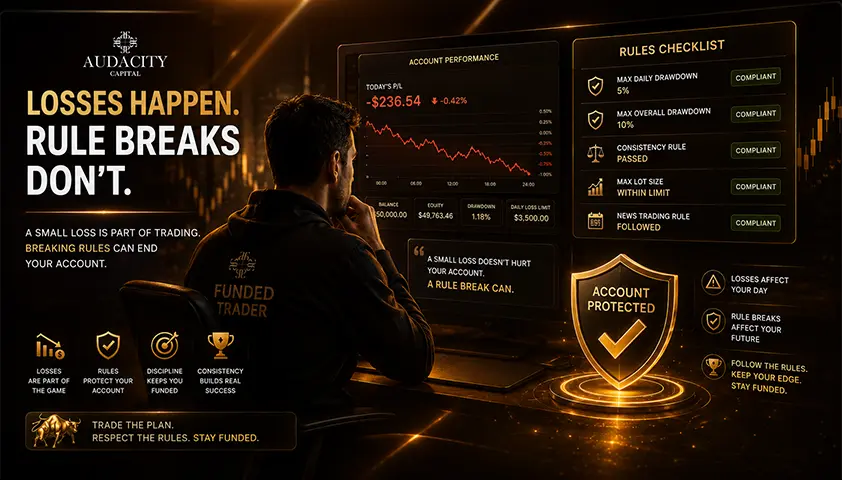
What Happens If You Lose Money on a Funded Account?
Your only real loss is the fee you paid. Here's what happens if you lose money on a funded account, what a breach actually costs, and how to avoid one.